AI for standard settlement instructions works best as a set of agents that do everything up to the decision: read change requests from emails, letters, portals and SSI databases in any language, map them to the template with a citation for every value, compare them with the counterparty's own published data, test the formats and sanctions lists, score fraud signals, book a call-back to the number already on file, and schedule an approved change in every system. What it should not do is decide. Choosing the call-back number, making the call, verifying the change and approving it belong to two different people, because a forged SSI change is designed to look exactly like a genuine one and an agent that can approve it is one more thing a fraudster can fool. That is the line Botminds' Standard Settlement Instruction Management draws, and it is the line the SEC's examination priorities and FINRA's guidance on AI agents point to. This guide is written for the head of operations or security officer weighing such a tool.
The examples come from a fictional asset manager, Quillfield Capital, as it runs through the solution; the figures from regulators are linked where they appear.
The authority line for AI agents on SSI changes: what agents may do, what people must do, and what agents never do
Read a change request in any language and map it to the template
Agent mayYes
Person mustReviews the cited fields
Agent never—
Compare the request with the counterparty’s own published data
Agent mayYes
Person mustSees the disagreement
Agent never—
Score fraud signals and hold a request
Agent mayYes
Person mustDecides what happens to a held request
Agent neverClear its own hold
Test BIC, IBAN, account format, place of settlement, sanctions
Agent mayYes
Person mustReads what the tests do not prove
Agent neverCall a change genuine
Choose the call-back number
Agent mayNo
Person mustMaintains the counterparty master
Agent neverUse a number that came with the request
Book the call and write the script
Agent mayYes
Person mustFollows or adapts the script
Agent never—
Make the call and confirm what was said
Agent mayNo
Person mustThe analyst calls and records the outcome
Agent neverDial, speak or mark a call confirmed
Verify and approve the change
Agent mayNo
Person mustA maker verifies; a different checker approves
Agent neverApprove or retire an instruction
Make the change live
Agent mayYes, after both signatures
Person mustSets the effective date
Agent neverActivate without two people, or move a date
Decide a fraud case and what is reported
Agent mayNo
Person mustFinancial crime officer
Agent neverContact the counterparty or a regulator
Can AI manage standard settlement instructions?
It can manage the work, not the authority. The mechanical part of an SSI change, reading, retyping, finding the counterparty's last letter, checking codes, updating four systems, is most of the clock time and almost none of the risk. Botminds' estimate for one bank or account change received by email or letter is about two hours by hand and under half an hour with agents, and of what remains, three-quarters is the call-back and the second approval. Those are the two steps that stop fraud, and they stay with people.
The distinction matters because the failure modes are different. An agent that misreads a field produces an error a checker can see, because every value is cited to its line. An agent with authority to approve produces a loss no one sees until the real counterparty asks where its money is. FINRA's 2026 oversight report lists among the risks of AI agents that they may act autonomously without a person validating and approving, and may act beyond the scope and authority the user intended (FINRA, 2026 Annual Regulatory Oversight Report). On an SSI desk, both risks have a dollar value.
Can an agent read SSI changes from emails and letters?
Yes, and this is where agents earn their place. Requests arrive in every shape: an industry database notice, a Swift standing settlement instruction message, a portal upload, an email with the details in the body, a scanned letter in Japanese. In the sample, the Intake agent read 31 requests overnight from five channels, letters in Japanese, German, Portuguese, Spanish and Chinese, merged two duplicates and linked each to the instruction on file, with every field cited to the line it came from.
The citation is the safeguard. An approver who can click from "account 0081-447120" to the line of the Japanese letter that says it is checking the counterparty's words, not a model's summary of them. Reading is not authenticating, though: an agent can extract a forged letter perfectly, and the better the extraction, the more official the forgery looks. AI for settlement instructions in PDFs covers what a firm must bring for the reading to go live.
Should an agent ever make a bank-detail change live?
Only as the last, mechanical step after two people have signed, and never on its own judgement. Making a change live means scheduling it at the agreed time in the SSI master, order management, the custodians and the payment platform, and collecting a receipt from each; an agent does that more reliably than a person working through four screens. Deciding that a change may go live is a different act. The CPMI's strategy on wholesale payments fraud lists a separate approval after a payment is initiated, and the separation of duties, among the process controls that protect payment endpoints (CPMI, 2018), and nothing about agents changes why.
Regulators' surveys show how rarely firms give AI final authority even where they use it widely. The Bank of England and FCA's 2024 survey found that 75% of responding firms were already using AI, that operations and IT was the largest area with about 22% of use cases, that 55% of use cases involved some automated decision-making, and that only 2% were fully autonomous (Bank of England and FCA, AI in UK financial services, 2024). An SSI approval is a poor candidate for the 2%.
How does an agent score fraud signals?
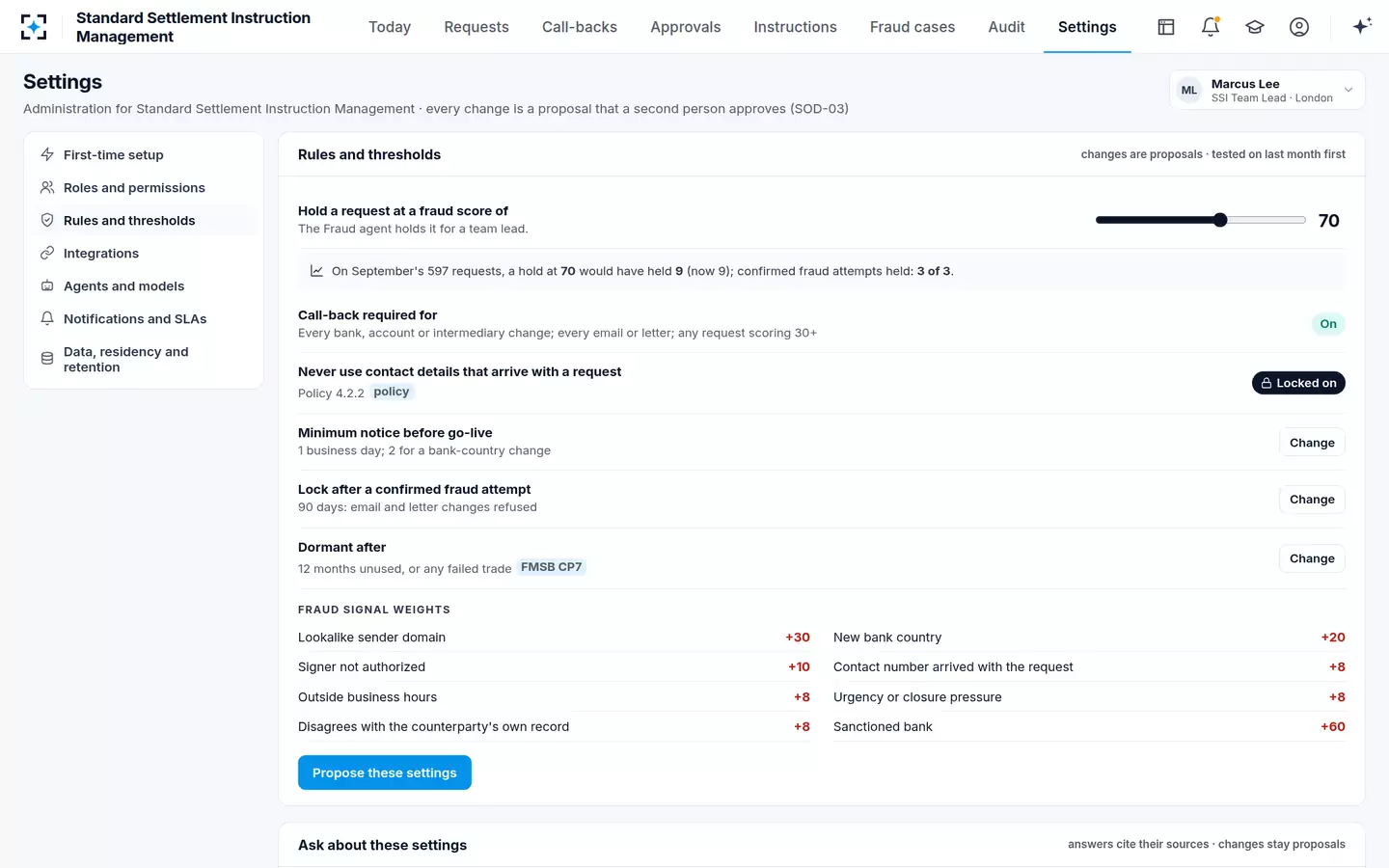
With weighted signals, each explained and backed by evidence, rather than one opaque number. In the sample firm's settings the Fraud agent adds 30 points for a lookalike sender domain, 20 for a new bank country, 10 for a signer not on the authorised list, 60 for a sanctioned bank, and 8 each for signals such as a contact number arriving with the request, a message outside business hours, urgency, and disagreement with the counterparty's own published data. A request at 70 or more is held for a team lead. The forged Brennmoor request scored 92; Kawabe's genuine change in Japanese scored 14.
Testing a hold threshold on last month's requests before changing it
597
change requests in September at the sample firm
9
that a hold at 70 would have held
3 of 3
confirmed fraud attempts among those held
Two design choices matter more than the weights. First, the score is separate from the format checks: the Checker agent tests BIC, IBAN, account format, place of settlement and sanctions on its own and is not allowed to call anything "genuine", so a perfect format cannot lower a fraud score. Second, the threshold is tested, not guessed: a proposal to move it is shown against last month's requests before a second person approves it. A threshold that held every confirmed attempt last month is a measurement; one chosen in a workshop is a hope.
SSI policy as settings in Standard Settlement Instruction Management: the hold threshold, the locked rules and the signal weights
Who chooses the call-back number?
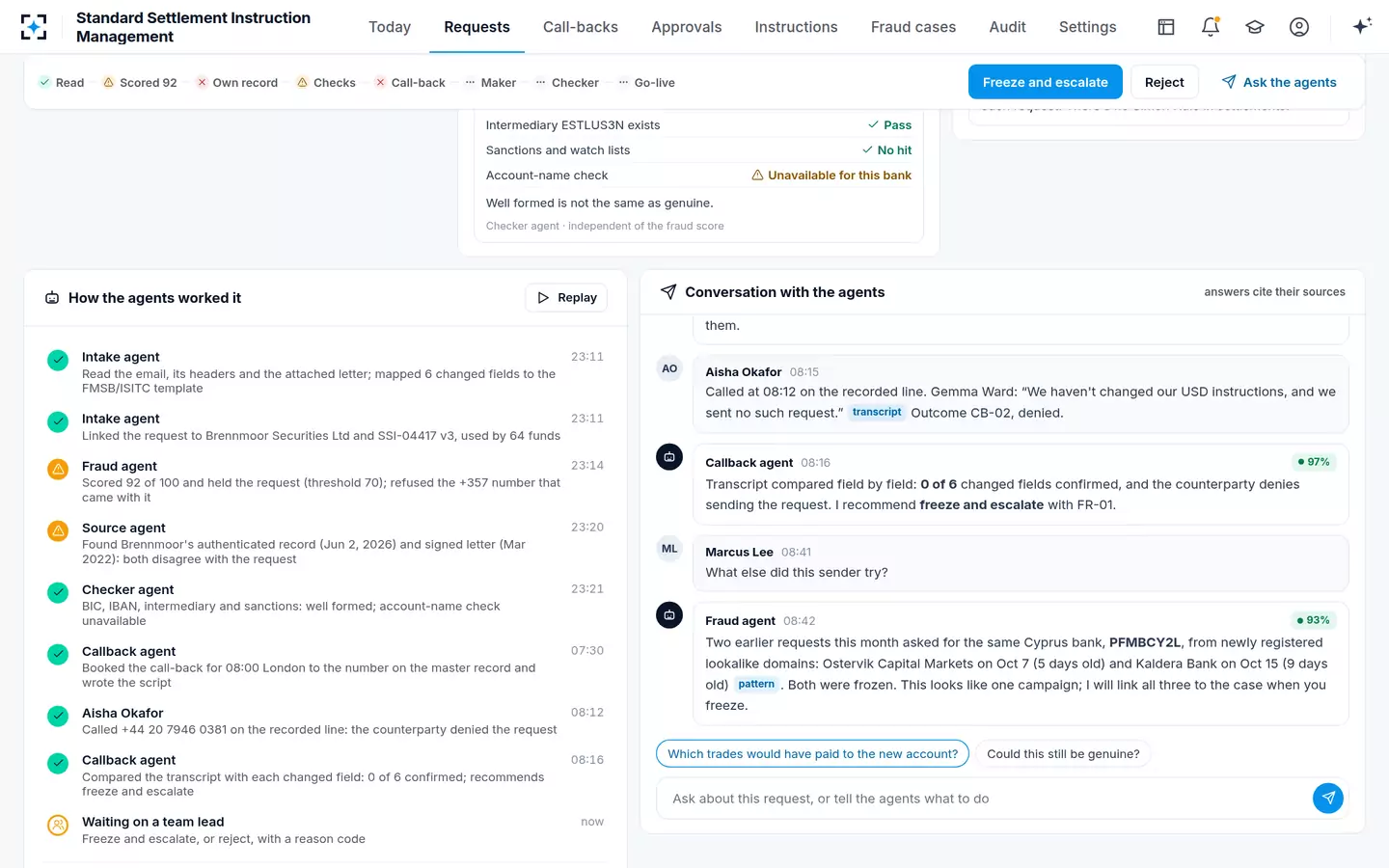
The firm does, in advance, and the agent is forbidden to choose otherwise. The number comes from the counterparty master, where it was set up independently and re-verified; any number, email address or contact that arrives with a change request is refused, because it belongs to whoever sent the request. In the Brennmoor case the Fraud agent refused the Cyprus number in the email and the Callback agent booked the call to the broker's settlements desk in London, re-verified on 11 February; the person who answered denied the request.
Voice makes the rule stricter, not looser. FINRA's 2026 report describes fraudsters using generative AI to create "a credible-sounding imitation, or voice clone, of an investor" to persuade firms to change access to accounts, and the FBI reports over $30 million of 2025 business email compromise losses involving AI, describing voice cloning among the methods (FBI, 2025 IC3 Report). A call that reaches a convincing voice proves nothing if the number came from the fraudster; a call to a number of known origin moves the burden back onto the attacker. The agent writes the script so that the counterparty reads its details out and is never read the new ones.
What do regulators say about AI in fraud prevention and back-office operations?
They expect firms to use it and to supervise it. The SEC's Division of Examinations says registrants are increasingly incorporating what it calls "super intelligence (SI)" into their businesses, and lists among its fiscal 2027 priorities the policies and procedures firms use to monitor SI in fraud prevention and detection and in back-office operations. It also warns that "Threat actors are using SI to automate and accelerate cyberattacks, making those attacks more efficient and harder to detect" (SEC, Fiscal Year 2027 Examination Priorities). Those are staff priorities, not rules, but they say where an examiner will look.
An agent that cannot approve a change, clear a hold or choose a bank account cannot be talked into paying the wrong one. FINRA's 2026 report asks firms using agents to think about exactly those limits.
FINRA's report goes further on agents specifically, suggesting firms consider how to monitor agents' system access and data handling, where to put human-in-the-loop oversight, and how to track agents' actions and decisions. ESMA warned in 2024 that providers and clients may rely too heavily on AI and neglect human judgement (ESMA public statement on AI and investment services, May 2024). An SSI tool that answers those points has locked rules an agent cannot override, a person at each decision, and a trail that shows which agent version did what.
What regulators ask of AI, and how it applies to an SSI desk
| Regulator’s point | On an SSI desk | In Standard Settlement Instruction Management |
|---|---|---|
| SEC: monitoring of SI used in fraud prevention and back-office operations (FY2027 priorities) | Know what the agents decided, and check it | Every agent step logged with its version; overrides recorded with a reason code |
| FINRA: autonomy and scope risks; guardrails on agent actions | No agent can approve, clear a hold or pick a number | Locked “never” rules; maker and different checker on every change |
| FINRA: track agent actions and decisions | Show the work behind each decision | Step-by-step trace for each request, ready to replay |
| ESMA: over-reliance on AI | People must read what the checks do not prove | The Checker agent states what each test does not prove |
| FINRA and FBI: voice clones and AI-written emails | A convincing voice or letter proves nothing | Call-backs only to numbers on the counterparty master |
What should be logged when agents work on SSIs?
Everything a person would need to reconstruct the decision: the request as it arrived, each field the agent extracted and the line it came from, each signal and its evidence, the number booked and where it came from, the call and what was said, each person's action with a reason code, the agent and its version for every automated step, and every override of an agent by a person. The sample firm's trail showed 32 overrides in 30 days, 17 of them corrected fields; each override is evidence that the people are reading, and data for tuning the agents.
For US advisers the retention clock already applies: Rule 204-2 requires the records it covers to be kept for at least five years, counted from the end of the fiscal year of the last entry (17 CFR 275.204-2(e)(1)). The sample firm keeps an append-only, hash-chained trail for seven years and can export the evidence for one request, one instruction or an examination request.
The agents' work, step by step, and a team lead asking them a question
What to ask a vendor of AI for SSIs
Ask what the agents are forbidden to do, then ask to see it enforced. A tool that reads and scores well but lets an agent clear a hold, or that uses the phone number in an email when the master has none, has moved risk rather than removed it. The checklist below is what we would ask of any vendor, including ourselves.
Questions to put to a vendor of AI for standard settlement instructions
- Show me every action the agents may never take, and that it cannot be switched off
Approve, clear a hold, use a number from the request, confirm a call, move an effective date.
- Show me the citation behind every extracted field, in the original language
An approver should never have to trust a translation or a summary.
- Show me the score broken into signals, each with its evidence
A single number cannot be challenged, tuned or explained to an examiner.
- Replay last month’s change requests against my rules before go-live
The only honest accuracy figure is the one measured on your own requests, including known frauds.
- Show me how a change goes live in every system, and what happens when one link fails
A change live in the master but not at the custodian builds instructions from old data.
- Show me the trail an examiner would get for one change
Request, call, both signatures, agent versions, receipts, in one export.
- Tell me what the tool does not do
Standard Settlement Instruction Management does not replace an industry SSI database, does not dial or speak on calls, does not decide fraud cases, and does not release payments.
The evidence an auditor will want from the people's side of the line is set out in the call back procedures audit. To see the agents on a month of your own change requests, start from Standard Settlement Instruction Management.
Questions people ask
Can AI detect lookalike domains in SSI change requests?
Yes, and it should report the evidence: the sender's domain, how it differs from the counterparty's known domain, and when it was registered. In the sample, the forged domain differed by one hyphen and had been registered six days earlier. Note that email authentication can pass for a lookalike domain, because the fraudster owns it.
Will AI replace the SSI team?
No. It removes the reading, retyping, searching and system updates, which are most of the hours, and leaves the call-backs, verification, approval and fraud decisions, which are most of the risk. The sample firm's team still has makers, checkers and a financial crime officer; they spend their time on the steps that protect the firm.
Can agents approve low-risk SSI changes in a batch?
Agents can select changes that meet strict criteria, such as a source document, the counterparty's own data or a confirmed call-back, passing checks, a low score and a maker who is not the approver. A person still signs. In the sample, a team lead approves five such changes with one signature and reason code, and each goes live at its own agreed time.
How accurate is AI on SSI changes?
No regulator or independent study publishes a benchmark. Measure it yourself: replay a past month of requests, including any known frauds, and compare the agents' extractions, scores and holds with what your team decided. Count corrected fields and missed holds, and keep counting after go-live.
Does it work with SSI databases and Swift messages?
Standard Settlement Instruction Management reads industry SSI database notices and authenticated entries, Swift MT 670 and MT 671 messages, emails, letters and portal uploads, and pushes approved changes to the SSI master, order management, custodians and payment platforms with a receipt from each.