Settlement instructions management is the work of keeping every counterparty's standard settlement instructions (SSIs) correct and proving each change before it is used, and its business case rests on what one wrong SSI costs. A stale instruction fails every trade that uses it until someone notices and fixes it, which in the EU means cash penalties, and everywhere means late cash, funding costs and staff time. A forged instruction is worse: it pays the trades' cash to an account the counterparty does not own, and the money is rarely recovered. So the case for a system is not the hours saved on retyping; it is the expected loss per change, multiplied by the number of changes. Botminds' Standard Settlement Instruction Management is built for that second number: it scores every change for fraud, compares it with the counterparty's own published data, books a call-back to a number on file and requires two people to approve, so that a change is proven before any trade settles to it.
The worked figures use a fictional asset manager, Quillfield Capital, as it runs through the solution, with assumptions stated where we make them. Regulators' rates and figures are linked.
One instruction, two days of trades: the exposure in the solution's sample
1
standing instruction: a broker’s USD cash SSI
64
funds that settle with the broker through it
23
trades due to settle to it on 20 and 21 October
$41.6M
of cash those trades would pay
What does a wrong SSI cost?
It costs whatever passes through it while it is wrong. A wrong SSI is not one error but one error per trade, for as long as it is live, so the first question is exposure: how many trades and how much money will use the instruction before the next check. In the sample, one broker's dollar cash instruction was used by 64 funds and had 23 trades worth $41.6 million due on two days.
The second question is which kind of wrong. A stale SSI, where the counterparty changed its details and your copy did not follow, produces trades that do not match and do not settle on time. The costs are real but bounded: penalties, funding, people. A forged SSI, where someone else changed your copy, produces trades that settle perfectly to the wrong place. Its cost is the principal.
Where the cost of one wrong SSI goes, stale or forged
Stale SSI: trades fail until it is fixed
- EU cash penalties · 40%
- Funding and lost interest on late cash · 33%
- Staff time: trace, correct, re-instruct · 27%
Forged SSI: trades settle to a fraudster
- Principal paid away, usually unrecovered; investigation and reporting on top · 100%
How many trades can one bad SSI fail?
All of them, until it is corrected. An SSI is applied automatically to every trade with that counterparty in that market and asset class, so its error rate is 100% for as long as it is wrong. The number of trades is set by your trading volume with that counterparty and the time to detection. Under T+1, detection usually comes on trade-date night, when instructions fail to match; the fix then has to be found, agreed with the counterparty and re-instructed before the settlement cut-off.
The width of the exposure is easy to underestimate. A broker's SSI is shared by every fund that trades with the broker; the sample firm's dollar cash instruction for one broker served 64 funds. At the sample firm, custodians reported 214 fails in September, of which 43 were traced to an instruction, down from 51 in April. No regulator publishes the share of fails caused by SSIs across the market, so that count, from your own fail reports, is the one to build the case on.
What is the penalty when a wrong SSI fails a trade in the EU?
The EU's settlement discipline regime charges a daily cash penalty on the value of a failed settlement, at a rate set by instrument type. The rates in Delegated Regulation (EU) 2017/389 are 1.0 basis point a day for liquid shares, 0.5 for illiquid shares and other instruments, 0.25 for SME growth market instruments, 0.20 for corporate and other debt, 0.15 for SME growth market debt and 0.10 for sovereign debt; a fail for lack of cash is charged at the central bank's overnight rate, floored at zero (Delegated Regulation (EU) 2017/389, Annex). The value is the number of instruments times a single reference price set by the CSD.
A worked example: ten EU equity trades on one stale broker SSI
| Item | Calculation | Result |
|---|---|---|
| Trades on the stale SSI before it is fixed | Ten liquid-share trades, EUR 2 million each | EUR 20 million |
| Days late | Found on trade-date night, fixed and re-instructed, settles two business days late | 2 days |
| EU cash penalty | EUR 20,000,000 × 1.0 basis point × 2 days | EUR 4,000 |
| Funding of late cash | EUR 20,000,000 × 3% × 2 ÷ 360, at an assumed rate | about EUR 3,300 |
| Rework | Ten trades, about two hours each to trace, correct and re-instruct, at an assumed EUR 135 an hour fully loaded | about EUR 2,700 |
| Total for a stale SSI | about EUR 10,000 | |
| If the same change had been forged | The cash leg of trades paid to an account the counterparty does not own | up to EUR 20 million |
The penalty arithmetic and its exceptions are a subject of their own, covered in Failed Trade Management's guide to CSDR penalties calculation. The point for a business case is the order of magnitude. A stale SSI that fails ten trades costs thousands; a forged one costs the trades. Penalties are designed to change behaviour across a market, not to measure an individual firm's loss.
What if the money goes to a fraudster?
Then the cost is the principal, less whatever can be frozen in time. The SEC's 2018 report on nine companies that paid fraudsters after email-driven changes to bank details found that together they lost close to $100 million, and got almost none of it back (SEC, Report of Investigation 34-84429; the case is told in full in the BEC advisory guide). FinCEN's advisory notes that such payments are often irrevocable and that recovery succeeds most often when the theft is reported to law enforcement within a day (FinCEN FIN-2019-A005).
On the same EUR 20 million, a stale SSI costs thousands and a forged one costs millions
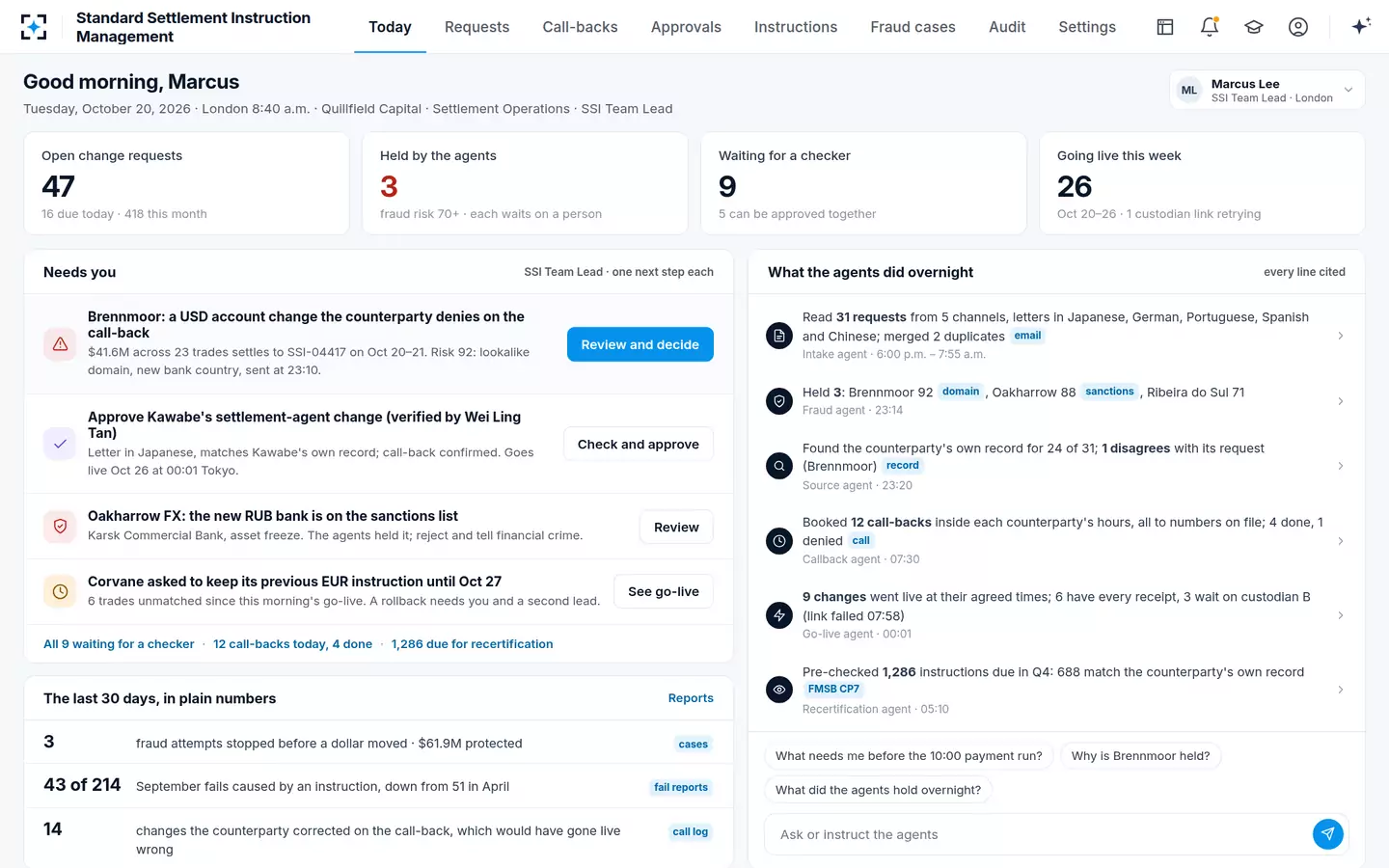
Fraud attempts are not rare events at this exposure. The sample firm stopped three in a month, all from lookalike domains, all asking for the same bank in Cyprus, with $61.9 million of settlements at risk. For the market as a whole, the FBI received reports of $3,046,598,558 of business email compromise losses in 2025, across all sectors; its Recovery Asset Team froze $679 million of $1.16 billion in attempted theft across the 3,900 incidents it acted on (FBI, 2025 IC3 Report).
Who bears the cost of a wrong SSI: fund, manager or broker?
It depends on which cost and whose error. EU cash penalties are charged to the failing CSD participant, usually a custodian or broker, and credited to the receiving one; whether they reach the fund is a matter of contract. ESMA noted in 2024 that no rule obliges a CSD participant to pass a penalty on to its client (ESMA, technical advice on the CSDR penalty mechanism). Funding costs fall on whoever is short of the cash or securities on the day.
A forged change that the asset manager accepted is the asset manager's problem first: it instructed the custodian to pay the new account. Whether the fund or the manager absorbs the loss is decided by the advisory agreement, the firm's error policy and, where relevant, insurance, and many firms treat it as an operational error the manager must make good; Trade Error Management covers how firms decide that. For a public company, the SEC's report adds another cost: the question of whether internal accounting controls were adequate.
How do you size the business case for settlement instructions management?
Count expected losses, then hours. The sum below has four terms, three of which are losses avoided, and every input can be measured from your own records: change volumes, fail reports, fraud attempts and the exposure behind each instruction. No regulator or independent study publishes these figures for the industry, so a case built on someone else's averages is a case no one should sign.
A business case for settlement instructions management, in four terms
Fraud losses avoided
attempts a year × exposure per attempt × (miss rate today − miss rate with the system)
Attempts from your own held, rejected and reported requests; exposure from the trades due to each targeted instruction.
Financial crime and settlement
Fail costs avoided
SSI-caused fails a year × (penalties + funding + rework per fail) × share removed
SSI-caused fails from custodian fail reports traced to an instruction; the share removed is a target until measured.
Settlement operations
Hours released
changes a year × (hours per change today − with the system) × cost per hour
Your own timing of a sample of changes, by channel; hours move to call-backs and approval rather than vanish.
Head of operations
Cost of the system
licence + integration + the people who still verify and approve
Include connecting the mailbox, the SSI database, Swift, recorded telephony, the SSI master and payments.
Head of operations
The hours are still worth counting honestly. Botminds' estimate for one bank or account change by email or letter is about two hours by hand and under half an hour with the solution. At the sample firm's 600 changes a month, that is roughly 1,200 hours against 280. Priced at the BLS mean wage for brokerage clerks, $72,850 a year in May 2025, or about $35 an hour before overheads by our arithmetic, the hours released are worth around $390,000 a year (BLS OEWS, 43-4011), a small fraction of two days' exposure on the single sample instruction above.
The numbers a business case should come from: the sample firm's last 30 days in Standard Settlement Instruction Management
What to look for in a settlement instructions management system
Look for the controls that change the expected loss, then for the automation that changes the hours. A system that reads requests quickly but lets the request supply its own verification has automated the fraud as well. The list below is what we would ask of any system, including ours.
What a settlement instructions management system should do, in order of what it saves
- Refuse contact details that arrive with a request, and book call-backs only to numbers on file
The single control behind most stopped frauds; it should not be a setting anyone can turn off.
- Require a maker and a different checker, and keep payment release separate
One person must never be able to make a changed instruction live.
- Score every request with explained signals and hold the risky ones
Lookalike domains, new bank countries, unknown signers, urgency; each with its evidence.
- Compare every change with the counterparty’s own published data
The one automated check that speaks to who made the change.
- Make changes live at an agreed time in every system, with receipts
Prevents the fails that come from one system using the old details.
- Review dormant and failed-trade instructions on a schedule
Removes stale SSIs before a trade picks them up.
- Read every channel and language, citing each field
Saves the hours and makes approval a check of sources, not of retyping.
The controls behind the first two items are what an examiner will test, and the call back procedures audit sets out the evidence. What a firm must prepare before go-live is in AI for settlement instructions in PDFs. To size the case on a month of your own change requests, start from Standard Settlement Instruction Management.
Questions people ask
Do EU cash penalties apply when a wrong SSI makes an instruction match late?
EU cash penalties apply to settlement fails, including instructions that match too late to settle on the intended date, and respondents to ESMA's 2024 consultation described late-matching penalties arising from place-of-settlement mismatches. The penalty is charged to the participant found to have caused the fail and paid to the other.
Is there a US equivalent of EU cash penalties?
Not for equities in the same form. US rules address fails through close-out requirements under Regulation SHO for fails to deliver, and in Treasuries through a market fails charge introduced by the Treasury Market Practices Group. The direct costs of a stale SSI in the US are mainly funding, late settlement and staff time.
How do you measure SSI-caused fails?
Take your custodians' fail reports, trace each fail to its cause, and count those where an instruction was wrong, stale or missing on either side. Keep the count monthly and by counterparty. At the sample firm it was 43 of 214 in September; your own figure, not an industry average, is the one to use.
What is the cost of one SSI change done by hand?
Botminds estimates about two hours for a bank or account change received by email or letter: reading and retyping, finding the counterparty's data, format and sanctions checks, finding a verified number and calling, a second approval, and updating each system. Time a sample of your own changes by channel; database notices take far less time than letters.
Does insurance cover a forged SSI change?
Some crime and cyber policies cover social-engineering fraud, often with sub-limits and conditions such as a call-back to a verified number. Read the policy before relying on it: a firm that skipped its own call-back procedure may find the claim harder, which is one more reason to keep the evidence of every call.