A settlement instruction letter is the document a counterparty sends to announce new or changed standard settlement instructions: on its letterhead, naming the accounts, agents and effective date, and signed by people it says are authorised. It is signed by the counterparty's authorised signatories, usually in operations, and it should be checked by two people at the firm that receives it: an analyst who verifies the change with the counterparty on a phone number already on file, and a different team lead who approves it. The letter matters because one accepted change can fail every trade with that counterparty or send its payments to a fraudster, so the real work of the seat that handles it is verification and evidence, not data entry. Botminds' Standard Settlement Instruction Management reads letters like these in any language, cites every field, checks the signer against the authorised list and books the call-back, and leaves the verifying and the approving to the two people whose names go on the decision.
The people and figures in the examples are from a fictional asset manager, Quillfield Capital, as it runs through the solution: 18,412 live instructions for 1,146 counterparties, and about 600 change requests a month.
The people a settlement instruction letter passes through, and what each must keep
Today
Retypes the letter into the SSI master, digs out a phone number, calls, writes it up.
With agents
Starts from a dossier with every field cited and the call booked to the number on file; makes the call and verifies as maker.
Still theirs: The call-back and the verification
Today
Approves 30 to 40 changes a day from a summary line and a colleague’s note.
With agents
Sees what arrived, what changes, the signals and the call; approves or freezes with a reason code and a signature.
Still theirs: Approval, and the decision to freeze
Today
Hears about attempts one at a time, if at all.
With agents
Receives a case with the evidence gathered and attempts linked across counterparties.
Still theirs: Every case decision and report
Today
Owns fails and the audit, with evidence in a mailbox, a phone log and a spreadsheet.
With agents
Sets thresholds and service levels as proposals tested on last month’s requests; answers auditors with one export.
Still theirs: Policy and accountability
Today
Releases payments to whatever the SSI master holds.
With agents
Unchanged, and barred from approving instructions.
Still theirs: Payment release, separated from SSI approval
What is a settlement instruction letter?
It is the paper or PDF form of an SSI change: a counterparty's statement, on its own letterhead, of where it now wants to receive securities or cash, from when, and for which markets. Most arrive by email as scanned attachments; some still arrive by post. In the sample firm's October, 58 of 418 change requests were signed letters, alongside 142 emails, 171 industry SSI database notices, 31 portal uploads and 16 Swift messages.
Regulators are moving away from it. The EU's 2026 settlement rules require firms to ask professional clients for their settlement reference data in a structured electronic form (Delegated Regulation (EU) 2026/1536), and the UK plan prefers automated, market-standard channels for SSI changes (UK Accelerated Settlement Technical Group, 2025). Letters will not disappear, because many counterparties and markets still use them, but a letter is now the channel that needs the most checking, not the one that proves the most.
Who signs a settlement instruction letter, and what does the signature prove?
The counterparty's authorised signatories sign it, typically a head of operations or settlements and often a second officer. The signature proves that someone produced a document that looks signed. It does not prove the counterparty sent it. The SEC's 2018 report on cyber-related frauds describes fraudsters attaching altered invoices carrying the new account details to otherwise ordinary requests, and one company paying $1.5 million over several months on the strength of forged paperwork for a bank change (SEC, Report of Investigation 34-84429).
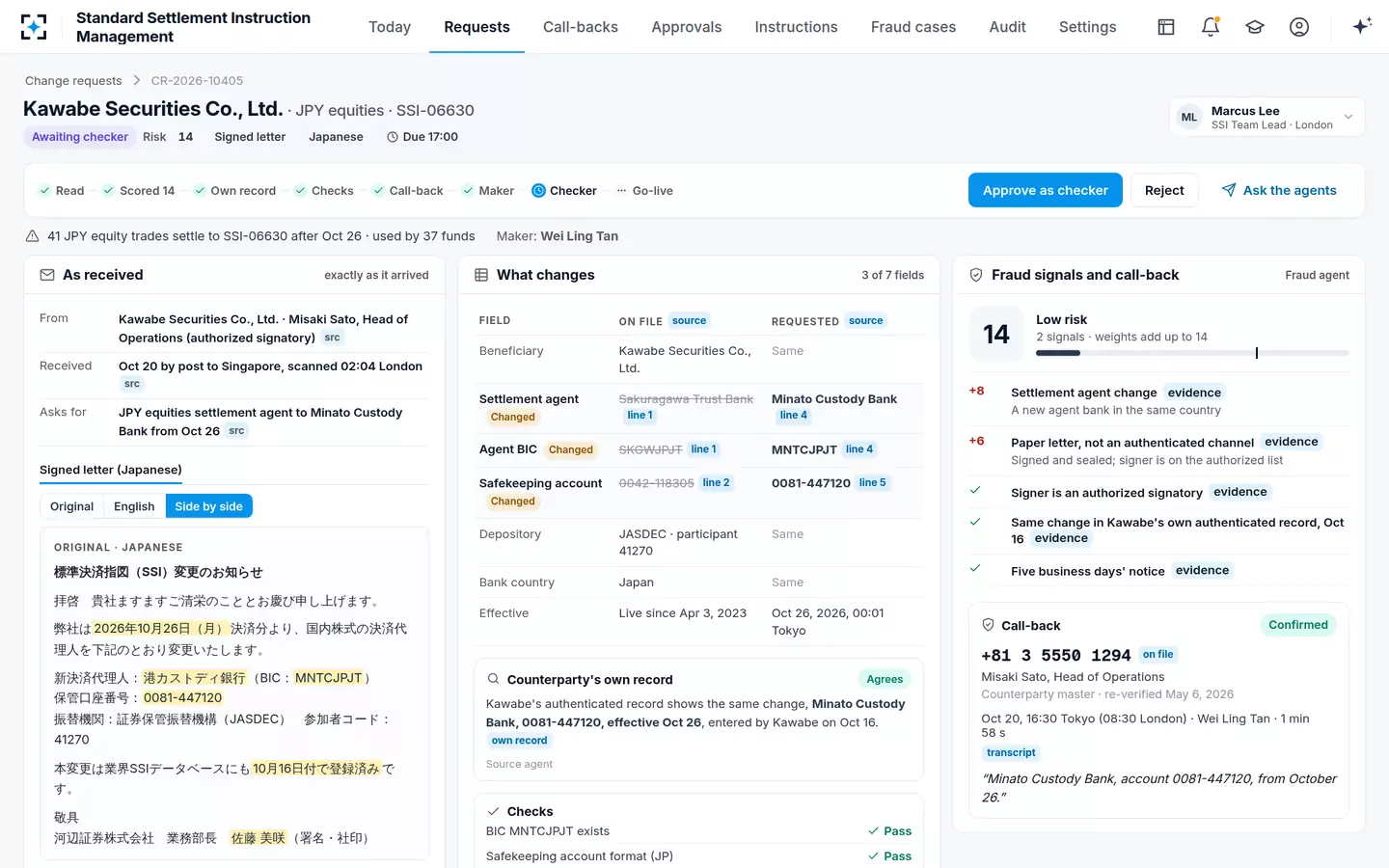
So the signer is checked, not trusted. In the sample, fictional Kawabe Securities' letter was signed by Misaki Sato, Head of Operations, who is on Kawabe's authorised signatory list, and the change also appeared in Kawabe's own entry in the industry SSI database; the call-back to the number on file confirmed it. The forged Brennmoor letter was signed by a "Simon Hale" who was on no list, which added 10 points to its fraud score, but the decisive evidence was the call-back, in which Brennmoor's settlements manager said "There's no Simon Hale in settlements."
A settlement instruction letter in Japanese, read field by field beside the English
Who manages SSIs in an asset manager?
A small static-data or reference-data team inside settlement operations, sometimes shared with the custodian or a middle-office provider. The work goes by many titles, among them SSI analyst, static data analyst and reference data analyst, and no official statistic counts it: the US Bureau of Labor Statistics has no occupation for any of them. Its closest category is brokerage clerks, whose duties O*NET describes as including "verifying stock transactions, accepting and delivering securities" and "keeping records of daily transactions and holdings" (O*NET 43-4011).
The nearest official count of the people who do settlement data work
35,940
brokerage clerks employed in the US, May 2025
$65,750
median annual wage
$72,850
mean annual wage
The team is small for what it controls. At the sample firm, one team lead in London approves 30 to 40 changes a day across Europe, the Middle East and Africa, and analysts in London and Singapore make the calls. Each of those changes alters where some of 412 funds and mandates settle with one counterparty.
What does a static data analyst do all day?
Mostly verifying, and much of the rest is finding things: the counterparty's last signed letter, the right person and the right number to call, the trades that will use the instruction. Botminds' estimate for one bank or account change received by email or letter puts the work by hand at about two hours, of which half an hour is finding a verified number, calling and writing it up.
Where a static data analyst's two hours on one SSI change go, by hand and with agents
By hand · about 2.0 hours
- Read and retype · 20%
- Find the counterparty’s data and letter · 15%
- BIC, IBAN, sanctions · 10%
- Find the number, call, write up · 25%
- Second approval · 15%
- Update every system · 15%
With agents · about 0.46 hours
- Read · 11%
- Find · 4%
- Checks · 4%
- The call-back, made by a person · 55%
- Second approval · 22%
- Update · 4%
The shape matters more than the total. With the reading, retyping, finding and system updates done by agents, more than three-quarters of the remaining time is the call-back and the second approval, the two steps that actually protect the firm. The seat becomes what it should have been: a verification desk.
Who approves an SSI change?
A different person from the one who verified it, and never someone who can also release payments. The CPMI's 2018 strategy on wholesale payments fraud lists, among the process controls that protect payment endpoints, "the practice of requesting an approval after a payment initiation" and the separation of duties between staff (CPMI, 2018). An SSI change is a payment instruction with a long life, so the same separation applies.
The SEC's report shows why the separation has to be enforced by the system, not by a policy document. In one of its cases an employee bypassed the company's two-person rule for wires by having junior colleagues sign off; in another, an employee read the company's authority matrix as giving him approval rights reserved for the chief financial officer (SEC 34-84429). In the solution, a team lead who verified a change cannot approve it, and the rule cannot be switched off.
A settlement instruction letter's route through Standard Settlement Instruction Management
Agent
Intake agentReads the letter in its language, maps each field to the template with a citation, links it to the counterparty and instruction on file.
Never: Writes to the SSI master
Agent
Source and Fraud agentsFind the counterparty’s own authenticated data; check the signer, the domain and the timing; score the request.
Never: Uses a number from the letter
Agent
Callback agentBooks the call to the number on the counterparty master, in its hours, and writes the script.
Never: Dials or confirms a call
A person decides
Analyst (maker)Makes the call on the recorded line and verifies the change with a reason code.
A person decides
Team lead (checker)Approves or freezes with a reason code and a signature; cannot approve a change they verified.
Agent
Go-live agentMakes the change live at the agreed time in every system, with a receipt from each.
Never: Moves an effective date
How many SSIs does a firm keep?
More than most people outside operations expect, because every counterparty needs one per market, asset class and currency it trades. The sample firm keeps 18,412 live instructions for 1,146 counterparties in 38 currencies, about sixteen per counterparty. No regulator or industry body publishes typical counts, so the useful measures are your own: instructions per counterparty, changes per month and the share of instructions not used in a year. At the sample firm 1,042 instructions had not been used for twelve months at the fourth-quarter review.
The letter your own firm sends: publishing the funds' SSIs
The seat works in both directions. When a fund changes custodian, opens a new market or moves to a new sub-custodian, the asset manager or its custodian must tell every broker that settles with the fund, and those brokers face the same question this guide asks: did the fund really send this? A firm that signs its own SSI letters with no way for the recipient to verify them is training its brokers to accept unverifiable letters.
The better practice mirrors the inbound one. Publish changes through an authenticated channel the counterparties already use, such as an industry SSI database, give brokers enough notice to verify and load the change before the effective date, and expect, even welcome, their call-back to the number they hold for you. Under the EU's 2026 rules the duty sits on the client side too: a professional client sending allocations to its broker must keep its settlement reference data current well ahead of settlement. A custodian change done well is announced weeks ahead, confirmed on a call the broker initiates, and live on the same date in every system on both sides.
Who is accountable when a wrong SSI fails a trade or pays a fraudster?
The firm that accepted the change, and in practice the people who verified and approved it. Regulation spreads the duty along the chain. In the EU, investment firms must require their professional clients to keep their settlement reference data up to date well before settlement (Delegated Regulation (EU) 2026/1536). In the UK, the FCA has said it will discuss with firms their "arrangements for standard settlement instructions" as part of T+1 readiness (UK Technical Group report). In the US, an adviser must keep "Originals of all written communications received" relating to "Any receipt, disbursement or delivery of funds or securities" (Rule 204-2(a)(7)), which on a plain reading takes in an SSI letter.
“Systems of internal accounting controls, by their nature, depend also on the personnel that implement, maintain, and follow them.”
SEC, Report of Investigation 34-84429, 16 October 2018
FINRA has made the same point about emailed instructions, noting firms that paid out after a phone check failed (FINRA RN 12-05). That is the most common way an SSI seat fails: the check was attempted, it did not succeed, and the change went through anyway because the letter looked right. Accountability is easier to carry when the evidence is gathered as the work is done: what arrived, who called which number, what the counterparty said, who approved and when. The call back procedures audit sets out that evidence piece by piece.
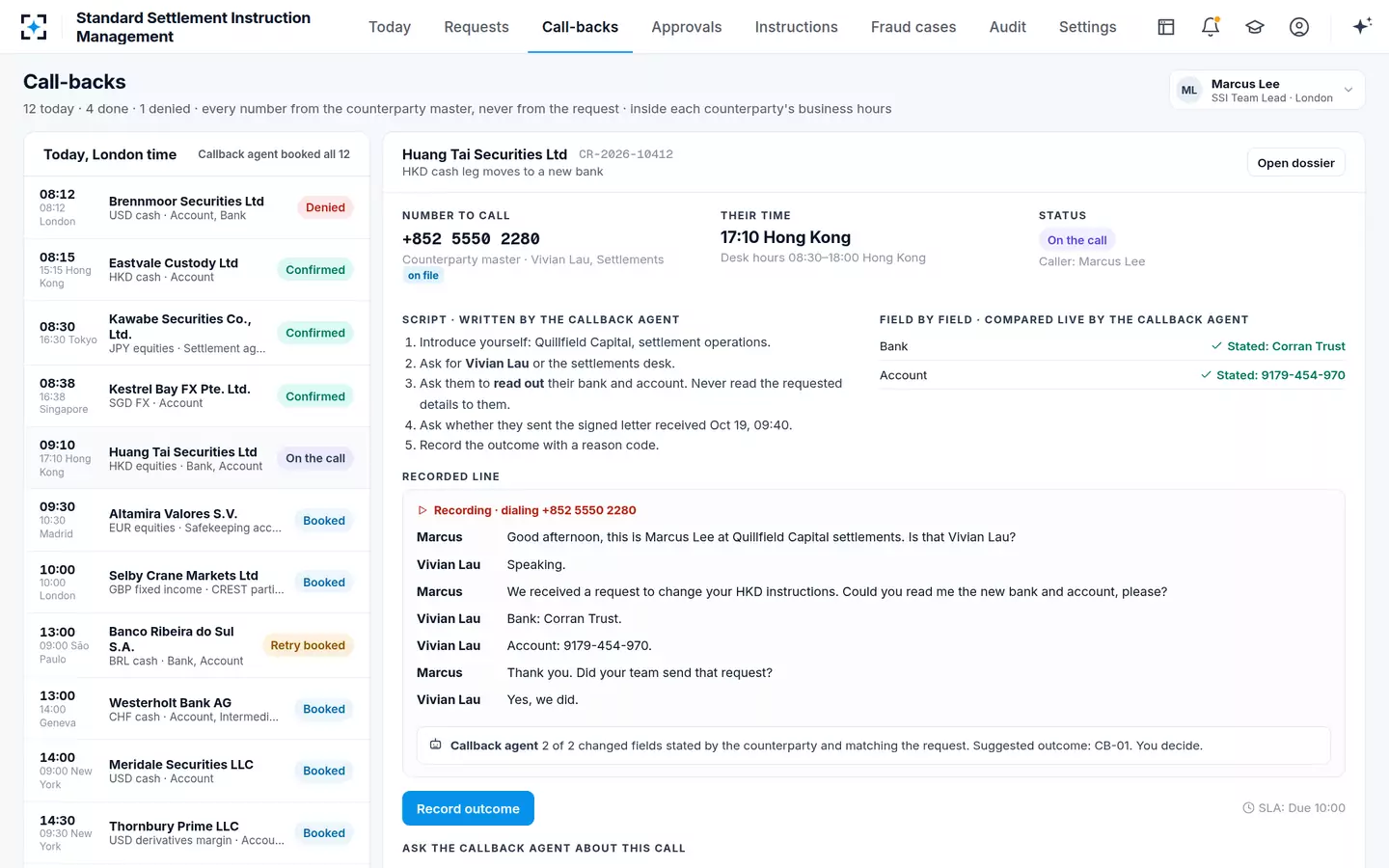
The call-back that verifies a letter goes to the number on file, with a script the analyst follows
What agents may and may not do on this seat is drawn as a line in AI for standard settlement instructions. To see letters from your own counterparties read and checked, start from Standard Settlement Instruction Management.
Questions people ask
What should a settlement instruction letter include?
The counterparty's full legal name and ideally its LEI; the markets, asset classes and currencies covered; the new and, ideally, the old details for every changed field; the effective date; the names and titles of the signatories. It should not be the source of the phone number you use to verify it.
Can an SSI letter be sent by email?
Most are, as scanned PDFs. Email is convenient and is also the channel business email compromise exploits, so an emailed letter should be treated as a request to be verified, not as authorisation. Structured channels, such as an industry SSI database where the counterparty maintains its own data, carry stronger evidence of origin.
Does a settlement instruction letter need a wet signature?
No general rule requires one; it depends on the agreement between the parties. A wet signature on a scanned letter is as easy to copy as a typed one. What makes a change safe is the call-back to a number on file and two people's approval, whatever the signature looks like.
How long should SSI letters be kept?
For US investment advisers, Rule 204-2 requires the written communications it covers to be kept for at least five years from the end of the fiscal year of the last entry, the first two in an appropriate office. Many firms keep SSI evidence longer; the sample firm keeps its audit trail for seven years.
What is an SSI verification letter?
In settlement, it usually means a counterparty's written confirmation that the SSIs you hold for it are current, often requested during a periodic review. In US benefits it means a letter about Supplemental Security Income, which is what most searches for the phrase return.