FinCEN's business email compromise advisory, FIN-2019-A005 of 16 July 2019, told US financial institutions that criminals succeed by inserting themselves into a business's normal processes and asking for a payment detail to change, and it counted more than 32,000 reports of attempted BEC theft, worth close to $9 billion, filed since its first advisory in 2016. Its core advice is to look at three business processes: how a firm authenticates who it is talking to, how it authorises transactions, and how it communicates changes to them. A settlement desk that maintains standard settlement instructions runs all three every time a counterparty asks to change a bank or an account, which makes the advisory one of the most practical documents an SSI team can read. Botminds' Standard Settlement Instruction Management is built around the same three processes: it reads and scores every change request, finds the counterparty's own authenticated data, books the call-back to a number already on file and leaves approval to two people.
The worked example is a fictional forged request against a fictional asset manager, Quillfield Capital, as it runs through the solution. The regulators' and the FBI's figures are linked where they appear and cover all sectors, not settlement alone.
What FinCEN counted between its two advisories
32,000+
BEC reports to FinCEN after the September 2016 advisory
~$9B
in attempted theft in those reports
1,100+
reports a month by 2018, up from just under 500 in 2016
$300M+
attempted each month in 2018, against $110 million in 2016
What did the FinCEN business email compromise advisory say?
It said that business email compromise had grown from a scheme against companies that wire money abroad into a way of misdirecting "any kind of payment", that criminals now target governments, universities and financial institutions themselves, and that the weak point is the victim's own routine: the better a criminal knows how the victim normally pays, and the weaker its checks on who is asking and who may approve, the more likely the scheme is to work and the more it pays (FinCEN FIN-2019-A005).
Its risk-management section asks institutions to assess, and if necessary harden, the processes by which they "1) authenticate participants in communications, 2) authorize transactions, and 3) communicate information and changes about transactions". The advisory updates FinCEN's 2016 advisory and keeps its red flags, and it says of itself that it "does not establish new regulatory interpretations, expectations, or requirements". It is guidance about where controls fail, not a rule, which is exactly why it travels well outside banking.
What is business email compromise, in FinCEN's words?
Business email compromise is a fraud in which criminals compromise or impersonate the email of a business to send payment instructions that move money to accounts they control. FinCEN defines email compromise fraud as schemes in which "criminals compromise the email accounts of victims to send fraudulent payment instructions to financial institutions or other business associates in order to misappropriate funds or value", and business email compromise as the variant that targets operational entities: "commercial, non-profit, non-governmental, or government entities" (FinCEN).
The account need not be hacked. A footnote in the advisory explains that criminals may instead impersonate a counterparty with an address that differs from the genuine one by a character or two, which is the lookalike domain. And financial firms are not only the banks that carry the payments; FinCEN describes schemes that imitate a bank's own "Society for Worldwide Interbank Financial Telecommunication (SWIFT) department with payment instructions and SWIFT reference numbers in the email text to enhance its apparent legitimacy to the victim". An SSI change request that quotes a BIC, an IBAN and a Swift reference looks official for the same reason.
How do fraudsters change payment or settlement instructions?
They ask. The SEC's 2018 investigation of nine public companies found that in the vendor variant, after breaking into a supplier's email, "The perpetrators then requested that the issuer personnel initiate changes to the vendors' banking information, and attached doctored invoices reflecting the new, fraudulent account information" (SEC, Report of Investigation 34-84429). Translate vendor to broker and invoice to settlement instruction letter, and that is an SSI change request.
The sample case in the solution follows the pattern closely. At 23:10 London on Monday 19 October 2026, an email from "Simon Hale" at brennmoor-sec.com, one hyphen away from the broker's real domain, asked the asset manager to send all of Brennmoor Securities' US dollar cash settlements to a new account in Cyprus "with immediate effect", with a signed letter attached and a Cyprus phone number for questions. Twenty-three trades worth $41.6 million were due to settle to Brennmoor's instruction over the next two days.
One campaign, three counterparties: each lookalike domain was used within days of being registered
- Domain registered5 days
- Used7 Oct
- Domain registered9 days
- Used15 Oct
- Domain registered 13 Oct6 days
- Used19 Oct
Three features recur in the SEC's cases, FinCEN's advisory and the sample: the request comes from a source the victim already deals with, or something that looks like it; it changes the destination of money rather than asking for a new payment; and it carries its own proof, a letter, a reference, a number to call. Nothing about it is technically difficult. The SEC said of the frauds it studied that they "were not sophisticated in design or the use of technology".
What did the SEC find when companies paid changed bank details?
It found that the companies had the right controls on paper and still paid. "Each of the nine issuers lost at least $1 million; two lost more than $30 million. In total, the nine issuers lost nearly $100 million to the perpetrators, almost all of which was never recovered" (SEC 34-84429). One company "paid eight invoices totaling $1.5 million over several months in response to a vendor's manipulated electronic documentation for a banking change; the fraud was only discovered when the real vendor complained about past due invoices".
“The existing controls could be (and were) interpreted by the company’s personnel to mean that the (ultimately compromised) electronic communications were, standing alone, sufficient to process significant wire transfers or changes to vendor banking data.”
SEC, Report of Investigation pursuant to Section 21(a), Release 34-84429, 16 October 2018
The SEC brought no enforcement action, but it used the report to tell issuers that internal accounting controls "may need to be reassessed in light of emerging risks", and it noted that "the spoofed vendor emails had fewer indicia of illegitimacy or red flags" than the fake-executive emails. For an SSI desk the lesson is precise: a verification step that can be satisfied by the request itself, a phone number in the email or a letter attached to it, is not a verification step.
How big are business email compromise losses?
Business email compromise was the second-costliest cyber-enabled fraud reported to the FBI in 2025, with $3,046,598,558 in reported losses from 24,768 complaints, behind investment fraud (FBI, 2025 IC3 Report). The figures are what victims chose to report, in every sector, so they understate the total and say nothing about settlement specifically; no regulator or independent study publishes losses from forged SSI changes.
Business email compromise losses reported to the FBI have stayed near $3 billion a year
Two other 2025 numbers matter to a settlement team. The FBI's Recovery Asset Team worked 3,900 incidents through its Financial Fraud Kill Chain, with $1,163,919,846 in attempted theft, and froze $679,013,183 of it, a 58% success rate on the incidents it acted on. The report also says businesses lost over $30 million to business email compromise scams involving AI in 2025, from emails written by text generators to cloned voices. A call-back that reaches a convincing voice proves little if the number came from the fraudster.
Which red flags apply to an SSI change request?
Nearly all of them. FINRA's Regulatory Notice 12-05 on emailed instructions lists "requests that funds be transferred to an unfamiliar third party account" and "requests that indicate urgency or otherwise appear designed to deter verification of the transfer instructions", and warns that firms have paid out after a phone check failed (FINRA Regulatory Notice 12-05). Read for SSIs, the unfamiliar account is a new bank, the urgency is "effective immediately", and the failed phone check is a call to a number that came with the request.
Red flags for a business email compromise SSI change, and how each showed up in one forged request
- The sender’s domain is new or one character off the counterparty’s
brennmoor-sec.com, registered six days earlier, against the counterparty’s brennmoorsec.com. FINRA suggests monitoring for “newly created imposter domains”.
- The money moves to a new bank, or a new country
US dollars from a New York bank to a bank in Cyprus, where the counterparty’s LEI data showed no entity.
- Urgency, or a reason the old account cannot wait
“With immediate effect”, and “our previous account will be closed this week”.
- The request brings its own contact details
A Cyprus number to call “directly”. FinCEN and FINRA both describe verification that the request itself cannot satisfy.
- It arrives outside the counterparty’s business hours
Sent at 23:10 London; the broker’s desk closes at 19:00.
- The signer is not someone you know
No “Simon Hale” on the counterparty’s authorised signatory list.
- It disagrees with the counterparty’s own published data
Brennmoor’s authenticated entry in the industry SSI database was unchanged since 2 June.
Most of those flags passed every format test. The bank, the BIC and the IBAN were real and well formed; the sanctions lists showed no hit. That is why the solution scores the signals rather than the syntax: the Fraud agent added 30 points for the lookalike domain, 20 for the new bank country, 10 for the unknown signer and 8 each for the number in the email, the hour, the urgency and the disagreement with the counterparty's own data, 92 in all against a hold threshold of 70.
Who carries the loss, and what has to be filed?
Usually the firm that paid. FinCEN notes that fraudulently induced transactions are often irrevocable, and the SEC's nine companies recovered almost nothing. Who bears a loss between a payer, its bank and its counterparty depends on contracts and payment law, and the best protection is not paying. Speed matters for the rest: FinCEN's advisory says it has recovered funds most often when victims or their banks report to law enforcement within a day, and the FBI asks victims to contact their bank and file with IC3 at once.
Filing duties depend on what kind of firm you are. For a bank or broker-dealer, FinCEN's advisory is explicit that "a financial institution has a SAR filing obligation regardless of whether the scheme or involved transactions were successful", and asks for the key term "BEC FRAUD" in the narrative (FinCEN). Registered investment advisers are not yet covered by the suspicious activity reporting rule written for them: FinCEN has delayed it, and "This rule is effective January 1, 2028" (FinCEN, 91 FR 36). An asset manager's custodian and broker affiliates may already have to file, which is one more reason to share the evidence quickly.
What an SSI desk should change after reading the advisory
Map each of FinCEN's three processes onto the SSI change and put a control at each that the request cannot satisfy by itself. The CPMI's 2018 strategy on wholesale payments fraud gives the same kind of list for payment endpoints, from separating duties to rules that "transactions need to occur during working hours", and notes that wholesale payments "are typically large-value, immediate and final, which may make them more susceptible to be targeted for fraud" (CPMI, Reducing the risk of wholesale payments fraud related to endpoint security, 2018).
FinCEN's three vulnerable processes, applied to a standard settlement instruction change
| FinCEN’s process | What it means for an SSI change | How Standard Settlement Instruction Management handles it |
|---|---|---|
| Authenticate participants in communications | Prove the request came from the counterparty, on a channel you chose. | Compares the request with the counterparty’s own authenticated data; books a call-back only to the number on the counterparty master; refuses any contact detail that arrived with the request. |
| Authorize transactions | No single person can make a changed instruction live. | An analyst verifies as maker, a different team lead approves as checker; anyone who can release payments cannot approve instructions. |
| Communicate information and changes about transactions | Changes are expected, dated and visible to everyone who pays to them. | Minimum notice before go-live; effective-dated changes in every system with receipts; a 90-day lock on email and letter changes after a confirmed fraud attempt. |
The fourth thing the advisory asks is that institutions see campaigns, not single attempts, and share what they learn. In the sample, the Fraud agent linked the Brennmoor request to two earlier ones against other counterparties that named the same Cyprus bank, so the financial crime officer opened one case with three attempts in it rather than three unrelated tickets.
A fraud case in Standard Settlement Instruction Management: the evidence gathered, the actions left to financial crime
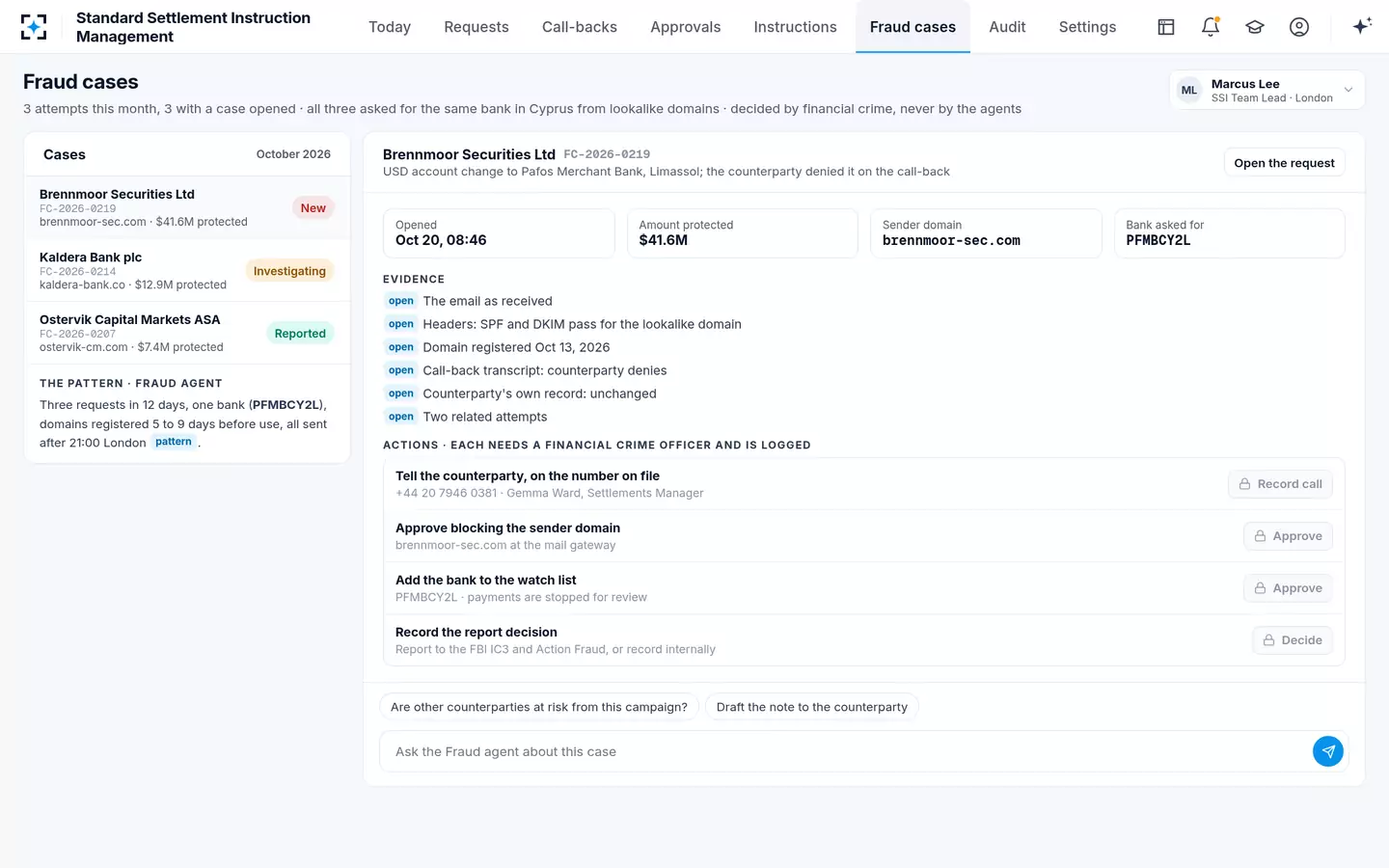
A forged request is stopped by the call-back, so the call-back's evidence is what an examiner will ask to see; the call back procedures audit sets it out. What a wrong SSI costs when the money does leave is worked through in settlement instructions management: what one wrong SSI costs. To see the solution on your own past requests, start from Standard Settlement Instruction Management.
Questions people ask
Is the 2019 FinCEN BEC advisory still current?
It remains FinCEN's published guidance on email compromise fraud, and it says the red flags of its 2016 predecessor "remain relevant". Its figures describe 2016 to 2018; for current losses, use the FBI's annual IC3 report, which put 2025 business email compromise losses at about $3.05 billion. The advisory creates no new legal requirement.
What key term goes in a SAR for business email compromise?
FinCEN asks filers to write "BEC FRAUD" in the narrative when a business or organisation is the victim and "EAC FRAUD" when an individual is, and to select the cyber event field. It also asks for transaction details, including the beneficiary's account and bank and any intermediary, and for the email addresses and IP addresses involved.
Does business email compromise include phone calls?
Yes. The FBI's 2025 report defines business email compromise to include compromising other channels such as phone numbers and virtual meeting applications, not only email. That is why a call-back must go to a number you already hold: a number in the request may reach the fraudster, or a cloned voice.
Is AI being used in business email compromise?
The FBI's 2025 report says businesses reported over $30 million in losses to business email compromise scams involving AI, and describes text generators that write official-sounding emails and voice cloning used to request payments. FINRA's 2026 oversight report describes voice clones being used to persuade firms to change access to accounts.
Does an asset manager have to file a SAR after a BEC attempt?
Not as an investment adviser today: FinCEN's AML and suspicious activity reporting rule for registered investment advisers takes effect on 1 January 2028. Banks and broker-dealers, including an asset manager's custodian or affiliated broker, must file for attempts as well as losses. Check whether any regulated affiliate in your group is involved.