Standard settlement instructions are the account details a firm and its counterparty agree once and then use for every trade of a given type: which custodian or bank receives the securities or the cash, the account number there, the agent's identifier code, any intermediary, and the market where settlement happens. People also call them standing settlement instructions, and both are shortened to SSIs. They matter because no one re-types them trade by trade, so a single wrong or out-of-date line is copied into every trade that uses it, and every one of those trades can fail to match. Botminds' Standard Settlement Instruction Management exists for the other half of the problem: an SSI is also the thing a fraudster asks you to change, and an asset manager receives hundreds of change requests a month by email, letter and message. The solution reads each request, checks it against the counterparty's own authenticated data, books a call-back to the number on file and leaves the decision to two people.
The examples come from a fictional asset manager, Quillfield Capital, with 18,412 live instructions for 1,146 counterparties in 38 currencies, as it runs through the solution. The rules come from EU, UK and US regulators and are linked where they appear.
Four of the thirteen fields Europe now requires on an allocation come from the SSI
EU written allocation, from 7 December 2026
- From the trade: type, ISIN, side, quantity, dates, price, currency, amount · 69%
- From the SSI: accounts, delivering and receiving participants, place of settlement · 31%
Fields an error in one SSI repeats on every trade
- Re-entered per trade · 69%
- Copied from the SSI, unchanged, into every allocation · 31%
What are standard settlement instructions?
An SSI is a counterparty's standing answer to the question "where do we deliver?". For a securities trade it names the custodian that holds the account, the safekeeping account, the depository where the trade settles and the identifiers of the agents in between. For a cash payment it names the beneficiary bank, the account, its identifier code and any correspondent. It is agreed in advance and kept on file, normally one per counterparty, market and asset class, so that when a trade is booked the settlement details are filled in automatically.
That last step is the point. The UK's Accelerated Settlement Technical Group put it plainly: "In the majority of instances SSIs should remove the need to exchange transaction specific settlement instructions and once in place will be used for settlement of all specified transactions between two counterparties" (UK Accelerated Settlement Technical Group, February 2025). An SSI is reference data, not a message. The messages that go to the depository each night are built from it, and how one SSI becomes tonight's settlement instruction follows that step field by field.
Standard or standing settlement instructions: is there a difference?
No: the two names mean the same thing, and both appear in official documents. The UK government's T+1 report and ESMA's 2024 report on T+1 write "standard settlement instructions"; the respondents to ESMA's consultation on cash penalties wrote "Standing Settlement Instructions" for the same data. "Standing" says how the instruction behaves, staying in force until it is changed; "standard" says what it does, giving every trade of one type the same details.
Two other uses of the letters cause confusion in search. In US benefits, SSI means Supplemental Security Income, which is why "SSI verification" and "SSI fraud" mostly lead to the Social Security Administration. In payments, a firm's own outbound instruction to its bank is sometimes called a standing payment instruction. The SSI in this guide is the counterparty's settlement data, held by the asset manager, its custodian and its brokers.
What does an SSI contain, and who owns each line?
An SSI contains the receiving party, its account, the bank or custodian holding that account, the identifiers that route messages to it, and the scope: which asset, currency and market the instruction covers, and from when. Each line belongs to someone, and the owner is the only party that can say whether it is right. That is why checking an SSI against a format rule proves less than it seems: the format can be perfect and the account can belong to someone else.
One cash SSI, line by line: what each part is and who can confirm it
Beneficiary
Value on fileBrennmoor Securities Ltd
Who confirms itCounterparty
What it doesThe legal entity that owns the account. Checked against its legal entity identifier.
Account
Value on file4410-228-916
Who confirms itCounterparty
What it doesThe cash or securities account to credit. One digit wrong and nothing matches.
Bank or custodian
Value on fileHalden Trust Company, New York
Who confirms itCounterparty
What it doesWhere the account is held: the agent that will receive the cash or the securities.
BIC of the bank
Value on fileHLDNUS33
Who confirms itCounterparty
What it doesThe business identifier code that routes the payment or settlement message.
Intermediary
Value on fileNone
Who confirms itCounterparty
What it doesA correspondent bank between the payer and the beneficiary bank, when there is one.
Routing number
Value on fileABA 026-014-593
Who confirms itMarket
What it doesThe US domestic clearing code for the beneficiary bank, used with Fedwire.
Market and asset
Value on fileUSD cash
Who confirms itBoth
What it doesWhich trades this instruction covers: one counterparty can have dozens, per currency and asset.
Effective from
Value on fileLive since 14 March 2022
Who confirms itBoth
What it doesThe date the instruction took effect, and the version that replaced the one before it.
A securities SSI has the same shape with different lines: the depository and the participant code there, the custodian or sub-custodian, its BIC, the safekeeping account and the place of settlement. Fictional Kawabe Securities' Japanese equities instruction in the sample names JASDEC as the depository, participant 41270, its settlement agent bank, the agent's BIC and a safekeeping account. The standard settlement instructions template lists the fields for equities, bonds, cash and FX side by side.
Who sends SSIs to whom?
The owner of the account sends its SSIs to everyone who must deliver to it: an asset manager's custodian publishes the fund's SSIs to the brokers that trade with it, and each broker sends its own to the asset manager and its custodian. Both sides then hold a copy of the other's instructions. Settlement works only when the two copies agree, because each side instructs its own custodian separately and the depository compares the two.
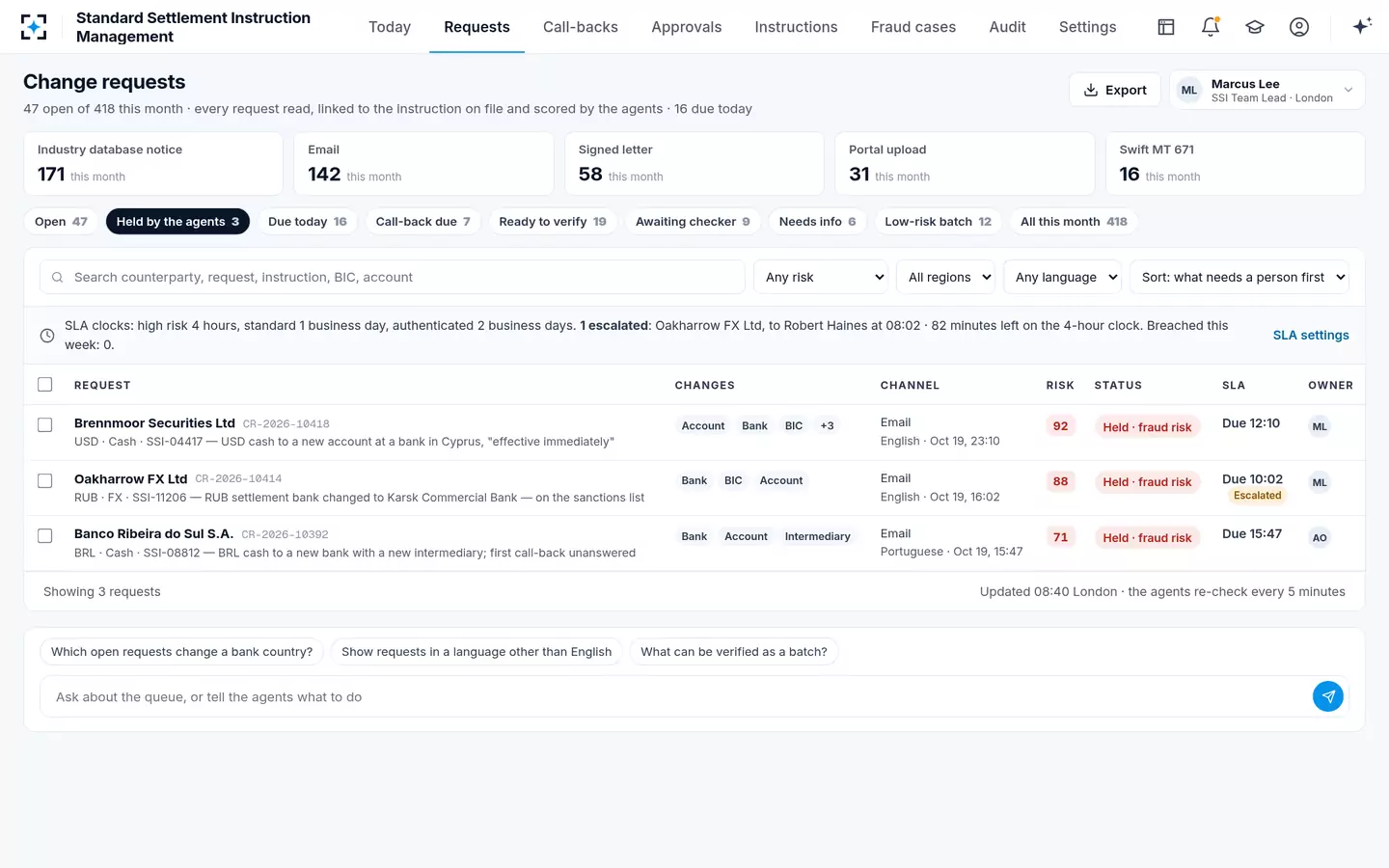
Those copies travel by several routes at once. In the sample firm's October to date there were 418 change requests: 171 notices from an industry SSI database, 142 emails, 58 signed letters, 31 portal uploads and 16 Swift MT 671 messages, the standing settlement instruction update message used across the industry. The SEC described the result in its T+1 rule: market participants' matching tools "often rely on inconsistent SSI data independently maintained by broker-dealers, investment managers, custodians, sub-custodians, and agents on separate databases" (SEC, Shortening the Securities Transaction Settlement Cycle, 2023).
A month of SSI changes arrives by five routes, and three of them were held
Why does a wrong SSI fail a trade?
A wrong SSI fails a trade because the depository settles only when the two sides' instructions match, and the account and participant details in each instruction come from the SSI each side holds. If the asset manager's copy of a broker's SSI is out of date, the asset manager's custodian instructs delivery to an account the broker no longer uses. The broker instructs against its new account. The two instructions do not match, and the trade does not settle on the intended date.
EU rules list what must match. Article 5(3) of the EU's settlement discipline standards requires participants to use eleven named matching fields, among them "the identifier of the participant that delivers the financial instruments or cash" and "the identifier of the participant that receives" them (Delegated Regulation (EU) 2018/1229). Those two come straight from SSIs. ESMA's 2024 report on T+1 named the typical errors, "wrong quantity of securities mentioned in the instruction, wrong place of settlement indicated in the instruction, wrong format of the instructions", and concluded that "more standardisation and automation will be needed at this level too (e.g. through the use of 'standard settlement instructions' (or SSIs) or of a centralised SSI repository)" (ESMA, report on shortening the settlement cycle, 2024).
No regulator publishes what share of settlement fails is caused by SSIs. The SEC's T+1 release records a commenter's view that SSI-related issues are among the most common reasons for fails, and it is recorded as a commenter's view, not a finding. The useful number is your own: the sample firm's custodians reported 214 fails in September, and 43 of them were traced to an instruction. What happens to a trade once it has failed is covered in what is a failed trade.
What does T+1 change about SSIs?
T+1 removes the night in which a wrong SSI used to be found and fixed. Under a two-day cycle, an unmatched instruction on the evening of trade date left all of the next business day to call the counterparty and correct it. Under T+1, the allocation, the confirmation and the instruction all have to be right on trade date, so the SSI has to be right before the trade is booked.
Three T+1 timetables, and the SSI deadlines inside them
- T+2 until 27 May 2024T+2
- T+1, with same-day allocation and affirmationT+1 from May 2024
- T+2T+2
- Allocation rulefrom Dec 2026
- T+1Oct 2027
- T+2T+2
- FMSB standardSTAT 01
- T+22027
- T+1Oct 2027
Europe's new rules reach into the SSI itself. From 7 December 2026, Delegated Regulation (EU) 2026/1536 requires professional clients' written allocations to reach the investment firm by 23:00 CET on trade date, in a structured electronic form (the full EU and UK timetable is in Failed Trade Management's guide to T+1 settlement in Europe), and adds the place of settlement to the allocation (Delegated Regulation (EU) 2026/1536). It also obliges firms to require their clients to keep their standing data current, in words that describe an SSI:
“Investment firms shall also require their professional clients to keep those reference data updated sufficiently in advance to ensure timely settlement of transactions.”
Delegated Regulation (EU) 2026/1536, Article 1(1)(b), new Article 2(3) of the settlement discipline standards
The UK plan is more specific. Its action STAT 01 says "All Market Participants will implement the Core Principles and templates contained in the Financial Markets Standard Board's (FMSB) Standard for Sharing of SSIs", from April 2025 and by 31 December 2026, and its automation chapter asks that changes "be notified in good time before the change is effective ideally using a market standard automated solution" (UK Accelerated Settlement Technical Group). The UK's T+1 date itself still needs legislation: the government has committed to legislate for 11 October 2027 and published a draft instrument (HM Treasury). In the US, the SEC chose not to require SSIs in its rule for matching services, saying instead that such a service "generally should consider developing incentives or requirements in its policies and procedures to encourage or compel the use of SSIs" (SEC, 2023).
An SSI is also where payment fraud lands
The same property that makes an SSI efficient makes it dangerous: change it once and every later trade pays the new account. A forged change request does not need to beat a payment control on each trade; it needs to be accepted once. In the SEC's 2018 report on cyber-related frauds against nine public companies, one company kept paying a supplier's invoices, $1.5 million over several months, to a bank account changed by a forged email, and found out only when the real supplier chased its money (SEC, Report of Investigation 34-84429). What FinCEN's business email compromise advisory teaches an SSI desk takes that pattern apart.
So an SSI has two ways to fail. It can be wrong because the counterparty changed it and nobody updated your copy, which fails trades. It can be wrong because someone who is not the counterparty changed it, which pays a fraudster. The controls are different: the first needs the change to reach you early and in a structured form, the second needs every change to be proven with the counterparty on a channel you chose.
Two ways an SSI goes wrong, and what catches each
| The counterparty changed it | Someone else changed it | |
|---|---|---|
| What happens | Your copy is stale; your instruction does not match theirs and the trade fails. | Your copy is forged; the instruction matches nothing genuine, or pays an account the counterparty does not own. |
| How you find out | An unmatched or failed trade, usually the same night. | Often weeks later, when the real counterparty asks where its money is. |
| What catches it early | Changes received in advance, in a structured form, from a source you trust; dormant SSIs reviewed. | A call-back to a number on file, never one in the request; a second person approves. |
| What it costs | Fails, penalties in the EU, funding, staff time. | The principal, which is rarely recovered. |
How often do SSIs change?
Often enough that an SSI file is never finished. Counterparties change custodians, move a market to a new sub-custodian, open accounts for new funds and close old ones, and merge. The sample firm receives about 600 change requests a month across 18,412 instructions, roughly one instruction in thirty a month; no regulator or independent study publishes the industry's rate, so the honest benchmark is your own change log.
Instructions also go stale without any request at all. The sample firm's fourth-quarter review found 1,042 instructions unused for twelve months, 97 used in a failed trade and 147 flagged high risk: 1,286 to review, of which 688 matched the counterparty's own authenticated data, 431 were proposed for retirement and 167 for a call-back. A stale instruction that is never used costs nothing until the day a trade picks it up.
How Standard Settlement Instruction Management keeps SSIs current
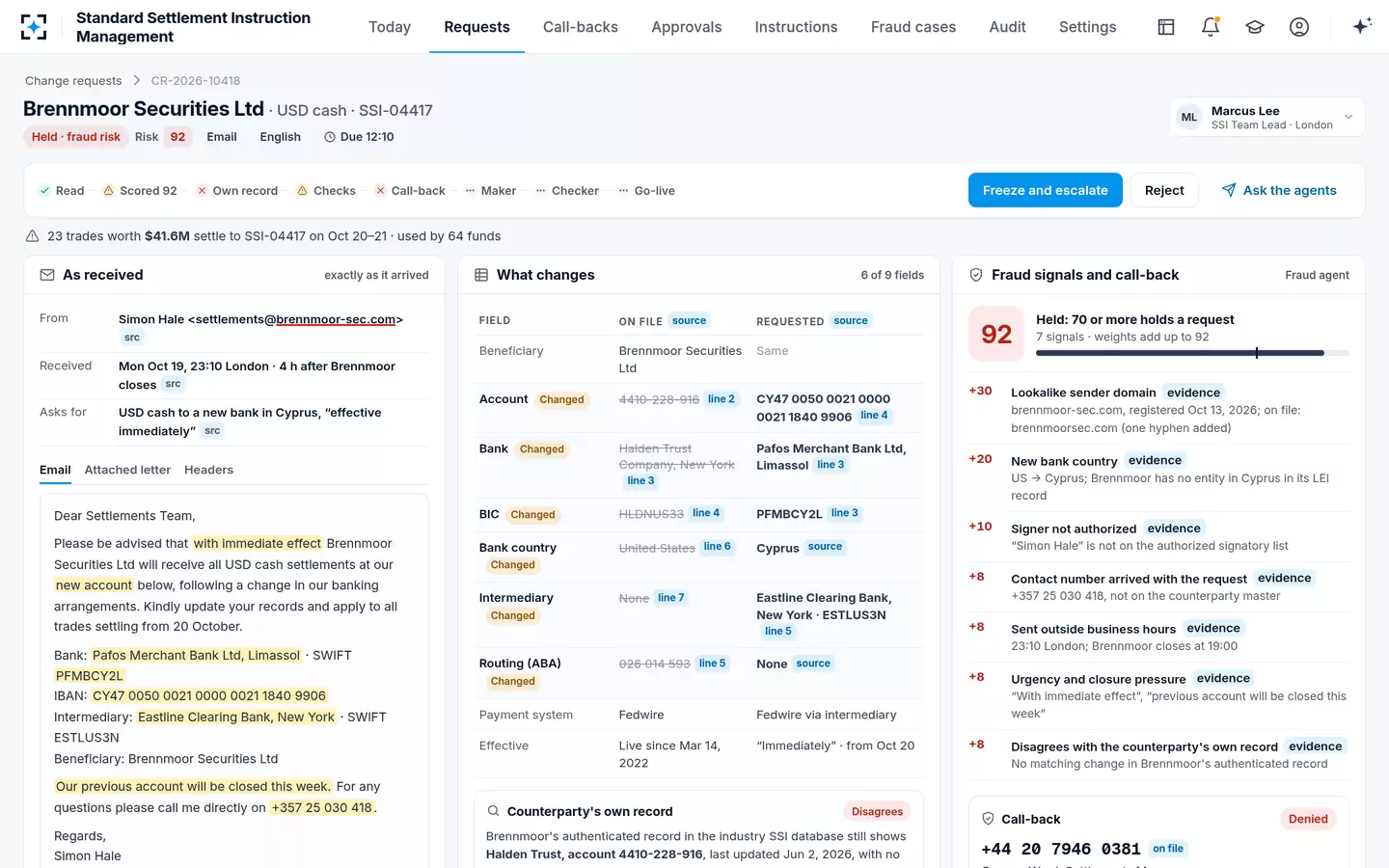
The solution treats every SSI change as a decision to be proven, not a row to be typed. Each request opens as one dossier: the request exactly as it arrived, the field-by-field change from the instruction on file with every value cited to its line, and the fraud signals with a call-back card. The agents read the request in any language, find the counterparty's own authenticated data in the industry SSI database and its signed letters, test the BIC, IBAN, account format, place of settlement and sanctions lists, and book a call-back to the number on the counterparty master. A person makes the call, an analyst verifies, and a different team lead approves or freezes.
One forged change in Standard Settlement Instruction Management: what arrived, what changes, and why it is held
Approved changes go live at the agreed time in the SSI master, order management, the custodians and the payment platform, with a receipt from each, and recertification campaigns review dormant and failed-trade instructions every quarter. What the agents may and may not do is set out in AI for standard settlement instructions. To see it on your own change requests, start from Standard Settlement Instruction Management.
Questions people ask
What is an SSI in banking?
In wholesale banking and securities, an SSI is a standard or standing settlement instruction: the account details a counterparty uses to receive cash or securities for every trade of one type. A bank holds SSIs for its trading counterparties and publishes its own. Retail banking rarely uses the term, which is why searches for "SSI" often land on US Supplemental Security Income instead.
Are standard settlement instructions required by law?
No law requires a firm to use SSIs as such. EU rules from 7 December 2026 require firms to make professional clients provide the reference data needed to settle "in a standardised, electronic format" and keep it updated in advance, and the UK's T+1 plan expects every market participant to adopt the FMSB SSI standard by the end of 2026. The SEC declined to mandate SSIs in its 2023 T+1 rules.
What is an SSI database?
An SSI database is a shared service where counterparties publish and maintain their own instructions, so others can take them from the source instead of from emails. ESMA's 2024 report pointed to "a centralised SSI repository" as one route to accurate instructions. A database reduces retyping but does not remove the need to check who made a change and when.
Do FX trades use SSIs?
Yes. An FX trade settles two cash legs, so each side holds the other's SSI for every currency it trades: the receiving bank, the account and any correspondent. A wrong FX SSI sends one currency to the wrong place while the other leg may already have been paid, which is why payment-versus-payment settlement, where one leg settles only if the other does, matters so much in FX.
Who is responsible when an SSI is wrong?
Each side is responsible for the instructions it sends and for the copies it holds of the other's. The counterparty must tell you when its SSI changes; you must update your copy, and prove that a change came from the counterparty before you use it. The EU's 2026 rules put the duty on investment firms to require their professional clients to keep reference data current.