A failed trade is a securities trade that has not settled by the end of its intended settlement date: the seller has not delivered the securities, or the buyer has not paid, and the contract stays open, recycled by the settlement system day after day, until it settles or both sides cancel it. It is the most ordinary exception in an operations department and one of the most expensive to ignore, because each market now prices the delay differently: the EU charges a cash penalty for every business day late, the US forces a close-out of equity fails the next morning, and the UK relies on its settlement system's rules. Shorter settlement cycles leave less time to catch a fail before it happens. Botminds' Failed Trade Management exists for that window: its agents link every custodian status message and counterparty email to its trade, name the cause, price what a miss would cost and draft the fix, and two people approve and release it before the market's cut-off.
The figures below come from regulators and central-bank research, linked where they appear. The worked examples come from the solution running on fictional sample data: a global asset manager called Quillfield Capital and its counterparties, with times on its clock in Brussels time.
Settlement fails are a monthly bill in the EU, not a rounding error
7.14%
of EU settlement instructions failed on average each month, March 2023 to February 2024
EUR 2.5bn
average value of settlement fails across the EEA each month over the same twelve months
EUR 127m
average cash penalties charged each month under the EU settlement discipline regime
What is a failed trade? A contract still open after its settlement date
A trade fails when the delivery of securities against payment does not happen on the date both sides agreed. The agreed date is the intended settlement date, set by the market's settlement cycle: in the US, broker-dealers may not contract for settlement later than the first business day after the trade unless the parties expressly agree otherwise (SEC Rule 15c6-1(a)), and in the EU the same one-day cycle becomes law on 11 October 2027, replacing the two-day cycle in force today (Regulation (EU) 2025/2075).
Settlement systems draw a precise line between a trade that is late and one that has failed. The EU's settlement discipline rules oblige every central securities depository (CSD) to show participants, in real time, which instructions are pending and "can still be settled on the intended settlement date" and which have failed and "can no longer be settled on the intended settlement date" (Delegated Regulation (EU) 2018/1229, Art. 11(2)). A pending instruction at 10 a.m. is a warning; the same instruction after the last settlement cycle of the day is a fail, and the clock that prices it has started.
Neither side is released from the contract. The seller still owes the securities and the buyer still owes the cash. CSDs "shall recycle settlement instructions that have resulted in a settlement fail until they have been settled or bilaterally cancelled" (2018/1229, Art. 9), which is why a failed trade turns up again on every morning's report until somebody fixes the reason it failed.
One failed trade, three regimes: what the delay costs and who enforces it
United States
Settlement cycleT+1 since May 28, 2024 for most broker-dealer trades (SEC Rule 15c6-1)
What a fail costsNo exchange-wide cash penalty on equities. A clearing participant must close out an equity fail to deliver by the next morning's open (Regulation SHO Rule 204), or face pre-borrow restrictions.
Who enforcesSEC and FINRA; the clearing agency runs settlement
Next deadlineTrade-date affirmation already expected under Rule 15c6-2
European Union
Settlement cycleT+2 today; T+1 from October 11, 2027 (Regulation (EU) 2025/2075)
What a fail costsA cash penalty for every business day the trade stays failed, charged by the CSD to the failing participant: 1.0 basis point a day on liquid shares, down to 0.10 on sovereign debt.
Who enforcesNational regulators and ESMA; the CSDs calculate and collect
Next deadline23:00 CET allocation deadline from December 7, 2026
United Kingdom
Settlement cycleT+2 today; T+1 planned for October 11, 2027 by a draft statutory instrument
What a fail costsNo statutory cash penalty: the EU settlement discipline articles were not carried into UK law. Discipline rests on the CREST rules and the industry's T+1 code.
Who enforcesFCA for venues and participants; Bank of England for CSDs and CCPs
Next deadlineAllocations and confirmations by 23:59 UK time on trade date, by December 31, 2026
What is the difference between a fail to deliver and a fail to receive?
They are the same failed trade seen from its two ends. The seller who has not delivered reports a fail to deliver; the buyer still waiting reports a fail to receive. The Federal Reserve Bank of New York's primary dealer statistics are built on exactly that pairing: when dealer A does not deliver to dealer B, "dealer A reports a fail to deliver and dealer B reports a fail to receive" (Fleming and Garbade, FRBNY, 2005).
Fail to deliver and fail to receive: the same trade, two positions
Fail to deliver (the seller's side): Securities the seller has not delivered by the end of the settlement date.
Fail to receive (the buyer's side): Securities the buyer has not received, so its cash has not been debited.
Fail to deliver (the seller's side): The seller is not paid until it delivers, so it loses the interest on the sale proceeds for every day of the fail.
Fail to receive (the buyer's side): The buyer keeps its cash, but may now be short of the securities for an onward sale or a loan recall.
Fail to deliver (the seller's side): Not enough securities in the account, an instruction not yet matched, or a hold the seller placed itself.
Fail to receive (the buyer's side): Not enough cash or credit, a mismatched instruction, or a wrong account in its own instruction.
Fail to deliver (the seller's side): Charged when the seller is the failing participant for lack of securities.
Fail to receive (the buyer's side): Charged when the buyer is the failing participant for lack of cash; otherwise it receives the penalty.
Fail to deliver (the seller's side): A clearing participant with a fail to deliver must close it out under Regulation SHO Rule 204.
Fail to receive (the buyer's side): No close-out duty; the buyer waits for the delivery or the close-out purchase.
A fail rarely stays on one trade. A seller who expected to receive securities from an unrelated purchase and did not cannot deliver what it sold. The same paper calls this a "daisy chain" of cascading fails, and it is why fails to deliver and fails to receive move together across a market: one missing delivery at the head of a chain produces a fail at every link after it.
What happens if settlement fails? The first day, then every day after
When settlement fails, the instruction is recycled into the next settlement cycle, the failing side starts to bear a daily cost, and in some markets a deadline to close the position begins to run. The sequence below is the EU's, with the US close-out added where it differs.
The life of a failed trade, from the intended settlement date onward
| When | What happens | Who acts |
|---|---|---|
| Intended settlement date, before the cut-off | The instruction is pending: matched or not, it can still settle today. The CSD shows the reason it has not settled yet. | Both settlement desks; the custodian sends status messages |
| Intended settlement date, after the last cycle | The instruction has failed. In the EU the CSD calculates a cash penalty at the end of the business day for each failing instruction, including ones a participant put on hold. | The CSD calculates; the custodian reports it to its client |
| Next business day, before the US market opens | A US clearing participant with an equity fail to deliver must close it out by borrowing or buying the shares, unless the fail came from a long sale or bona fide market making. | The broker-dealer; the fund sees it only through its broker |
| Every business day after | The instruction is recycled. In the EU another day's penalty is calculated on that day's reference price. | The CSD; the desk chases the cause |
| Third settlement day after the settlement date (US) | Close-out deadline for fails that came from long sales or market making. | The broker-dealer |
| Monthly (EU) | The CSD charges and collects net penalties from failing participants and distributes them to the receiving side, at least once a month. | The CSD, then each custodian along the chain |
For a fund, the most immediate damage is often to its cash, not its penalty bill. In the sample, Quillfield's EUR 11.8 million sale of Hallberg Industrie shares was due to fund a purchase on the following Monday. Had the sale failed, the Penalty agent calculated, the fund would have been overdrawn by EUR 9,630,100 on Monday, on top of a penalty of about EUR 1,184 a day. A failed sale is a funding problem the portfolio manager feels before the operations report shows it.
Why trades fail: the causes the EU's market participants listed
Most fails come from four families of cause: instructions sent late, instructions that do not match, securities that are not in the right place, and cash that is not there. When ESMA asked the market in 2023–24, respondents grouped them almost exactly that way, and added a fifth that no single firm controls: the chain of fails itself (ESMA, CSDR penalty mechanism final report, November 2024).
Late instructions came first. Respondents blamed limited automation and straight-through processing, latency in confirming and allocating trades, missing reference data, "changes in SSIs not being communicated or updated in good time", and time zones, where a client instructs in its own business hours rather than the CSD's. Mismatches came next: divergent economic data such as the ISIN, quantity or settlement date, an incorrect holiday calendar, and "UNT/FAMT confusion in the quantity fields", the classic error of booking a bond in units instead of face amount. Lack of securities usually meant inventory sitting in the wrong account or a purchase that had not arrived; lack of cash was described as rare, "less than 1% of total failures, and typically resolved within hours".
No regulator publishes the share of fails each cause accounts for, so a firm has to measure its own. In the sample, the Cause agent classed the 1,214 exceptions it had worked by early afternoon as 41% unaffirmed or unmatched, 27% short securities and 18% SSI mismatches. Wrong standing settlement instructions are the cause with the most obvious owner, and the one Standard Settlement Instruction Management is built for (its guide to what standard settlement instructions are starts there).
"Surges in fails sometimes result from operational disruptions, but often reflect market participants' insufficient incentive to avoid failing."
Michael Fleming and Kenneth Garbade, Federal Reserve Bank of New York, 2005
In the EU, a failed trade is billed every business day
Under the EU Central Securities Depositories Regulation (CSDR), the CSD charges a cash penalty to the participant that caused the fail for every business day after the intended settlement date "until the transaction is either settled or bilaterally cancelled" (CSDR Article 7(2), as amended by Regulation (EU) 2023/2845). The rate depends on what failed: 1.0 basis point a day for liquid shares, 0.5 for illiquid shares, 0.20 for other bonds, 0.10 for sovereign debt, and the central bank's overnight credit rate when the fail is for lack of cash (Delegated Regulation (EU) 2017/389, Annex).
The basis is the instrument's market value each day, not the trade price, and the money moves along the chain: the CSD collects net penalties at least monthly and pays them to the receiving participants. How a single late sale turns into a penalty line, and how to check it at month end, is worked through in CSDR penalties calculation, worked on one late sale. Mandatory buy-ins, the other half of the original regime, are now "a measure of last resort" that the Commission may switch on only by a separate implementing act, and it has not done so (Regulation (EU) 2023/2845, recital 10).
In the US, the clock is a close-out, not a fee
The US has no CSD-level cash penalty on equity fails. Its sanction is time: a participant of a registered clearing agency with a fail to deliver in an equity security must close it out before regular trading opens on the next settlement day, by borrowing or buying the same securities (Regulation SHO Rule 204(a); the rule's own words, and what the SEC's public fails file can and cannot show, are in fails to deliver: what the SEC's data shows). Fails from long sales and bona fide market making get until the third consecutive settlement day. A participant that misses the deadline may not accept short sales in that security without borrowing first until the position is closed.
The move to T+1 did not raise the fail rate the SEC had feared. "The data shows, though, that fail rates stayed relatively flat," the SEC chair said a month after the change (Gensler, June 20, 2024). The public face of US equity fails is the SEC's twice-monthly fails-to-deliver file, which is often misread; what the fails-to-deliver data shows, and what it cannot explains why it counts balances, not trades.
In the UK, settlement discipline sits in the CREST rules
The UK has no statutory cash penalty for settlement fails. When it onshored the EU regulation, the government noted that the settlement discipline articles "will not become UK law after exit and will not appear in the onshored CSDR" (HM Treasury, explanatory information, 2019). The industry's T+1 plan leaves it there: the Technical Group's view is that its code of conduct, "in conjunction with CREST Rules, provides a framework that promotes high levels of settlement discipline and minimises fails" (Accelerated Settlement Technical Group, February 2025).
The date is the same as the EU's. HM Treasury has published a draft instrument to make T+1 the standard settlement period from 11 October 2027 and says it will put the final instrument before Parliament ahead of that date (HM Treasury, Accelerated Settlement (T+1), updated 20 November 2025). Until Parliament approves it, UK T+1 is a government commitment, not yet law. Every EU and UK deadline between now and then is set out in T+1 settlement in Europe.
Who is responsible when a trade fails?
The participant whose side caused the fail, as the settlement system sees it, and that is usually decided by the reason code. In TARGET2-Securities (T2S), the Eurosystem's securities settlement platform, a fail for "LACK" (lack of securities in your own position) or "MONY" (lack of your own cash) makes the instruction eligible for a penalty, while "CLAC" and "CMON", the same shortfalls on the counterparty's side, do not (ECB, T2S User Detailed Functional Specifications, 2024). A trade that matched late is charged to whichever participant last entered or changed its instruction (2018/1229, Art. 16(3)).
Responsibility between a custodian and its fund client is a matter of contract. ESMA recorded that most respondents pass penalties on to their clients, while noting that nothing in the rules obliges a CSD participant to do so (ESMA, 2024, paragraph 121); who ends up paying is worked through in CSDR penalties calculation. A fund that never sees its penalty report cannot dispute a penalty it did not cause or claim the credit it is owed. Reading the reason codes that decide all this is the subject of MT548 reason codes: what each status says about the fix.
Does a failed trade get cancelled?
Not automatically, and not quickly. A matched instruction is recycled until it settles or both parties cancel it; in T2S the current recycling period for matched instructions is 60 working days, and unmatched instructions are cancelled after 20 working days without a match (T2S UDFS, recycling). A trade that is cancelled and re-instructed is still a failed trade for the days it was open: the penalty days already calculated stay calculated, and a re-instruction with a new account number restarts the matching, not the history.
The practical consequence is that a fails desk has no natural end to its queue. Old fails pile up alongside new ones, and the aging report becomes the work list. The useful discipline is the reverse: fix the cause today, and search for every other open trade with the same cause before it fails too.
How Failed Trade Management works a failed trade
Failed Trade Management treats each fail as a case with a cause, a price and a deadline. Take the sample sale above, QF-88213, unmatched at Euroclear Bank at 13:41 with the market's 15:30 cut-off ahead. The Intake agent linked the custodian's status message and the counterparty's allegement to the trade. The Cause agent named the reason with its sources: the instruction still carried Brennmoor Securities' old account, because the trade had been enriched the day before the SSI team verified the new one. The Penalty agent priced the miss at about EUR 1,184 a day plus the Monday overdraft.
A failed trade in Failed Trade Management: cause cited, miss priced, fix checked
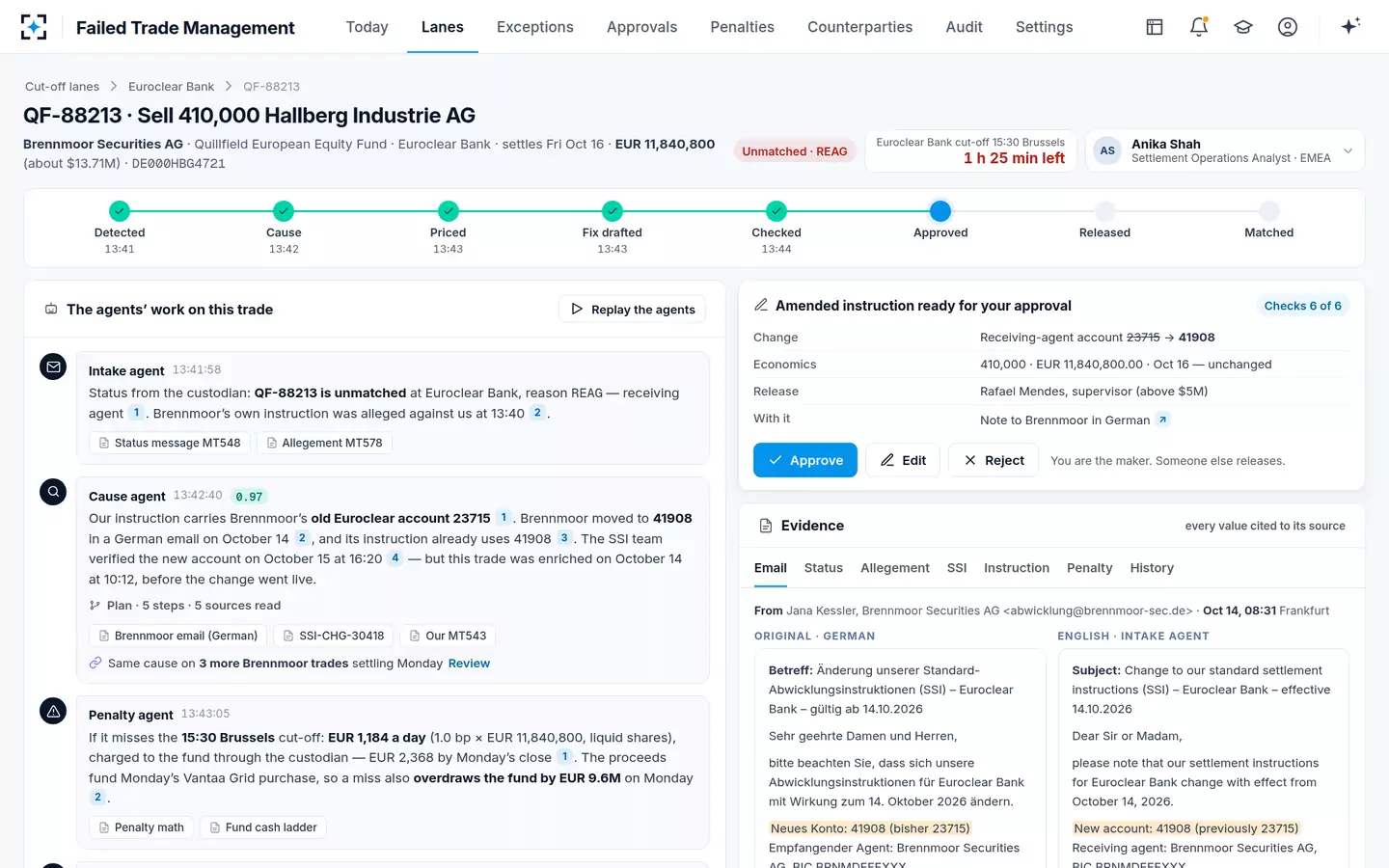
The Chaser agent drafted a cancel-and-replace of the instruction, changing only the receiving-agent account, and a note to Brennmoor in German. The Checker agent re-checked the fix six ways before a person saw it. The analyst approved at 14:05, the supervisor released at 14:07 because the trade was above $5 million, and the status came back matched at 14:31, 59 minutes before the cut-off. The Cause agent then found three more Brennmoor trades due on Monday with the same old account. The agents never send an instruction, edit a standing settlement instruction or accept a partial delivery; people do. One trade is followed minute by minute, with every logged step, in AI in trade settlement: one exception traced from status to fix.
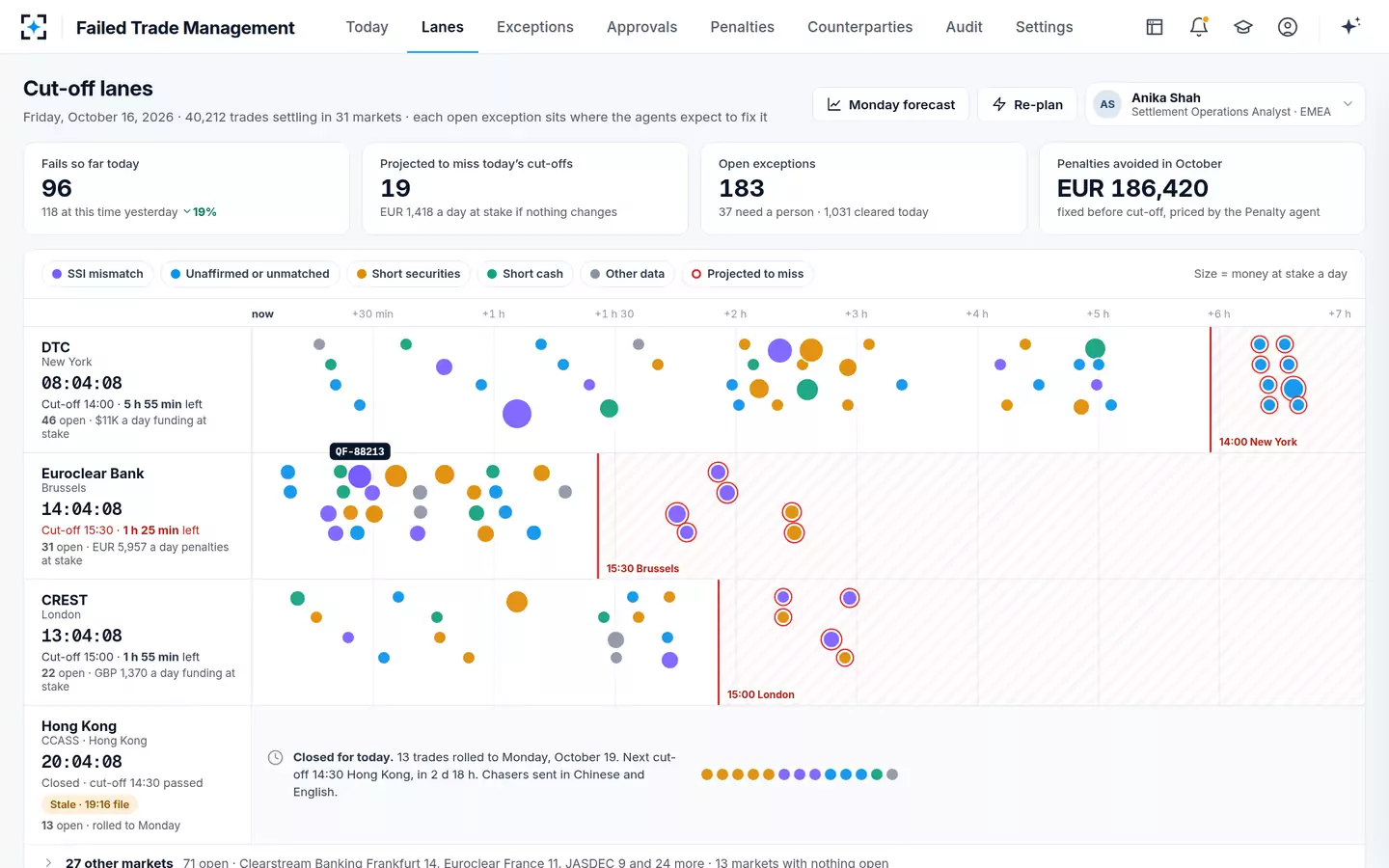
Every failing trade on its own market's clock
Questions people ask
What happens if settlement fails?
The trade stays open and is recycled into the next settlement cycle until it settles or both sides cancel it. In the EU the failing participant is charged a cash penalty for each business day of the fail, and in the US a clearing participant must close out an equity fail to deliver by the next morning's market open. The fund on the other side may be left without the cash or securities it planned to use.
What does T+1 mean for failed trades?
T+1 means a trade settles one business day after it is agreed, so allocations, confirmations and settlement instructions must be complete on trade date. The US moved on May 28, 2024; the EU moves on 11 October 2027, and the UK government has committed to the same date. A fix that used to have a day to land now has an evening, which is why fail prevention moves to trade date.
Are failed trades penalised in the US like in Europe?
Not for equities. The US relies on Regulation SHO's close-out deadline and the restrictions that follow a missed close-out, not on a daily cash charge. US Treasuries have a market practice instead: the Treasury Market Practices Group fails charge, introduced in May 2009 at 3 percent a year minus the federal funds target rate, with a floor of zero (FRBNY Economic Policy Review, 2010).
How long can a trade stay failed?
As long as it remains unsettled and uncancelled; there is no fixed limit in EU law. T2S currently recycles matched instructions for 60 working days and cancels unmatched ones after 20. Of all the failing value T2S counted in March 2024, 72% was failing on its intended settlement date itself and 8% belonged to trades more than ten business days late, according to data ESMA obtained from the T2S operator.
Is a failed trade the same as a trade error?
No. A trade error is a mistake in the trade itself, such as the wrong quantity, account or security; a failed trade may be perfectly correct and still not settle because a delivery or payment did not happen. The two meet when an error in the booking or allocation causes the fail, which is how a trade error often first shows up.
How common are failed trades?
In the EU, 7.14% of settlement instructions failed on average each month between March 2023 and February 2024, according to ESMA, and exchange-traded funds failed far more often: 17.32% of ETF instructions by volume over June 2023 to May 2024. Fail rates are measured differently in each jurisdiction, so ESMA itself warns that comparisons across markets are very difficult.