AI for failed trades can be live on a fund manager's main European markets before the EU moves to T+1 on 11 October 2027, the date the UK has also committed to, if the plan is worked backwards from the dates that cannot move: the EU's 23:00 CET deadline for allocations and confirmations from 7 December 2026, its fail-reason reporting from 1 July 2027, and T+1 itself. In practice that means connecting custodian feeds and settlement mailboxes and testing on past fails before the end of 2026, a parallel run on one market in early 2027, live operation there by spring, every market switched over by late summer with its T+1 cut-offs set, and a period of close watching after T+1 day. Botminds' Failed Trade Management fits that plan because its agents only draft and check: the people and the release rules a desk already has stay in place, so going live is a change in who does the reading, not in who decides.
The regulatory dates are quoted from EU law and the UK government's documents; the phases, durations and sign-offs are our plan, offered as a starting point. Product examples come from the solution's fictional sample firm, Quillfield Capital.
Six phases, worked back from the EU and UK dates
- T+2
- 23:00 CET allocations (EU)from 7 Dec 2026
- Fail reasons reported (EU)from 1 Jul 2027
- T+1 (EU and UK)from 11 Oct 2027
- 1 Connect and testNov–Dec 2026
- 2 Parallel run, one marketJan–Mar 2027
- 3 Live, first marketApr–Jun 2027
- 4 All marketsJul–Aug 2027
- 5 Rehearse
- 6 After T+1Oct–Dec 2027
How long does it take to put AI on settlement fails?
For a fund manager with several custodians and markets, our plan above takes about eleven months from connection to T+1 day, with the first market live in about five. The long poles are not the agents. They are getting every custodian's status messages and the settlement mailboxes connected, agreeing the release rules and cut-off calendar as settings, and running long enough in parallel to trust the result. The US move to T+1 is a useful scale for a regulated deadline: "The process from final rule adoption to smooth implementation of T+1 in the U.S. was 15 months," the SEC chair said afterwards (Gensler, June 20, 2024).
Two things shorten it. The solution sends nothing on its own, so a desk can start with the agents drafting in parallel while people work as before, and switch over market by market without a big-bang day. And its rules are settings, not code: a release threshold, a confidence floor or a market's cut-off changes with a second administrator's approval, so adapting to a CSD's new T+1 timetable does not need a release.
Work backwards from 11 October 2027
Start from the last date and ask what must be true the day before. On 11 October 2027 the EU's settlement cycle becomes one business day (Regulation (EU) 2025/2075); CSDs must ask for settlement instructions "where feasible by 23:59 CET" on trade date and offer automatic partial settlement (Delegated Regulation (EU) 2026/1536); and the UK plans the same cycle, with the industry asking for instructions at the CSD by 05:59 UK time on T+1 (UK Technical Group, SETT 02; HM Treasury). Every market's cut-offs must be set and tested for that day before it arrives.
Earlier dates set the earlier phases. From 7 December 2026 the 23:00 CET allocation deadline applies to professional clients while the cycle is still two days, so trade-date status monitoring is useful from then. From 1 July 2027 CSDs record a reason for every fail and require their top failing participants to report the main reasons monthly, so a fund should be able to explain its own fails by cause by then. And the UK's Technical Group expects firms to plan readiness testing "if necessary, from January 2027". Every date and what it asks is set out in T+1 settlement in Europe.
The six phases, and what each must prove
Each phase of the go-live, what it delivers and how you know it is done
| Phase | What happens | Done when |
|---|---|---|
| 1 · Connect and test (Nov–Dec 2026) | Connect custodian status feeds, settlement mailboxes, the SSI master read-only, portfolio accounting and penalty reports; load cut-off calendars and release rules as settings; run a seeded test on a past month. | Seeded test passed against marks agreed in advance; all feeds arriving |
| 2 · Parallel run, one market (Jan–Mar 2027) | Agents link, explain, price and draft on live traffic for the first market; people work the old way; daily comparison of causes and fixes. | Agreement with the desk's own outcomes at the agreed rate for six weeks running |
| 3 · Live, first market (Apr–Jun 2027) | Analysts approve the agents' drafts; second analyst or supervisor releases; penalty reconciliation run through the solution for the first month-end. | One full month-end reconciled; escalations and overrides reviewed |
| 4 · All markets (Jul–Aug 2027) | Remaining EU and UK markets, then others, one or two at a time; fail reasons by cause ready for custodians' questions under the July 2027 rules. | Every market live, with its cut-off and holiday calendar |
| 5 · T+1 settings and rehearsal (Sep–10 Oct 2027) | T+1 cut-offs loaded as pending settings; trade-date evening coverage staffed; rehearsal on a replayed day with T+1 timings. | Settings approved by a second administrator, effective 11 October |
| 6 · After T+1 (Oct–Dec 2027) | Daily review of fails, penalties and escalations; thresholds tuned; counterparty reviews from the scorecards. | Fail rate and penalties back to, or below, the pre-T+1 baseline |
What data does AI for failed trades need from custodians?
Every message the desk reads today, as it arrives, plus the reference data the desk checks against. The custodian feeds are the backbone: settlement status, allegements and penalty reports, in ISO 15022 or ISO 20022. Where a CSD settles on the Eurosystem's T2S platform, it reports in ISO 20022 only and conversion to MT messages "remains therefore under the responsibility of the T2S Actors" (ECB, T2S User Detailed Functional Specifications), so each custodian's message format has to be checked, not assumed.
The feeds Failed Trade Management reads, and why each matters
| Source | What it provides | Why the agents need it |
|---|---|---|
| Order management system | Trades and allocations (about 40,000 settling a day in the sample) | The trade every message is linked to |
| Global custodian and SWIFT gateway | Status (MT548 or sese.024), allegements (MT578 or sese.028), pending and penalty statements; instructions out only after release | Status and reason codes, and the only route for a released fix |
| Central matching and affirmation | Affirmation status and confirmations against the 9 p.m. ET cut-off | US trade-date affirmation chasing |
| Portfolio accounting and fund administrator | Positions, cash ladders, penalty and overdraft bookings by fund | Pricing what a miss costs, beyond the penalty |
| SSI master, CRM and sanctions screening | Verified standing instructions (read-only), contacts, screening | Checking every fix; never editing an SSI |
| Settlement mailboxes and documents | Counterparty emails and letters in any language, originals kept | Account changes and partial offers that never reach a status message |
The mailboxes are the feed most often left out and most often needed. In the sample, the cause of the failing sale was a counterparty's new account announced in a German email; no status message carried it.
Which markets go first?
The market where fails cost most and are least explained, using the firm's own numbers. Rank each market by fails a month, penalty exposure and analyst hours, and start where all three are high and the custodian feed is clean. For most European managers that points at an EU CSD rather than a non-penalty market, because penalties apply from the first failing day and ESMA records most respondents expecting efficiency to worsen "at least in the short term" after T+1 (ESMA, T+1 report, paragraph 138).
Avoid starting where the data is weakest. In the sample, the Hong Kong lane was marked stale because the sub-custodian's file was 24 minutes late; a market like that tests the feed, not the agents. Instrument mix matters too: a market heavy in exchange-traded funds, which fail far more often in the EU, gives a fast read on value.
How do you run old and new side by side?
Let the agents work in full on live traffic while the desk works as it does today, and compare every day. The agents link, explain, price and draft; nothing they draft is approved or released during the parallel run; people do the real fixes by hand. Each morning the supervisor compares the agents' causes and drafts with what the desk actually found and did, and logs every difference with a reason.
The comparison measures what a seeded test cannot: performance on this month's traffic, this month's counterparties and this month's custodian formats. It also tunes the thresholds, the confidence floors below which agents ask a person, before anyone depends on them. The seeded test that should come first is set out in AI for settlement exceptions: test it with seeded breaks first.
Who signs each phase of the go-live
Today
Owns fail rates and penalties for the COO and fund boards, from monthly spreadsheets.
With agents
Sets the scope and pass marks, decides each market's switch-over, signs the month-end penalty reconciliation.
Still theirs: The go-live decision, market by market
Today
Releases large amendments, partials and shapes, rebuilding each case by hand.
With agents
Proposes release thresholds and escalation times; runs the parallel run day to day; releases by rule.
Still theirs: Release authority above the threshold
Today
Guards the SSI master against emailed changes.
With agents
Confirms the agents get read-only access and that every SSI change still goes through call-back and a second approver.
Still theirs: Every change to standing settlement instructions
Today
Reviews controls after the event.
With agents
Reviews the seeded test, the thresholds and the monthly override report before and after go-live.
Still theirs: Sign-off on the test and on threshold changes
Today
Maintains custodian feeds and the SWIFT gateway.
With agents
Connects feeds and mailboxes, confirms the gateway sends only released instructions, and where records are kept.
Still theirs: Access, data residency and the gateway
What does the second approver see?
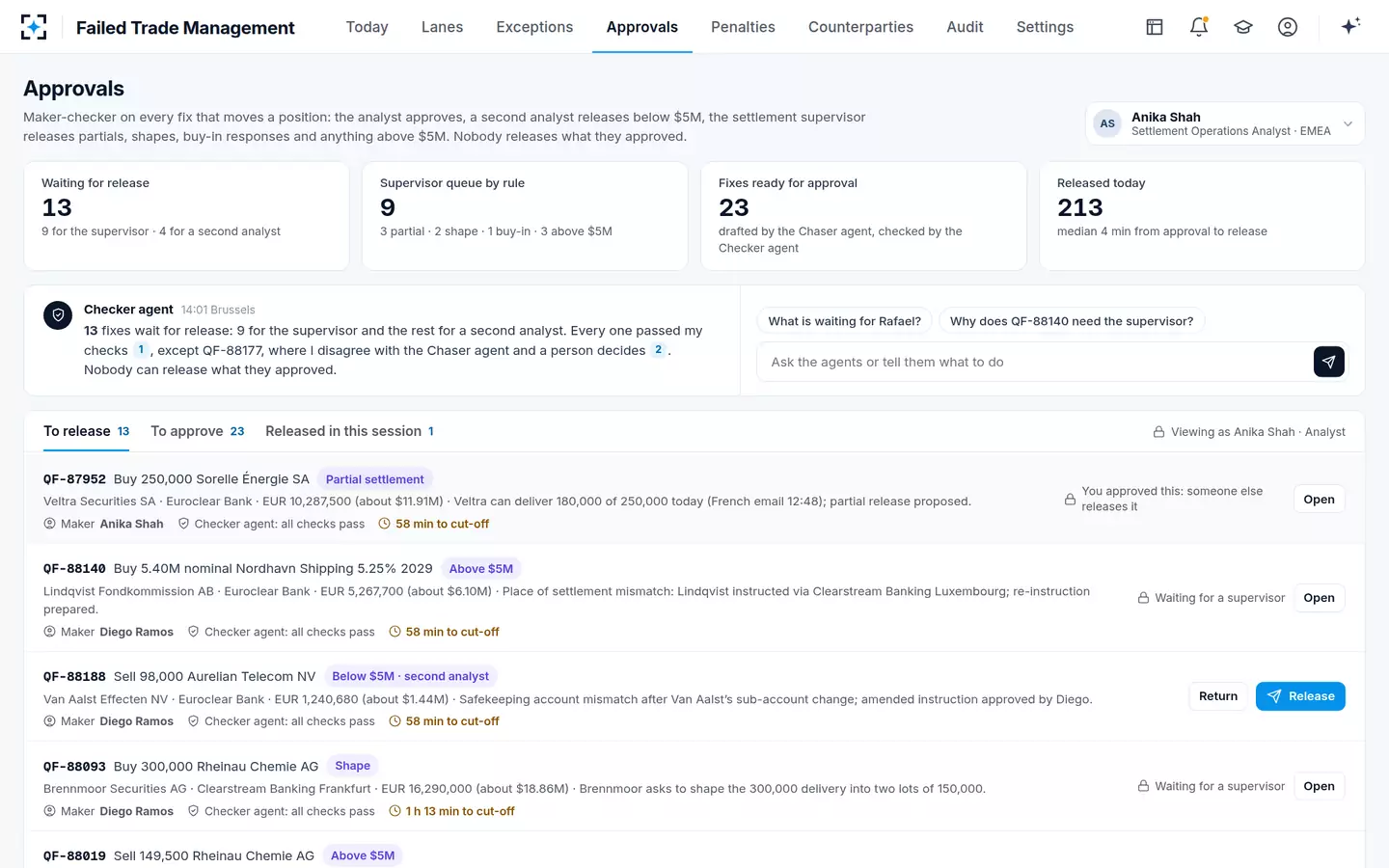
The case already assembled: the rule that sent the fix to them, the second agent's check, the evidence and who approved it. In the sample, the supervisor's queue sorts each item by the rule that routed it, three partials, two shapes, one buy-in response and three above $5 million, and shows "You approved this: someone else releases it" on any item its viewer approved. The median time from approval to release that day was four minutes.
The release queue a supervisor works after go-live
How do you measure the result?
Against a baseline taken before phase 2, with the same definitions the CSDs use, per market. The most important measures are outcomes, not activity: fails by number and by value, penalties charged and avoided, credits recovered, and the share of exceptions fixed before the market's cut-off. Activity measures, messages linked, drafts produced, explain how the outcomes moved.
What a year of AI on failed trades is worth, term by term
Penalties avoided
Fails fixed before cut-off × daily penalty priced at the time
Priced with the rate table in force each day; in the sample, EUR 187,604 avoided by mid-October.
Penalty agent, signed off monthly
Credits recovered
Penalty credits owed to funds − credits passed on
In the sample, EUR 4,630 held by two brokers in October.
Head of trade support
Funding cost avoided
Overdrafts and failed onward purchases avoided × days × funding rate
Often larger than the penalty: one sample sale would have overdrawn a fund by EUR 9.6 million.
Treasury and portfolio accounting
Analyst time
Analyst-days on exceptions before − after
The solution's own estimate for a six-analyst desk is 5.0 analyst-days a day by hand, 1.3 with the agents; measure your own.
Settlement supervisor
Be careful with the fail rate in the months around T+1: it may rise for reasons no system controls, as respondents told ESMA they expected. Compare each market with its own pre-T+1 baseline and with the CSD's published efficiency for the same period, so the agents are judged on what they could affect.
Before you sign: what to have in writing from the go-live plan
- The fixed dates and the phase each one drives
7 December 2026, 1 July 2027, 11 October 2027, with the UK date marked as depending on Parliament.
- Pass marks for the seeded test and the parallel run
Agreed before either starts, per exception type.
- The order of markets and the reason for it
From your own fail counts, penalty exposure and analyst hours.
- Release rules and thresholds as settings
Each with an owner and a second approver; no agent can send, edit an SSI or accept a partial.
- The baseline and the measures
Fails by number and value per market, penalties, credits, fixes before cut-off.
- Records and residency
Where the audit trail lives, how long, and how evidence for a trade or a period is exported.
After go-live: the counterparty evidence a service review needs
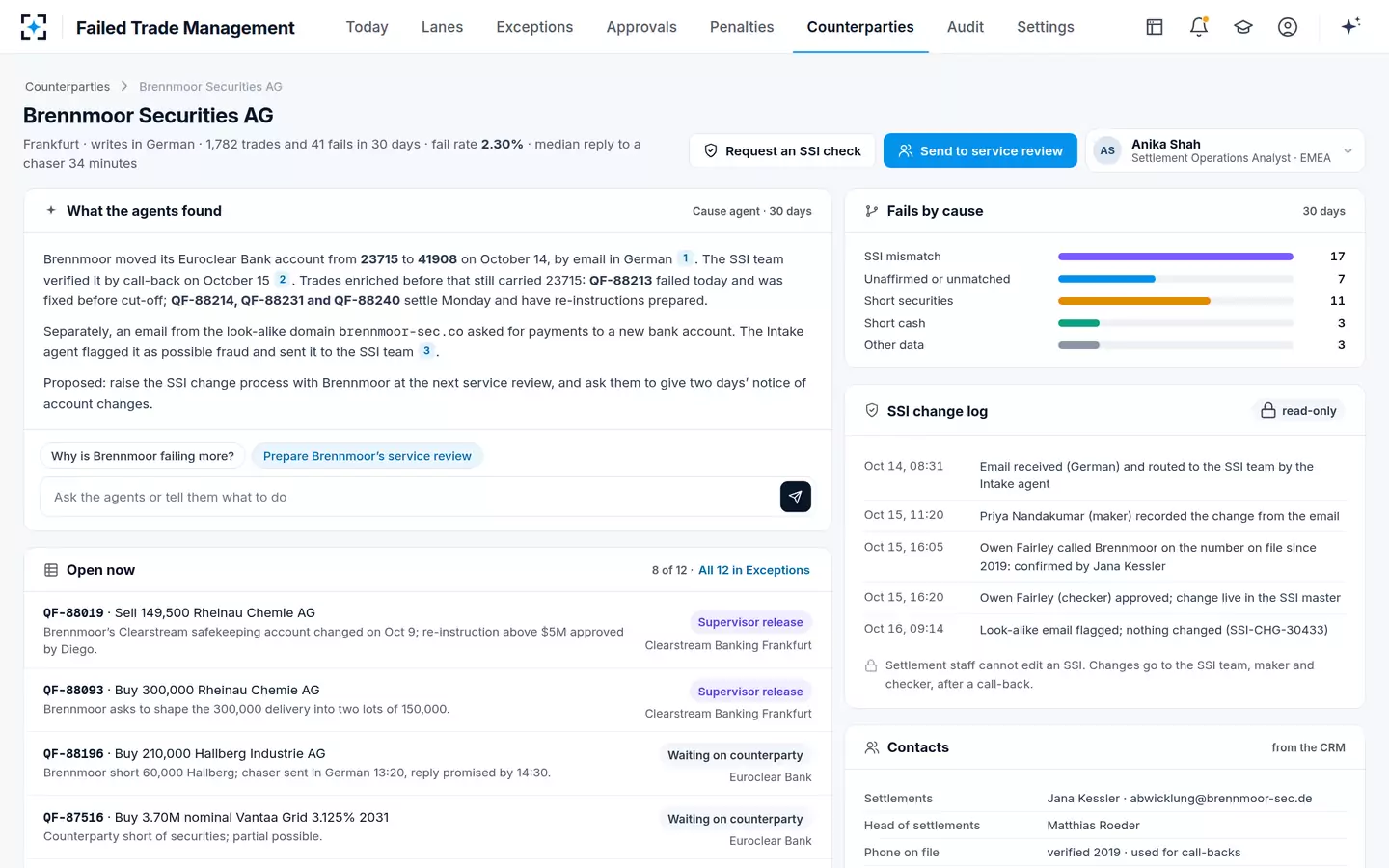
The plan's last phase is where most of the lasting value is: each cause found and fixed once, at its source, instead of every day on a new trade. What that looks like for one trade, minute by minute, is traced in AI in trade settlement: one exception traced from status to fix.
Questions people ask
What must be in place before 7 December 2026?
For the EU rule itself, professional clients' allocations and confirmations must reach their brokers by 23:00 CET on trade date in a structured electronic format, with the new fields including place of settlement. For the go-live plan, custodian feeds and mailboxes should be connected and the seeded test run, so trade-date status monitoring is available as the new deadline starts.
Is it too late to start after T+1?
No, but it is more expensive. Starting after 11 October 2027 means learning the agents and the new cycle at the same time, when ESMA's respondents expect efficiency to dip. A parallel run on one market before T+1 gives a baseline and a tested configuration to switch on when it matters.
Do we need to change custodians or our SWIFT set-up?
No. The solution reads the messages custodians already send and the mailboxes the desk already uses, and sends released instructions through the existing gateway. What may need work is getting each custodian's feed delivered in a form that can be read automatically rather than only in a portal.
Who is accountable for a fix the agents drafted?
The analyst who approved it and the person who released it, exactly as today. The agents draft and check; every approval carries a reason and every release a second person, recorded on a chained audit trail. Accountability does not move to the software.
Can we go live in the UK before the T+1 instrument is law?
Yes. Fails, funding costs and cut-offs exist on today's two-day cycle, and the agents work on it as well as on T+1. The UK date only decides when the T+1 cut-off settings take effect, and those can be prepared as pending settings to switch on when the instrument comes into force.