A fail to deliver is a securities sale whose seller has not delivered the securities by the settlement date, and in US equities the term usually means the position recorded at the clearing agency when a clearing member does not deliver. The SEC publishes these fails to deliver twice a month for every equity security with a balance in the National Securities Clearing Corporation's continuous net settlement system: the date, CUSIP, ticker, issuer, price and the aggregate net number of shares that failed. It is a useful public signal of which securities are hard to deliver, and it is easy to misread, because it counts balances, not trades, and the SEC states that the age of fails cannot be read from it. Regulation SHO's Rule 204 then gives a clearing participant until the next morning's market open to close out most equity fails. Botminds' Failed Trade Management works the other end of the problem: a fund's own fails, trade by trade, with each counterparty's history, so a fail is predicted and chased on trade date instead of found in a public file two weeks later.
The analysis below is ours, from the SEC's own file for the second half of September 2026, the latest the SEC had published at the end of October 2026; examples of the solution come from its fictional sample firm, Quillfield Capital.
Fails to deliver by value, each settlement day of late September 2026
What does fail to deliver mean?
A fail to deliver is the seller's side of a failed trade: securities sold and not delivered by the settlement date. The buyer's side of the same trade is a fail to receive. For most US securities trades the settlement date is now the first business day after the trade, under the SEC's T+1 rule (Rule 15c6-1), so a sale on Monday that has not delivered by the end of Tuesday's settlement is a fail to deliver.
In US equities the fail that regulators count sits at the clearing agency, not at the fund. A fund's broker or custodian is the clearing participant; its fail to deliver at the National Securities Clearing Corporation (NSCC) is a net position across all its clients' trades in that security. That is why a fund manager rarely sees "its" fail in the public data, and why the close-out duty falls on the broker. How a failed trade looks from the fund's side, and how the EU and UK treat it, is explained in What is a failed trade?
Where can I find fails-to-deliver data?
On the SEC's Fails-to-Deliver Data page, which publishes "the date, CUSIP numbers, ticker symbols, issuer name, price, and total number of fails-to-deliver" for equity securities in NSCC's continuous net settlement system (SEC, Fails-to-Deliver Data). Each month comes in two files, one for each half of the month, posted roughly two weeks after the period ends; the file for the second half of September 2026 was the latest on 28 October 2026. Each file is a pipe-delimited text file with one row per security per settlement date.
One half-month of SEC fails-to-deliver data, counted
13,397
securities with a fails balance on at least one of 12 settlement dates, 15–30 September 2026
435
securities with a balance on every one of the 12 days
10 of 10
largest balances by average daily value were exchange-traded funds
49%
of rows were balances under 1,000 shares
What one half-month of the file shows
Three things stand out. First, fails are concentrated: the ten securities with the largest average daily value, all exchange-traded funds, made up more than a third of the half-month's value, and the top 100 almost two thirds. Second, most rows are small: half of all balances were under 1,000 shares. Third, a hard core persists. Of 13,397 securities that appeared at least once, 435 had a balance on every settlement day of the period.
The prominence of ETFs is not peculiar to the US. In the EU, ESMA reports that "17,32% of the monthly total volume of ETF settlement instructions at EEA level failed between June 2023 and May 2024, representing 19,27% of the value" (ESMA, T+1 assessment report, footnote 51), and its penalty review describes ETFs as needing longer to settle "due to their intrinsic characteristics" (ESMA, 2024). A fund that sells or lends ETFs should expect the deliveries it relies on to be the ones most likely to fail.
The single-day spike on 21 September, more than twice the half-month's average, is the kind of number that invites a story. The file cannot support one: it does not say which participants failed, why, or whether the same balance was carried from the previous day.
Do fails to deliver mean naked short selling?
No, not on their own. The SEC says plainly that fails "are not necessarily the result of short selling", and the file does not distinguish long sales from short sales (SEC, Fails-to-Deliver Data). A long seller whose shares are on loan and not recalled in time fails to deliver; so does a seller waiting on its own purchase. The Federal Reserve Bank of New York's research on fails names operational disruptions, miscommunication and "daisy chain" cascades as ordinary causes, alongside sellers' insufficient incentive to borrow (Fleming and Garbade, FRBNY, 2005).
A persistent balance in a security is a signal worth investigating, not a finding. It says the security is hard to deliver; it does not say who is at fault, and it cannot be traced to any trade.
What the SEC's fails-to-deliver file contains, and what it does not
What the file gives you: The aggregate net balance of shares that failed to be delivered, per security, per settlement date.
What it cannot tell you: The number of failed trades, or the size of any one trade.
What the file gives you: All NSCC continuous net settlement participants together.
What it cannot tell you: Which broker failed, or for which client.
What the file gives you: Whether a security had a balance on a given day.
What it cannot tell you: How old any fail is: "the age of fails cannot be determined by looking at these numbers".
What the file gives you: Nothing about the cause.
What it cannot tell you: Whether the fail came from a short sale, a long sale, a loan recall or an operational error.
What the file gives you: Equity securities in NSCC's continuous net settlement system.
What it cannot tell you: Trades settled outside it, bonds, or fails in other markets.
What the file gives you: Data as reported by NSCC to the SEC.
What it cannot tell you: A guarantee: the SEC says it does not guarantee the data's accuracy.
What is Reg SHO Rule 204?
Rule 204 of Regulation SHO is the US close-out requirement for equity fails. A participant of a registered clearing agency with a fail to deliver in any equity security, from a long or a short sale, must "by no later than the beginning of regular trading hours on the settlement day following the settlement date, immediately close out its fail to deliver position by borrowing or purchasing securities of like kind and quantity" (17 CFR 242.204(a)). Under T+1 that means a short sale traded on Monday, failing on Tuesday, must be closed out before Wednesday's open.
The rule gives longer for fails a seller did not create by selling short. If the participant can show on its books that the fail came from a long sale, or from bona fide market making, it has until the beginning of regular trading hours on the third consecutive settlement day after the settlement date. For securities sold by someone deemed to own them and waiting for restrictions on delivery to be removed, the limit is the 35th calendar day after the trade date, and the close-out must be a purchase.
How long can a fail last before close-out?
Under Rule 204, one settlement day for most short sales and three for long sales and market making, measured from the settlement date to the next market open; after that, the participant is restricted. A participant that misses the deadline, and any broker clearing through it, "may not accept a short sale order in the equity security from another person, or effect a short sale in the equity security for its own account" without first borrowing or arranging to borrow, until the fail is closed out by a purchase that has cleared and settled (Rule 204(b)).
Regulation SHO Rule 204 close-out deadlines, counted under T+1
| Type of fail | Close out by | Trade Monday, settlement Tuesday: deadline | How |
|---|---|---|---|
| Short sale | Beginning of regular trading hours on the settlement day after the settlement date | Wednesday, before the open | Borrow or purchase |
| Long sale, shown on the books | Beginning of regular trading hours on the third consecutive settlement day after the settlement date | That Friday, before the open | Purchase or borrow |
| Bona fide market making | Same as a long sale | That Friday, before the open | Purchase or borrow |
| Sale of securities deemed owned, awaiting removal of delivery restrictions | Beginning of regular trading hours on the 35th consecutive calendar day after the trade date | Five weeks after the trade | Purchase only |
| Any of the above, not closed out in time | Pre-borrow requirement until a closing purchase clears and settles | Until then | Borrow before any short sale |
Rule 204 is a deadline, not a price. The EU charges a cash penalty for every business day a trade stays failed, while the US puts the pressure on the clearing participant to buy or borrow; the two regimes reward different fixes, as CSDR penalties calculation shows for the EU side.
Can a fund check its own fails against the public data?
Only indirectly. The file cannot show a fund its own fails, because they are netted into its brokers' positions, and it is published two weeks after the period. What it can do is warn. A security that has carried a fails balance every day for weeks is one where deliveries to the fund, and recalls of shares the fund has lent, are likely to be late. Used that way, the file belongs in the morning check of tomorrow's settlements, beside the fund's own history.
Using the SEC's fails-to-deliver file on a fund's settlement desk
- Load each half-month file when it is posted
Keep the history: persistence across files says more than any single day.
- Flag securities with a balance on most settlement days
In the late September 2026 file, 435 securities had a balance on all 12 days.
- Match them to tomorrow's receipts and to lent positions
A purchase or loan recall in a persistent name is the delivery most likely to arrive late; a sale that depends on it is next.
- Check ETFs first
Exchange-traded funds dominated the largest balances by value, and fail often in the EU too.
- Never read the file as evidence about a counterparty
It does not identify participants or causes; use your own status history for that.
- Compare with your own fail record, not instead of it
Your custodians' status messages are the only trade-level source of your fails.
Where Failed Trade Management fits
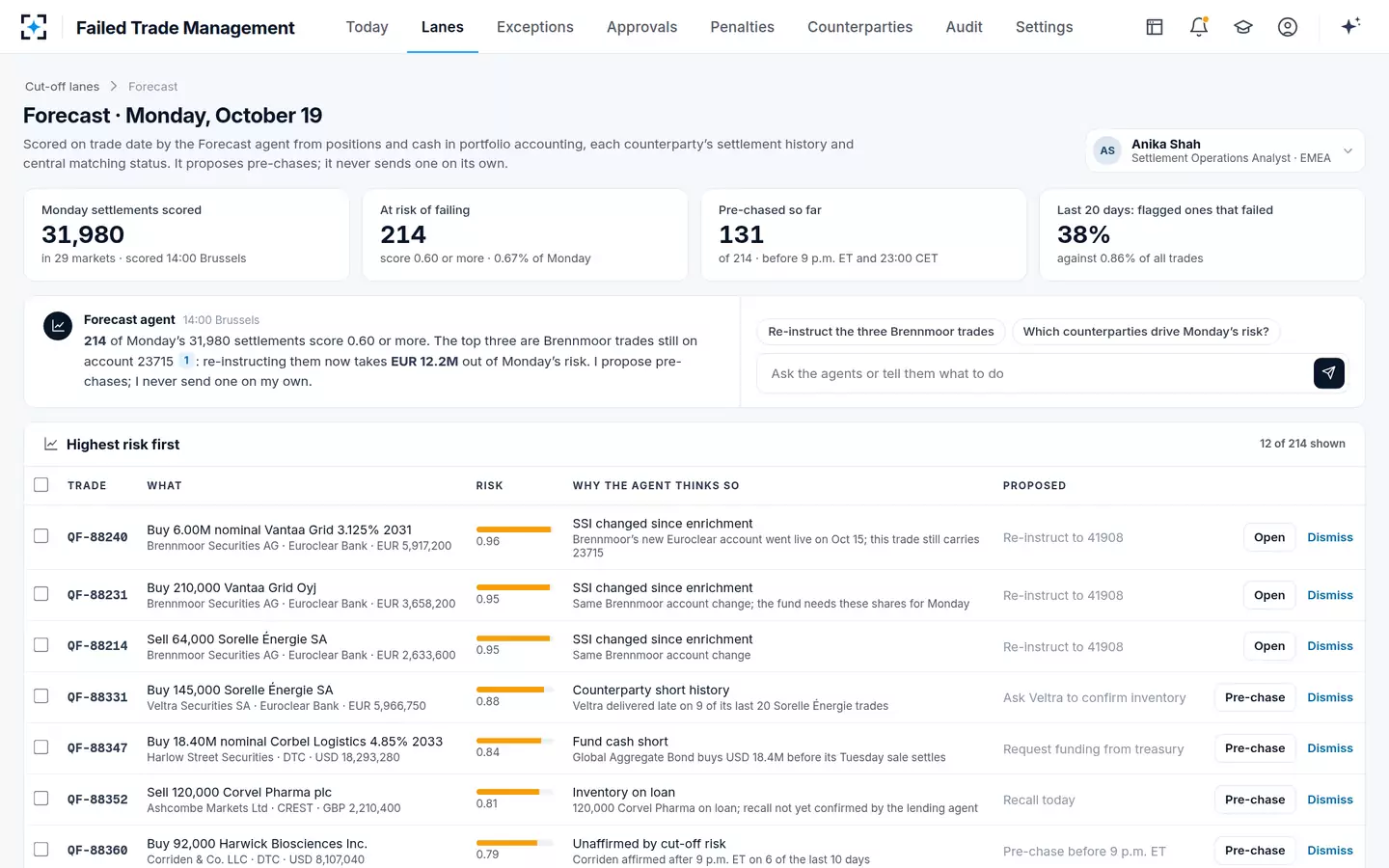
Failed Trade Management works from the trade-level sources the public file lacks: every status message and allegement from the fund's custodians, each counterparty's settlement history, positions and loans from portfolio accounting, and the standing settlement instruction change log. Its Forecast agent scores tomorrow's settlements on trade date and says why each is at risk. In the sample, the reasons on its highest-risk list included a counterparty that "delivered late on 9 of its last 20" trades in one security, shares on loan with the recall not yet confirmed, and a fund short of cash for a purchase.
A counterparty's fails, causes and open trades, from the fund's own records
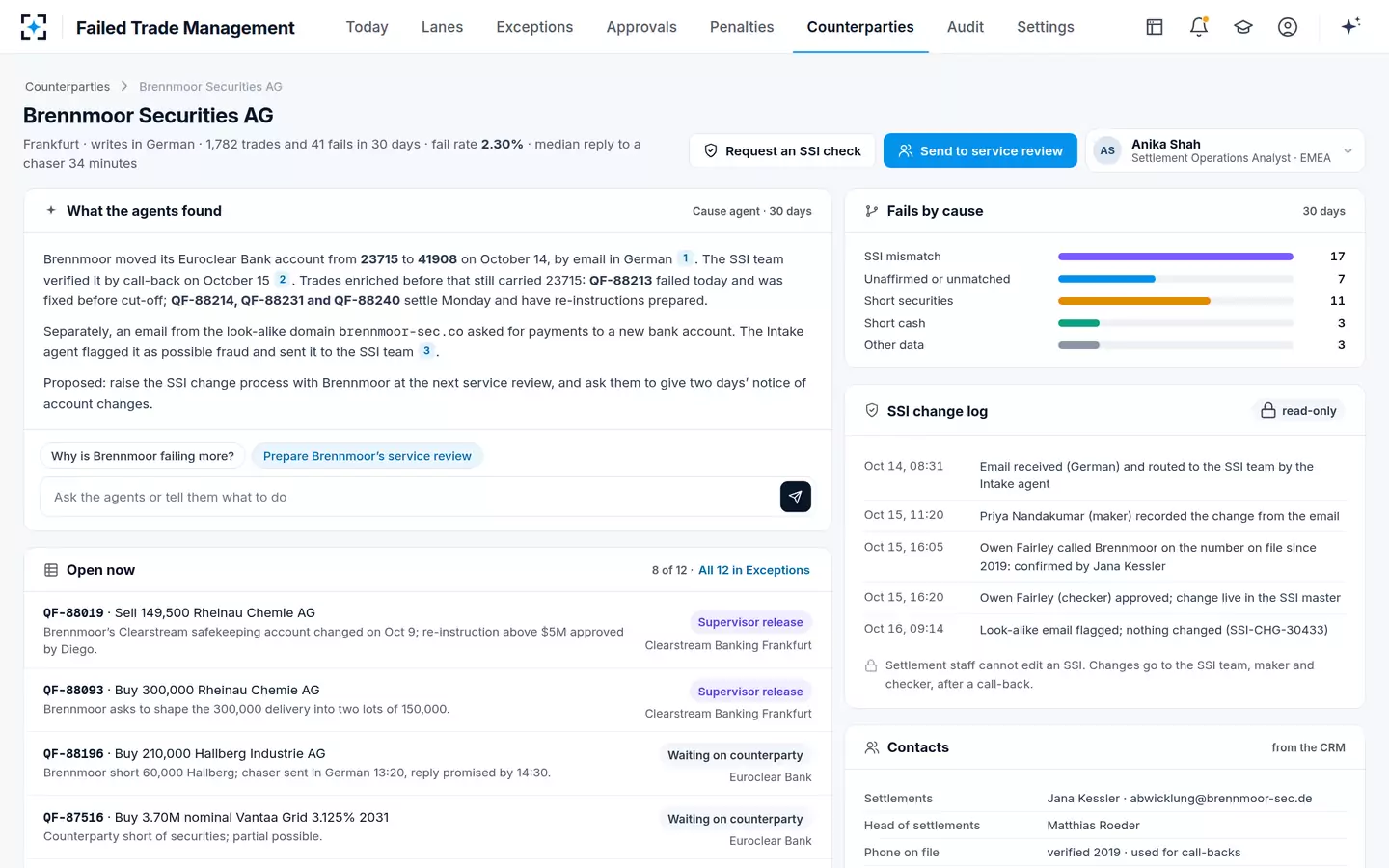
The agents propose; people act. The Forecast agent "never sends a chaser on its own", and every re-instruction it prepares goes through an analyst's approval and a second person's release. When the cause is a stale account rather than a shortage, as with the counterparty above, the fix belongs with the SSI team, and the reason codes that separate the two are explained in MT548 reason codes.
Tomorrow's settlements scored for fail risk, with the reason for each
Questions people ask
How often does the SEC publish fails-to-deliver data?
Twice a month, one file for each half of the month, usually about two weeks after the half-month ends; the SEC does not promise a date. Each file lists, per settlement date and security, the CUSIP, ticker, issuer, price and aggregate net shares failed. Before 16 September 2008 the data covered only securities with at least 10,000 shares in fails.
Is a fail to deliver illegal?
No. A fail is a settlement event, and many have ordinary operational causes. What US rules require is the close-out: under Regulation SHO Rule 204 a clearing participant must close out an equity fail to deliver by the next settlement day's market open, or three settlement days for long sales and market making, and faces a pre-borrow requirement if it does not.
Does the fails-to-deliver file cover bonds?
No. It covers equity securities in NSCC's continuous net settlement system. US Treasury fails are tracked separately and are subject to a market-practice fails charge, which the Treasury Market Practices Group introduced in 2009 when near-zero interest rates removed the incentive to deliver on time.
Why are ETFs so prominent in fails data?
In the late September 2026 file, the ten largest balances by value were all exchange-traded funds. ESMA records the same pattern in the EU, with 17.32% of ETF settlement instructions failing by volume, and notes ETFs can need longer to settle because of how they are created and traded across markets. Neither source assigns a single cause.
Can a fund be named in the SEC's fails data?
No. The file aggregates all NSCC participants' net fails by security and names no firm. A fund's fails are netted inside its brokers' and custodians' positions; the fund's only record of its own fails is the status reporting from those custodians.