T+1 settlement in Europe begins on Monday 11 October 2027: from that day most trades in shares and bonds executed on EU trading venues must settle no later than one business day after the trade, under Regulation (EU) 2025/2075, and the UK government plans the same date for UK venues through a draft statutory instrument it has committed to lay before Parliament. The settlement cycle is the last change, not the first. The EU's amended settlement discipline rules start on 7 December 2026 with a 23:00 CET trade-date deadline for allocations and confirmations, more rules follow on 1 July 2027, and the UK's industry plan asks firms to finish most of their changes by 31 December 2026. For a fund's settlement team, every one of those dates moves work onto trade date, where a fail is cheapest to prevent. Botminds' Failed Trade Management is built for that day: its agents read each status and counterparty message as it arrives, plan each market's work backwards from its own cut-off, and draft fixes that two people approve and release.
Every date below is quoted from the EU regulations, HM Treasury's documents and the UK Accelerated Settlement Technical Group's report. Examples come from the solution's fictional sample firm, Quillfield Capital.
Europe's T+1 is three timetables, and two of them start in 2026
- T+2 continuesto 10 Oct 2027
- T+1
- Prepare
- 23:00 CET allocations, machine-readable, PSETfrom 7 Dec 2026
- Fail reasons and reportingfrom 1 Jul 2027
- T+1
- Most actions dueto 31 Dec 2026
- Testing and the remaining actions2027
- T+1
When is T+1 in Europe? 11 October 2027, in the EU and the UK
The EU's date is fixed in law. Regulation (EU) 2025/2075 of 8 October 2025 amends the settlement cycle in the Central Securities Depositories Regulation "to no later than one business day after the trading takes place", and its Article 2 says plainly: "It shall apply from 11 October 2027." (Regulation (EU) 2025/2075). The date was ESMA's recommendation, chosen to avoid both the end of a quarter and the busy last weeks of the year (ESMA, T+1 assessment report, November 2024).
The scope stays where T+2 was: transferable securities executed on trading venues, with the existing exceptions for privately negotiated and bilaterally executed trades. Securities financing transactions documented as single transactions of two linked operations are exempt, and the regulation tells ESMA to watch settlement efficiency "with increased frequency" in the months before and after the switch. It also lets the Commission temporarily adjust the penalty parameters if the move threatens "a material increase in settlement fails".
Is UK T+1 law yet? Not until Parliament approves the instrument
No. The government "committed to legislate to mandate T+1 as the standard settlement period in the UK from 11 October 2027", published a draft statutory instrument in November 2025 for technical comments by 27 February 2026, and "intends to lay the final SI in advance of 11 October 2027" (HM Treasury, Accelerated Settlement (T+1), updated 20 November 2025). The draft, The Central Securities Depositories (Amendment) (Intended Settlement Date) Regulations 2026, needs the affirmative procedure: "it needs to be debated and approved by both Houses of Parliament before it can be made" (HM Treasury policy note).
The draft would change the UK regulation's words to "no later than the first business day after the day on which trading takes place", keep the existing exceptions, add an exemption for securities lending, repos and buy-sell-backs, and come into force on 11 October 2027. The FCA would enforce it for trading venues and CSD participants, the Bank of England for CCPs and CSDs, including CREST's operator. A plan that treats the UK date as certain is reasonable; a document that calls it law is not, yet.
Every EU and UK T+1 deadline between now and T+1 day
| Date | Where | What changes | Source |
|---|---|---|---|
| 7 December 2026 | EU | Professional clients' written allocations and confirmations reach the investment firm by 23:00 CET on trade date, in a structured electronic format, with new fields including the place of settlement (PSET); firms confirm receipt within two hours; retail clients' settlement information by 23:00 CET | Regulation 2026/1536, Art. 1(1)–(2), Art. 2 |
| 7 December 2026 | EU | Clients must keep the reference data needed to settle up to date well before settlement; new transaction-type taxonomy in settlement instructions | Regulation 2026/1536, Art. 1(1), 1(3)(a) |
| 31 December 2026 | UK (industry plan) | Allocations and confirmations by 23:59 UK time on trade date, electronically (SETT 01); policies and procedures (SETT 03); FMSB SSI standard (STAT 01); contract review (SETT 06); auto-partial, auto-shaping, PSET and hold-and-release practices used systematically (SETT 07–10) | Technical Group report, Feb 2025 |
| January 2027 | UK | Firms' plans should provide for readiness testing "if necessary, from January 2027" | Technical Group report, 1.6.5 |
| 1 July 2027 | EU | CSDs record the reason for each fail; top failing participants report main reasons and remediation monthly; place of trading (MIC) in instructions; new monthly fail reporting | Regulation 2026/1536, Art. 2 |
| 11 July 2027 | UK | CREST's operator publishes T+1-style monitoring data in parallel with T+2 (SETT 05) | Technical Group report |
| 11 October 2027 | EU | T+1 settlement cycle; settlement instructions to the CSD "where feasible by 23:59 CET" on trade date; every CSD offers auto-partial settlement (opt-out allowed), partial release, RTGS or at least three batches a day, and automated collateralisation | Regulation 2025/2075; 2026/1536, Art. 2 |
| 11 October 2027 | UK | T+1 (draft instrument scheduled to come into force); settlement instructions to the CSD by 05:59 UK time on T+1 (SETT 02) | Draft SI and policy note; Technical Group report |
What changes on 7 December 2026?
On 7 December 2026 the EU's amended settlement discipline rules start to apply, ten months before T+1, and the biggest change is the deadline for allocations. Today a professional client may send its allocation and confirmation to the broker by close of business on trade date, or by 12.00 CET the next business day if the time zones are more than two hours apart or the order was executed after 16.00 CET (Delegated Regulation (EU) 2018/1229, Article 2(2)). From 7 December there is one deadline for everyone: the investment firm must receive them "as soon as possible and by no later than 23:00 CET on the business day on which the transaction has taken place" (Delegated Regulation (EU) 2026/1536, Article 1(1)(b)).
Article 2 of the regulation is the place to check this: "It shall start to apply from 7 December 2026", followed by two lists of points deferred to 1 July 2027 and 11 October 2027. The allocation rule, point (1), is in neither list, so it applies from 7 December 2026 while the settlement cycle is still T+2. Firms get ten months of practice at trade-date allocation before the cycle itself shortens, which is the regulation's stated aim: rules shortening pre-settlement timeframes "should start to apply at an earlier stage so that market participants have sufficient time for testing".
The 23:00 CET allocation deadline, line by line
The 23:00 CET deadline is more than a time. The same article changes how allocations are sent and what they contain, and each change removes a cause of fails that firms reported to ESMA.
Allocations and confirmations in the EU: the rule until December 2026, and after
Until 6 December 2026: Close of business on trade date, or 12.00 CET on the next business day for distant time zones or orders executed after 16.00 CET.
From 7 December 2026: "As soon as possible and by no later than 23:00 CET" on trade date, for every professional client.
Until 6 December 2026: Firms must offer the option of sending them electronically through international open standards.
From 7 December 2026: An "electronic standardised communication method structured so that software applications can easily identify, recognise and extract specific data"; unstructured methods only during documented outages.
Until 6 December 2026: Includes the entity where securities and cash are held and the accounts to credit or debit.
From 7 December 2026: Adds the cash settlement amount, the delivering and receiving participants and the place of settlement (PSET).
Until 6 December 2026: No express duty on the client to keep it current.
From 7 December 2026: Firms must require clients to keep settlement reference data current far enough ahead of settlement, in a structured electronic format.
Until 6 December 2026: Firm confirms receipt within two hours.
From 7 December 2026: Unchanged: within two hours, or within an hour of next day's opening if received less than an hour before close.
The time zone is where the deadline bites. While Central European Time applies, 23:00 CET is 22:00 in London, 17:00 in New York and 07:00 the next morning in Tokyo. An Asian portfolio team allocating European trades after its own morning meeting would already be late. A US manager allocating European executions at the end of the New York day would be too. The regulation leaves no later fallback for distance, so the allocation process, not just its timing, has to be redesigned for the regions furthest east and west of Brussels.
The place of settlement field matters more than it looks. ESMA's respondents named place of settlement mismatches among the reasons instructions fail to match, and the regulation's recitals ask for the place of settlement to be passed on early in the process, not discovered at matching. In the sample, one exception on the supervisor's queue was exactly this: a broker instructed via Clearstream Banking Luxembourg while the fund's instruction said Euroclear Bank. How allocations themselves are checked and booked by the deadline is covered in Trade Error Management's guide to post-trade allocation under T+1.
When must settlement instructions reach the CSD?
In the EU, as soon as possible and where feasible by 23:59 CET on trade date, from 11 October 2027; in the UK, no later than 05:59 UK time on T+1 under the industry plan. The EU wording is a target the CSD must require, not a cliff: the regulation's recital says a later instruction is still processed and draws no cash penalty by itself, because penalties follow only from a fail (Regulation 2026/1536, recital 7; the full field list is in Standard Settlement Instruction Management's guide to what a settlement instruction is).
The UK version is tighter in practice. The Technical Group's SETT 02 asks for all instructions to the CSD "no later than 05.59 UK time on T+1", and notes that CREST's opening hours on trade date "will be extended to 21.00" so firms can instruct the same evening (Technical Group report, February 2025). The same report found how far the market had to go: "approximately 5% of UK equity trades (bilaterally agreed & non-cleared) are submitted early and accurately enough to allow settlement on T+1".
The UK market's starting point, and its target times
~5%
of bilaterally agreed, non-cleared UK equity trades instructed early and accurately enough for T+1 today
23:59
UK time on trade date: allocations and confirmations complete (SETT 01)
05:59
UK time on T+1: settlement instructions at the CSD (SETT 02)
21:00
CREST's planned trade-date closing for instruction input under T+1
Does the EU require auto-partial settlement?
Yes, from 11 October 2027. Every EU CSD must be able to settle part of a matched trade automatically, up to the securities the deliverer holds, with no manual step, and every matched instruction is eligible unless one side opts out (Regulation 2026/1536, Article 1(5); the arithmetic of a partial is in settlement efficiency). The same date removes the derogation that let settlement systems with low fail levels skip partial settlement and hold-and-release, and requires CSDs to offer real-time settlement or at least three batches a day.
The UK plan asks for the same behaviour a year earlier through practice rather than rules: auto partial and auto shaping "used systematically by all Market Participants for increased settlement efficiency", completed by 31 December 2026. Why a partial delivery is usually better for both sides, and when a fund should refuse one, is the subject of Settlement efficiency: why a partial delivery beats a failed trade.
What changes on 1 July 2027?
On 1 July 2027 the EU's new fail reporting starts, and it reaches beyond the CSD. CSDs must record "the reason for the settlement fail, based on the information directly available to the CSD, or communicated to it by its participants", and require their top failing participants "to report to them, on a monthly basis, the main reasons for settlement fails and the measures to address such settlement fails" (Regulation 2026/1536, Article 1(8)). Settlement instructions also carry the market identifier code of the venue where the trade was executed.
For a custodian ranked among a CSD's top failers, that monthly report will be built from its clients' fails. A fund that can explain its own fails by cause, with evidence, will be asked for that explanation; one that cannot will be told its cause by someone else. The reason codes those reports will start from are explained in MT548 reason codes.
The UK plan's deadlines for 31 December 2026
Many of the UK's 38 actions, 12 "critical" and 26 "highly recommended", fall due by the end of 2026, ten months before the switch. The checklist below gathers those that land on a buy-side settlement team, with the Technical Group's action numbers.
What a fund's settlement team needs done by 31 December 2026 for UK T+1
- Trade-date allocation and confirmation, electronic (SETT 01)
Complete no later than 23:59 UK time on trade date, "using a recognised industry standard and corresponding data dictionary".
- Written policies and procedures for the new deadlines (SETT 03)
Covering allocations, confirmations and settlement instructions, with the owners named.
- SSIs shared to the FMSB standard (STAT 01)
The Technical Group asks all participants to implement the Financial Markets Standards Board's core principles and templates for sharing standing settlement instructions.
- Contracts reviewed for T+1 timings (SETT 06)
Every bilateral agreement with counterparties and service providers, especially service-level deadlines.
- Partial, shaping, PSET and hold-and-release practices in use (SETT 07–10)
Agree with custodians and brokers which trades may be partialled or shaped, and how place of settlement is communicated.
- A testing plan for 2027
The report expects firms' plans to provide for readiness testing from January 2027 where needed.
Standing settlement instructions deserve their own plan, because a wrong or stale SSI is a fail waiting for a trade; that work is set out in what standard settlement instructions are, and who owns them.
What the US move to T+1 tells Europe
The US experience says trade-date affirmation can move fast once it is required, and that fails need not spike. The SEC's rule asks broker-dealers to complete allocation, confirmation and affirmation by the end of trade date or keep procedures designed to do so (SEC Rule 15c6-2). The SEC chair reported the same-day affirmation rate at 73% in January 2024 and "approximately 95 percent at 9 p.m. ET" the day after the switch, and that "fail rates stayed relatively flat" (Gensler, June 20, 2024). The process from final rule to go-live took 15 months.
Europe's market is harder to move: more CSDs, more currencies, more intermediaries in each chain. ESMA recorded that most respondents expected "a deterioration of settlement efficiency levels at least in the short term" after T+1, with some expecting a return to earlier levels later (ESMA, T+1 report, paragraph 138). Since cash penalties apply from the first failing day, a deterioration in the EU is a cost the US move did not carry.
Where Failed Trade Management fits the EU and UK timetable
Failed Trade Management is aimed at the trade-date window the new deadlines create. The Forecast agent scores tomorrow's settlements on trade date and proposes pre-chases; in the sample, it had pre-chased 131 of 214 at-risk trades "before 9 p.m. ET and 23:00 CET". The Cut-off agent holds each market's cut-off as a setting, in local time with its holiday calendar, so a change such as CREST's later trade-date close or a CSD's 23:59 CET target is a reviewed settings change, not a code release.
Monday's settlements scored on Friday: the trade-date work T+1 asks for
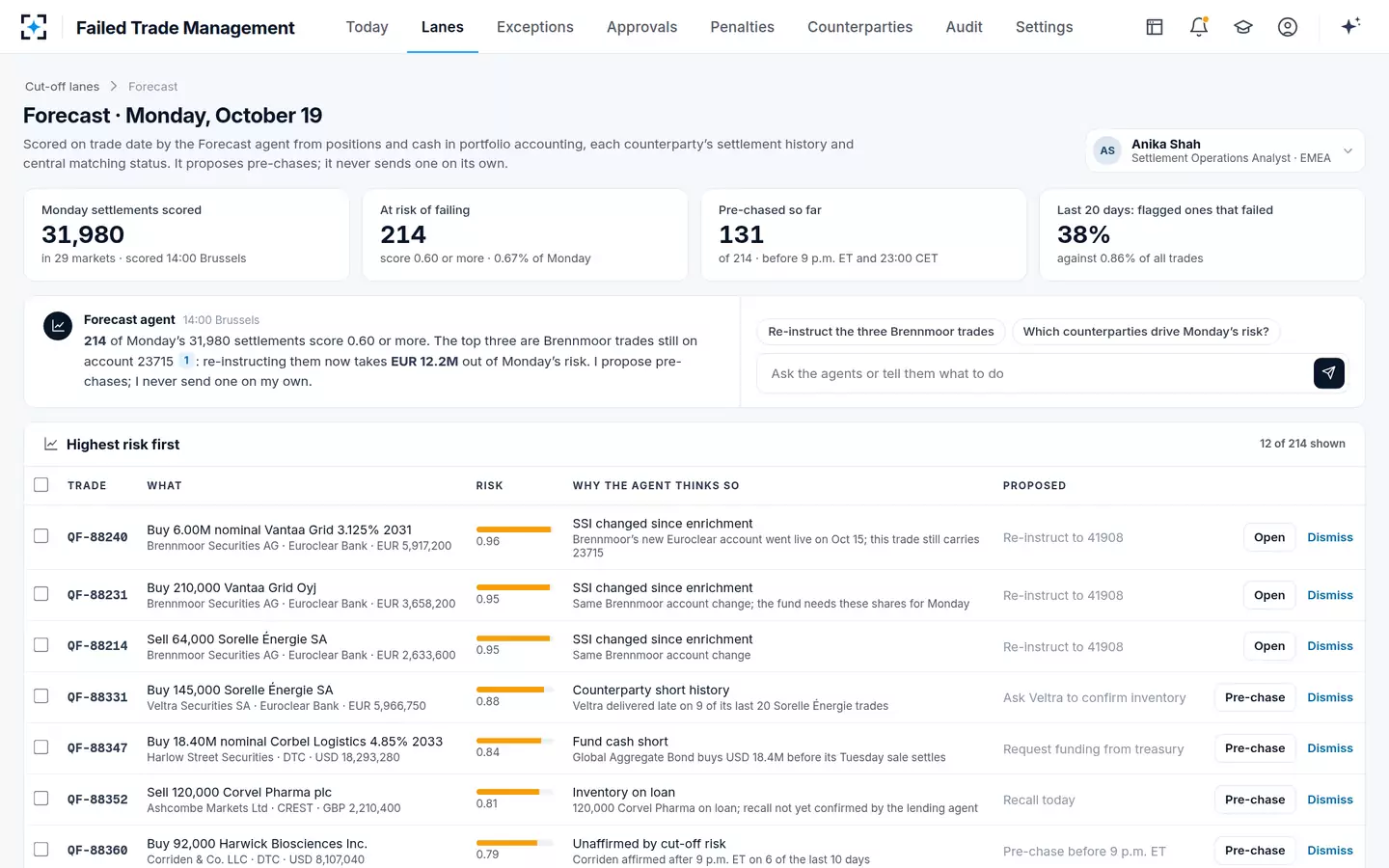
What the solution does not do matters as much in a regulatory programme. It does not send allocations or instructions on its own, and it does not change standing settlement instructions: the agents draft, a second agent checks, and people approve and release. A plan that brings agents live before 11 October 2027, with the EU's December 2026 rules already running, is laid out phase by phase in AI for failed trades: a go-live plan that lands before EU T+1.
Questions people ask
When does the UK move to T+1?
The government's planned date is 11 October 2027, the same day as the EU, and its draft instrument is scheduled to come into force then. Until both Houses of Parliament approve the final instrument it is a commitment, not law. The Technical Group's preparatory actions mostly fall due on 31 December 2026.
Does T+1 in Europe apply to bonds and ETFs?
It applies to transferable securities executed on EU trading venues, which includes shares, bonds and exchange-traded funds traded on a venue. Securities financing transactions documented as two linked operations are exempt, as are privately negotiated or bilaterally executed trades already outside T+2. For the UK, HM Treasury notes the taskforce's view that derivative contracts will generally fall outside the rule.
Does Switzerland move to T+1 at the same time?
Switzerland is outside both the EU regulation and the UK instrument, so neither sets its date. Firms settling Swiss securities should take the date from the Swiss authorities and market infrastructure directly rather than assume it matches the EU's.
What is the 23:00 CET allocation deadline?
From 7 December 2026, professional clients in the EU must make sure their broker receives written allocations and confirmations by 23:00 CET on trade date, in a structured electronic format. It replaces today's close-of-business or 12.00 CET next-day deadline, and applies while the settlement cycle is still T+2.
Will CSDR penalties change when the EU moves to T+1?
The rates have not changed, but Regulation 2025/2075 lets the Commission temporarily adjust the penalty parameters if the move risks a material increase in fails. ESMA's 2024 advice also proposed higher rates for most instruments except liquid shares. Either would change the arithmetic in CSDR penalties calculation.