A settlement instruction is the order a participant in a central securities depository (CSD) sends to deliver or receive a specific quantity of a security, usually against a specific amount of cash, on a specific date. It is built from two things: the trade's own details, such as the security, quantity, price and dates, and the counterparty's standard settlement instruction (SSI), which supplies the accounts, the participants and the place of settlement. Each side sends its own instruction, and the CSD settles only when the two match. Under the EU's 2026 rules, CSDs must ask their participants to send instructions by 23:59 CET on trade date where feasible from October 2027, and the UK plan sets 05:59 on the morning after the trade, so an error in the SSI now surfaces at night, when no one is at the desk to fix it. Botminds' Standard Settlement Instruction Management works upstream of the instruction: it keeps each SSI current and proven, and makes every approved change live at a set time, so the instructions built from it are right the first time.
The examples use a fictional asset manager, Quillfield Capital, and its fictional counterparties as they run through the solution; the rules are linked where they appear.
From standing instruction to matched settlement: what each step adds, and who does it
A person decides
SSI agreed and approvedThe counterparty’s accounts, agents and place of settlement are verified with it and approved by two people, once.
Never: Taken from an unverified email
Agent
Trade booked, SSI attachedThe order management system adds the SSI for this counterparty, market and asset to the trade.
A person decides
Allocation and confirmationThe asset manager allocates the block to funds and confirms terms with the broker on trade date, with the accounts and place of settlement from the SSI.
Agent
Settlement instruction generatedEach side’s custodian builds its instruction from the trade and the SSI it holds, and sends it to the CSD.
Agent
Matching at the CSDThe CSD compares the two instructions field by field; a match makes them eligible to settle on the intended date.
Agent
SettlementSecurities and cash move, delivery against payment, if both sides have the assets.
What is a settlement instruction?
In EU law a settlement instruction is "a transfer order as defined in point (i) of Article 2 of Directive 98/26/EC" (Delegated Regulation (EU) 2018/1229, Article 1). That directive, on settlement finality, describes a transfer order for securities as an instruction by a participant to transfer title to, or an interest in, securities by a book entry on a register, and for cash as an instruction to place money at a recipient's disposal (Directive 98/26/EC, original text). In plain terms: it is the order that actually moves the asset, and once a system has accepted it under its rules, the finality protections attach to it.
An instruction is specific. It names one security by its ISIN, one quantity, one cash amount, one trade date and one intended settlement date, whether it delivers or receives, and the two participants. It exists for one trade, or one allocation of a trade, and disappears once settled or cancelled.
How is a settlement instruction different from an SSI?
The SSI is standing data and the settlement instruction is a message: the SSI says where a counterparty settles every trade of a type, and the instruction says what to settle on this trade. The UK's T+1 report draws the line in the same place when it says SSIs should make it unnecessary for counterparties to exchange instructions trade by trade, because each side can build the instruction from the trade and the SSI it already holds (UK Accelerated Settlement Technical Group, February 2025). What are standard settlement instructions in detail is covered in what an SSI holds and who owns each line.
Confusingly, "settlement instructions" is also what many people call the SSI letter a counterparty sends. A "settlement instruction letter" is almost always an SSI notice, not a trade instruction, and who signs a settlement instruction letter deals with it. In this guide, an instruction is the trade-level message.
Which fields must match at the CSD?
In the EU, Article 5(3) of the settlement discipline standards lists them: CSDs must require participants to use eleven named matching fields, plus any others the CSD needs (Delegated Regulation (EU) 2018/1229). Eight of the eleven come from the trade. Three come from standing data, and an error in standing data repeats on every trade.
The eleven EU matching fields, and where each value comes from
| Matching field, Article 5(3) | Comes from | What breaks it |
|---|---|---|
| (a) Type of settlement instruction | The trade | Delivery against payment on one side, free of payment on the other |
| (b) Intended settlement date | The trade and the market calendar | A holiday counted on one side and not the other |
| (c) Trade date | The trade | A late booking re-dated |
| (d) Currency | The trade | Settlement currency differs from trade currency |
| (e) Settlement amount | The trade | Outside the CSD’s tolerance: EUR 2 up to EUR 100,000, EUR 25 above |
| (f) Nominal value or quantity | The trade | Units on one side, face amount on the other |
| (g) Delivery or receipt | The trade | Both sides instructing to receive |
| (h) ISIN | The trade and the security master | A new line or a corporate action changes the ISIN |
| (i) Delivering participant | The SSI | An old participant code in a stale SSI |
| (j) Receiving participant | The SSI | A counterparty that moved custodian |
| (k) CSD of the counterparty, on a common infrastructure | The SSI | The counterparty settles through another CSD than expected |
The place of settlement is not on the list. Respondents to ESMA's 2024 consultation noted that a mismatch in the place of settlement still stops matching even though it is "not a mandatory matching criteria at trade level" (ESMA, technical advice on the CSDR penalty mechanism, November 2024). The 2026 amendments put it on the allocation instead, which place of settlement (PSET) explains. They also extend the transaction-type field in instructions to buy-sell-backs from December 2026 and add a place-of-trading field, the trading venue's market identifier code, from July 2027 (Delegated Regulation (EU) 2026/1536).
What is the EU's 23:59 CET target, and the UK's 05:59 deadline?
They are the times by which settlement instructions should reach the CSD under T+1. In the EU, from 11 October 2027, "CSDs shall require participants to send settlement instructions as soon as possible and where feasible by 23:59 CET on the business day on which the transaction has taken place" (Delegated Regulation (EU) 2026/1536). In the UK, action SETT 02 of the T+1 plan says instructions to the CSD should be submitted "no later than 05.59 UK time on T+1", with CREST's opening hours on trade date extended to 21:00 (UK Accelerated Settlement Technical Group).
Trade-date night under T+1: what has to be done, by when, in each market's own time
- Allocations and confirmations to the brokerby 23:00
- To CSDby 23:59
- Later instructions: still processedafter 23:59
- Allocations and confirmationsby 23:59 T
- Settlement instructions to the CSDby 05:59 T+1
- Allocation, confirmation, affirmationby end of T
- Overnight to settlement on T+1T+1
The EU target is softer than it looks. The regulation's recital says that sending instructions after 23:59 "should not prevent CSDs from processing those settlement instructions, nor give rise to the application of cash penalties" unless the ordinary conditions for penalties are met. The deadline exists so that CSDs can run their overnight optimisation on as many instructions as possible; missing it costs a night's chance to settle, not a fine in itself.
How does an SSI become a settlement instruction?
Through two copies of it. Your custodian builds your instruction from the SSI you hold for the broker; the broker's custodian builds the broker's from the SSI the broker holds for your fund. If both copies are current, the participant fields match without anyone looking at them. If one is stale, the CSD sees two honest instructions that disagree, and neither side's system shows an error until matching fails.
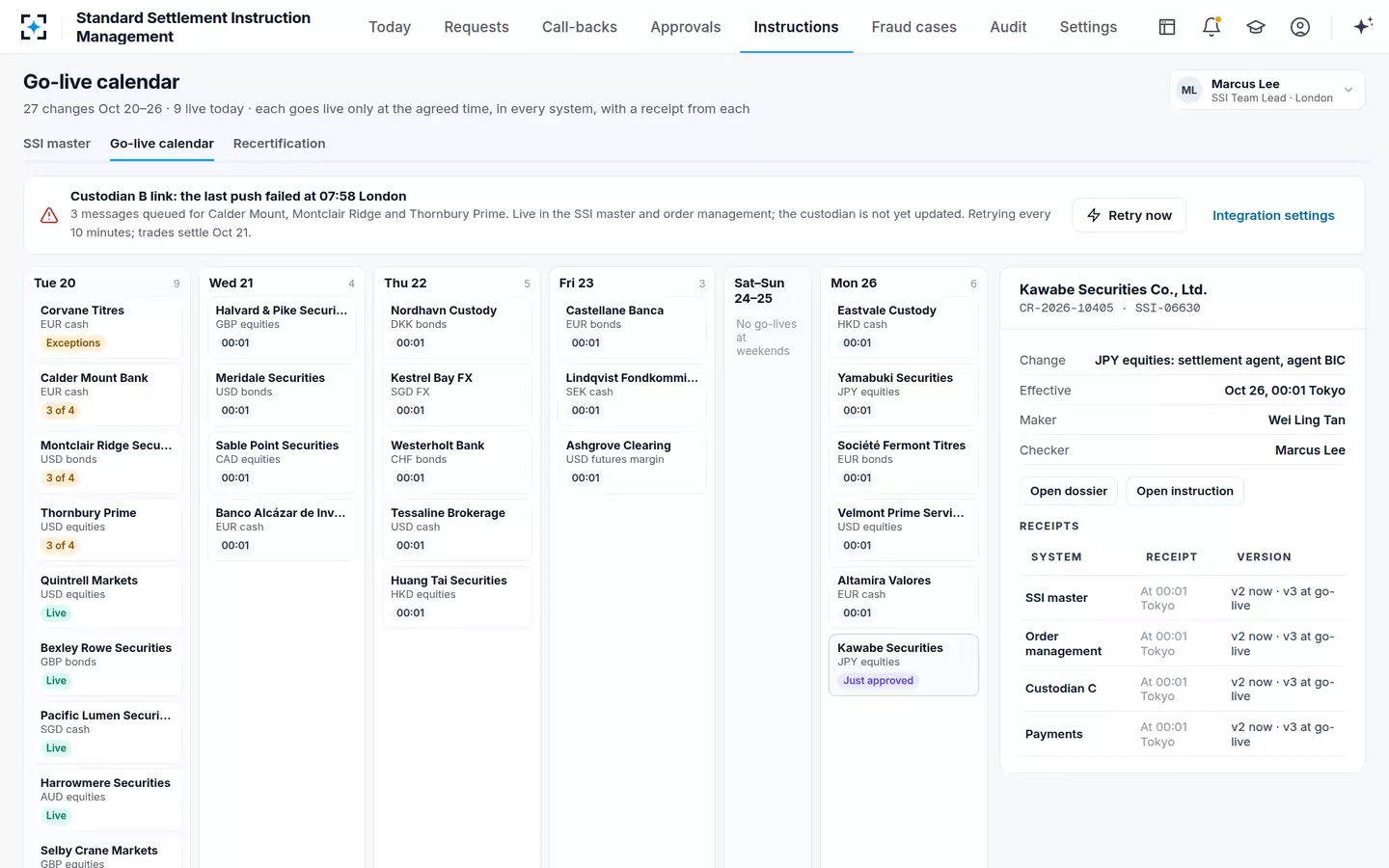
That is why the timing of an SSI change matters as much as its content. A change must go live on both sides at the same moment, and trades already booked against the old details must settle there. In the sample, Kawabe Securities' new Japanese settlement agent took effect at 00:01 Tokyo on 26 October; trades settling before then stayed on the old agent, and 41 JPY equity trades settled to the new instruction afterwards.
Approved SSI changes go live at an agreed time, in every system that builds instructions from them
What fails when the SSI and the instruction disagree?
Matching fails, and with it the trade's chance of settling on the intended date. EU CSDs must offer participants the option to be told about a counterparty's unmatched instruction within an hour of the first failed matching attempt, or at once close to the cut-off (what the resulting status codes mean is in MT548 reason codes), and must recycle failed instructions "until they have been settled or bilaterally cancelled" (Delegated Regulation (EU) 2018/1229, Articles 9 and 11). Someone then has to find which side is wrong, which under T+1 means doing it overnight or early on the settlement date.
One trade, two copies of the broker's SSI: current versus stale
Your copy is current: Allocation sent with the broker’s current participant and accounts.
Your copy is stale: Allocation sent with the participant the broker left last month.
Your copy is current: Broker confirms; details agree.
Your copy is stale: Broker confirms the economics; few systems compare the settlement details at this stage.
Your copy is current: Both custodians instruct; participant fields agree.
Your copy is stale: Your custodian instructs to the old participant; the broker’s custodian instructs from its own data.
Your copy is current: Matched within minutes; eligible for the overnight cycle.
Your copy is stale: Unmatched; each side is told the other’s instruction is pending.
Your copy is current: Settles.
Your copy is stale: Someone traces the mismatch, corrects the SSI and re-instructs; the trade may settle late or fail.
What it costs once a trade has failed is worked through in CSDR penalties calculation; the cost of one wrong SSI across every trade it touches is worked through in settlement instructions management: what one wrong SSI costs. The prevention is older than T+1. The CPSS–IOSCO recommendations for securities settlement systems of November 2001, which the 2012 principles keep in effect, put it in one sentence:
“Speedy, accurate verification of trades and matching settlement instructions is an essential precondition for avoiding settlement failures, especially when the settlement cycle is relatively short.”
CPSS-IOSCO, Principles for financial market infrastructures (April 2012), Annex C, Recommendation 2, explanatory note 3.10
Why the US settled the question differently
The US moved to T+1 on 28 May 2024 without trade-date deadlines for instructions to the depository. Its rule sits one step earlier: Rule 15c6-2 makes broker-dealers put agreements or procedures in place so that allocation, confirmation and affirmation are finished on trade date itself (17 CFR 240.15c6-2). The SEC was asked to require that settlement instructions be linked to the affirmation and declined: "the Commission is not modifying the rule to include a requirement for linking the transmission of settlement instructions to the receipt of an affirmation", noting that it would need custodians' cooperation (SEC, Shortening the Securities Transaction Settlement Cycle, 2023).
The market structure also differs. In the SEC's words, DTC "is the CSD that provides custody and book-entry transfer services for the vast majority of securities transactions in the U.S. market", so the US place-of-settlement question that divides European markets rarely arises for domestic trades. The SSI problem does not go away: the same release observed that firms' local matching tools "often rely on inconsistent SSI data independently maintained" across brokers, managers and custodians.
Where Standard Settlement Instruction Management sits in the chain
It sits before the first instruction, at the point where an SSI is created or changed. The CPMI–IOSCO principles describe straight-through processing as "procedures that require trade data to be entered only once and then use those same data for all post-trade requirements related to settlement" (PFMI, Annex C); for settlement data, that single entry is the SSI. If it is right and proven, every allocation and instruction built from it inherits that. If it is wrong, automation repeats the error faster.
The solution reads each change request in any language, cites every field to its source, compares it with the counterparty's own authenticated data, checks formats, the place of settlement and sanctions lists, and books a call-back to the number on file. An analyst verifies, a different team lead approves, and the Go-live agent makes the change live in the SSI master, order management, the custodians and payments at the agreed time, collecting a receipt from each. To see it on a month of your own change requests, start from Standard Settlement Instruction Management.
Questions people ask
What does "matched" mean for a settlement instruction?
It means the CSD has found the counterparty's instruction for the same trade and the matching fields agree, within the cash tolerance. A matched instruction is eligible to settle on its intended date if both sides have the securities and cash. In the EU, a matched instruction is cancelled bilaterally, through the CSD's cancellation facility.
What happens if an instruction is sent after 23:59 CET?
The CSD still processes it. Delegated Regulation (EU) 2026/1536 says late submission should not prevent processing or by itself give rise to cash penalties. The cost is practical: the instruction may miss the CSD's overnight settlement, leaving less of the settlement date to resolve any mismatch.
What is hold and release?
A CSD function that lets a participant put its own pending instruction on hold and release it later, wholly or, from October 2027 in the EU, partly. Firms use it to instruct early, so the instruction can match, while keeping control of when it settles, for example until a client's cash arrives.
Can a settlement instruction be changed after it is sent?
Not in place. A wrong instruction is cancelled and a new one sent; once matched, the cancellation needs both sides. That is why a stale SSI is costly under T+1: correcting one instruction means a cancellation, a new instruction and a new match, all before the settlement cut-off.
What is the tolerance for settlement amounts?
In the EU, CSDs match instructions whose cash amounts differ by up to EUR 2 for amounts up to EUR 100,000 and EUR 25 above, or the equivalent in other currencies. From December 2026, firms must require professional clients to apply the CSD's tolerance when they state the cash amount in their allocations.