The place of settlement, PSET for short, is the location where a trade finally settles: the central securities depository (CSD) in whose books the securities pass from seller to buyer and the cash from buyer to seller. ESMA defines it as "the location where the final transfer of securities or funds will take place" (ESMA consultation paper, February 2025). It matters because many securities can settle in more than one place, especially exchange-traded funds and international bonds, and if the two sides of a trade instruct different places, their instructions cannot match. From 7 December 2026, Delegated Regulation (EU) 2026/1536 requires professional clients' written allocations to include "the place of settlement ('PSET')", so the question has to be answered on trade date, before any instruction is sent (Delegated Regulation (EU) 2026/1536). In a standing settlement instruction, the place of settlement is one of the lines that, once wrong, is wrong on every trade; Botminds' Standard Settlement Instruction Management checks it on every change, alongside the account format by market, sanctions lists and the counterparty's own published data.
Examples use fictional counterparties from the solution's sample data. The rules and ESMA's analysis are linked where they appear.
One cross-border ETF trade, two outcomes: the place of settlement agreed at allocation, or discovered at matching
PSET agreed on trade date: The asset manager’s allocation names the CSD where its custodian holds the ETF; the broker accepts it.
PSET left to each side: The allocation names accounts but no place of settlement; each side assumes its usual CSD.
PSET agreed on trade date: Both custodians instruct at the same CSD.
PSET left to each side: The fund’s custodian instructs where the fund’s ETF position sits; the broker instructs at the CSD of the venue it traded on.
PSET agreed on trade date: Matched; eligible for overnight settlement.
PSET left to each side: Each CSD holds one instruction with no counterpart. Nothing matches.
PSET agreed on trade date: None needed.
PSET left to each side: Find the mismatch, agree one place, cancel and re-instruct, or realign the position across CSDs, which takes time a T+1 cycle does not have.
PSET agreed on trade date: Settles on the intended date.
PSET left to each side: Late matching or a fail, and a cash penalty in the EU on the side found to have failed.
What is the place of settlement (PSET)?
It is the CSD where a specific trade settles. ESMA's 2025 consultation put it in one paragraph: the place of settlement "refers to the location where the final transfer of securities or funds will take place. This is the place where the ownership of securities is officially transferred from the seller to the buyer, and where funds are moved from the buyer to the seller. The PSET is typically specified in the settlement instructions" (ESMA, paragraph 145).
The term comes from the messaging standards. ESMA explains that "'PSET' is the ISO15022 label" of the message element that, in the ISO 20022 messages used by TARGET2-Securities, is called the receiving or delivering depository, and that "This field is already a mandatory matching field in T2S". In practice it is usually filled with the identifier code of the CSD. Two caveats matter: the place of settlement is a property of a trade between two parties, not of a security, and ESMA notes that it "may change along the settlement chain in the case of netting", for example when a central counterparty nets many trades into one settlement.
How is place of settlement different from place of safekeeping?
The place of safekeeping, PSAF, is where the securities are held; the place of settlement is where this trade will move them. ESMA describes PSAF as the field that "identifies the location where the financial instruments are/will be safekept", typically the account or system where a custodian keeps them (ESMA, paragraph 155). For most domestic trades the two are the same CSD. They diverge when a fund holds a security in one CSD and trades it with a broker who settles in another, and that gap is what turns a matched trade into a realignment.
Place of settlement and the three things it is often confused with
| Term | What it identifies | Where it lives | Who decides it |
|---|---|---|---|
| Place of settlement (PSET) | The CSD where this trade’s securities and cash finally move | Allocation, confirmation and settlement instruction; standing instruction per market | Agreed by the two parties, constrained by where the security can settle |
| Place of safekeeping (PSAF) | Where the securities are or will be held | Custody statements and some instructions | The account owner and its custodian |
| Custodian or settlement agent | The bank that holds the account and acts at the CSD | Standing settlement instruction, with its BIC | The account owner |
| Participant code at the CSD | The account or member identifier inside the CSD | Standing instruction; matching field for delivering and receiving participants | The CSD assigns it; the owner communicates it |
Why do PSET mismatches fail trades?
Because a CSD can match only instructions it holds, and two instructions sent to two different CSDs never meet. The EU's matching fields name the delivering and receiving participants and, where CSDs share an infrastructure, the counterparty's CSD, but not the place of settlement itself. Respondents to ESMA's 2024 consultation on cash penalties said instructions still fail to match on non-economic data "such as place of settlement (although this information is not a mandatory matching criteria at trade level)" (ESMA, November 2024).
ESMA's own report on T+1 counted a wrong place of settlement in the instruction among the errors that a shorter cycle leaves no time to fix, and singled out ETFs, which are often listed on several venues and held in several CSDs, so that a broker must "check, for each transaction, the content of the SSIs (e.g. to check the place of settlement), prior to sending the SSIs to settlement" (ESMA T+1 report, November 2024). The EU T+1 industry task force told ESMA that "The industry has identified PSET mismatches as a common cause of settlement fails"; no regulator publishes how common.
Does the EU now require PSET in allocations?
Yes, from 7 December 2026. Delegated Regulation (EU) 2026/1536 adds "(p) the place of settlement ('PSET')" to the list of what a professional client's written allocation must specify, and its recital gives the reason: "to avoid late-stage adjustments which are particularly critical in the context of a shortened settlement cycle, the place of settlement should be communicated as early as possible in the settlement process" (Delegated Regulation (EU) 2026/1536). The allocation rule is not among the provisions the regulation defers to 2027, so under its Article 2 it applies from the general date.
How the place of settlement went from optional to required on EU allocations
- ConsideredNov 2024
- Consultation: not requiredFeb 2025
- Final report: requiredOct 2025
- Adopted; applies 7 DecJul 2026
The turn came from the consultation. ESMA had proposed leaving PSET to industry best practice; the feedback "unanimously supported the critical role of PSET in improving settlement efficiency, in particular for cross-border settlement and for multi-listed securities (such as ETFs and bonds)", with "a slight majority in favour" of a legal requirement (ESMA final report, 13 October 2025). ESMA then added it to the allocation, while noting that it was not proposing to make PSET a matching field for settlement instructions. One thing it deliberately left out:
“ESMA has consciously left the term ‘place of settlement or PSET’ undefined to ensure that an industry-wide agreement can be reached in this area.”
ESMA, Final Report on amendments to the RTS on settlement discipline, 13 October 2025, paragraph 137
So the law requires the field and the industry supplies the meaning. Respondents pointed to the market practice of the Securities Market Practice Group; some suggested rules such as letting the buy side, which alone sees its custody structure, provide the PSET, or deriving it from the security's ISIN and the trading venue's market identifier code.
What does the UK T+1 plan say about PSET and PSAF?
It asks for a market practice first and its use second. Action SETT 09a says the UK taskforce and the investment, banking and markets associations "will agree, support and publish new market practice for the communication of Place of Settlement and Place of Safekeeping between the brokerage, custodian and buy-side communities", due by 31 December 2025; SETT 09b says the published practice "will be implemented and used systematically" by 31 December 2026 (UK Accelerated Settlement Technical Group, February 2025). Both are among the report's "highly recommended" actions rather than its critical ones.
ESMA's consultation records that the UK group also recommended that PSET be clarified at an earlier stage, when a client is onboarded. That is the SSI's job: if each standing instruction states the place of settlement per market, the allocation can carry it without anyone looking it up trade by trade. Collecting it at account opening is one of the five legs of counterparty onboarding.
How do you find the right place of settlement for a security?
Start from where your own position sits and where your counterparty settles, not from the security alone. A security issued into one CSD may be held through others linked to it, and a multi-listed ETF may settle where it traded or where the investor holds it. The right PSET for a trade is the one both sides can settle in without moving the position first.
Finding and holding the right place of settlement, market by market
- Know where each fund’s position is held
Your custodian’s statements of holdings should show the place of safekeeping for each line; ask for it where they do not.
- Record a place of settlement in every standing instruction, per market
Store the CSD, normally by its identifier code, not just the custodian. One counterparty may need different PSETs for different markets.
- Agree it with the counterparty when the relationship starts
The UK group recommended clarifying PSET at onboarding; a broker that settles some ETFs in another CSD should say so then.
- Send it on the allocation
Required in the EU from 7 December 2026; good practice everywhere a security settles in more than one place.
- Watch multi-listed securities and new venues
A new listing or venue can change where a counterparty settles a security you already trade.
- Treat a PSET change in an SSI as a change to verify
A new place of settlement moves where your trades settle, so it is confirmed with the counterparty like an account change.
Where PSET lives in a standing settlement instruction
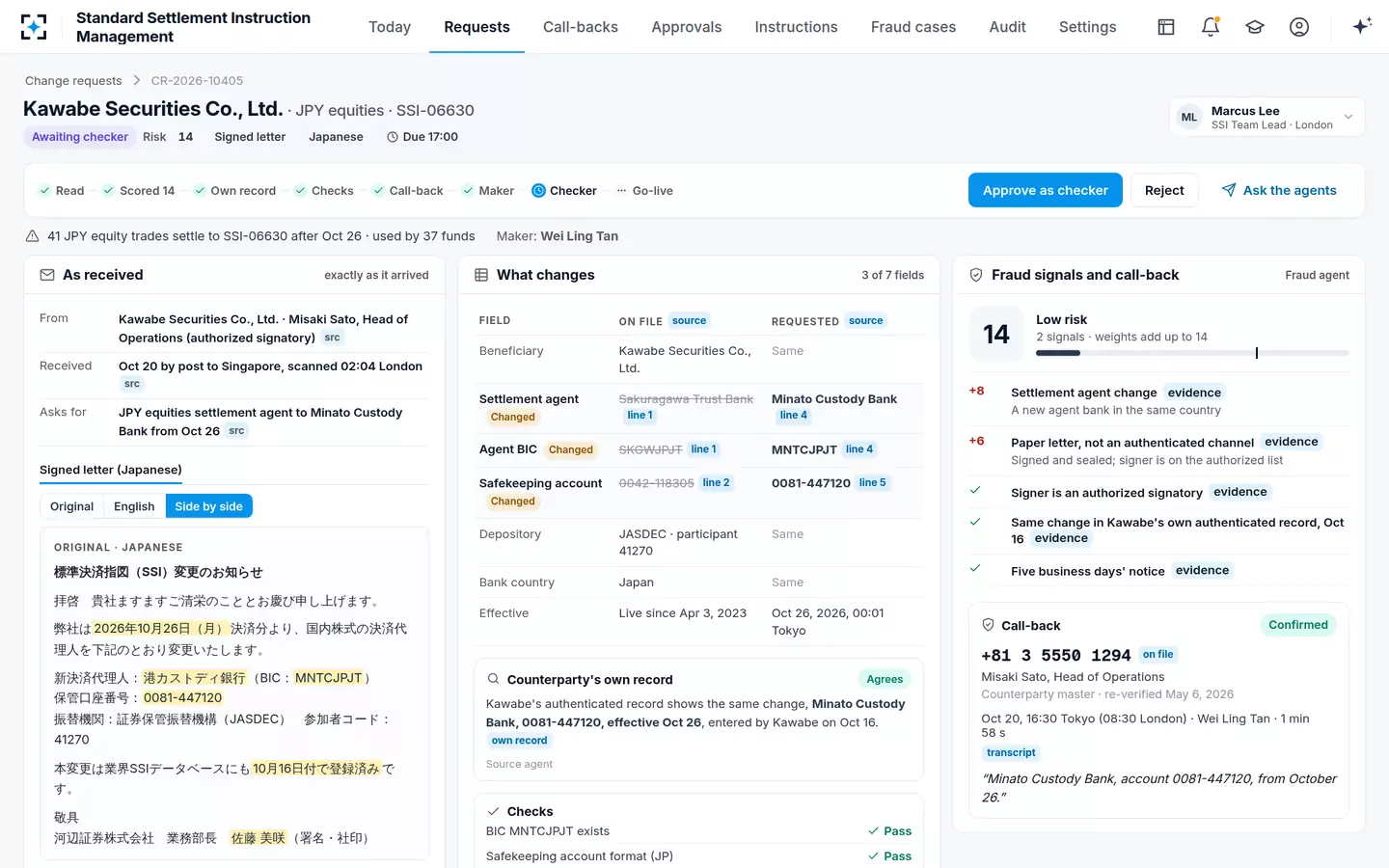
In a securities SSI it is the depository line, sometimes labelled "place of settlement", sometimes "depository" with a participant code beside it. Fictional Kawabe Securities' Japanese equities SSI in the solution's sample names JASDEC as the depository and participant 41270; when Kawabe moved its settlement agent to a new bank, the depository and participant did not change, and the solution showed them as unchanged rather than leaving the approver to infer it.
A Japanese equities SSI in Standard Settlement Instruction Management: the agent changes, the place of settlement does not
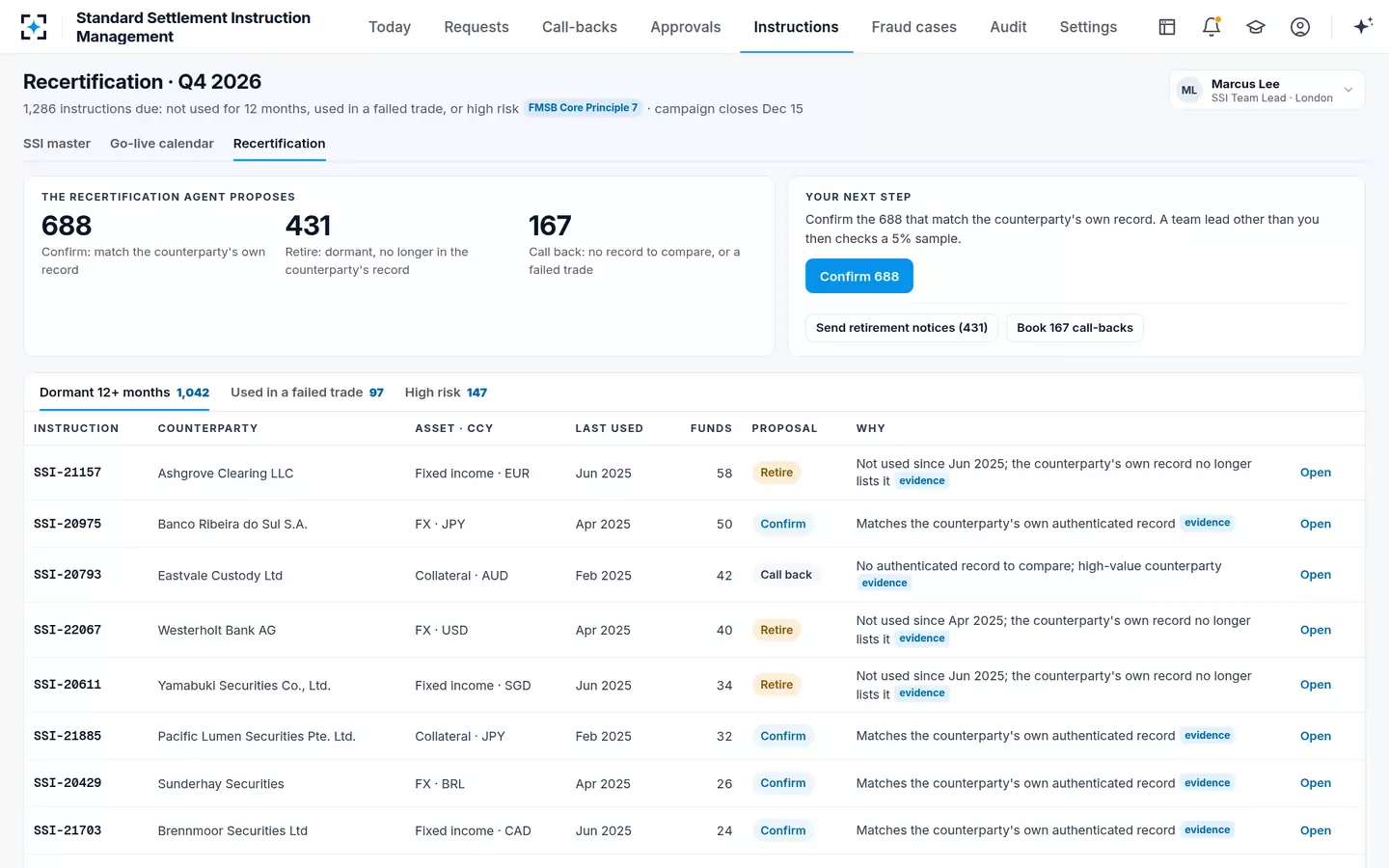
Place of settlement also ages. A standing instruction set up years ago for a market the firm rarely trades may name a depository arrangement the counterparty has since changed, and it fails the first trade that uses it. That is one reason the sample firm's quarterly review targets instructions unused for twelve months.
A quarterly review of dormant instructions, market by market
How Standard Settlement Instruction Management checks place of settlement
The Checker agent tests every new or changed instruction on its own, apart from the fraud score: BIC, IBAN and routing codes, the account format for the market, the place of settlement, sanctions and watch lists, and whether the template is complete. A change that moves the place of settlement is treated as a change to verify with the counterparty on the number on file, like an account change, and goes live at an agreed time in the SSI master, order management, the custodians and payments, so that allocations built from it carry the new PSET from the same moment. From the SSI to the CSD instruction shows where the allocation goes next. To see it on your own instructions, start from Standard Settlement Instruction Management.
Questions people ask
Is there a place of settlement PSET list?
No regulator publishes a single list of PSET codes. In practice the place of settlement is identified by the CSD's identifier code, and CSDs and custodians publish their own market guides. Because ESMA left the term undefined in EU law, the industry's market practice, not a register, decides how the field is filled.
Can the place of settlement change along the chain?
Yes. ESMA notes that the place of settlement, and the place of safekeeping, may change along the settlement chain where trades are netted, for example by a central counterparty. A client's allocation and the broker's final instruction to the CSD may then name different places, which is why the place agreed bilaterally is the one to record.
Is PSET a matching field?
It is a mandatory matching field in TARGET2-Securities, ESMA says, but EU law does not list it among the matching fields CSDs must require, and ESMA's 2025 final report did not propose adding it there. From December 2026 the EU requires it in the allocation instead, so the parties agree it before instructing.
What is the place of settlement for US securities?
For most US equities and corporate and municipal bonds it is DTC, which the SEC describes as the depository that settles most US securities transactions (SEC, 2023). US Treasuries settle elsewhere. The question becomes live mainly for foreign securities and cross-border holdings.
Why does PSET matter more for ETFs?
An ETF is often listed on several exchanges and held in several CSDs, so the same ISIN can settle in more than one place and the two sides may assume different ones. ESMA's 2024 report found that a broker has to check the place of settlement in the SSI for each ETF trade before instructing.