MT548 reason codes are the four-letter codes a custodian puts in an MT548, the settlement status and processing advice, to say why a settlement instruction has been rejected, has not matched or has not settled: LACK means the instruction is short of securities in its own account, CLAC that the counterparty is short, MONY and CMON the same for cash, PREA and PRCY that one side has put its instruction on hold, LATE that a market deadline was missed. In ISO 20022 the same information travels in the sese.024 status advice, with the same codes. Read together with the status they qualify, the codes answer the two questions a settlement analyst has to answer for every exception: whose problem is this, and what fixes it. Botminds' Failed Trade Management starts there. Its Intake agent links every status message, allegement and counterparty email to its trade, and its Cause agent names the real reason with cited evidence, which is often more than the code says.
The code meanings and rules on this page are the European Central Bank's, from its specifications for TARGET2-Securities (T2S), the Eurosystem's settlement platform, and the EU settlement discipline regulations. Examples come from the solution's fictional sample firm, Quillfield Capital.
The settlement-status reason codes: what each means, whose fail it is, and the first fix
| Code | ISO name | Whose problem | Penalty eligible in T2S | First fix |
|---|---|---|---|---|
| LACK | Lack of securities | Yours: not enough securities in your position | Yes | Find the inventory: unsettled purchase, wrong account, securities on loan. Recall, realign or borrow. |
| CLAC | Counterparty insufficient securities | The seller's, when you are buying | No | Chase the counterparty for a delivery time; consider accepting a partial. |
| MONY | Insufficient money | Yours: not enough cash or credit | Yes | Fund the account or raise credit headroom before the next cycle. |
| CMON | Counterparty insufficient money | The buyer's, when you are selling | No | Chase the buyer; check whether your sale funds a later purchase. |
| PREA | Your instruction on hold | Yours: you or your custodian held it | Yes | Find who held it and why; release it or cancel it. |
| PRCY | Counterparty instruction on hold | The counterparty's | No | Ask the counterparty to release. |
| CSDH | CSD hold | Yours, through your CSD | Yes | Ask your custodian what the CSD needs. |
| CVAL | CSD validation hold | Yours: the CSD has not validated it | Yes | Correct the field the CSD rule flagged. |
| LINK | Pending linked instruction | Yours if you linked it to another instruction | Yes, for your own link | Fix or remove the link to the instruction that is failing. |
| LATE | Market deadline missed | Usually yours: sent or released too late | Depends on the other reasons | Re-plan to the next cycle; find out why it was late. |
| BLOC / SBLO | Account blocked / securities blocked | Yours if the restriction is on your account or ISIN | Yes for your own; no for the counterparty's | Find the restriction and its owner. |
What is an MT548? A status advice with three statuses in it
An MT548 is the message a custodian or CSD sends to tell its client what has happened to a settlement instruction it received, usually an MT540 to MT543 for receipts and deliveries free or against payment. Each message reports a status and, where it helps, a reason. In ISO 20022 the counterpart is sese.024, the securities settlement transaction status advice, and the ECB's guide to it explains the structure that both share: an instruction has several statuses at once, one for each process, and "for the 'pending' status there are different reason codes which provide the user with the information why the instruction remains unsettled" (ECB, Multiple-status reporting in a status notification).
The three statuses that matter to a fails desk are processing, matching and settlement. Processing says whether the instruction was accepted or rejected. Matching says whether it found its counterparty's instruction. Settlement says whether it is pending, which means it can still settle on its intended date, or failing, which means it cannot. A message can change one, two or all three at once, and T2S sends a new status advice whenever "there is a change in a status value" or a change in the reason code.
"T2S does not support ISO 15022 messages. Both inbound and outbound communication in T2S takes place in ISO 20022 (i.e. XML) format only."
ECB, T2S User Detailed Functional Specifications, R2024.JUN
That sentence explains why the MT548 a fund receives is often a translation. Where the CSD settles on T2S, the platform reports in sese.024, and "any kind of conversion to MT-based ISO 15022 messages or other syntax formats remains therefore under the responsibility of the T2S Actors" (T2S UDFS, section 3.2.1.2). Each custodian in the chain can add its own narrative, omit a code or merge two statuses, so the same fail can arrive at a fund worded differently by two custodians on the same day.
What do MT548 reason codes mean? Pending against failing
The reason codes qualify the settlement status, and the first thing to read is whether that status is pending or failing. The EU's settlement discipline rules oblige CSDs to show participants which instructions can still settle on their intended date and which no longer can, together with "the reasons why instructions are pending or failing" (Delegated Regulation (EU) 2018/1229, Article 11). In sese.024, T2S codes the first FUTU and the second CYCL.
The same reason code means different things before and after the cut-off
Pending (can still settle today): The securities have not arrived yet; a purchase may settle in the next cycle and cure it.
Failing (can no longer settle on the intended date): —
Pending (can still settle today): —
Failing (can no longer settle on the intended date): A fail. In the EU a penalty is calculated tonight on your instruction.
Pending (can still settle today): Your buy is waiting on the seller. Ask for a delivery time; nothing is charged to you.
Failing (can no longer settle on the intended date): The seller has failed you. Its participant pays a penalty, and your side receives it.
Pending (can still settle today): Your own hold is stopping settlement. Release it if the hold was not deliberate.
Failing (can no longer settle on the intended date): A fail you caused by holding the instruction: eligible for a penalty.
Pending (can still settle today): Prevent: fix the cause before the cut-off.
Failing (can no longer settle on the intended date): Cure: fix it for the next cycle, and record the cause for the penalty reconciliation.
In the sample, a purchase of 320,000 Kinsei Robotics shares arrived at Quillfield with the status "PENF//CLAC at JASDEC (Japan)": pending, failing, because the counterparty, Kaito Shoken, was short of securities. CLAC said whose problem it was. It did not say the whole problem, as the next sections show.
Whose fail is it? LACK against CLAC, and why it decides the penalty
The reason code is how the settlement system decides who caused a fail, and in the EU that decides who pays. T2S's penalty mechanism reads "the reason(s) for failing that the instruction had at the end of the applicable cut-off" against its Failing Reasons Dictionary: "As soon as one reason for failing has a positive eligibility result, the Settlement Instruction is eligible for a penalty" (T2S UDFS, Penalty eligibility). LACK and MONY, your own shortfalls, are eligible; CLAC and CMON, your counterparty's, are not. Your own hold is eligible; your counterparty's is not.
That makes the code a piece of evidence in every penalty dispute. A fund charged a penalty on a trade its own status history shows as CLAC at the cut-off has a dispute worth raising. A fund whose instruction showed LACK because securities were sitting in the wrong account has a penalty it caused and a process to fix. How the penalty itself is priced is worked through in CSDR penalties calculation, worked on one late sale.
Rejection codes: the instruction never got in
A rejected instruction is worse than a failing one, because the market does not know it exists. Rejection codes come on the processing status, and T2S lists the reasons it may use, among them DDAT, DEPT, DMON, DQUA, DSEC, DTRD, ICAG, ICUS, NCRR and SAFE. Its business rules show what each guards. DTRD fires when the trade date is later than the intended settlement date; DMON when an instruction against payment has no settlement amount; DSEC when the ISIN does not exist in T2S; NCRR when the currency differs from that of the cash account to be debited or credited; SAFE when the securities account does not exist; DEPT when the delivering or receiving depository does not; ICUS when a client's BIC is not valid on the settlement date. DQUA catches the error ESMA's respondents called UNT/FAMT confusion: a settlement quantity "not expressed using the same Settlement Type" as the security's reference data, units against face amount (T2S UDFS, business rules).
Rejections are the cheapest fails to fix and the easiest to miss. They arrive minutes after the instruction is sent, they are almost always caused by the sender's own data, and a desk that only watches its failing list will see them hours later as an unmatched trade on the counterparty's allegement. ESMA's respondents described the same problem from the market side: instructions "rejected by the CSD or custodian due to incorrect format", and "differing use and acceptance of ISO transaction types" leading to rejection at a CSD's gateway (ESMA, CSDR penalty mechanism final report, 2024).
Which codes mean the counterparty has not instructed? None: unmatched comes with an allegement
No settlement-status code says "the counterparty has not instructed". An instruction with no counterpart is simply unmatched, and in T2S the unmatched status is reported with "'NORE' ISO code", no specified reason (T2S UDFS, sese.024 Accepted). Some custodians add their own unmatched reasons; the platform itself does not. The most common exception on a fails desk, an unmatched trade, therefore arrives with the least information.
The information comes from the other side. When an instruction does not match at the first attempt, T2S sends the counterparty an allegement, a message saying an instruction has been entered against it, after a standard delay period or, at the latest, shortly before the cut-off. The EU rules require CSDs to offer this "within one hour after the first unsuccessful attempt to match that instruction, or immediately" when the attempt is within five hours of the cut-off (2018/1229, Article 11(1)). The allegement carries the counterparty's version of the trade, and comparing it field by field with your own instruction is how an unmatched trade is diagnosed.
The matching rules that decide whether two instructions meet
EUR 2
cash tolerance on settlement amounts up to EUR 100,000 in T2S matching
EUR 25
cash tolerance above EUR 100,000; the deliverer's amount is the one that settles
20days
working days an unmatched instruction is recycled before T2S cancels it
1hour
after the first failed match attempt, the latest a CSD must be able to tell the counterparty
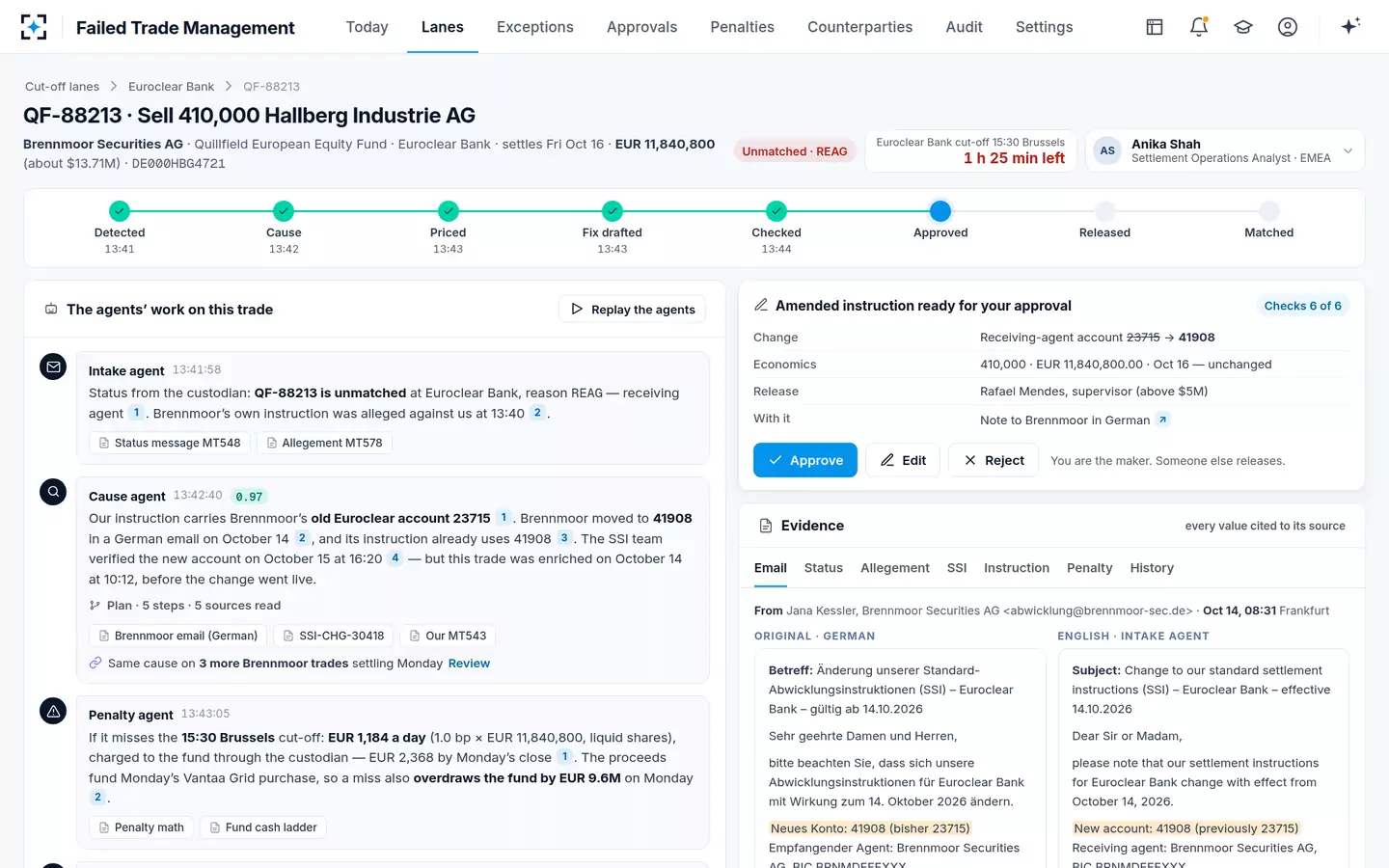
Matching is strict for a reason. Mandatory matching fields "should be the same in both Settlement Instructions" except the settlement amount, where the tolerance applies, and upper- and lower-case letters count as different. In the sample, QF-88213 was unmatched because Quillfield's instruction still carried Brennmoor Securities' old receiving-agent account while Brennmoor's own instruction, alleged against Quillfield, used the new one. The status said unmatched; the allegement and a German email said why.
From code to owner to fix: mapping each status message
Most of the work a code makes possible is routing. A status message names a trade, a status and a reason; a desk's own rules say who owns each reason and what the first action is. That mapping is the first thing a fails desk can automate safely, because the code is data, not judgement. The step after it, deciding what the real cause is and what to change, is where judgement starts.
One status message through Failed Trade Management: code, cause, chaser
Agent
Link the messageThe Intake agent reads the status advice, any allegement and the counterparty's emails in any language, and links each to its trade.
Never: discard a message it cannot link: below 0.95 it waits for a person with the best candidates
Agent
Read the code, then the evidenceThe Cause agent starts from the reason code and the status history, compares the allegement with the instruction field by field, and checks the SSI master.
Never: state a cause without its source; below 0.85 confidence it asks a person
Agent
Route by ownerCounterparty reasons go to a chaser; own-side reasons to the analyst, the SSI team or the funding desk; holds to whoever placed them.
Never: change an owner without telling them
Agent
Draft the fixThe Chaser agent drafts the chaser in the counterparty's language and any amended instruction; the Checker agent re-checks it against the verified SSI and the counterparty's instruction.
Never: send an instruction, or edit an SSI
A person decides
Approve and releaseThe analyst approves with a reason; a second analyst or the supervisor releases. Partials, shapes and buy-in responses always go to the supervisor.
Which codes can software act on, and which need a person?
Software can safely classify, route and chase on almost every code; it should not decide the fix when the code and the evidence disagree. The sample shows why. On the Kinsei Robotics purchase, the code was CLAC and Kaito Shoken's letter, in Japanese, offered 300,000 shares on Monday and "the remainder" on Tuesday. The Chaser agent drafted an acceptance of the partial. The Checker agent objected: Quillfield's trade was 320,000 shares and Kaito's own instruction was for 300,000, so the 20,000-share gap was a quantity mismatch, which the Checker agent labelled DQUA, not only a shortage.
When the code says CLAC and the evidence says quantity, a person decides
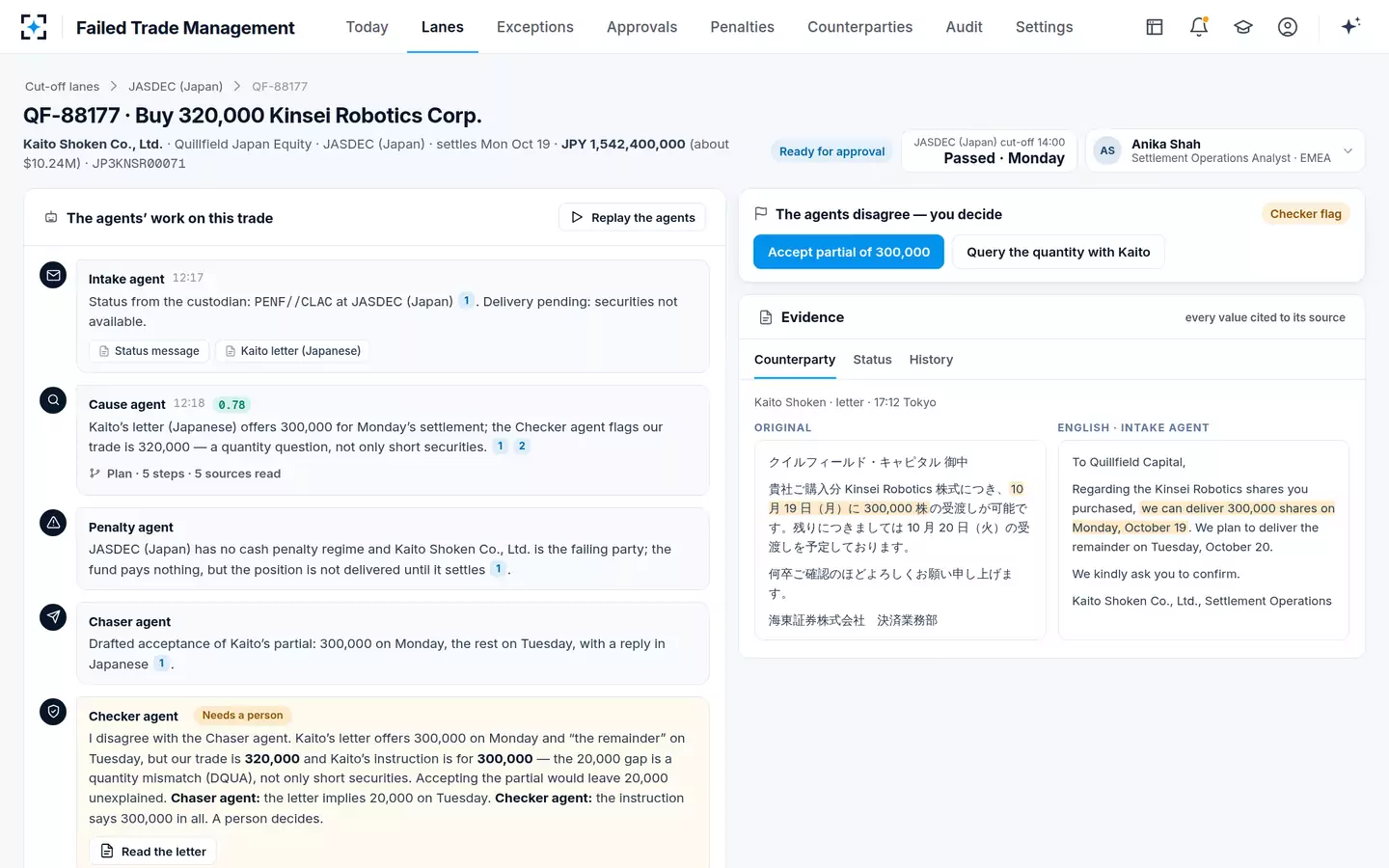
A code-only rule would have accepted the partial and left 20,000 shares unexplained until the next day's status. The general lesson holds for any automation on settlement status: the code is a strong prior, the allegement and the counterparty's own words are the evidence, and a disagreement between them is exactly the case to hand to a person with both arguments visible.
How fast must a status be acted on under T+1?
Within the same evening for most trades, and within the hour for anything near a cut-off. From 7 December 2026, EU professional clients must get allocations and confirmations to their broker by 23:00 CET on trade date; from 11 October 2027, CSDs must ask for settlement instructions "where feasible by 23:59 CET" the same day (Delegated Regulation (EU) 2026/1536), and the UK plan wants instructions at the CSD by 05:59 UK time on T+1 (UK Technical Group, SETT 02). A rejection or an unmatched status received at 21:00 on trade date leaves hours, not a day, to correct and re-instruct.
The practical standard is set by each market's cut-off, not by the regulation. In the sample, the analyst saw QF-88213's unmatched status at 13:41 Brussels time with 1 hour 49 minutes to Euroclear Bank's 15:30 cut-off; the firm's rules sent a follow-up chaser after 20 minutes without a reply and escalated to the supervisor 60 minutes before the cut-off. Every deadline from now to T+1 day is laid out in T+1 settlement in Europe, and the cost of each status a desk does not act on is set out in What is a failed trade?
The status message, the allegement and the email, linked to one trade
Questions people ask
What is the ISO 20022 equivalent of the MT548?
The sese.024 securities settlement transaction status advice. It carries the same processing, matching and settlement statuses and the same four-letter reason codes. Allegements, MT578 in ISO 15022, travel as sese.028, and T2S's daily and monthly penalty reports as semt.044.
What is an allegement?
A message telling an account owner that another party has entered a settlement instruction against it that it has not matched. It usually means you have not instructed, or instructed with different details. In the EU, CSDs must be able to send it within an hour of the first failed match attempt, or immediately when the cut-off is less than five hours away.
Which codes mean lack of securities or lack of cash?
LACK and MONY are your own shortage of securities and of cash or credit; CLAC and CMON are the counterparty's. In T2S, LACK and MONY make your instruction eligible for a CSDR penalty; CLAC and CMON do not. Respondents told ESMA that lack-of-cash fails are under 1% of the total and usually resolved within hours.
What does LATE mean on a settlement status?
Market deadline missed: the instruction, a release or a matching event came after the relevant cut-off for the cycle. It often appears together with another reason, and the other reason usually explains why the deadline was missed. Repeated LATE codes on one counterparty or one custodian point to a process timing problem rather than a data error.
Can one status message carry several reason codes?
Yes. T2S applies a multiple-status principle: an instruction has separate statuses for processing, matching and settlement, and one status advice can change several at once or report several reasons. For penalties, one eligible reason at the cut-off is enough to make the instruction eligible.
Do custodians use the same reason codes as T2S?
They use the ISO code sets, but each custodian decides which codes it forwards, how it words narratives and whether it adds proprietary reasons. A fund with several custodians should keep a mapping table per custodian and test it against real messages, because the same fail can be reported two different ways.