AI in trade settlement is used today to read the messages a settlement desk drowns in, custodian status advices, allegements, counterparty emails and letters, link each to its trade, explain why the trade is not settling, estimate what a miss would cost and draft the fix, so that a settlement analyst decides instead of searching. The line that matters is between preparing and acting: an agent that drafts a corrected instruction saves an analyst twenty minutes; an agent that sends one on its own takes a decision regulators expect a person to own. Botminds' Failed Trade Management is built on that line. Its seven agents link, explain, price, draft and check; an analyst approves; a second person releases. The clearest way to judge any such system is to follow one exception through it, step by step, and that is what this page does.
The exception is QF-88213 from the solution's fictional sample firm, Quillfield Capital, on Friday 16 October 2026. Times are Brussels time, as the solution's audit trail records them. Regulators' expectations are quoted from FINRA, the SEC and EU rules, linked where they appear.
Fifty minutes from unmatched to matched: the agents took three of them
How is AI used in trade settlement?
Mostly for reading and linking, increasingly for explaining and drafting, and rarely for deciding. A settlement desk's raw material is unstructured or semi-structured: four-letter reason codes, allegements with the counterparty's version of the trade, and emails in whatever language the counterparty writes. In the sample, by early afternoon the agents had read 18,406 status messages, 2,214 allegements and 412 counterparty emails in 11 languages and linked 99.98% of them to their trades, with the rest waiting for a person.
The market's own diagnosis says this is where the time and the fails are. Respondents told ESMA that instructions are sent late because of limited straight-through processing and "low data quality due to the use of non-standard channel and manual processing" (ESMA, CSDR penalty mechanism final report, 2024). US rules push the same way: a central matching service must report "Metrics concerning the use of manual and automated processes" by its users each year (SEC Rule 17Ad-27), and from 7 December 2026 the EU requires allocations in a structured electronic format that software can read field by field (Delegated Regulation (EU) 2026/1536).
The trace: 13:41 to 14:31, step by step
At 13:41:58 the custodian's status message arrived: QF-88213, a sale of 410,000 Hallberg Industrie AG shares to Brennmoor Securities for EUR 11,840,800, unmatched at Euroclear Bank. The Intake agent linked it to the trade, together with Brennmoor's allegement, which had come in at 13:40 and showed Brennmoor's own instruction for the same trade.
At 13:42:40 the Cause agent named the reason at 0.97 confidence, with four sources: Quillfield's instruction carried Brennmoor's old Euroclear account 23715; Brennmoor had moved to 41908 in a German email on 14 October; Brennmoor's own instruction already used 41908; the SSI team had verified the new account on 15 October at 16:20, but this trade had been enriched on 14 October at 10:12, before the change went live. It also noted three more Brennmoor trades settling on Monday with the same cause.
At 13:43:05 the Penalty agent priced a miss: EUR 1,184 a day at 1.0 basis point on liquid shares, and, because the proceeds funded Monday's purchase, a EUR 9.6 million overdraft on the fund. At 13:43:40 the Chaser agent drafted a cancel-and-replace of the delivery instruction changing only the receiving-agent account, and a short note to Brennmoor in German. At 13:44:02 the Checker agent passed the fix six of six: the verified SSI, a match with Brennmoor's instruction, a valid format, no sanctions hit, and quantity, amount and date unchanged. At 13:44:10 the Cut-off agent queued it for the analyst, with an escalation to the supervisor at 14:30 if it was not approved.
The trade at 14:05: four agents' work on one screen, waiting for a person
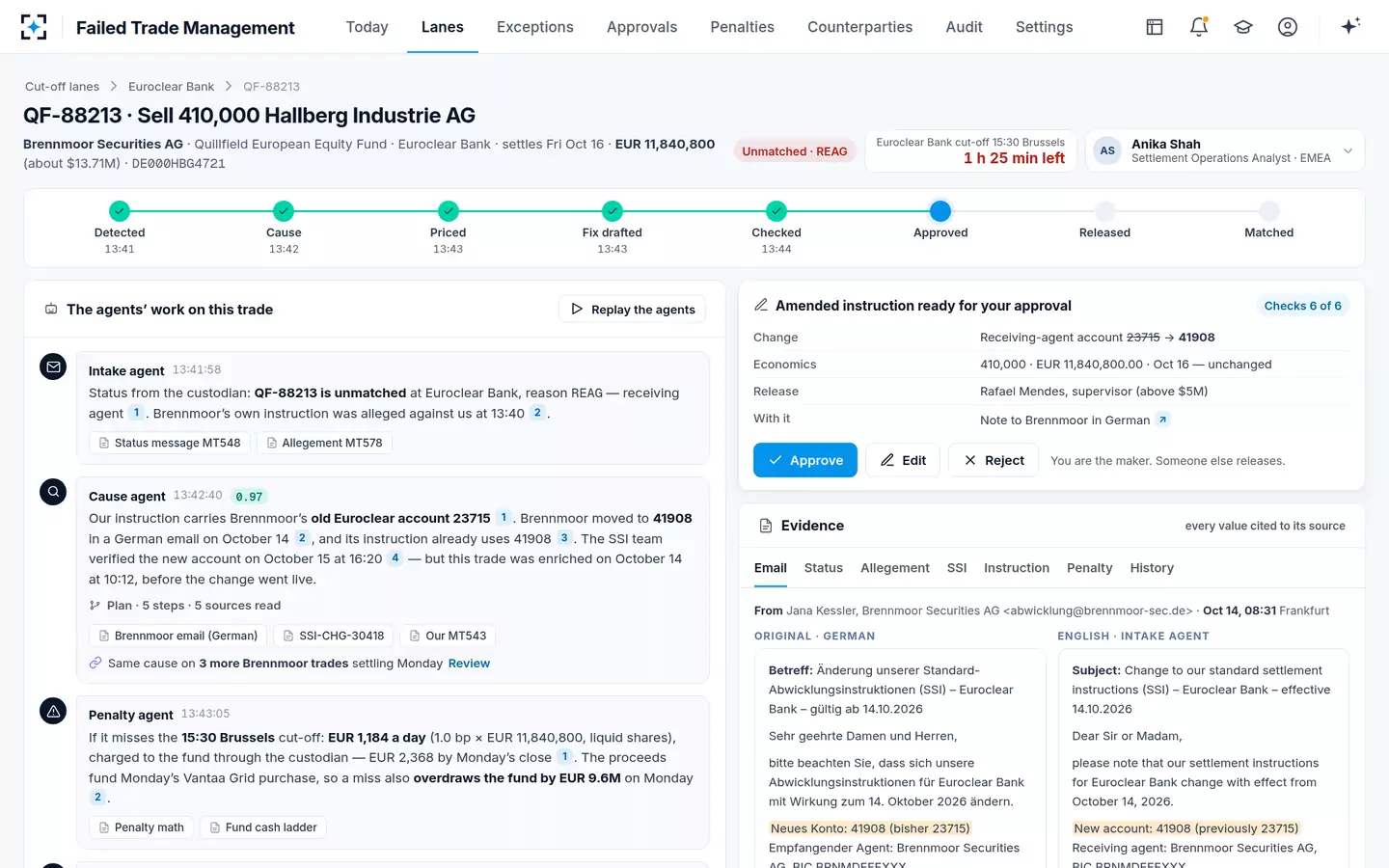
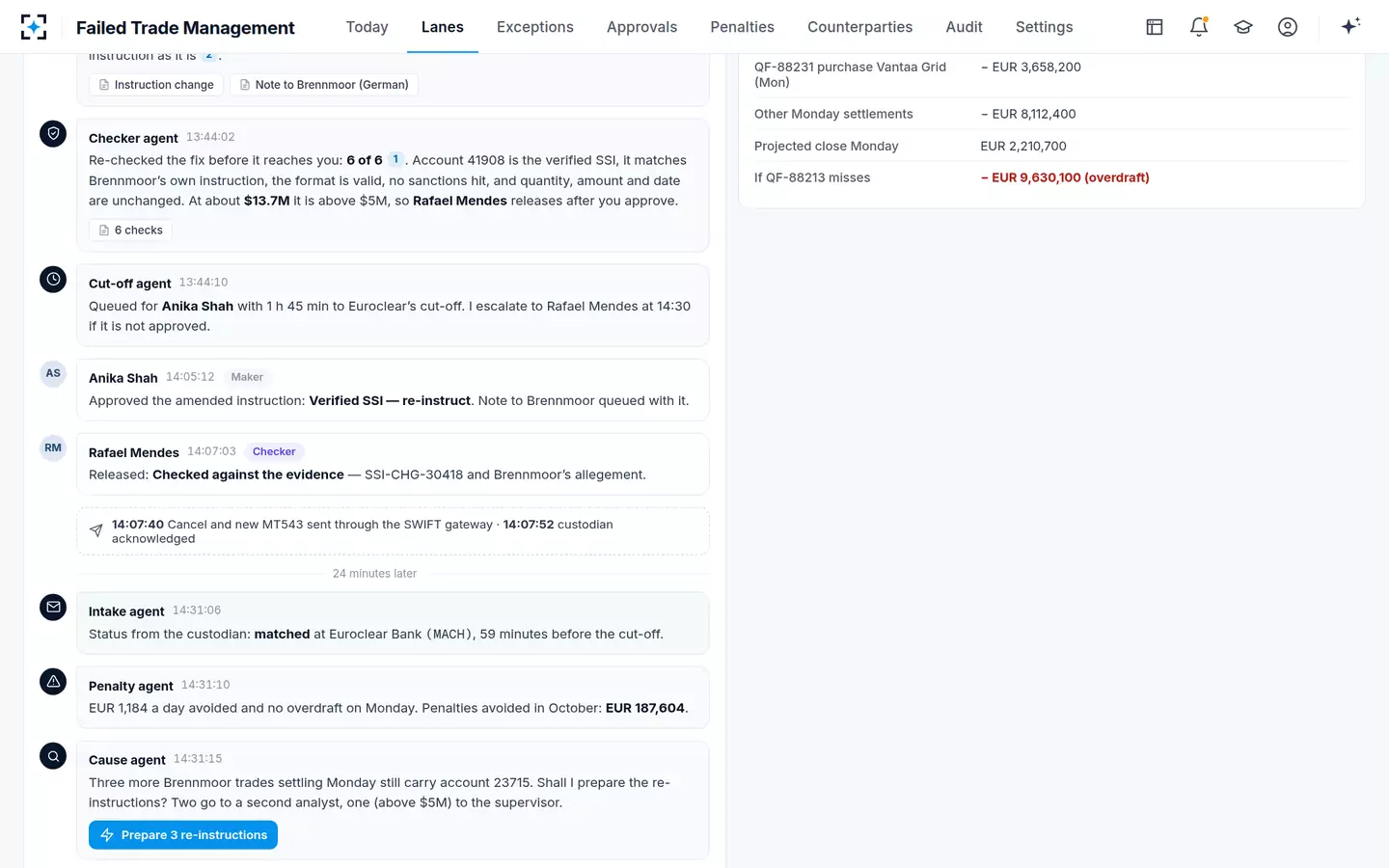
The trade then waited 21 minutes in the analyst's queue, the longest step in the trace and a human one. At 14:05:12 the analyst approved with the reason "Verified SSI — re-instruct". Because the trade was above $5 million, the sample firm's rules sent the release to the settlement supervisor, who released it at 14:07:03 with the reason "Checked against the evidence". The SWIFT gateway sent the cancel and the new instruction at 14:07:40, the custodian acknowledged at 14:07:52, and at 14:31:06 the status came back matched, 59 minutes before Euroclear Bank's 15:30 cut-off. Four seconds later the Penalty agent recorded EUR 1,184 a day avoided; nine seconds later the Cause agent offered to prepare the three Monday re-instructions.
Can AI read custodian status messages and emails?
Yes, and the two need different kinds of reading. Status messages are structured: the status, the reason code and the references can be parsed, and the hard part is linking each one to the right trade when references are missing or rewritten along a chain of custodians. Emails and letters are not: the new account number in Brennmoor's email sat in a German sentence, "Neues Konto: 41908 (bisher 23715)", and Kaito Shoken's offer of a partial delivery was a letter in Japanese.
Two design choices make that reading checkable. The Intake agent keeps the original beside its English, with the same lines highlighted in both, so the analyst can see what was translated. And it never discards a message it cannot link: below a confidence of 0.95 the message waits for a person with the best candidate trades. The reason codes it starts from are explained in MT548 reason codes.
What does an agent do, and what does a person approve?
Agents prepare; people decide anything that moves a position or changes reference data. The division in Failed Trade Management is written into each agent's limits, not left to a policy document.
Seven agents in Failed Trade Management, and what each may never do
Agent
Intake agentReads status messages, allegements, penalty reports, affirmation reports, custodian fails files and counterparty emails in any language; links each to its trade.
Never: discard a message it cannot link, or act on an SSI change: it routes it to the SSI team and flags look-alike senders
Agent
Forecast agentScores tomorrow's settlements for fail risk on trade date and says why.
Never: send a chaser; it proposes pre-chases
Agent
Cause agentNames the real reason for each fail with cited evidence and finds other trades with the same cause.
Never: state a cause without its source; below 0.85 confidence it asks a person
Agent
Penalty agentPrices the CSDR penalty, funding and overdraft cost of a miss; reconciles penalty reports; drafts appeals.
Never: book or dispute a penalty without sign-off
Agent
Chaser agentDrafts the chaser in the counterparty's language and the amended instruction, partial or shape request.
Never: send an instruction, or edit an SSI
Agent
Checker agentRe-validates every fix before a person sees it, on a separate model family from the agent that drafted it.
Never: approve; a failed check blocks release, and a disagreement goes to a person with both arguments
Agent
Cut-off agentPlans the day backward from each market's cut-off in its own time zone and calendar; escalates what will not make it.
Never: change an owner without telling them; escalations notify, they do not act
A person decides
Analyst, second analyst, supervisorThe analyst approves with a reason; a second analyst releases below $5 million; the supervisor releases above it and every partial, shape and buy-in response. Nobody releases what they approved.
Why does a second agent check the first?
Because the failure mode of a drafting agent is a confident, plausible draft, and the cheapest control is an independent check before a person spends attention on it. The Checker agent runs on a separate model family from the agent that drafted the fix and re-derives each check from the sources: is the account in the verified SSI master, does it match the counterparty's own instruction, are quantity, amount and date unchanged. In the sample it re-checked 386 proposed fixes before they reached a person and stopped nine.
One of the nine shows why the check exists. On a Japanese purchase the Chaser agent drafted acceptance of a partial delivery; the Checker agent found the counterparty's instruction was for 300,000 shares against a 320,000-share trade, so accepting would leave 20,000 shares unexplained. Neither agent decided. Both arguments went to the analyst. How to test that a checker actually catches what it should, before go-live, is the subject of AI for settlement exceptions: test it with seeded breaks first.
What is logged for each step?
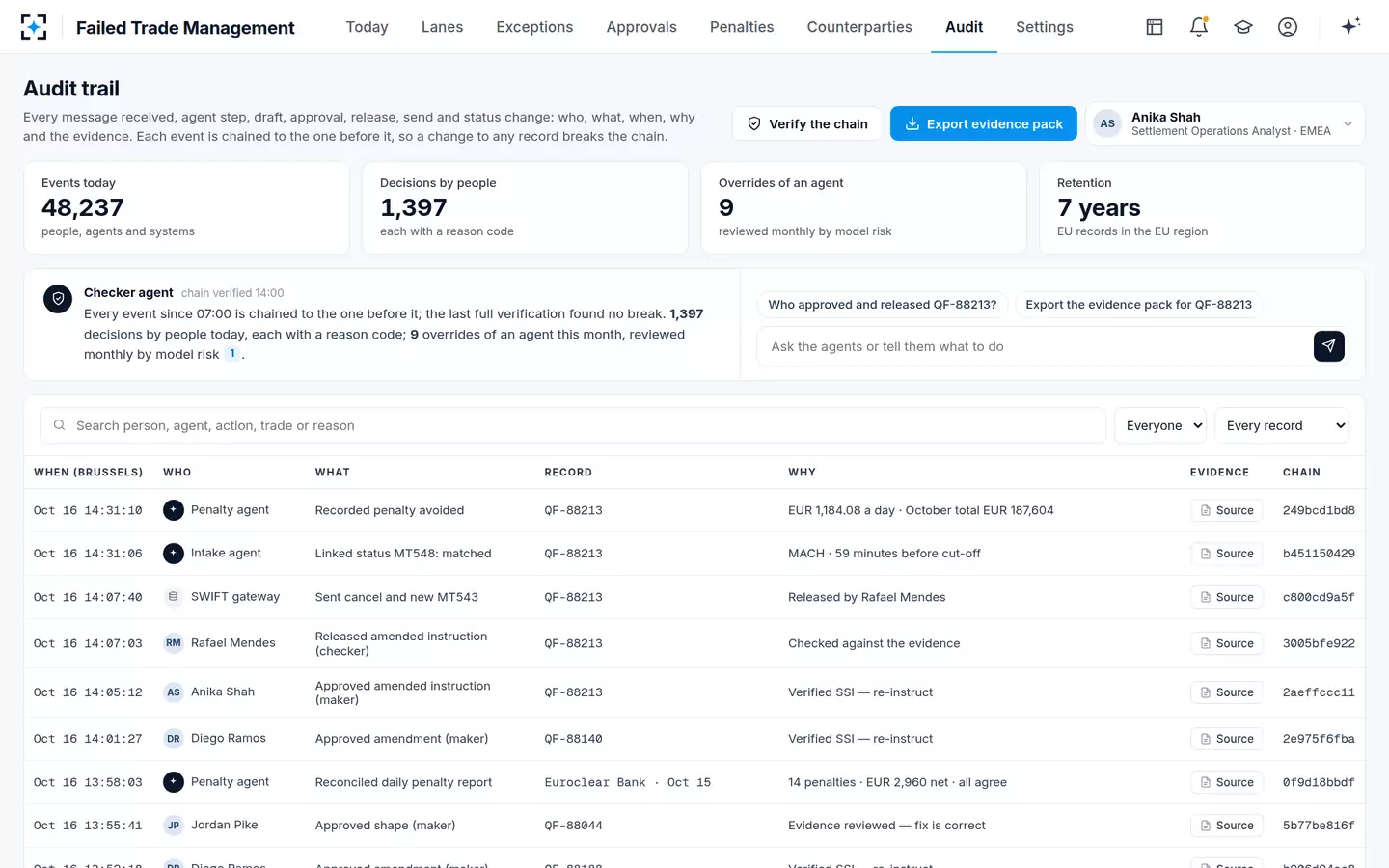
Every message received, agent step, draft, approval, release, send and status change, with who, when, why and the evidence, each event chained to the one before it so that a change to any record breaks the chain. For an adviser this is more than good practice: SEC rules already require advisers to keep each allocation and affirmation with a date and time stamp (Rule 204-2(a)(7)(iii)), and FINRA has long expected firms to have a way of verifying that an emailed instruction really came from the customer (FINRA Regulatory Notice 12-05).
What the audit trail recorded for QF-88213, and why each line matters
| When (Brussels) | Who | What | Why it is on the record |
|---|---|---|---|
| 14:05:12 | Analyst (maker) | Approved amended instruction | Reason "Verified SSI — re-instruct"; the approver cannot also release |
| 14:07:03 | Supervisor (checker) | Released amended instruction | Above $5 million; reason "Checked against the evidence" |
| 14:07:40 | SWIFT gateway | Sent cancel and new instruction | Only what a person released can be sent |
| 14:31:06 | Intake agent | Linked status: matched | 59 minutes before the cut-off |
| 14:31:10 | Penalty agent | Recorded penalty avoided | EUR 1,184.08 a day, priced with the rate table version in force |
| Each line | Chain | Hash of the previous event | Altering any earlier record breaks the chain; the export bundles the evidence for a trade or period |
The audit trail: every person, agent and system event, chained
What do regulators expect of AI agents in settlement operations?
Supervision proportionate to the autonomy, and evidence that it works. FINRA's 2026 oversight report lists the risks of AI agents as autonomy without human validation and approval, acting beyond the user's intended scope and authority, and multi-step reasoning that is hard to trace or audit; among the controls it asks firms to consider are mechanisms that limit what an agent may do, decide or act on (FINRA, 2026 Annual Regulatory Oversight Report). Each risk maps to something visible in the trace above: approval by a person, limits written per agent, and a log of every step.
The SEC's examination division uses its own term for the technology, "super intelligence (SI)", and its fiscal 2027 priorities name back-office operations among the uses of it that examiners will review, alongside fraud prevention and trading (SEC, Division of Examinations, FY2027 priorities). The same document lists, for clearing agencies, the "facilitation of straight-through processing by central matching service providers". A firm that deploys agents on its settlement desk should expect to show how they are monitored, not only that they exist.
What should a buyer look for in AI for trade settlement?
Evidence, limits and a test on your own data. The checklist below is the one we would use to evaluate any system, including ours.
Ten questions to ask of any AI system for trade settlement
- Does every statement cite its source?
A cause without the status message, allegement or email behind it cannot be checked in the minutes before a cut-off.
- What happens below the confidence floor?
The answer should be: it asks a person, with the best candidates, and nothing is discarded.
- Can it send an instruction or edit an SSI on its own?
It should not. Sending belongs to a release by a person; SSI changes to the SSI team after a call-back.
- Is the check independent of the draft?
A second agent on a different model, re-deriving the checks from sources, catches what the first missed.
- Does maker-checker hold for releases?
Nobody releases what they approved; thresholds for supervisor release are settings, changed with a second approval.
- Are cut-offs per market, in local time, with holidays?
And changeable as reviewed settings when a CSD or the regulation moves a deadline.
- Does it read emails and letters in your counterparties' languages, keeping originals?
Most account changes and partial offers arrive that way.
- Is the penalty priced with a versioned rate table?
So a future change to the rates cannot reprice a past month.
- Is every step logged, chained and exportable?
The exported evidence file is what an examiner or auditor will ask for.
- Will the vendor test it on your past fails before you rely on it?
With known exceptions planted in a real month, and a pass mark agreed in advance.
Where AI does not fit on a settlement desk
Agents add least where the work is already structured and rare. A desk settling a few hundred trades a day in one market through one custodian, with clean SSIs and few counterparty emails, may get most of the benefit from rules in its existing systems. Agents also cannot fix what they cannot see: if custodians report status only in a portal with no message feed or export, linking depends on getting that data out first.
Some work should stay out of their reach by design: changing standing settlement instructions, accepting partials or buy-ins, disputing penalties and releasing instructions. Those are decisions with accountability attached, and the value of agents is that they arrive at those decisions with the evidence assembled. The cost of the fails they help avoid is set out in What is a failed trade?, and a timetable for bringing them live before European markets move to T+1 in AI for failed trades: a go-live plan.
Approved, released, matched: the end of the trace
Questions people ask
Can AI predict settlement fails before they happen?
It can score them. In the sample, the Forecast agent scored Monday's 31,980 settlements on Friday and flagged 214 as at risk; over the previous 20 days, 38% of trades it flagged failed against 0.86% of all trades. That is the sample's own back-test, not a measured customer result, and the agent only proposes pre-chases.
Does AI in settlement replace the SWIFT gateway or the custodian?
No. It sits beside them: messages come in from custodians and central matching as they do today, and instructions go out through the existing gateway, but only after a person releases them. Nothing about the settlement chain itself changes.
How accurate does AI need to be for trade settlement?
No regulator publishes a pass mark. What matters is that errors are caught before release: a confidence floor below which the agent asks, an independent checker, and maker-checker release. Measure linking and cause accuracy on your own past exceptions with known answers before relying on it.
Is AI in trade settlement allowed under SEC and FINRA rules?
Using it is not prohibited; the existing obligations, books and records, supervision and verification of instructions, still apply, and examiners will look at how it is monitored. FINRA's 2026 report and the SEC's fiscal 2027 priorities both address the use of AI and, in the SEC's words, super intelligence in back-office work.
What data does AI need to work on settlement exceptions?
Trades and allocations, custodian status and allegement messages, penalty reports, affirmation status from central matching, positions and cash from portfolio accounting, the SSI master read-only, and the settlement mailboxes. Without the mailboxes, it misses the account changes and partial offers that arrive by email.