The main T+1 settlement challenge for an operations team is time: an unmatched trade that a two-day cycle let the desk fix the next morning now has to be found and fixed on trade date or in the hours before the settlement-date cut-off, and in the EU every fail costs a cash penalty from its first day. That turns the settlement desk into a sequence of local deadlines (US affirmation by the end of trade date, EU allocations by 23:00 CET from 7 December 2026, EU and UK settlement on T+1 from 11 October 2027) and puts pressure on three things a head of settlements controls: how the desk is staffed across the trade-date evening, how much analyst time goes on reading and re-keying rather than deciding, and who may release what. Botminds' Failed Trade Management reads custodian status messages, allegements and counterparty correspondence, finds each fail's cause and drafts a checked fix, so the desk's people spend the scarce hours on decisions.
This guide is for the head of settlements, the chief operating officer and the settlement supervisors of an asset manager. The day described is a composite built on the solution's fictional sample firm, whose EMEA settlement desk works from London; its cut-offs are the sample's settings.
A London settlement desk's day is set by other markets' clocks
- Overnight fails, aging07:00–09:00
- Statuses and causes09:00–12:00
- Chasing to the 14:30 and 15:00 cut-offs12:00–15:00
- Penalties, hand-over15:00–18:00
- Review
- Decide what needs a person08:00–11:00
- Counterparties, partials, escalations11:00–15:00
- Penalties, tomorrow's causes15:00–18:00
What are the operational challenges of T+1 settlement?
Three, for an asset manager's settlement desk: a compressed and later working day, more deadlines in more time zones, and less time to fix each break before it becomes a fail. Under T+2 an exception found on the morning after trade date had a day to be fixed; under T+1 the same discovery is on settlement date itself. The SEC's rule asks brokers to complete allocation, confirmation and affirmation by the end of trade date, and an adviser must keep each allocation and affirmation with a date and time stamp (SEC Rule 204-2(a)(7)(iii)).
Europe adds cost to the clock. Every EU fail that a trade-date evening misses draws a CSDR cash penalty from the first day, and when ESMA consulted on the penalty regime, most respondents expected settlement efficiency to worsen "at least in the short term" after the move (ESMA, technical advice on the CSDR penalty mechanism, November 2024). What a penalty costs, line by line, is set out in CSDR penalties calculation.
The deadlines a T+1 desk works to, in their own time zones
Every market has its own cut-off, every custodian an earlier one for instructions it must pass on, and each regulator a trade-date deadline for allocation, confirmation and instruction. A global desk works all of them in local time with local holidays, so the head of settlements' first artefact is the cut-off calendar and the second is the rota built on it.
The deadlines on a European and US settlement desk, in their own time zones
| Deadline | Time | What must be done | Set by |
|---|---|---|---|
| DTC (US) amendment cut-off | 14:00 New York | Last amendment that can still settle today | The sample's settings |
| Euroclear Bank cut-off | 15:30 Brussels | Last amendment for today's settlement | The sample's settings |
| CREST cut-off | 15:00 London | Last amendment for today's settlement | The sample's settings |
| US trade-date affirmation | End of trade date | Allocation, confirmation and affirmation completed, or procedures designed to do so | SEC Rule 15c6-2 |
| EU allocations and confirmations | 23:00 CET on trade date, from 7 Dec 2026 | Professional clients' allocations and confirmations received by the broker | Regulation (EU) 2026/1536 |
| EU settlement instructions | 23:59 CET on trade date, where feasible, from 11 Oct 2027 | Instructions at the CSD | Regulation (EU) 2026/1536 |
| UK allocations and confirmations | 23:59 UK time on trade date | Electronic allocation and confirmation | UK Technical Group, SETT 01 |
| UK settlement instructions | 05:59 UK time on T+1, from 11 Oct 2027 | Instructions at the CSD | UK Technical Group, SETT 02 |
The regulatory deadlines push the desk's day later as well as earlier. A London desk can no longer leave European allocations to the next morning once 23:00 CET applies from December 2026, and the UK plan extends CREST's trade-date instruction input to 21:00 (UK Technical Group, February 2025). The full EU and UK timetable is in T+1 settlement in Europe: every deadline to October 2027.
How should a settlement desk be staffed for T+1?
By cut-off, not by office hours: the rota should put a decision-maker on every deadline the firm's markets impose, including a trade-date evening that a single-shift London desk does not cover. Three patterns work. A follow-the-sun hand-over between regional desks, with the cases, causes and evidence passed in writing; a late shift in each region that owns the trade-date allocation and instruction deadlines; or a smaller late shift backed by automation that prepares each break so one person can decide many.
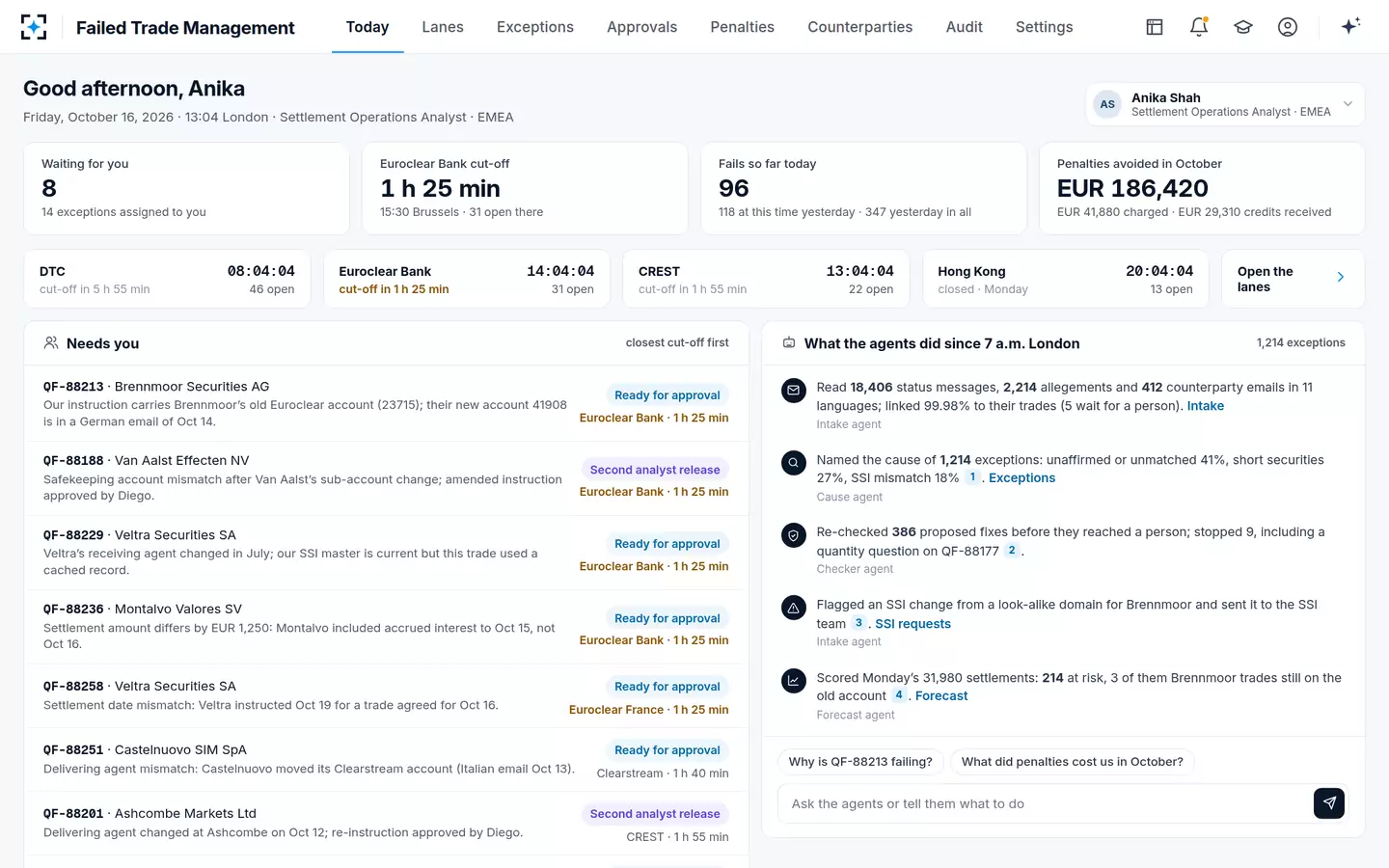
The US experience sets the standard the evening has to meet. The SEC chair reported the trade-date affirmation rate at 73% in January 2024 and "approximately 95 percent at 9 p.m. ET" the day after the switch (Gensler, June 20, 2024). That gave US desks a new evening metric, the share of trades affirmed by 9 p.m. Eastern on trade date. In the sample, 96.6% of Thursday's US trades, 6,002 of 6,214, were affirmed by then, and the design goal is that each of the rest is chased before then.
Three ways to cover the T+1 trade-date evening
| Pattern | How it works | What it needs | Where it breaks |
|---|---|---|---|
| Follow the sun | London hands open breaks to New York, New York to Asia | A written hand-over: case, cause, evidence, next step | Context lost at hand-over; the receiving desk re-reads everything |
| Regional late shift | Each region staffs its own trade-date evening | Headcount for two shifts; rota cover for holidays | Cost; thin cover on the late shift |
| Late shift with automation | Agents prepare each break; one person decides many | Cited causes and checked fixes ready before the person arrives | Only as good as the evidence the agents attach |
Is hiring for the evening enough?
The UK's own T+1 plan says no. The Accelerated Settlement Technical Group states that "relying on the expediency of adding manual resource should not be considered as anything other than a short-term work around whilst automated solutions are developed." It draws the lesson from North America: reviews of the US move "suggest that whilst the overall implementation was successful, insufficient focus may have been given to automation, leading to firms having to deal with increased volumes of manual processing and exception management post-implementation, in turn leading to increased staffing costs, higher risk of settlement failure and reduced capacity to respond to market events."
The group names standing settlement instructions as one of the areas where automation is critical: all UK participants "are expected to use Standard Settlement Instructions," and changes "should be notified in good time before the change is effective ideally using a market standard automated solution," where possible before the trade is executed. For the desk that means the email in German announcing a new account is the exception the market is trying to remove, and the control around it, the call-back by the SSI team, has to survive until it is gone.
A worked staffing case shows why the two approaches diverge. Take the solution's estimate of five analyst-days of exception work a day by hand, and suppose an illustrative 30% of it arrives after 17:00 London, from late allocations, US trades and the EU's trade-date deadlines. By hand that is 1.5 analyst-days of evening work, two people on a late shift once breaks and holidays are covered, every night of the year. On the solution's estimate of 1.3 analyst-days with the agents preparing each break, the same 30% is about 0.4 analyst-days: one person, backed by the regional desk that hands over. The estimate is the solution's, not a measurement, which is why the firm's own evening volume should be measured before the rota is set.
Where does the settlement desk's time go?
Mostly on finding and moving information, not on deciding. Failed Trade Management's estimate for a desk of six settlement analysts puts a day's exception work at five analyst-days, of which the largest block, a quarter, is finding the counterparty's instruction in emails and letters. Reading status codes and re-keying take another two-fifths.
Where a six-analyst desk's day on settlement fails goes, before and after
By hand · 5.0 analyst-days
- Reading status codes in portals · 20%
- Finding the counterparty's instruction · 25%
- Checking SSIs, pricing the miss · 15%
- Drafting chasers, re-keying · 20%
- Second checks, releases · 10%
- Penalty reports, tracking · 10%
With the agents · 1.3 analyst-days
- Reading statuses · 11.5%
- Instructions · 15.4%
- SSIs, pricing · 11.5%
- Chasers · 23.1%
- Checks, releases · 30.8%
- Penalties · 7.7%
The second bar is the staffing argument. Second checks and releases barely shrink, from 0.5 to 0.4 analyst-days, because they are decisions and stay with people. What shrinks is reading, searching and typing. ESMA's respondents blamed late instructions on limited automation and on poor data arriving through non-standard channels and manual re-keying (ESMA, 2024), which describes an analyst re-keying an account number from an email; removing the re-keying removes a cause of fails as well as an hour of work.
Who should decide what on a T+1 desk?
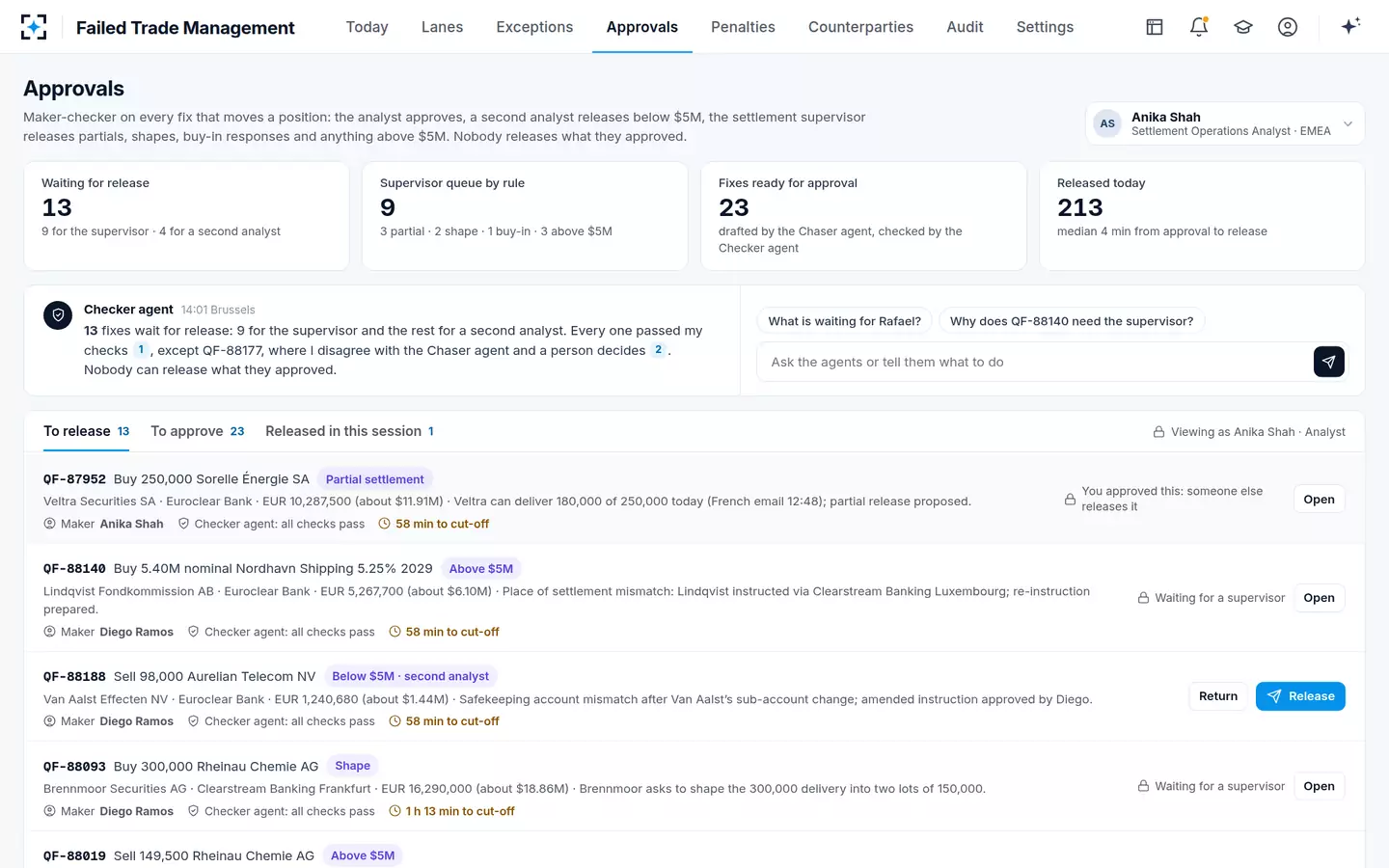
Decision rights should be written by rule: what an analyst may approve, what needs a second person, and what only the supervisor may release. Under T+1 the rule also needs a clock, because a decision that arrives after the cut-off has decided nothing. The sample firm routes partials, shapes, buy-in responses and anything above $5 million to the supervisor, sends smaller fixes to a second analyst, alerts the supervisor 60 minutes before each market's cut-off, and keeps every change to standing settlement instructions with the SSI team after a call-back.
Five people on a settlement desk, by hand and with Failed Trade Management
Today
Reads reason codes in custodian portals, hunts for a counterparty's new account in a shared mailbox, often in German or French, and re-keys the instruction under the clock.
With agents
Opens each trade with the cause cited, the miss priced and a checked fix drafted; reads the evidence, asks what she needs and approves with a reason.
Still theirs: The decision to re-instruct, and the reason recorded with it
Today
Releases partials, shapes, buy-in responses and anything above $5 million, reassembling each case before putting his name to it.
With agents
Works one queue sorted by the rule that sent each item there, each with the second agent's check, and is alerted 60 minutes before a market's cut-off.
Still theirs: Release authority above the firm's threshold
Today
Answers to the COO and fund boards for fail rates and penalties, from spreadsheets rebuilt each month.
With agents
Signs off the month-end penalty reconciliation the supervisor prepares, with disputes and unpaid credits listed.
Still theirs: Sign-off of the penalty month and the fail report
Today
Takes repeat-failing counterparties to service reviews and asks for the evidence first.
With agents
Opens a counterparty's scorecard: fail rate, causes, open trades and the change behind them.
Still theirs: The conversation with the counterparty's head of settlements
Today
Guards the standing settlement instructions against changes that arrive by email, including ones that only look genuine.
With agents
Calls back on the number on file before approving a change; sees look-alike senders flagged before anyone acts.
Still theirs: Every change to the SSI master
Decision rights for a T+1 settlement desk
- Analyst approves fixes, never releases them
Amendments, re-instructions and chasers, each approved with a reason.
- Second person releases below the threshold
Another analyst for routine fixes under the firm's value limit, $5 million in the sample.
- Supervisor releases by rule
Partials, shapes, buy-in responses and anything above the threshold.
- Escalation on a clock
A set time before each market's cut-off, 60 minutes in the sample, for anything that will not settle.
- SSI changes stay with the SSI team
Recorded only after a call-back on the number on file; never edited by the desk.
- Penalty month signed by the head of trade support
The supervisor prepares the reconciliation; disputes and unpaid credits listed.
What does T+1 mean for standing settlement instruction changes?
It shortens the time to verify a change before it is used, which is when fraudulent and mistaken changes do most harm. A counterparty's new account number that arrives by email on trade date and is keyed the same evening can settle the next morning; under T+2 there was a day to call back. The control does not change with the cycle: a change to the standing settlement instruction master is recorded only by the SSI team, only after a call-back on the number already on file, never by the analyst who needs the trade to settle.
In the sample the analyst's queue held a counterparty's change of account in German, and the settlement fix waited on the SSI team's call-back rather than on the email. Failed Trade Management flags look-alike sender domains before anyone acts and routes every SSI change to the SSI checker; the desk can see that the fix is blocked and why, which is the information it needs to escalate before the cut-off rather than to bypass the control.
Securities lending recalls and FX: deadlines the desk inherits from upstream
Two causes of T+1 fails sit outside the settlement desk: a lent security sold before it is recalled, and a currency not in place to pay for a purchase. Both get shorter under T+1, and the UK plan writes actions for each.
On lending, action SFT 01 asks lending intermediaries and borrowers to "automate recalls processing" with standardised electronic messaging, to be completed by 31 December 2026. SFT 02 aligns "the operational deadline for instructing next day stock lending recalls" with the close of trading on the London Stock Exchange from 11 October 2027. And SFT 04 puts a duty on the buy side: participants "will provide notification to lending intermediaries of any sales as soon as possible after execution to expedite any potential recalls." A portfolio manager who sells a lent position at 16:00 and the order system tells the lending agent the next morning has created tomorrow's fail. The settlement desk sees it first, so the head of settlements has an interest in the order-to-lending-agent feed even though another team owns it.
On currency, action FX 03.00 asks participants to make sure "CLS eligible FX transactions continue to settle in CLS" by engaging with CLS and custodians on instruction methods, including "cut-off alignment after UK market close" and handling of currency holidays, and FX 02.00 asks firms to review practices for FX trades settling outside payment-versus-payment. For a European fund buying US shares, the dollar purchase now has one day instead of two; an FX trade executed late enough to miss the CLS cycle settles outside it, with the principal risk that brings, or leaves the securities purchase unfunded. A desk's fail analysis should carry an "upstream" cause for both, so the conversation with the lending and FX teams starts from counts rather than anecdote.
What T+1 metrics should a head of settlements track?
Track the ones that show whether the desk is beating the clock: trade-date affirmation by the evening deadline, fails by cause and counterparty, penalties paid and received by fund, and time from approval to release. A fail rate alone says how bad the day was; a fail rate by cause says what to change, and by counterparty says whom to call.
The sample desk's day in four numbers
96.6%
of Thursday's US trades affirmed by 9 p.m. Eastern on trade date (6,002 of 6,214)
96
fails so far by 13:04 London, against 118 at the same time the day before
EUR 186,420
of CSDR penalties avoided in October to date
4 min
median time from approval to release, 213 releases that day
The analyst's afternoon: the list sorted by the closest cut-off
Is automation on the settlement desk accepted by regulators?
Automation of the reading and routing is common; fully autonomous decisions are rare, and firms keep accountability with named people. Operations was the largest area of reported AI use cases in the Bank of England and FCA's 2024 survey of UK financial firms, with 118 firms responding, and only 2% of use cases let the system decide entirely on its own (Bank of England and FCA, Artificial intelligence in UK financial services, 2024). A desk that automates should be able to show, for each released fix, the evidence the agent used, the person who approved it and the person who released it.
Languages are part of the case. In the sample, the queue held a counterparty's change of account in German and a delivery offer in Japanese; the Intake agent translated both and kept the originals beside the English, so the analyst decides from the source. Whether agents can be trusted with the reading is a question to test before buying, as set out in AI for settlement exceptions: test it with seeded breaks first.
What the supervisor sees: releases queued by the rule that sent them
The go-live sequence for a desk that must be ready before 11 October 2027 is in AI for failed trades: a go-live plan that lands before EU T+1, and the agents, the cut-off clocks and the approval rules are on the Failed Trade Management page.
Questions people ask
What are the biggest challenges of T+1 settlement for asset managers?
Less time to fix each break, deadlines that move into the trade-date evening, and in the EU a cash penalty from the first day of a fail. The US move in May 2024 lifted trade-date affirmation from 73% in January 2024 to about 95% by 9 p.m. Eastern, which shows what the evening has to achieve.
When does Europe move to T+1?
On 11 October 2027, in the EU and the UK. EU allocations and confirmations for professional clients are due by 23:00 CET on trade date from 7 December 2026, under Delegated Regulation (EU) 2026/1536.
Does T+1 require a late shift on the settlement desk?
Not by rule, but the deadlines usually do. A London desk that stops at 18:00 misses the 23:00 CET EU allocation deadline and the UK's 23:59 allocation deadline unless another region or an automated process covers them.
Who should release a settlement fix?
Someone other than the person who approved it. The sample firm sends partials, shapes, buy-in responses and anything above $5 million to the supervisor and routine fixes to a second analyst, with an alert 60 minutes before each cut-off.
What records must an adviser keep for T+1 affirmation?
For transactions subject to Rule 15c6-2(a), SEC Rule 204-2(a)(7)(iii) requires an adviser to keep each confirmation received and any allocation and each affirmation sent or received, with a date and time stamp for each allocation and affirmation.
How much of settlement exception work can be automated?
The reading, searching and re-keying, which is most of it by Failed Trade Management's estimate: five analyst-days of exception work falls to about 1.3, while second checks and releases fall only from 0.5 to 0.4 analyst-days because they stay with people. A firm should measure its own baseline first.