Settlement efficiency is the proportion of settlement instructions, by number or by value, that settle on their intended settlement date; its complement is the fail rate, which in the EU averaged 7.14% of instructions a month between March 2023 and February 2024. Partial settlement is one of the few tools that raises it without anyone finding more securities: when a seller holds only part of what it sold, the settlement system delivers that part against payment and leaves a smaller fail for the rest. The buyer gets most of its securities, the seller gets most of its cash, and the daily CSDR penalty falls in proportion. The EU has now made the tool universal: from 11 October 2027 every CSD must offer automatic partial settlement, with an opt-out, and the UK's T+1 plan asks firms to use it systematically by the end of 2026. That turns a fund's partial policy into a cost decision. Botminds' Failed Trade Management drafts partial and shaping requests from the counterparty's own words, checks them, and leaves every acceptance to a supervisor.
Rules and figures come from EU regulations, ESMA, the European Central Bank's specifications for its settlement platform and the UK Technical Group's report. The worked sale is illustrative; product examples come from the solution's fictional sample firm, Quillfield Capital.
The same EUR 10 million sale, with 70% of the shares available: fail it, partial it, or shape it
Fail the whole trade: Nothing. 400,000 shares stay with the seller.
Partial settlement today: 280,000 shares delivered against EUR 7.0 million.
Fail the whole trade: 400,000 shares, EUR 10.0 million.
Partial settlement today: 120,000 shares, EUR 3.0 million, recycled for tomorrow.
Fail the whole trade: EUR 1,000 to the seller's side.
Partial settlement today: EUR 300 on the 120,000 still unsettled.
Fail the whole trade: None until the whole delivery settles.
Partial settlement today: EUR 7.0 million today, available for its next purchase.
Fail the whole trade: No shares; a fail to receive on the full lot.
Partial settlement today: 70% of the shares; a fail to receive on the rest.
Fail the whole trade: —
Partial settlement today: Two shapes settle (200,000 shares, EUR 5.0 million); two fail (EUR 500 penalty). Shaping helps most where partials are not available or accepted.
What is settlement efficiency?
Settlement efficiency measures how much of what was due to settle on a day actually did. The EU measures it at the CSD level, from the settlement fails every CSD must report: CSDR requires each CSD to run "a system that monitors settlement fails" and report "the number and details of settlement fails" to its regulator, including "the measures envisaged by the CSD and its participants to improve settlement efficiency" (CSDR Article 7(1), as amended). From 1 July 2027 those reports become monthly, carry the reason for each fail and name the top failing participants.
The measure is simple; comparing it is not. ESMA warns that "the differences in the way settlement efficiency is measured in the EU and in other jurisdictions makes comparisons very difficult" (ESMA, T+1 assessment report, paragraph 140), and respondents to its penalty consultation complained that CSDs "have introduced differences in the fail reporting parameters, leading to divergences even between CSDs in the same group" (ESMA, CSDR penalty mechanism final report, 2024). A fund measuring its own efficiency should define it once, by number and by value, per market, and keep the definition fixed.
How efficient is EU settlement today?
About 93 instructions in 100 settle on time, on ESMA's latest published averages, and much worse for some instruments.
EU settlement efficiency in four numbers
7.14%
of instructions failed on average each month, March 2023 to February 2024
17.32%
of ETF settlement instructions failed, by volume, June 2023 to May 2024
6.6% → 3.8%
T2S fail rate by value, January 2022 to January 2024, as cited by respondents
EUR 2.5bn
a year: the fail value below which a CSD could skip partial settlement until October 2027
ESMA's own reading is that fails have fallen since cash penalties started in February 2022, but that the decrease "can however be considered subdued", and that "certain asset classes, in particular ETFs, are still associated with high levels of settlement fails". That is the gap partial settlement is meant to close: most fails are not a total absence of securities but a shortfall, and a system that delivers the part that exists settles most of the value.
What is partial settlement?
Partial settlement is the delivery of part of the quantity in a settlement instruction, against the corresponding part of the cash, with the rest left pending. ESMA's definition puts the decision with the receiver: partials occur "when a buyer accepts a delivery of less than the contracted amount", and "partial delivery does not fully satisfy the contractual obligation of the seller" (ESMA, T+1 report, footnote 74).
"Unlike shaping (which is an operational action by the seller), partial is a decision made by the buyer. The seller remains obliged to complete the full delivery."
ESMA, Report on the assessment of the shortening of the settlement cycle in the EU, November 2024
In practice there are two kinds. Automatic partialling happens inside the settlement system: it settles whatever the deliverer's account holds, if neither side has opted out. Manual partials are agreed between the parties, often after a counterparty writes to offer part of a delivery now and the rest later. The second kind is where judgement comes in, because the offer and the instruction do not always say the same thing.
Do all EU CSDs have to offer auto-partial settlement?
Yes, from 11 October 2027. Every CSD "shall have a functionality that enables the automatic partial settlement of a transaction based on the availability of securities in the deliverer's account, without requiring manual intervention", and matched instructions are eligible for it "unless one of the participants opts out from partial settlement" (Delegated Regulation (EU) 2026/1536, Article 1(5)). Until then the 2018 rule applies: CSDs "shall allow for the partial settlement of settlement instructions", but a CSD with low fail levels could rely on a derogation (2018/1229, Articles 10 and 12).
The Commission gave its reason in the regulation itself: "The effective contribution to settlement efficiency by auto-partial settlement and by the hold and release functionalities has become evident since the application of the settlement discipline regime." From the same date, when a mandatory buy-in's extension period ends and some of the securities are available, the parties "shall partially settle the initial settlement instruction" unless it is on hold, a rule that matters only if the Commission ever switches buy-ins on.
Can I opt out of partialling?
Yes. The EU rule makes automatic partial settlement the default for matched instructions but lets either participant opt out, and recital 8 explains why: the functionality "is not necessary in all cases". The question for a fund is not whether it may opt out but when it should, and that is a policy the operations head, the portfolio managers and the custodian agree in advance.
When a fund might refuse a partial, and what refusing costs
| Situation | Why refuse the partial | What refusing costs |
|---|---|---|
| Onward delivery of the full lot | A partial receipt cannot cover a full onward sale; the fund fails its next buyer anyway. | The whole receipt fails; the seller's side is penalised on all of it. |
| Odd lots or minimum denominations | A bond partial may need to respect the security's minimum denomination; small residues can be hard to trade. | Usually little: the residue settles when the seller delivers. |
| Corporate action pending | Splitting a position across a record date complicates entitlements and claims. | Penalty on the full quantity for the days until the event clears. |
| Doubt about the quantity | The offer and the instruction disagree: a partial would hide a quantity mismatch. | A short delay while the quantity is confirmed, then partial or not. |
| None of the above | There is rarely a reason to refuse: a partial settles value, frees cash and cuts the penalty. | — |
What is hold and release?
Hold and release lets a participant send an instruction early and stop it from settling until it chooses. The EU rules require CSDs to provide "a hold mechanism that allows pending settlement instructions to be blocked by the instructing participant for the purpose of settlement" and a release mechanism (2018/1229, Article 8); from 11 October 2027 held instructions can be "totally or partially released" (2026/1536, Article 1(4)). It lets a custodian instruct and match on trade date while still waiting for its client's approval or funding, which is exactly what T+1 needs.
A hold has a cost if it is left on. In T2S an instruction on hold by its own party at the cut-off is coded PREA and is eligible for a penalty; a counterparty's hold, PRCY, is not (ECB, T2S UDFS, Failing Reasons Dictionary). The UK plan asks the brokerage and custodian communities to agree a market practice for "systematic implementation where necessary, of the existing Hold & Release functionality" and use it from 2026 (UK Technical Group, SETT 10). The status codes that reveal a forgotten hold are in MT548 reason codes.
What is shaping?
Shaping splits one large delivery into several smaller ones before settlement. ESMA describes it as "an operational process in which instructions for the delivery of a large amount of collateral are divided into smaller deliveries or 'shapes'", whose "primary goal is to limit the economic impact of settlement failures", and stresses that "Shaping does not alter the underlying transaction" (ESMA, T+1 report, footnote 73).
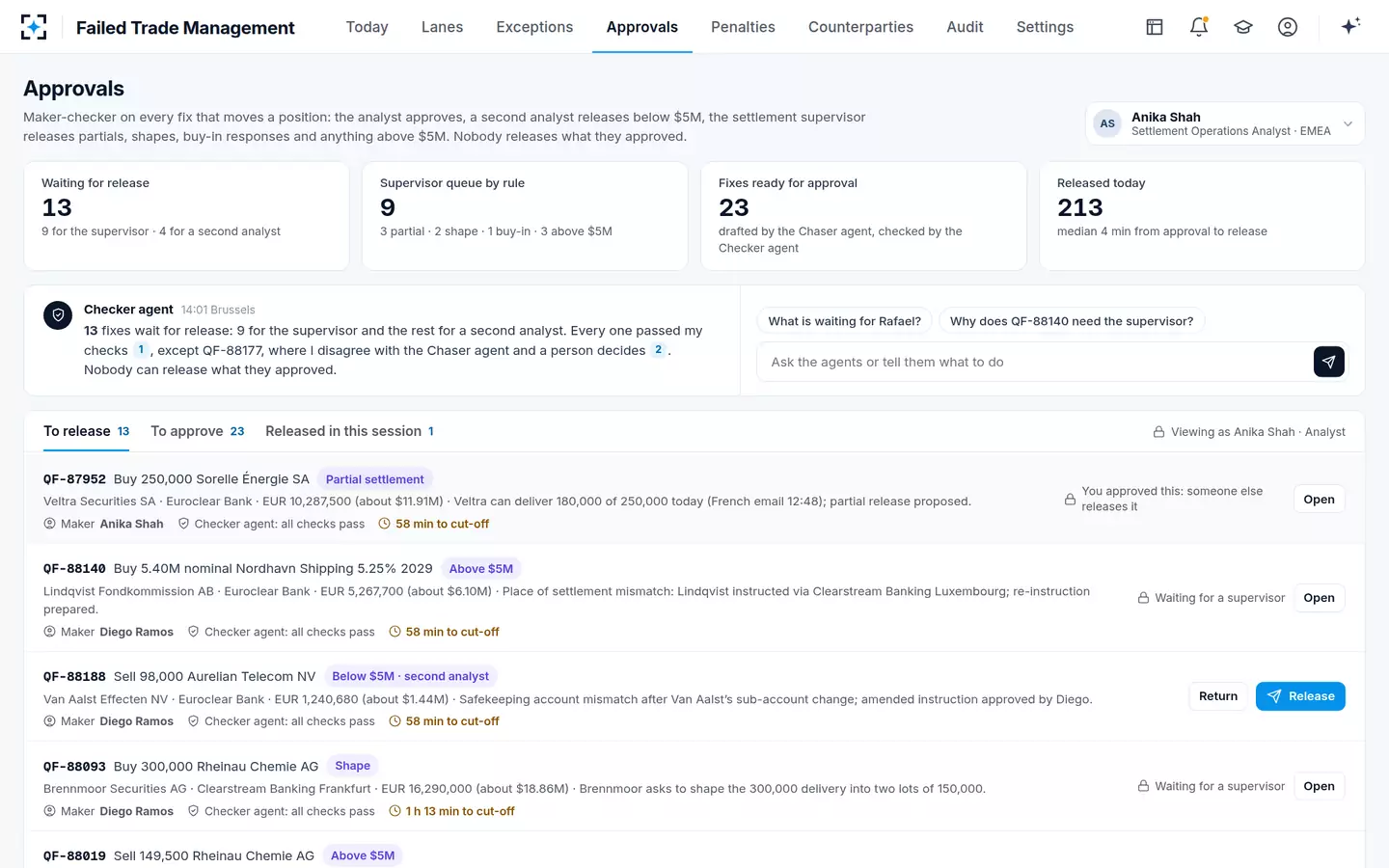
Shaping helps when a delivery is too large to settle in one piece, or where the receiver will not partial. Each shape settles or fails on its own, so a seller with most of the securities can deliver most of the shapes. The UK plan asks for "Auto shaping usage" to be "implemented and used systematically by all Market Participants" by 31 December 2026 (UK Technical Group, SETT 08). In the sample, a counterparty asked Quillfield to shape a 300,000-share delivery into two lots of 150,000; the request sat in the supervisor's queue, because shapes, like partials, are the supervisor's to release.
Does a partial settlement stop the CSDR penalty on the rest?
It stops it on the part that settles, not on the rest. Penalties are calculated per failing instruction per business day, and T2S's worked examples price each one on the "Quantity failed to settle" (T2S UDFS, penalty calculation). In the example at the top of this page, a partial of 70% cuts the day's penalty from EUR 1,000 to EUR 300; the remaining EUR 300 a day continues until the seller delivers the rest or the parties cancel it. How each day's amount is computed is set out in CSDR penalties calculation.
The bigger saving is usually the cash. A seller that receives 70% of its proceeds today can pay for its own purchases; a buyer that receives 70% of its securities can meet most of an onward delivery. In the sample, the cost Quillfield's Penalty agent flagged on a failing EUR 11.8 million sale was not the EUR 1,184 daily penalty but a EUR 9.6 million overdraft on the fund's Monday purchase.
Who decides a partial in Failed Trade Management?
A person, every time. The agents read the counterparty's offer, draft the acceptance and check it; the analyst approves; the settlement supervisor releases every partial and every shape, whatever the amount. The sample shows why the check matters. Kaito Shoken's letter, in Japanese, offered 300,000 Kinsei Robotics shares on Monday and "the remainder" on Tuesday; the Chaser agent drafted an acceptance; the Checker agent pointed out that Quillfield's trade was for 320,000 and Kaito's instruction for 300,000, so accepting would leave 20,000 shares unexplained.
A partial delivery offer through Failed Trade Management
Agent
Read the offerThe Intake agent links the counterparty's letter or email, in any language, to the trade and keeps the original beside the English.
Never: act on a message it cannot link with confidence
Agent
Draft the acceptanceThe Chaser agent drafts the partial or shape request and a reply in the counterparty's language.
Never: accept a partial, shape or buy-in
Agent
Check quantity and economicsThe Checker agent compares the offer, the trade and the counterparty's own instruction; a disagreement goes to a person with both arguments.
Never: approve; a failed check blocks release
A person decides
Analyst decidesAccept the partial, or query the quantity with the counterparty, with a reason recorded.
A person decides
Supervisor releasesEvery partial and shape is the supervisor's to release; nobody releases what they approved.
Partials and shapes wait for the supervisor in Failed Trade Management
Questions people ask
When do the UK T+1 actions on partials apply?
The UK Technical Group asks for automatic partialling and splitting (SETT 07) and auto shaping (SETT 08) to be used systematically by all market participants from 1 February 2025, completed by 31 December 2026, ahead of the planned move to T+1 on 11 October 2027. They are industry actions endorsed by the government, not regulation.
Does a partially settled trade still count as a settlement fail?
Yes, for the unsettled part. In ESMA's T2S duration analysis, transactions that are partially settled at the end of the day are classified as failed, and the penalty is calculated on the quantity that failed to settle. The settled part counts as settled.
What is partial release?
Partial release lets a participant release part of an instruction it has put on hold, so that part can settle while the rest stays held. The EU adds it to the hold-and-release mechanism CSDs must offer from 11 October 2027. It is the instructing party's tool, whereas a partial settlement depends on what the deliverer's account holds.
Is partial settlement the same as a partial fill?
No. A partial fill is an execution: only part of an order was traded. Partial settlement happens after the trade, when part of an agreed quantity is delivered. A partially filled order produces a smaller trade that can settle in full; a partially settled trade still owes the rest.
Why do ETFs fail so often in the EU?
ESMA reports 17.32% of ETF instructions failing by volume between June 2023 and May 2024. Respondents to its penalty review pointed to the intrinsic characteristics of ETFs, such as ETFs issued in a different time zone, or with different trading times, from their underlying instruments, and ESMA proposed raising the penalty rate for the category that includes them from 0.5 to 0.75 basis point. Partials help most where some of the units are already in place.