A CSDR penalty is calculated for each settlement instruction that fails, for each business day it stays failed after its intended settlement date: the penalty rate for the type of instrument, set in Commission Delegated Regulation (EU) 2017/389, multiplied by the instruction's reference price, which is the quantity that failed times that day's closing market price. For liquid shares the rate is 1.0 basis point a day, so a sale worth EUR 11.8 million that fails for three business days costs its failing side about EUR 3,500. The calculation is mechanical; what is hard is everything around it: the CSD charges the penalty to its participant, the participant passes it down a chain of custodians and brokers, and by the time a fund sees the bill it is a monthly line it can barely trace to a trade. Botminds' Failed Trade Management has a Penalty agent that prices each miss before the market's cut-off and reconciles every daily and monthly penalty report against its own calculation.
The rules below are quoted from the regulations and from the European Central Bank's specification for its settlement platform. The worked sale comes from the solution's fictional sample data, an asset manager called Quillfield Capital; the closing prices on its later days are illustrative.
The CSDR penalty for one failing day, term by term
Penalty rate
Rate for the type of fail, from the Annex to Regulation 2017/389
1.0 bp a day for liquid shares; 0.5 illiquid shares; 0.25 SME growth market instruments; 0.10 sovereign debt; 0.20 other debt; 0.15 SME growth market debt; 0.5 everything else; for lack of cash, the central bank's overnight credit rate, floored at zero.
Set by the Commission
Quantity
Units, or nominal for bonds, that failed to settle that day
After a partial delivery, only the part still unsettled.
From the matched instruction
Reference price
Closing price on the most relevant market, that business day
Not the trade price: the same price is used by every CSD for the same instrument on the same day.
Supplied by the CSD
Days
One sub-amount for each business day the instruction fails
Weekends and settlement holidays do not count. A late-matched instruction is charged back to its intended settlement date.
Calculated at end of day by the CSD
How are CSDR penalties calculated? Rate times reference price, every business day
CSDR penalties are calculated by the central securities depository (CSD), not by the trading parties, at the end of each business day an instruction fails. The regulation sets the formula in two sentences: the penalty is calculated "by applying the relevant penalty rate set out in the Annex to this Regulation to the reference price of the transaction", and the reference price "shall be equal to the aggregated market value of the financial instruments" for each business day the transaction fails (Delegated Regulation (EU) 2017/389, Articles 2 and 3).
Two consequences follow, and both surprise people who reconcile penalties by hand. First, the basis is the market value of the securities that day, determined from "the closing price of the most relevant market in terms of liquidity" for most listed instruments (Article 7), not the price the parties traded at. A penalty on a sale that has fallen in price is smaller than one computed on the trade amount. Second, the same reference price serves whatever the cause: it "shall be used to calculate the level of cash penalties for all settlement fails, irrespective of whether the settlement fail is due to a lack of securities or cash" (Article 3(2)). For a fail caused by the buyer's lack of cash, only the rate changes.
The European Central Bank's specification for TARGET2-Securities (T2S), the Eurosystem's settlement platform, spells out how this is coded. A failing delivery is priced as "Security Penalty Rate x Reference Price x Quantity"; a failing receipt against payment as the cash discount penalty rate times the same reference price and quantity; and each business day is a separate sub-amount (ECB, T2S User Detailed Functional Specifications, 2024).
One late sale, priced day by day
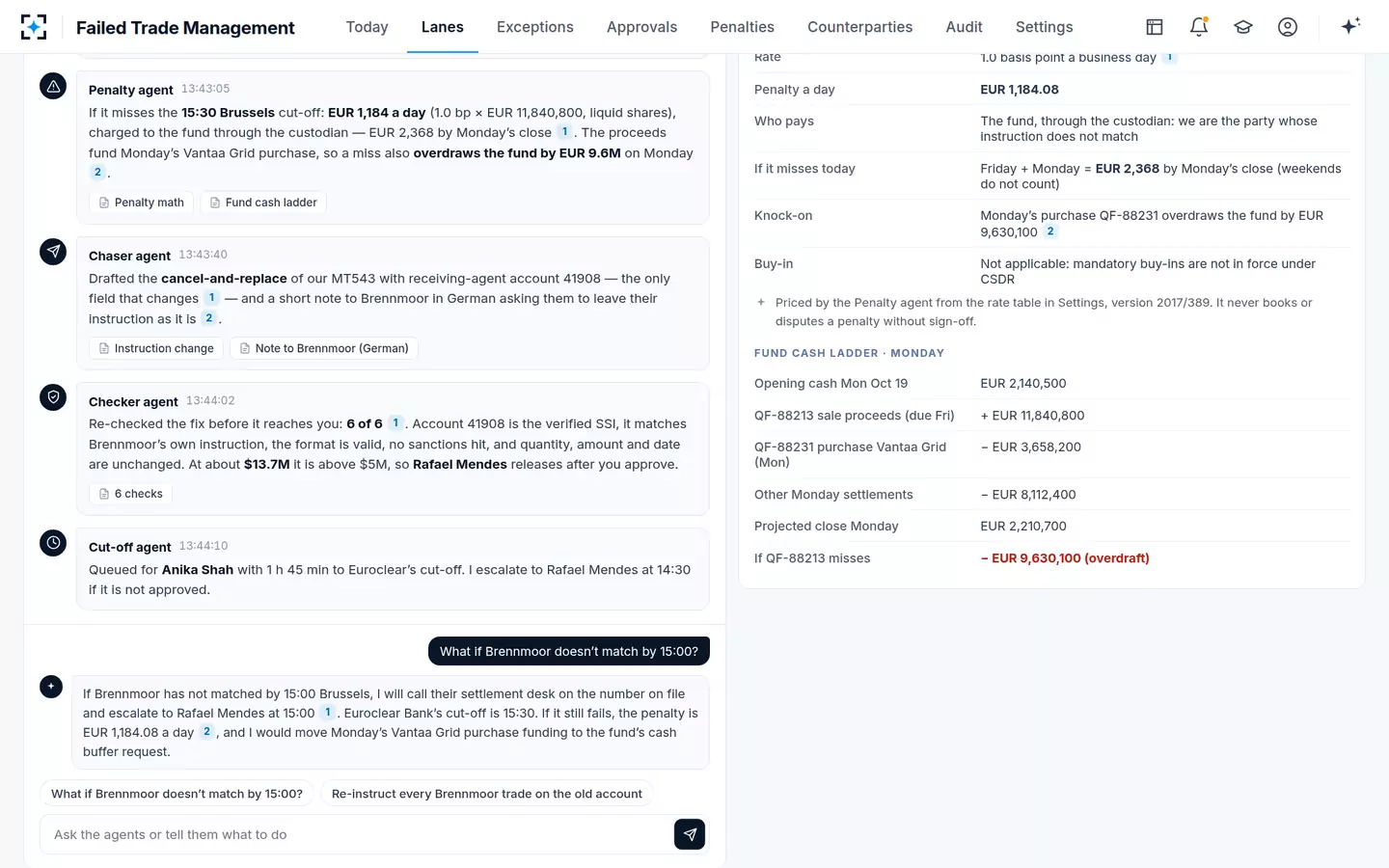
The worked example is QF-88213 in the sample: Quillfield's European Equity Fund selling 410,000 shares of Hallberg Industrie AG, a liquid share, to Brennmoor Securities for EUR 11,840,800, a trade price of EUR 28.88. In the sample it was fixed 59 minutes before the cut-off. Suppose instead it had failed on its intended settlement date, Friday 16 October, and settled on the following Wednesday.
QF-88213 if it had failed: three penalty days, each on its own closing price
| Business day | Status at end of day | Reference price (410,000 × close) | Rate | Penalty |
|---|---|---|---|---|
| Fri 16 Oct · intended settlement date | Failed | 410,000 × EUR 28.88 = EUR 11,840,800 | 1.0 bp | EUR 1,184.08 |
| Sat 17 and Sun 18 Oct | Not business days | — | — | None |
| Mon 19 Oct | Failed | 410,000 × EUR 28.52 = EUR 11,693,200 | 1.0 bp | EUR 1,169.32 |
| Tue 20 Oct | Failed | 410,000 × EUR 29.10 = EUR 11,931,000 | 1.0 bp | EUR 1,193.10 |
| Wed 21 Oct | Settled | — | — | None |
| Total | Three failing business days | EUR 3,546.50 |
The Penalty agent in the sample priced the Friday miss at EUR 1,184.08 a day, "EUR 2,368 by Monday's close", the same arithmetic at the trade price. It also priced what the penalty does not capture: the sale was funding the fund's Monday purchase, and a miss would have overdrawn the fund by EUR 9,630,100. For a large sale the overdraft interest and the knock-on fail of the next purchase usually dwarf the penalty, which is why the agent shows both before the cut-off.
Bonds work the same way with the nominal amount and the clean or dirty price the CSD uses as reference. A EUR 50 million nominal sale of a government bond at a price of 98 that fails for one day costs 0.10 basis point of EUR 49 million, EUR 490; the same nominal of a corporate bond at 0.20 basis point costs EUR 980 (our arithmetic). The rates are small by design. Recital 7 of the regulation explains why sovereign debt gets the lowest: "the typically large size of these transactions and their importance for the smooth and orderly functioning of the financial markets".
What are the CSDR penalty rates? Eight types of fail
There are eight penalty rates, one for each type of fail in the Annex to Regulation 2017/389, and they have not changed since penalties started on 1 February 2022. The table adds the annual rate each one is equivalent to, as ESMA computes it, and ESMA's November 2024 advice on changing them.
The CSDR penalty rates, what they equal over a year, and what ESMA proposed
| Type of fail | Rate per business day | ESMA's yearly equivalent | ESMA proposal, November 2024 |
|---|---|---|---|
| 1. Lack of shares with a liquid market | 1.0 basis point | 3.65% | Keep at 1.0 |
| 2. Lack of shares without a liquid market | 0.5 basis point | 1.83% | Raise to 0.75 |
| 3. Lack of instruments traded on SME growth markets (not debt) | 0.25 basis point | 0.91% | Keep at 0.25 |
| 4. Lack of sovereign, local government, central bank, MDB or EFSF/ESM debt | 0.10 basis point | 0.37% | Raise to 0.20 |
| 5. Lack of other debt instruments | 0.20 basis point | 0.73% | Raise to 0.30 |
| 6. Lack of debt instruments traded on SME growth markets | 0.15 basis point | 0.56% | Keep at 0.15 |
| 7. Lack of all other financial instruments, including ETFs | 0.5 basis point | 1.83% | Raise to 0.75 |
| 8. Lack of cash | Central bank overnight credit rate, floor of zero | — | Same rate, with a higher floor |
The ranking is deliberate. Recital 6 gives liquid shares the highest rate because they "could therefore be bought easily", and recital 10 puts exchange-traded funds and depositary receipts with illiquid shares because they "do not usually have a highly standardised settlement and liquid markets". The cash rate is tied to borrowing: recital 12 says the rate "should be the official interest rate of the central bank issuing the settlement currency", since a participant short of cash can borrow it.
Is the penalty high enough? Only for liquid shares does it beat borrowing
A penalty deters a fail only if failing costs more than fixing it, and for most instruments it does not. ESMA compared each rate, converted to a yearly equivalent, with the average fee for borrowing the same kind of security reported under the Securities Financing Transactions Regulation (ESMA, 2024, Table 1).
In 2023, failing cost less than borrowing for every type ESMA compared except liquid shares
ESMA's own conclusion was that "the penalty rates have been lower than securities lending and borrowing rates" for illiquid shares, sovereign bonds, SME growth market bonds and other instruments, "in particular ETFs", which is why it proposed raising those rates and leaving liquid shares alone. The finding matters for a fund's own policy too. A desk that lets a sale of an ETF fail rather than borrow is, at 2023 rates, choosing the cheaper option; whether it should depends on what the fail does to the buyer and the relationship, not only on the penalty.
Who pays the CSDR penalty: the failing participant, then its client?
The CSD charges the penalty to its own participant, the custodian or broker whose instruction failed, and pays it to the participant on the other side. It nets the month: CSDs "shall charge and collect on at least a monthly basis the net amount of cash penalties to be paid by each failing participant" and distribute it "on at least a monthly basis" to receiving participants (Delegated Regulation (EU) 2018/1229, Article 17). In T2S, penalties can be corrected until the end of an appeal period on "the 13th business day of the month following its computation", and the monthly aggregated amounts are reported on the 14th (T2S UDFS).
Which side fails is decided by the reason the instruction did not settle. In T2S's "Failing Reasons Dictionary", a fail for LACK (lack of securities in your own position) or MONY (lack of your own cash) makes the instruction eligible for a penalty; CLAC and CMON, the same shortfalls at the counterparty, do not; an instruction left on hold by its own party (PREA) is eligible, one held by the counterparty (PRCY) is not. The reason codes behind this are set out in MT548 reason codes: what each status says about the fix.
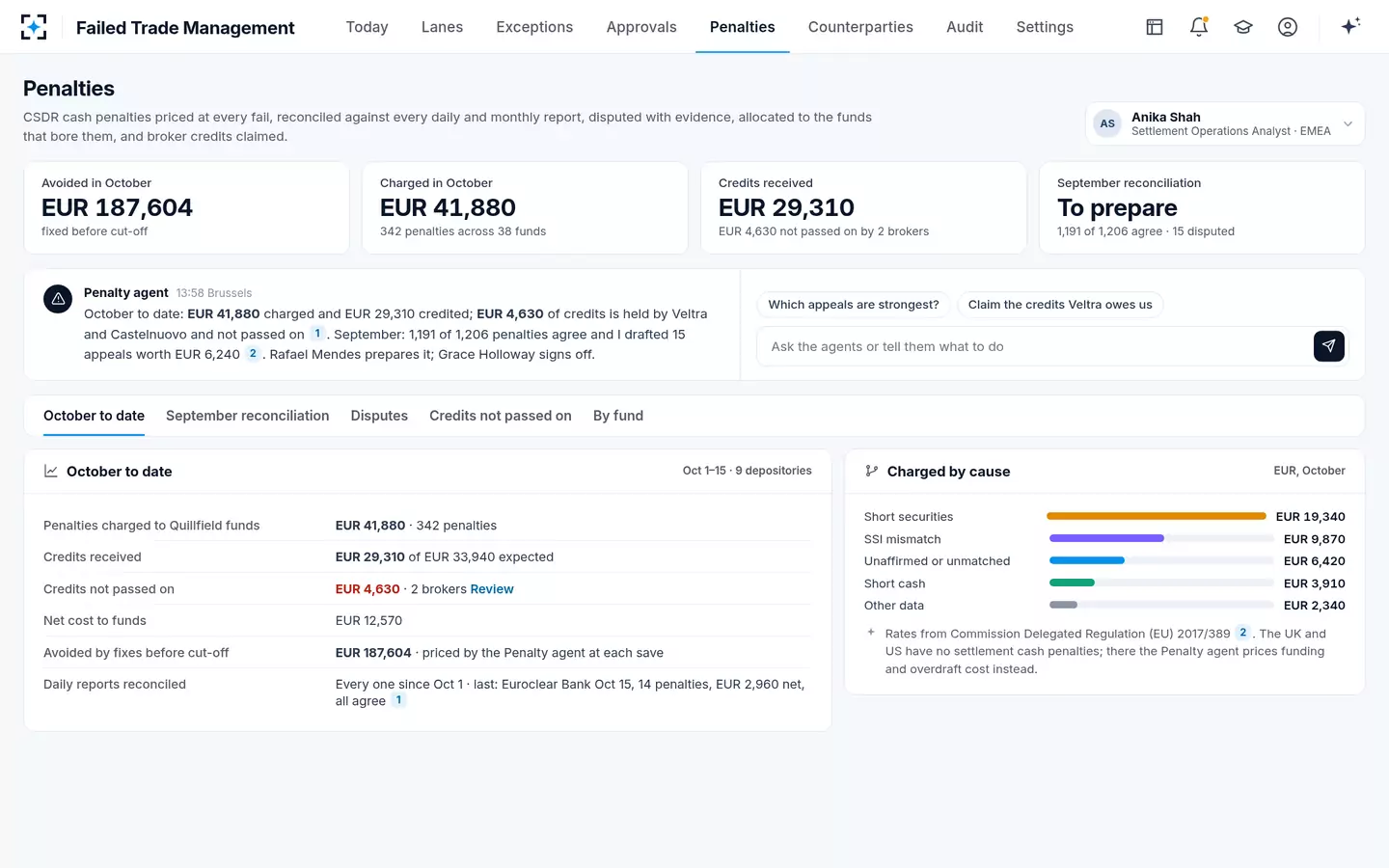
Below the CSD, it is contract. ESMA found that most respondents pass penalties on to their clients, but stated that "currently there is no requirement for CSD participants to pass on the penalties to their clients" (ESMA, 2024, paragraph 121). Some respondents described funds where "the fund receives the penalties, but the manager of the fund pays them". A fund manager therefore needs three numbers, not one: penalties charged to each fund, credits the fund was owed as the receiving side, and credits actually passed on. In the sample, October's credits received were EUR 29,310 of EUR 33,940 expected, EUR 4,630 held by two brokers.
What is a late matching fail penalty?
A late matching fail penalty (LMFP) charges for the days before an instruction even matched. When instructions are matched after the intended settlement date, "cash penalties shall be calculated and applied as from the intended settlement date", and the penalty for the days before matching "shall be paid by the last participant who has entered or modified the relevant settlement instruction in the securities settlement system" (2018/1229, Article 16(3)).
That rule makes the instruction's timestamp evidence. The party that sends or amends its instruction last pays for the whole late period, so a fund whose custodian re-instructed a trade on the intended settlement date afternoon can find itself charged for a mismatch the broker caused. One response summarised by ESMA put the objection plainly: late matching penalties "have the potential to punish the wrong party within a chain of failed settlements". One respondent reported that the share of penalties that were late matching penalties fell from about 13% to about 5% after penalties started.
Which fails are not penalised?
Penalties apply only to matched instructions that fail in instruments subject to the regime, and the revised regulation removes four kinds of fail altogether. The penalty mechanism "shall not apply to" fails whose cause "is not attributable to the participants in the transaction", operations "that are not considered as trading", transactions where a central counterparty is the failing participant (with an exception), and transactions where insolvency proceedings have been opened against the failing participant (CSDR Article 7(3), as amended by Regulation (EU) 2023/2845). The first two apply from 17 January 2026, and the Commission is empowered to specify by delegated act which causes count.
Some exemptions are operational. T2S excludes its own realignment instructions and instructions with the transaction code for corporate actions, CORP. And the amended EU rules that set a 23:59 CET trade-date target for settlement instructions from 11 October 2027 state that an instruction sent after that time should not by itself "give rise to the application of cash penalties" (Delegated Regulation (EU) 2026/1536, recital 7); penalties still follow only from an actual fail.
How much do EU firms pay in CSDR penalties each month?
About EUR 127 million a month across the European Economic Area. ESMA reports a monthly average of EUR 127,258,663.00 in cash penalties over March 2023 to February 2024, against an average monthly value of settlement fails of about EUR 2.5 billion (ESMA, T+1 assessment report, November 2024, paragraphs 140–141). One respondent to ESMA's penalty consultation counted the number of penalties falling from about 130,000 a month to around 80,000 after the regime started.
Most of the money is made on the first day. ESMA asked the T2S operator for the duration of fails in March 2024: of all the failing value counted across the month, most was on the intended settlement date itself, and a long tail of old fails made up the rest.
Seven euros in ten of failing value fail on day one; one in twelve is over ten days late
Value of failing instructions in T2S, March 2024
- On the intended settlement date · 71.9%
- One day late · 8.1%
- Two to four days · 7.1%
- Five to ten days · 4.8%
- More than ten days · 8%
The shape tells a fund where to spend effort. Fixing a trade before the intended date's cut-off removes the largest block of penalty value at once; a trade that runs more than ten days usually has a cause no amount of chasing fixes, such as a security that cannot be borrowed, and costs a penalty every day until someone decides to partial, shape or cancel it. How partial delivery changes that arithmetic is in Settlement efficiency: why a partial delivery beats a failed trade.
Will CSDR penalties rise, and are mandatory buy-ins in force?
Penalty rates may rise; buy-ins are switched off. ESMA proposed "an overall moderate increase of the penalty rates for most of the asset classes" in November 2024, the figures in the table above, but the Commission has to amend Regulation 2017/389 to make it law, and as of October 2026 it has not. ESMA also warned that "a significant increase of penalty rates may divert resources" from T+1 preparation. Respondents to its T+1 call for evidence mostly expected settlement efficiency to get worse "at least in the short term" after the move to T+1 on 11 October 2027 (ESMA T+1 report, paragraph 138), which would raise penalty bills even at unchanged rates.
Mandatory buy-ins are not in force. The CSDR revision made them "a measure of last resort", to be introduced only by a Commission implementing act after a cost-benefit analysis by ESMA and consultation of the European Systemic Risk Board, and only where penalties have not reduced fails (Regulation (EU) 2023/2845, recitals 10–11 and Article 7a). If they are switched on, a buy-in would start after an extension period of five business days. The Penalty agent in the sample says it plainly when asked: "Not applicable: mandatory buy-ins are not in force under CSDR."
Reconciling CSDR penalties at month end
A penalty report is only useful if every line can be tied to a trade, a reason and a fund. The checklist below is the reconciliation a fund manager's operations team can run each month before the CSD's appeal window closes.
A month-end CSDR penalty reconciliation, before the appeal window closes
- Tie every daily penalty to a failed instruction
Match on the instruction reference, ISIN, quantity and day. A penalty with no matching fail in your own records is the first dispute.
- Check the reason that made it yours
A penalty charged on a fail coded CLAC or CMON, the counterparty's shortfall, should not be yours in T2S.
- Recompute the amount
Rate for the instrument type × quantity still unsettled × that day's reference price. Check the instrument's liquidity class against the list the regime uses.
- Check late-matching penalties against timestamps
The last participant to enter or modify the instruction pays for the days before matching; keep the instruction history to prove who that was.
- Reconcile the receiving side
List the penalties your funds should have received when counterparties failed, and compare with credits actually passed on.
- Allocate to the fund that bore the fail
Charges and credits belong to the fund on the trade, not to the manager's general account, unless the contract says otherwise.
- Dispute in time
In T2S, penalties become final after the 13th business day of the following month; a dispute raised through the custodian after that is too late.
In the sample, the Penalty agent prepares the reconciliation and the people sign it: September's showed 1,191 of 1,206 penalties agreeing with its own calculation and 15 appeals drafted, worth EUR 6,240, which the settlement supervisor prepared and the Head of Trade Support signed off. The agent "never books or disputes a penalty without sign-off", and each day is priced with the rate table version in force that day, so a future change to the rates cannot silently reprice an old month.
CSDR penalties in Failed Trade Management: charged, credited, passed on and avoided
Asking what a miss costs, before the cut-off
Questions people ask
Is the CSDR penalty charged for lack of cash?
Yes. A fail caused by the buyer's lack of cash is charged at the official overnight credit rate of the central bank issuing the settlement currency, with a floor of zero, applied to the same reference price. For euro, ESMA identifies that rate as the ECB's marginal lending facility rate; respondents told ESMA lack-of-cash fails are under 1% of the total.
Are penalties charged when the counterparty caused the fail?
Not to you. The penalty goes to the failing participant, and your side receives it. In T2S the reason code decides: a fail for the counterparty's lack of securities (CLAC) or cash (CMON), or the counterparty's hold (PRCY), is not eligible for a penalty on your instruction.
Do CSDR penalties apply to UK or US trades?
Only to trades settling in an EU or EEA CSD. The UK did not carry the settlement discipline articles into its onshored regulation, and the US has no CSD cash penalty on equities, relying on Regulation SHO's close-out rule. A UK or US fund settling in Euroclear France or Clearstream Banking Frankfurt is inside the regime.
Does a partial settlement reduce the penalty?
Yes. T2S's own worked examples price each penalty on the "Quantity failed to settle", so a delivery of 300,000 of 320,000 shares leaves a penalty on 20,000 shares, not on all of them. From 11 October 2027 every EU CSD must offer automatic partial settlement unless a participant opts out.
How do I calculate a CSDR penalty in a spreadsheet?
One row per instruction per failing business day: rate for the instrument type, quantity unsettled that day, the CSD's reference price that day, and their product. The common errors are using the trade price instead of the reference price, counting calendar days instead of business days, and missing late-matching days before the instruction matched.
What happened to CSDR mandatory buy-ins?
They were never switched on. The 2023 revision of CSDR turned them into a last-resort tool the Commission can introduce only by an implementing act, after ESMA's cost-benefit analysis, if penalties fail to bring fails down. No such act had been adopted as of October 2026.