LEI renewal is the yearly re-certification of a legal entity identifier's reference data with the issuer that manages it. The 20-character code stays the same, but if the entity does not confirm its data by the next renewal date, its registration status turns from ISSUED to LAPSED. A lapsed LEI still identifies the entity, yet under EU derivatives reporting it cannot be used by the counterparty that reports, and in any security master it is a sign that the data behind the code has not been checked for a year. Fund groups feel it most, because every fund and sub-fund has its own LEI and nobody's job description says "renew it". Botminds' Security Master Data Management treats the issuer and guarantor LEIs on every instrument as cited fields that a person confirms, so a wrong or unverified entity never reaches the funds unseen.
The counts on this page come from GLEIF's public LEI database on 28 October 2026; they move every day. The rules come from the CFTC, the European Commission and ESMA, and the US agencies' 2026 data-standards rule. Product examples use fictional sample data.
How many LEIs have lapsed: issued against lapsed, by group
All LEIs · 3.21 million
- Issued · 62.2%
- Lapsed · 37.8%
Funds · 202,442
- Issued · 75.9%
- Lapsed · 24.1%
US entities · 343,356
- Issued · 40.1%
- Lapsed · 59.9%
US funds · 39,884
- Issued · 74.5%
- Lapsed · 25.5%
What does LEI renewal mean? Re-certifying the data every year
Renewal means the entity, or an agent acting for it, confirms that its reference data is still correct, and the LEI issuer validates it again. GLEIF's data format defines the renewal date as "The next date by which the LEI information must be renewed and re-certified by the Legal Entity", and a lapsed registration as "An LEI registration that has not been renewed by the NextRenewalDate" (GLEIF, LEI-CDF format).
The yearly rhythm is a policy of the system's public overseer, the LEI Regulatory Oversight Committee. Its 2018 policy on legal entity events sets out the principle in one sentence: reference data is validated at registration, entities must update it when it changes, and an LEI stays issued only if it is revalidated every year.
"for a record to be considered active (i.e., have an “issued” registration status), it must be revalidated at least annually."
LEI Regulatory Oversight Committee, policy on legal entity events, 30 October 2018
What renewal does not do is change the identifier. A lapsed LEI keeps its code, its entity and its history, and once the entity renews and its data is revalidated, it meets the overseers' test for an active record again. That is why a lapse is easy to miss: nothing a trader or portfolio manager sees changes, and the first sign is often a rejected report or a counterparty asking why the status is stale.
How many LEIs have lapsed? GLEIF's own counts
On 28 October 2026 GLEIF's database held 1,994,612 LEIs with status ISSUED and 1,214,408 LAPSED: 37.8% of the two together. Among entities registered as funds the share was lower, 24.1%, or 48,721 lapsed against 153,721 issued. For entities with a US legal address the picture is reversed: 205,522 lapsed against 137,834 issued, almost 60%.
Every LEI ever issued, by registration status today
Read these numbers carefully. A lapsed count is not a count of live companies breaking a rule. Many lapsed LEIs belong to entities that have stopped trading without anyone telling the system, and the overseers have said as much: the ROC noted in 2018 that "currently any entity that fails to renew its LEI registration is treated as “lapsed”", including dormant entities, and asked for a clearer way to mark entities "that are still legally in existence but have no operations". The US figure says more about how LEIs were obtained, often once for a single reporting purpose, than about current market participants.
For a security master the useful question is narrower: of the LEIs on your own records, issuers, guarantors and your own funds, how many have lapsed, and do you know why? That is a number you can produce in an afternoon from GLEIF's public files, and the checklist below shows how.
Is a lapsed LEI still valid? What the rules say, regime by regime
A lapsed LEI is still a valid identifier of its entity, but some reporting regimes refuse it in particular fields. The rules differ by who is reporting and in which role, which is why one fund's lapsed LEI can be harmless in one report and a rejection in another.
What a lapsed LEI means, regime by regime
| Regime | Who must hold an LEI | What it says about renewal | In practice |
|---|---|---|---|
| CFTC swap reporting, 17 CFR 45.6 | Each counterparty eligible for one must "obtain, maintain, and be identified" by it | Swap dealers, major swap participants, SEFs, DCMs, DCOs and SDRs "shall maintain and renew" | The express renewal duty sits on registrants and market infrastructure, not on every fund counterparty |
| EMIR reporting, Implementing Regulation (EU) 2022/1860 | All entities named in a derivative report | For the entity responsible for reporting and counterparty 1: "The LEI must be duly renewed" | A reporting fund with a lapsed LEI cannot report; the other counterparty's lapsed LEI is accepted |
| MiFIR reference data, RTS 23 and ESMA Q&A 1672 | Issuers of instruments traded on EU venues | Issuers "should ensure that their LEI is renewed"; venues are "not expected to ensure" it | Responsibility sits with the issuer; the venue only checks the LEI is in GLEIF's database |
| SEC fund forms (N-PORT, N-CEN, N-MFP) | The registrant and series; issuers of holdings "if any" | Form N-PORT's text defines the LEI but sets no renewal step | The FDTA rule notes some existing reporting forms already accept lapsed LEIs; a lapse still signals stale data |
| FDTA joint data standards (2026) | No new holder; LEI is the joint entity standard | Agencies may "permit LEIs that have lapsed to nonetheless be reported" | How strict each US form becomes is left to each agency |
The EU derivatives rule is the sharpest. When ESMA drafted it, it decided that "the renewal of the LEI will be validated only for the reporting counterparty and the entity responsible for reporting, while for entities other than the counterparty 1 and the entity responsible for reporting a lapsed LEI should be allowed", and reminded firms that "legal entities are responsible for renewing and maintaining their own LEI" (ESMA final report, 17 December 2020, paragraphs 155 and 158). An EU fund that reports its own derivatives, and lets its LEI lapse, has a reporting problem the next day.
The US rule for swaps is gentler on funds but not silent. Every eligible counterparty must "obtain, maintain, and be identified in all recordkeeping and all swap data reporting" by its LEI, and the explicit "maintain and renew" duty applies to swap dealers, major swap participants and the trading and clearing infrastructure (17 CFR 45.6). A dealer that onboards a fund has its own reason to ask about a lapsed LEI, because its records depend on it; collecting counterparty LEIs at onboarding is one of the five legs of counterparty onboarding.
For issuers whose bonds a fund holds, the obligation is the issuer's, not the fund's. ESMA's answer on MiFIR reference data says issuers "should ensure that their LEI is renewed", while venues "are not expected to ensure that the LEI pertaining to the issuer of the financial instrument has been renewed" (ESMA Q&A 1672). A security master records an issuer's lapsed status as a fact about the issuer; it does not fix it.
Why fund LEIs lapse: launches that never happened, and nobody's job
Fund LEIs lapse for reasons that have little to do with negligence. A fund group obtains LEIs for every fund, sub-fund and share-class vehicle that might trade derivatives or file a form, often at launch. Some never launch. The ROC's 2018 policy describes exactly this case: "some entities may obtain an LEI but never begin operation, such as in the case of a fund that fails to raise sufficient capital to begin operation", and one issuer reported sub-funds that requested an LEI "but were never ultimately launched" (ROC, 2018).
The rest lapse because renewal is a calendar task without an owner. The adviser registered the LEI; the administrator files the forms that carry it; the legal team approves the reference data; a renewal agent may hold the account. When the fund merges, liquidates or changes name, the LEI's data should change too, and the ROC's own wording puts "the ultimate responsibility for data accuracy" on the registrant. In a group with hundreds of vehicles, a renewal date is easy to lose.
The quarter of fund LEIs that show as lapsed is therefore a mixture: real funds whose renewal slipped, funds that closed without retiring their LEI, and vehicles that never existed. Only the first group is a live risk, and only a firm's own list can separate them.
How the LEI renewal process works, and what it costs
Renewal is done with the LEI issuer (a local operating unit) that manages the record, or after transferring the record to another one. The entity confirms or updates its name, addresses, legal form, registration authority and, where required, its parent relationships; the issuer validates the data against public or official sources and moves the next renewal date on by a year.
The cost is modest. The US agencies wrote in their 2026 rule that they "understand that these fees are approximately between $50 to $100 for registration and the same annually for renewal of an individual LEI", that fees follow a cost-recovery principle, and that issuers compete on price; they add that GLEIF is exploring multiyear issuance agreements, bulk registration and registration agents to cut costs further (FDTA final rule, section II.C.1). The real cost of a lapse is not the fee. It is the rejected report, the onboarding delay at a dealer, or the issuer limit that aggregated under the wrong parent because the LEI's relationship data was a year old.
Who owns LEI renewal in a fund group?
Three different LEIs sit in an investment firm's data, and each has a different owner. Mixing them up is how renewals fall through.
- The firm's own and its funds' LEIs. The firm owns these. Renewal belongs with whoever owns the fund's legal and regulatory data, usually fund governance or the administrator under a written arrangement, with the reference data team checking the status.
- Issuers' and guarantors' LEIs on instruments. The issuer owns these. The security master records them from the offering document, checks them against GLEIF's data, and keeps the status as information for compliance and reporting.
- Counterparties' LEIs. The counterparty owns these; the firm records them at onboarding and checks them before reporting, because a regime like EMIR cares whose LEI sits in which field.
The security master is the natural place to see all three, because it already links issuers to instruments and funds to holdings. It is the wrong place to own renewal of other firms' identifiers.
A monthly LEI status check for the security master
The check takes GLEIF's public data and the master's own list of LEIs and produces a short list of exceptions. GLEIF publishes complete files of current and historical LEI records three times a day, in XML, CSV and JSON: "GLEIF makes available three sets of updated Golden Copy Files daily (02:00 UTC, 10:00 UTC, 18:00 UTC)" (GLEIF Golden Copy).
Monthly LEI status check: seven steps from GLEIF's files to a short exception list
- List every LEI the master holds, by role
Own firm and funds, issuers, guarantors, counterparties. The role decides who acts on a lapse.
- Match against the latest GLEIF golden copy file
Registration status, next renewal date, entity status, legal name and any successor entity.
- Flag your own funds' LEIs due within 60 days
Send them to the owner of fund legal data before they lapse, not after.
- Flag lapsed own-fund LEIs for any fund that reports derivatives in the EU
Under the EMIR reporting fields for counterparty 1 the LEI must be duly renewed.
- Check retired, merged and annulled issuer LEIs
A retired issuer with live bonds in the master usually means a successor entity the record has not caught up with.
- Compare legal names and parents
A name or parent change in GLEIF's data can move issuer limits; route it to a steward, never auto-apply.
- Report the counts to the head of reference data
Lapsed by role, due in 60 days, and changes accepted; the trend matters more than the level.
Where Security Master Data Management fits
The solution does not renew anyone's LEI, and it is not an LEI registry. Its part is the issuer and guarantor LEIs on each instrument record, which it treats like any other term: read from the offering document, cited to the page, and confirmed by a person when the agents are unsure.
A guarantor LEI the agents were not sure of, left for a person to confirm
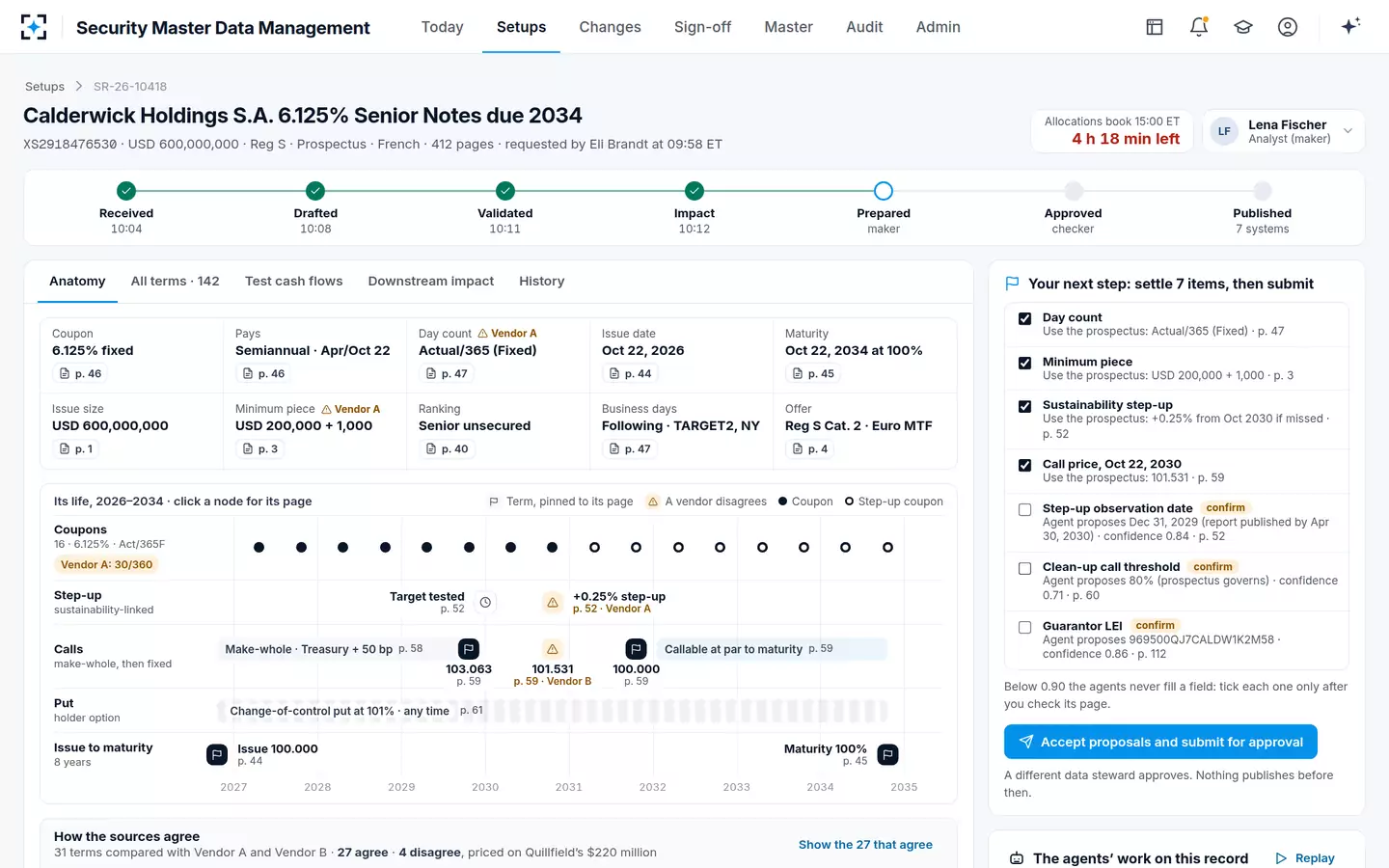
On the sample bond the Setup agent proposed the guarantor's LEI from page 112 of the prospectus at 0.86 confidence. Below its 0.90 threshold it never fills a field, so the analyst had to open the page and tick the value before the record could be submitted, and a second steward approved it. Any later change to an identifier on the record goes to a steward, because the solution's rules treat identifiers as economic terms. The guarantor matters for issuer limits and for the bond's ranking, which is why the security master's field map puts parties and their LEIs beside the economic terms, and why the FDTA's one adopted identifier is the LEI. The rest of the solution is on the Security Master Data Management page.
Questions people ask
Does an LEI expire?
No. The code stays assigned to the entity; what lapses is the registration status, when the data is not re-certified by the next renewal date. The entity can still renew with its LEI issuer, and once the data is revalidated the record counts as active again.
How much does LEI renewal cost?
The US agencies put it at roughly $50 to $100 a year for one LEI in the United States, the same as the first registration. Fees are set on a cost-recovery basis, issuers compete on price, and the agencies note that GLEIF is exploring multiyear and bulk arrangements to lower them.
Can I still report with a lapsed LEI?
It depends on the regime and the field. EU derivatives reports reject a lapsed LEI for the reporting counterparty and the entity responsible for reporting, but accept one for the other counterparty. In the US, the 2026 data-standards rule notes that some existing reporting forms already permit lapsed LEIs and leaves each agency free to keep doing so.
Who should renew a fund's LEI?
The fund, through whoever manages its legal and regulatory data, often the adviser's fund governance team or the administrator under a written arrangement. The responsibility for the data's accuracy sits with the registrant, so the renewal should be a named task with an owner, not left to the LEI issuer's reminder emails.
How can I check an LEI's status?
Search GLEIF's public database, or for many LEIs at once, download GLEIF's golden copy files, published three times a day, and match on the code. The status, next renewal date and entity status are all public and free.