A security master in finance is the database that holds the reference data for every instrument a firm owns or trades: identifiers, issuer, coupon, day count, call and put schedules, maturity, denomination and classifications. Trading, portfolio accounting, compliance, pricing, risk and the fund administrator all read it, so one wrong term reaches every fund that holds the bond. The hard part is not storing the fields; it is deciding, field by field, which source is right when the issuer's document and two data vendors disagree. Botminds' Security Master Data Management is built for that decision: agents draft each new instrument from its offering document, cite every term to its page, compare it with the vendors, and leave the approval to two data stewards.
The worked examples on this page come from the solution running on fictional sample data: an asset manager called Quillfield Capital setting up a new bond, the Calderwick Holdings S.A. 6.125% Senior Notes due 2034, from a 412-page prospectus written in French. The rules and forms quoted come from the SEC, ESMA and the US financial regulators, linked where they appear.
A security master sits between documents and every system that trades, values or reports
Agent
Offering documents and notices inProspectus, offering circular, final terms, term sheet; later the call, reset and step-up notices.
Never: Never treated as data until each term is located on a page
Agent
Identifiers and classificationISIN from the numbering agency, CUSIP, FIGI, CFI and FISN; issuer and guarantor LEIs.
Never: An ISIN check digit is checked, not assumed
Agent
Vendor terms and conditionsTwo vendor files compared term by term with the document.
Never: A vendor value never overwrites the document silently
A person decides
Source-precedence decisionA steward settles each disagreement with a reason; a second steward approves the record.
Never: The person who prepares a record cannot approve it
Agent
Published to downstream systemsOrder management, portfolio accounting, compliance, pricing, risk and the fund administrator.
Never: Nothing publishes before the checker approves
What is a security master in finance?
A security master is the authoritative record of what each instrument is, kept separately from what the firm does with it. Positions, prices and trades change daily and live elsewhere; the security master holds the terms that make those numbers mean something: that a bond pays 6.125% twice a year on an Actual/365 (Fixed) basis, can be called at 101.531 from 22 October 2030, and settles only in lots of USD 200,000 plus multiples of 1,000.
Firms call it the security master file, the instrument master or simply the master. Whatever the name, it does two jobs at once. It is a dictionary, so that every system describes the same bond the same way, and it is a control, because a term that is wrong in the master is wrong in every downstream calculation that reads it. A coupon accrual in portfolio accounting, a yield-to-worst in the risk system and an issuer limit in the compliance engine all start from the same row.
That is why the quality of a security master is not measured by how many fields it has. A master with 300 fields per bond and no rule for which source wins is less reliable than one with 120 fields, each traced to a page. The rest of this page follows that idea: field by field, where the value should come from, and who decides when sources disagree.
What is security master data? The six field families
Security master data is the set of attributes that identify, describe and classify an instrument, plus the terms that determine its cash flows. For a corporate bond it falls into six families, and each family has a natural owner among the possible sources.
Security master fields, family by family, and the source that should win for each
| Field family | Typical fields | Source that should win | Why |
|---|---|---|---|
| Identifiers | ISIN, CUSIP, FIGI, ticker, SEDOL | The numbering agency or allocating body | An identifier is assigned, not described; the allocator is the only primary source. |
| Issuer and parties | Issuer LEI, guarantor and its LEI, country of incorporation, trustee, paying agent | The offering document, checked against the LEI registry | The document names the obligors; the registry confirms the entity and its status. |
| Economic terms | Coupon, day count, payment dates, business-day convention, maturity, redemption price | The offering document (final terms or pricing supplement) | These drive every cash flow; a vendor is reading the same document second-hand. |
| Optionality | Call schedule, make-whole spread, puts, step-ups, sinking funds | The offering document, then each notice | Schedules change by notice, and a missing one overstates yield. |
| Settlement attributes | Minimum denomination, increments, form, place of settlement, selling restrictions | The offering document | A wrong minimum piece lets a portfolio buy a lot that cannot settle. |
| Classification | CFI code, FISN, sector, country of risk, ratings, liquidity bucket | The numbering agency for CFI and FISN; vendors or the firm's own policy for the rest | These are judgements or derived codes; the precedence rule must say whose judgement. |
The table carries one rule that many masters break: the economic terms come from the issuer's document, not from a vendor feed. Vendors are useful, often faster and usually right, but their terms and conditions data is a reading of the same prospectus. When the two disagree on a seasoned bond, a firm may sensibly let two agreeing vendors stand. On a new issue, the document should govern until it has been read.
The classification family is the opposite case. A CFI code is assigned by the national numbering agency, and ESMA's Q&A for EU reference data says ISINs, CFI codes and FISNs "issued by the relevant National Numbering Agency (NNA) should be used" (ESMA Q&A 1504). Sector and country of risk are judgements that each firm makes differently, which is why the same bond can sit in two sectors at two managers and both be right by their own rules.
What regulators ask a fund's security master to carry
Regulators define a much smaller set of fields than a firm needs, but those fields are the ones that leave the building, so they set the floor. Three regimes show the pattern.
In the United States, Form N-PORT asks a registered fund to identify each holding by issuer name, the issuer's LEI "(if any)", the title of the issue, the CUSIP "(if any)" and "at least one of the following other identifiers": an ISIN, a ticker if there is no ISIN, or another unique identifier. For debt it adds the maturity date, the coupon type ("fixed, floating, variable, none") and the annualized rate, and whether the bond is in default (SEC, Form N-PORT, Items C.1 and C.9). Form 13F keeps the CUSIP mandatory; since the SEC's 2022 amendments a manager may add a security's share-class FIGI beside it (SEC, 87 FR 38943).
In the European Union, trading venues and systematic internalisers report instrument reference data to regulators under MiFIR, and ESMA publishes it through its FIRDS database. The field list in Table 3 of RTS 23 is short for a bond: ISIN, full name, CFI, issuer LEI, FISN, total issued nominal, maturity date, currency, nominal value per unit, fixed rate, the floating-rate index and spread, and seniority (Delegated Regulation (EU) 2017/585, Annex, Table 3). There is no field for a day count, a call schedule or a step-up.
What a regulator's reference data holds for a bond, and what a security master must hold
EU reference data (FIRDS, RTS 23 Table 3): ISIN, full name, CFI code, FISN, issuer LEI.
A working security master: The same, plus CUSIP and FIGI where they exist, guarantor and its LEI, and history of every identifier change.
EU reference data (FIRDS, RTS 23 Table 3): Fixed rate as a percentage, or the index, its term and the basis-point spread.
A working security master: Rate, frequency, day count, payment calendar, business-day convention, first coupon date, step-up triggers and floors.
EU reference data (FIRDS, RTS 23 Table 3): Maturity date; 9999-12-31 for perpetuals and for bonds past an unpaid maturity.
A working security master: Maturity and redemption price, every call date and price, make-whole spread, puts, sinking-fund schedule.
EU reference data (FIRDS, RTS 23 Table 3): Total issued nominal; nominal value per unit or minimum traded value.
A working security master: Issue size, minimum denomination and increments, outstanding amount after partial calls.
EU reference data (FIRDS, RTS 23 Table 3): Seniority: senior, mezzanine, subordinated or junior.
A working security master: Ranking, security, guarantees, selling restrictions (Reg S, 144A) and the eligibility each fund needs.
Two details in ESMA's guidance are worth carrying into any master. A perpetual bond's maturity is reported as 9999-12-31, and so is a bond that "were not paid out on the originally intended maturity date", until it is finally paid (ESMA Q&A 1682). And there is no cross-check between the seniority letter inside the CFI code and the separate seniority field: ESMA says plainly that "There is no validation rule in place that compares the value in field 3 with that populated in field 23" (Q&A 1689). A firm's own master can hold two contradictory descriptions of the same bond in the same way, and nothing will flag it unless the firm builds the check.
ESMA consulted on changing RTS 23 in 2024, then "decided to not propose any changes to the existing RTS 23 at this stage" in favour of a wider review of reporting (ESMA final report, 23 June 2025). The regulatory floor is stable; the gap between it and what a fund's systems need is the security master's job.
Who reads each field downstream, and what breaks when one is wrong
Every field has readers, and the cost of an error depends on who reads it and when they notice. The useful way to rank fields is not by how often they are wrong but by how far a wrong value travels before someone sees it.
Where a wrong security master field surfaces, and how late
| Field | First reader | What goes wrong | Who usually notices |
|---|---|---|---|
| Day count | Portfolio accounting | Every accrual and coupon is misstated in every fund that holds the bond | The custodian, as an accrued-interest break at month-end |
| Call schedule | Risk and pricing | Yield-to-worst and duration are overstated; a called bond is still valued to maturity | Risk, or the redemption notice |
| Minimum denomination | Order management | A model portfolio buys a lot that cannot settle | Settlement, on the day it fails |
| Coupon type and floor | Pricing and accounting | A floating coupon resets on the wrong basis | The paying agent's payment, against the accrual |
| Issuer or guarantor LEI | Compliance and regulatory reporting | Issuer limits aggregate under the wrong group; a report is rejected or filed with a wrong entity | Compliance testing, or the regulator's validation |
| Selling restriction | Compliance | A Reg S bond is bought for an account that may not hold it | Compliance, after the trade |
The day count line is the one the sample shows in money. On the Calderwick notes, one vendor carried 30/360 where the prospectus says Actual/365 (Fixed). On Quillfield's $220 million position, that vendor's basis would have overstated the first coupon by $18,458.90, and it misstates all 16 coupons by $73,835.62 over the life of the bond. It might have surfaced at a month-end as an accrued-interest break with the custodian, or not until the first coupon was paid six months later; either way, every fund's daily accrual would have been wrong from the first day. The arithmetic is set out in day count conventions for bonds.
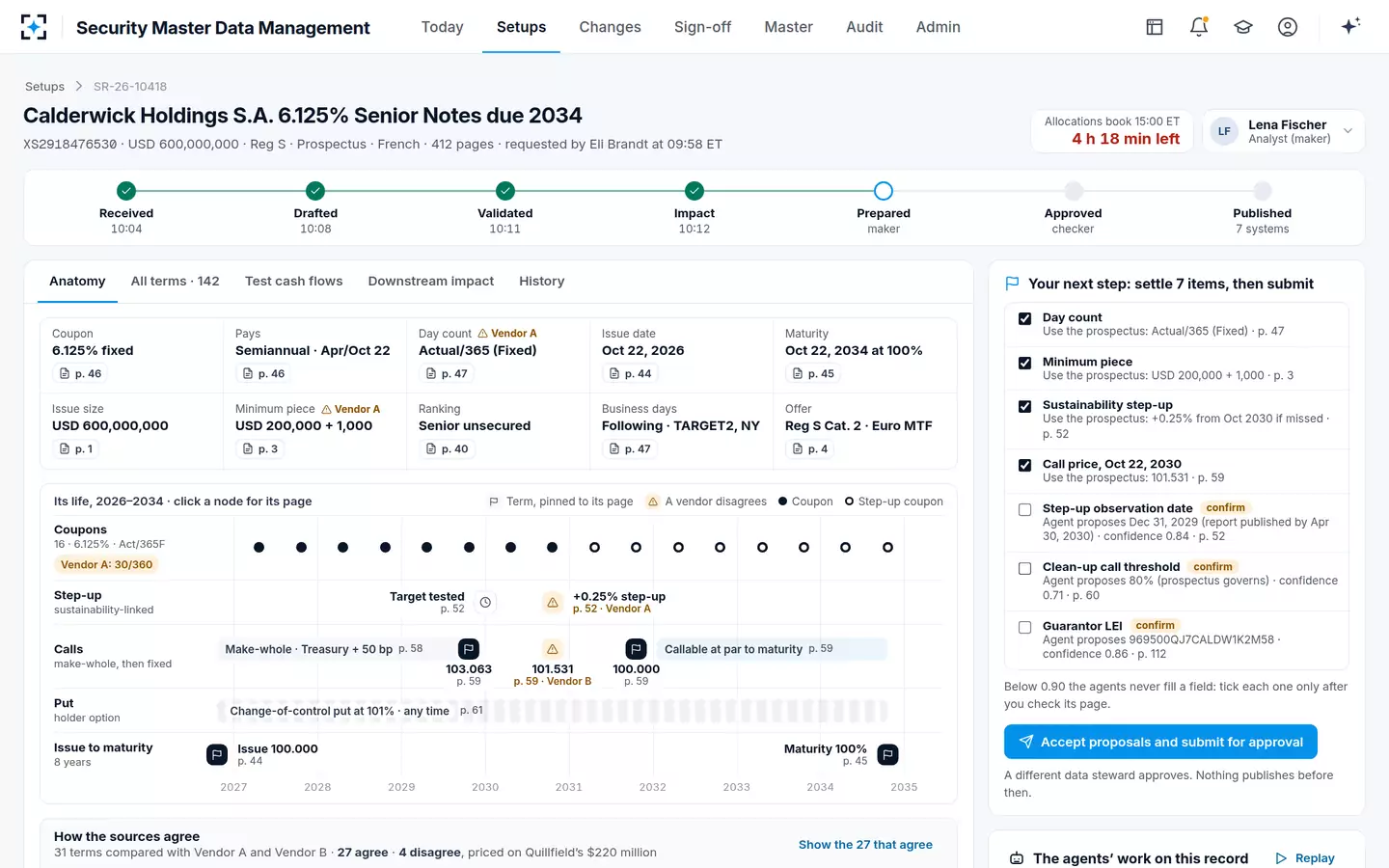
One new bond in Security Master Data Management: each key term with the page it came from
Reference data vs master data: is there a difference?
In investment operations the two terms overlap, and the useful distinction is between data that describes the world and data that describes the firm's relationship to it. Instrument reference data is the first kind: the bond's terms are the same for every holder. Counterparty, account and settlement-instruction data is the second kind, and it differs from firm to firm.
Enterprise data teams use "master data" for the core entities of a business, and "reference data" for the code lists those entities use, such as currency and country codes. A security master straddles both senses: the instrument is a master entity, and its CFI code, currency and country of risk are reference values. Operations teams mostly say reference data for all of it, which is why the team that runs the security master is usually called the reference data team.
The distinction matters in one practical way. External reference data has an external truth to check against, the issuer's document or the numbering agency, so it can be tested. A firm's own master data, such as which fund may hold which bond, has no outside source and needs its own governance. A security master needs both kinds of control.
The source-precedence rule is the security master
The rule that decides which source wins for each field is what turns a database into a security master. Without it, the master is the last value someone typed; with it, every value has a reason that can be checked.
A precedence rule names the source order per asset class and field, the period it applies for, and what happens on a disagreement. A common shape is to let the offering document govern a new issue for a set period, to accept a vendor change on a seasoned bond only when two vendors agree, and to send any change to an economic term to a steward whatever the vendors say. The US agencies' rule on financial data standards makes a related point about classification codes: CFI, they wrote, is to be used "to classify financial instruments, not to identify them", because many instruments share the same code (FDTA joint data standards, 2026). A master that matches bonds on a classification code, or that lets a classification feed overwrite an identifier, has its precedence backwards.
Golden-source rules as settings: which source wins, per asset class and field
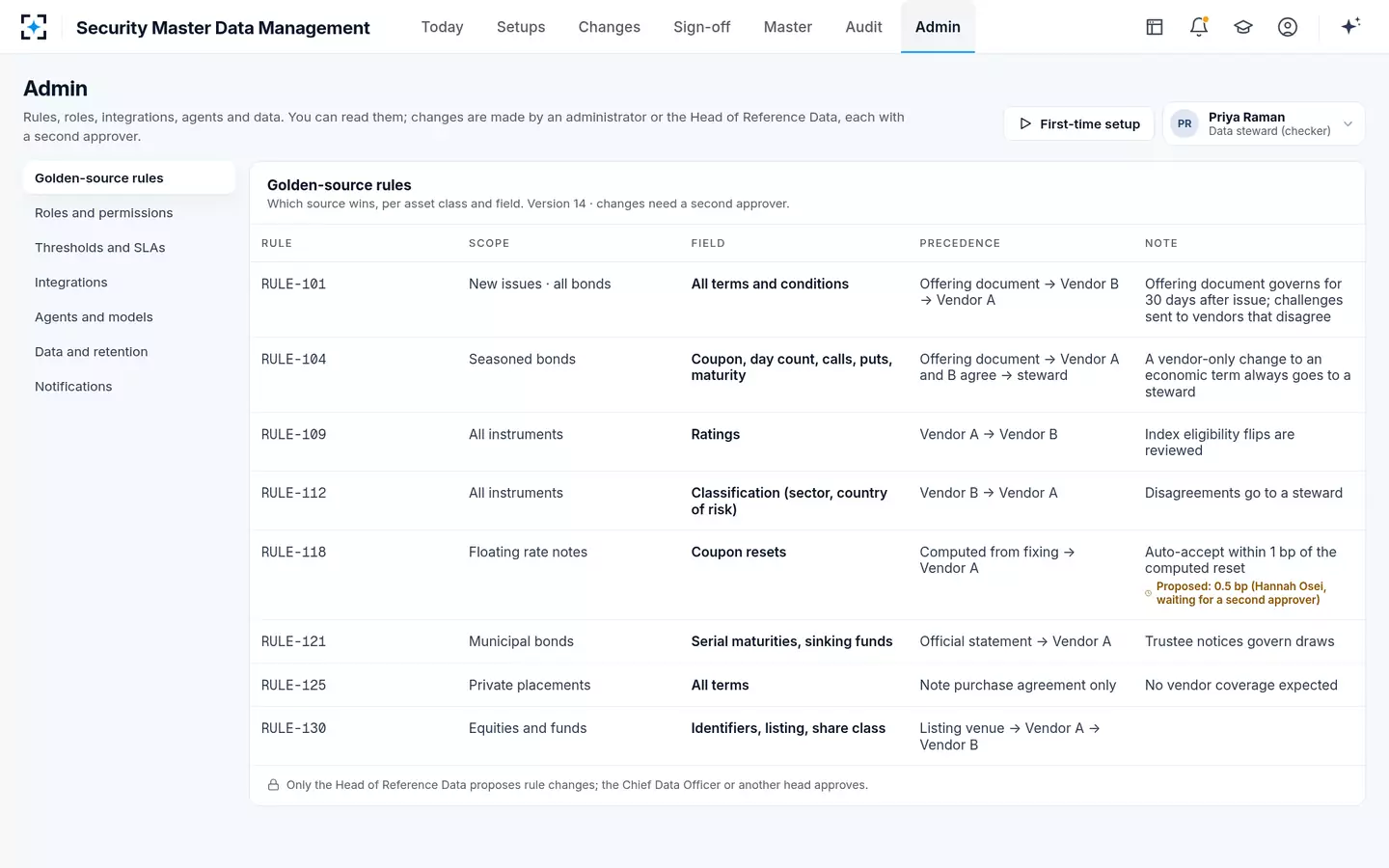
Notice what the sample's rules leave to people. Classification disagreements go to a steward. A change to an economic term on a seasoned bond goes to a steward even if both vendors agree. Private placements have no vendor at all, so the note purchase agreement is the only source and every term is read from it. The rules are precise enough for software to apply and modest enough to stop where judgement starts.
How Security Master Data Management sets up one record, field by field
The solution applies the field map above to each new instrument and shows its work. On the sample Calderwick bond it drafted 142 fields: 131 cited to prospectus pages, 6 to the two-page pricing term sheet and 5 derived, such as the FISN, sector and liquidity bucket. Three fields fell below its 0.90 confidence threshold, so it proposed values without filling them: the step-up observation date, the clean-up call threshold and the guarantor's LEI. The analyst cannot submit the record until she has opened each page and ticked it.
One new bond, set up from its prospectus
142
fields drafted from a 412-page prospectus in French
131 cited to its pages
27 of 31
economic terms on which both vendors agreed with the document
4
disagreements, each priced on the firm's own position
7
downstream systems published to, after a second steward approved
The Validator agent then compared 31 economic terms with both vendors. Twenty-seven agreed. Four did not: one vendor's day count, minimum piece and missing step-up, and the other vendor's rounding of the 2030 call price to 101.500 against the prospectus's 101.531. Each disagreement is priced on the position, so the steward sees that the call price is worth $68,200 if the bond is called in 2030 and the minimum piece would block three wealth model portfolios. The steward accepts the document's value with a reason, a different steward approves, and only then does the record publish. How that published value becomes the firm's one version of the truth is the subject of the golden copy; which identifiers the record should carry after the US agencies' 2026 rule is covered in FIGI vs CUSIP. The full walk-through is on the Security Master Data Management page.
Questions people ask
What is a security master file?
It is another name for the security master: the database of instrument reference data that a firm's trading, accounting, compliance, pricing and risk systems read. "File" survives from the days when it was a nightly flat file sent to each system. Today it is usually a database with versioned records, but the job is the same.
How many fields does a security master hold for a bond?
The working range the solution is built for is 100 to 200 for a corporate bond, depending on optionality and how many classifications the firm keeps. The EU's regulatory reference data for a bond needs about two dozen of them; the rest exist because downstream systems need cash-flow terms, schedules and settlement attributes that regulators do not ask for. The sample bond in the solution has 142.
Is the security master the same as the investment book of record?
No. The investment book of record holds positions, transactions and cash: what the firm owns. The security master holds what each instrument is. The book of record reads the master to value and accrue positions, which is why a wrong day count in the master shows up as a wrong accrual in the book.
Which identifiers does a US fund report on Form N-PORT?
For each holding, the issuer's LEI if it has one, the CUSIP if there is one, and at least one other identifier: an ISIN, a ticker if no ISIN exists, or another unique identifier with its type stated. A security master that holds all three for every bond avoids a scramble at each filing.
Who owns the security master in an asset manager?
Usually a reference data team inside operations, led by a head of reference data and answerable to a chief data officer or the COO. Analysts prepare records and data stewards approve them; the precedence rules, and changes to them, belong to the head of the function with a second approver.