A day count convention for bonds is the rule, written into each bond's terms, that sets two numbers: how many days of interest have accrued, and how many days make a year. 30/360 counts every month as 30 days in a 360-day year; Actual/365 (Fixed) counts calendar days over 365; Actual/Actual counts calendar days over the actual length of the coupon period; Actual/360 counts calendar days over 360. On the same bond and the same dates, they produce different coupons and different accrued interest, so the day count is the first field a security master should take from the offering document and the first one it should test. Botminds' Security Master Data Management, which sets up and checks instrument terms from prospectuses for reference data teams, cites the day count to its page and recomputes every coupon under each source's convention before a bond is approved.
The worked figures use one fictional sample bond from the solution: the Calderwick Holdings S.A. 6.125% Senior Notes due 2034, issued 22 October 2026 and paying semiannually, whose French prospectus states Actual/365 (Fixed). The market conventions come from the US Treasury, FINRA, the UK Debt Management Office, the EU's Economic and Financial Committee and the Federal Reserve's reference-rate committee.
One coupon, four conventions: the sample bond's first payment
| Convention | Fraction of a year | Per $100 million | On a $220 million position | Against the prospectus |
|---|---|---|---|---|
| Actual/365 (Fixed), as the prospectus states | 182 ÷ 365 | $3,054,109.59 | $6,719,041.10 | — |
| 30/360 | 180 ÷ 360 | $3,062,500.00 | $6,737,500.00 | +$18,458.90 |
| Actual/Actual, half-yearly periods | ½ × (182 ÷ 182) | $3,062,500.00 | $6,737,500.00 | +$18,458.90 |
| Actual/360 | 182 ÷ 360 | $3,096,527.78 | $6,812,361.11 | +$93,320.01 |
What is a day count convention for bonds?
It is the part of a bond's terms that turns an annual coupon rate into money for a given stretch of days. Every accrual uses it: the coupon paid on each payment date when the period is irregular, the accrued interest a buyer pays the seller between coupon dates, and the daily income a fund books in its net asset value. The convention is written as a fraction, days in the period over days in the year, and each part of the fraction has its own rule.
The numerator is either actual calendar days or a 30-day-month count. The denominator is 360, 365, or the actual number of days in the year or the coupon period. Those two choices give the four conventions that cover most bonds an asset manager holds. Variants, such as the European 30E/360 that treats a 31st differently from the US 30/360, change the count at month-ends.
Three neighbouring terms are often confused with it. The business-day convention says what happens when a payment date falls on a weekend or holiday. The adjustment rule says whether interest is still calculated to the unadjusted date. The payment calendar says which cities' holidays count. The sample prospectus states all three beside the day count on the same page, and a security master needs all four fields to reproduce a coupon.
Which day count convention do bonds use, by market and currency?
Government bonds in the US, the UK and most of the EU use Actual/Actual, US corporate bonds traditionally use 30/360, euro-area Treasury bills and SOFR floating-rate notes use Actual/360, and UK Treasury bills use Actual/365. But the convention belongs to each bond, not to its currency, and the bond's own terms always override the market norm.
Day count conventions by market, from the issuers' and regulators' own documents
| Market | Convention | Official source |
|---|---|---|
| US Treasury notes and bonds | Actual/Actual: a full half-year pays half the annual coupon; part-periods use actual days in the half-year | US Treasury, 31 CFR part 356, Appendix B |
| US Treasury floating rate notes | Actual/360 on the daily index rate plus the spread | 31 CFR part 356, Appendix B |
| US corporate bond trades under FINRA's Uniform Practice Code | 30/360 for the interest added to the dollar price | FINRA Rule 11620(b) |
| USD floating rate notes on SOFR | Actual/360, "Accrual Period divided by 360" | Alternative Reference Rates Committee, FRN conventions (2019) |
| UK gilts | Actual/Actual, since 1 November 1998 | UK Debt Management Office, gilt formulae (December 2024) |
| Euro area government bonds | ACT/ACT; Treasury bills ACT/360 | EU Economic and Financial Committee, market conventions (2019 survey) |
| UK Treasury bills | ACT/365 | EFC market conventions (2019 survey) |
| Swedish government bonds | 30E/360 | EFC market conventions (2019 survey) |
The table is why "day count convention by currency list" is a useful search and a dangerous shortcut. The sample Calderwick bond is a US dollar Reg S note whose French prospectus chose Actual/365 (Fixed). A vendor that filled the field from a US dollar corporate default, 30/360, would be wrong on every coupon, and that is exactly the disagreement the sample shows. The list tells a reference data analyst what to expect; only the document says what is true.
How 30/360 counts days, in FINRA's words
30/360 pretends every month has 30 days. FINRA's Uniform Practice Code puts it in two clauses: interest is computed on a year of 360 days, and "every period from a date in one month to the same date in the following month shall be considered to be 30 days" (FINRA Rule 11620(b)). Its examples settle the awkward cases: from the 1st to the 30th of the same month is 29 days, and from the 30th or 31st to the 1st of the next month is one day.
30/360 against actual days: where the two counts part company
30/360 (FINRA Rule 11620): Always 30 days.
Actual calendar days: 28, 29, 30 or 31 days, depending on the month.
30/360 (FINRA Rule 11620): 31 days: 31 January counts as the 30th, one day to 1 February, then 30.
Actual calendar days: 29 days.
30/360 (FINRA Rule 11620): 180 days, every time.
Actual calendar days: 181 to 184 days.
30/360 (FINRA Rule 11620): 83 days.
Actual calendar days: 85 days.
30/360 (FINRA Rule 11620): 360 ÷ 360: one year's coupon.
Actual calendar days: 365 or 366 days; over a 365-day denominator, a leap year pays a day extra.
The practical consequence is that 30/360 pays the same coupon every regular period, which is why issuers and investors like it for fixed-rate corporate bonds. An Actual/365 (Fixed) bond pays slightly different amounts in 182-day and 183-day periods. In the sample bond's test cash flows the first coupon is $3,054,109.59 per $100 million for 182 days and the second $3,070,890.41 for 183 days. A security master that holds the wrong convention will get the coupons wrong in both directions, and the errors will not cancel neatly.
Why Actual/Actual pays the same coupon in short and long half-years
Actual/Actual, in the form used for government bonds, measures accrued interest in actual days but pays each full coupon as a fixed fraction of the annual rate. The US Treasury's rule is explicit that "a semiannual interest payment represents one half of one year's interest, and is computed on this basis regardless of the actual number of days in the half-year", while for part-periods "We base the daily interest decimal on the actual number of calendar days in the half-year or half-years involved" (31 CFR part 356, Appendix B). The UK Debt Management Office computes gilt accrued interest "based on the ‘actual / actual’ daycount convention effective from 1 November 1998" (DMO, gilt formulae).
That is why the third row of the lead table equals the 30/360 row on a full coupon: both pay exactly half of 6.125%. They differ between coupon dates, where Actual/Actual accrues by actual days over the actual length of the period and 30/360 by its 30-day months. Treasury's examples show the mechanics: a 6¾% note with 92 days accrued in a 184-day half-year paid accrued interest of $16.87500 per $1,000.
Accrued interest at settlement: where a wrong day count shows first
Accrued interest is the first place a wrong day count costs money, because it changes the settlement amount of every secondary-market trade. A buyer pays the seller the coupon earned since the last payment date, computed on the bond's convention; if the buyer's master holds a different convention from the seller's, the two settlement amounts will not match.
Accrued interest on $50 million of the sample bond, settling 15 January 2027
On one $50 million trade the four conventions spread over $17,013.89. Against the prospectus basis, a master holding 30/360 would understate the buyer's payment by $7,108.54 on this date; at other dates in the period it would overstate it. That is the pattern an operations lead recognises as an accrued-interest break with the counterparty or the custodian, and it usually arrives weeks after the setup error that caused it. The causes of reconciliation breaks are where those breaks are counted; the day count in the master is where they start.
Where the prospectus states the day count, and how a vendor gets it wrong
The day count sits in the interest provisions of the terms and conditions, usually beside the business-day convention and the payment calendars. In an English-law note it may be called the day count fraction; in a French prospectus the "base de calcul"; in a pricing supplement it is often one line in a table. It is never in the regulator's reference data: the EU's field list for a bond has a fixed rate and a floating-rate index and spread, but no day count (RTS 23, Annex, Table 3).
The day count clause on page 47, in French and English, with the phrase highlighted
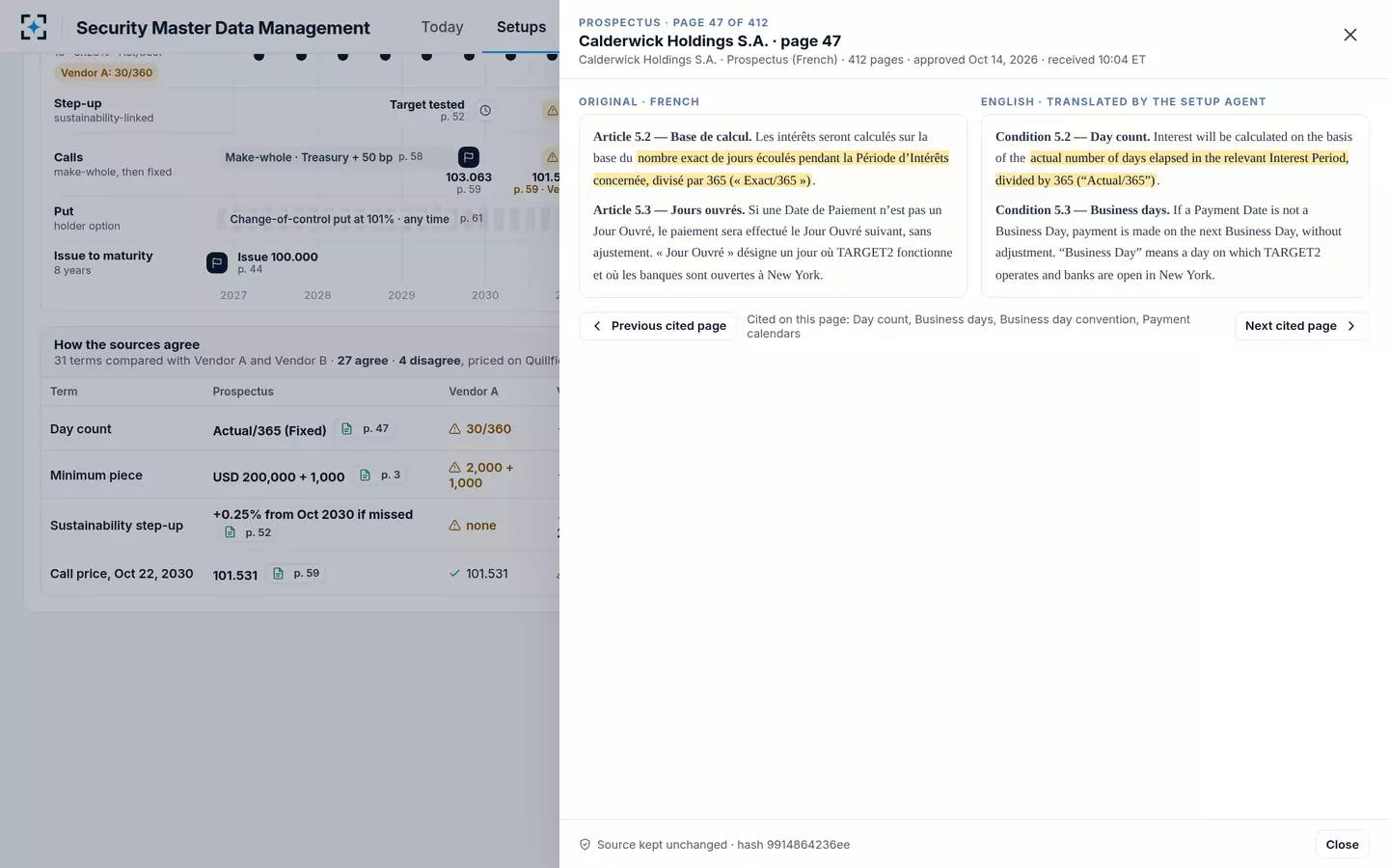
Vendors get day counts wrong in predictable ways. They default from the currency or the issuer's other bonds; they read an English summary where the binding text is in another language; they label a convention with a name that means something else in another market, such as "Exact/365" against "Actual/365"; or they confuse the day count with the business-day convention on the same page. On the sample month in the solution, day count was the field one vendor got wrong most often, 31 of its 118 disagreements with the documents, mostly on new European issues.
How to catch a wrong day count before it reaches NAV
Test it, do not just compare it. Two vendors agreeing on a convention is weaker evidence than one cash flow that matches the document's own example or the paying agent's first payment. The checks below are cheap and catch most errors before a fund accrues a single day.
Six checks that catch a wrong day count before the first accrual
- Cite the clause, not the summary
Record the page and the exact words of the interest calculation provision, in the original language where it governs.
- Generate every coupon under the cited convention
Unequal coupons are expected under Actual/365 (Fixed); equal coupons under 30/360. The pattern itself is a test.
- Recompute under each vendor's convention
Price the difference on your own position, so a steward sees what the disagreement is worth.
- Store the business-day convention and calendar separately
Adjusted or unadjusted, following or modified following, which cities: each changes a payment, none is the day count.
- Check accrued interest at a test settlement date
Match it to the dealer's confirmation on the first secondary trade; a mismatch is a master error until proved otherwise.
- Compare the first payment with the paying agent's amount
If it differs, the master, every fund's accrual and every settlement since issue need correcting.
How Security Master Data Management tests a day count against the document
The solution treats the day count as an economic term: drafted from the document with its page, compared with both vendors, tested in cash flows, and approved by a second steward. On the sample bond the Setup agent read Actual/365 (Fixed) from page 47; one vendor agreed and the other carried 30/360. The Validator agent generated all 16 coupons under each basis and priced the gap on Quillfield's $220 million position: $18,458.90 too much on the first coupon, and $73,835.62 misstated across the life of the bond.
Every coupon under the prospectus basis and under the vendor's 30/360
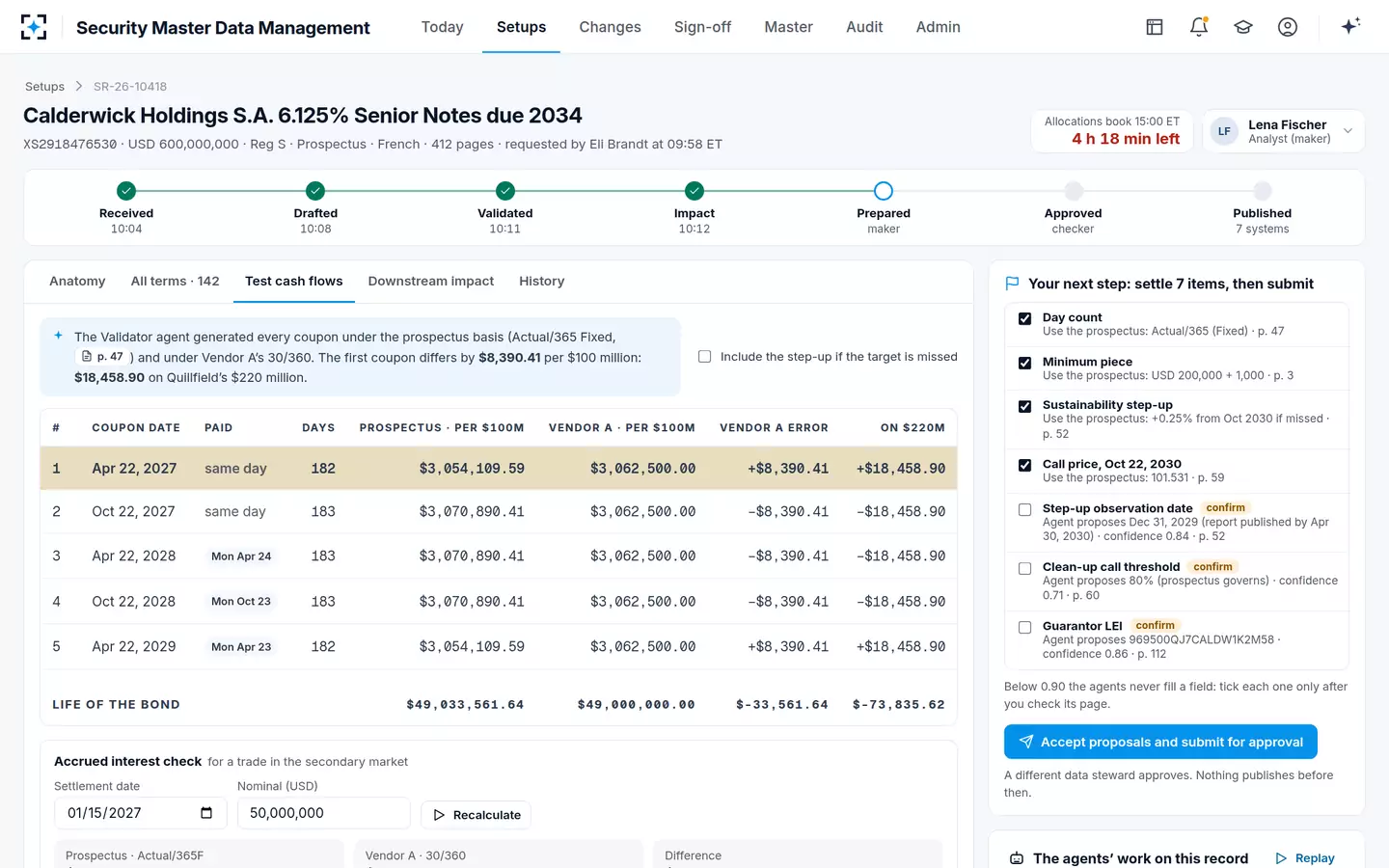
The steward then accepted the prospectus value with the reason "Offering document governs — new issue", a different steward approved, and the Challenge agent sent the vendor the page as evidence once a steward approved that too. The agents never overwrite a value and never resolve a disagreement themselves. Every vendor challenge also feeds a scorecard of how often each vendor's terms disagree with the documents; a challenge to a vendor's price, rather than its terms, is a different exercise, described in what a price challenge is. Where the day count fits among the other fields a master holds is in the security master in finance, and how the corrected value travels to every system is in the golden copy. The solution is on the Security Master Data Management page.
Questions people ask
What day count convention do US corporate bonds use?
Traditionally 30/360: FINRA's Uniform Practice Code computes the interest added to the price on a 360-day year with 30-day months. But a bond's own terms govern, and USD bonds issued abroad, such as Reg S notes under a European prospectus, often use another convention. Read the interest provisions before relying on the default.
What is the difference between Actual/365 and Actual/Actual?
Actual/365 (Fixed) always divides by 365, so a 183-day coupon pays more than a 182-day one. Actual/Actual divides by the actual length of the period, so every full half-year coupon pays exactly half the annual rate. They agree only when the period happens to be half of 365 days, which no real half-year is.
What day count do US Treasuries use?
Actual/Actual. A full semiannual coupon is half a year's interest whatever the number of days, and accrued interest uses the actual days in the half-year. Treasury floating rate notes are the exception: they accrue daily on an Actual/360 basis.
How much can a wrong day count cost?
On the sample bond, a 6.125% note, 30/360 instead of Actual/365 (Fixed) misstates each coupon by $8,390.41 per $100 million and accrued interest on a single $50 million trade by up to several thousand dollars. Actual/360 instead of Actual/365 would overstate the first coupon by $93,320.01 on a $220 million position. Multiplied across funds and trades, the cost is in breaks and corrections as much as in money.
Does the business-day convention change the coupon?
Only if the bond adjusts the interest period. The sample bond moves a payment that falls on a weekend to the next business day "without adjustment", so the coupon is still calculated to the scheduled date. An adjusted bond would accrue the extra days, which is why a master stores the adjustment rule beside the day count.