Cash and position reconciliation breaks are the differences left when a fund's books are matched against its custodian, prime broker and bank records and the matching rules cannot clear them: a position quantity that does not agree, a cash balance that is out by a dividend, an FX conversion booked at the wrong rate. Most of them fall into a short list of causes, and the list is short enough to count: timing, trades the custodian does not show, corporate actions not booked, FX rates, fees and charges, and a remainder that nobody can yet explain. Counting breaks by cause, every day, is what lets a reconciliation team see which upstream process keeps producing them. Botminds' Position and Cash Reconciliation codes every break to a cause with the source line that proves it, so the counts below come straight out of the morning's work.
The figures on this page come from a fictional manager as it runs through the solution: Quillfield Capital's reconciliation of 46 funds as of the close on Friday 16 October 2026, which left 1,214 breaks (486 on positions, 728 on cash) worth $316.7 million in absolute value. The rules quoted are the FCA's, the EU's and the CFTC's.
Half the 1,214 sample breaks are timing; a quarter are FX and fees
Share of the 1,214 breaks by count
- Timing · 50%
- FX rate, fees and charges · 25%
- Corporate action not booked · 12%
- Trade not on custodian, or unknown · 12%
What is a reconciliation break in a fund?
A reconciliation break is a difference between the books and an external record that falls outside the firm's tolerance and that the matching rules cannot pair away. It is not the same as an error. Many breaks are correct on both sides and simply early or late; some are errors in the book; some are errors at the custodian; a few are a sign that something has gone missing.
The FCA's definition of when a discrepancy is resolved is the most useful one to work to, wherever a firm is regulated: not until it has been fully investigated and corrected and any shortfall it caused has been made good, with the firm holding every asset it ought to hold and its own records, and those of the third party, agreeing with that position (FCA CASS 6.6.48G). Netting two breaks against each other, writing a small one off, or labelling one "timing" without evidence each closes a line on a report without meeting that test.
The search phrase "what is cash and position reconciliation" covers the two halves of the same morning. Position breaks are about holdings: quantity, par, accrued interest. Cash breaks are about balances and the movements behind them. They are linked, because a corporate action or a trade usually moves both: a dividend not booked leaves the cash short and a receivable open; a trade not settled leaves the position long and the cash unspent. Position reconciliation, books against custodian and prime broker walks through the daily cycle in which these breaks appear.
What causes cash and position breaks? Six causes you can count
Six causes account for almost every break in a typical asset manager's reconciliation, and each one points to a different upstream process and a different fix. The table sets them out with the document that usually proves each one, because a cause without a document is a guess.
Six causes of cash and position breaks, the proof and the usual fix
| Cause | What it looks like | The document that proves it | The usual fix and owner |
|---|---|---|---|
| Timing | Book on trade date, custodian on settlement; a loan recalled but not yet booked by the lending agent | A matched pending instruction with a settlement date; the lending agent's returns file | None: carry forward and test it at the next run; settlements if it passes its date |
| Trade not on custodian | A purchase, sale or transfer in the book that the custodian does not show | The order blotter and broker instruction; the custodian's instruction status | Query the custodian; hand a failing trade to settlements |
| Corporate action not booked | A dividend, coupon, rights issue or split paid or credited that the book has not booked, or booked on another date | The custodian statement line and the issuer's own notice | Correcting entry; a note to corporate actions; a challenge to the data vendor |
| FX rate | A conversion booked at the book's rate rather than the rate the custodian dealt | The custodian's cash message showing the dealt rate | Correcting entry at the dealt rate; a tolerance review if it recurs |
| Fees and charges | Custody, transaction or bank fees debited but not accrued, or charged above the agreed schedule | The fee line on the statement and the fee schedule | Accrual entry; query any charge above the schedule |
| Unknown | No trade, event, transfer or fee explains the difference | None yet | A named owner and an investigation; escalation if it ages |
The causes behave very differently by value. Fees and charges were 14% of the sample breaks but under 1% of the value: 171 small items, 164 of them with accrual entries the agents drafted and replayed. Trades the custodian did not show were 8% of breaks but a fifth of the value, because a missing instruction on a large trade is a large number. Reporting breaks only by count makes fee noise look like the problem; reporting only by value hides a hundred small items that each take an analyst's time. A desk needs both.
Absolute value of the sample breaks by cause, in millions of dollars
Which breaks are timing and which are real?
A break is timing only when a document shows it will clear without anyone doing anything: a pending instruction matched at the custodian with a settlement date, a lending return the agent has not yet booked. Everything else is real until it is explained, however familiar it looks.
The test matters because timing is the largest cause and the easiest label to apply. In the sample, 612 breaks were coded timing, and the agents' own carry-forward note said 598 of them were matched pending at the custodian and due to settle that day. The firm's rule is that a break may be called timing only when it is matched pending at the custodian with a settlement date; anything else stays in its own cause. A timing break that is still there after its settlement date has changed cause: it is now a fail or a trade the custodian never received.
Shorter settlement cycles make that change happen faster. Since US trades moved to settlement one business day after the trade on 28 May 2024 (SEC, Release 34-96930), a timing break has one business day to clear, not two. The sample's lending recall shows the other kind of timing: the Brenford Logistics position was 12,400 shares long at the custodian because a recalled loan had come back on 16 October and the lending agent would not book it until 19 October. The Explainer agent first could not explain it; the analyst asked it to read the lending returns file, and the break moved to timing at 96% confidence with row 412 as its proof.
Corporate actions, FX and fees: the breaks that hide in cash
Cash breaks are harder than position breaks because the amount, not the existence, is wrong, and three causes produce most of them: corporate-action income paid on a different date or at a different net amount, FX conversions at a different rate, and fees the book has not accrued. Each needs the custodian's own line, often in the local market's language.
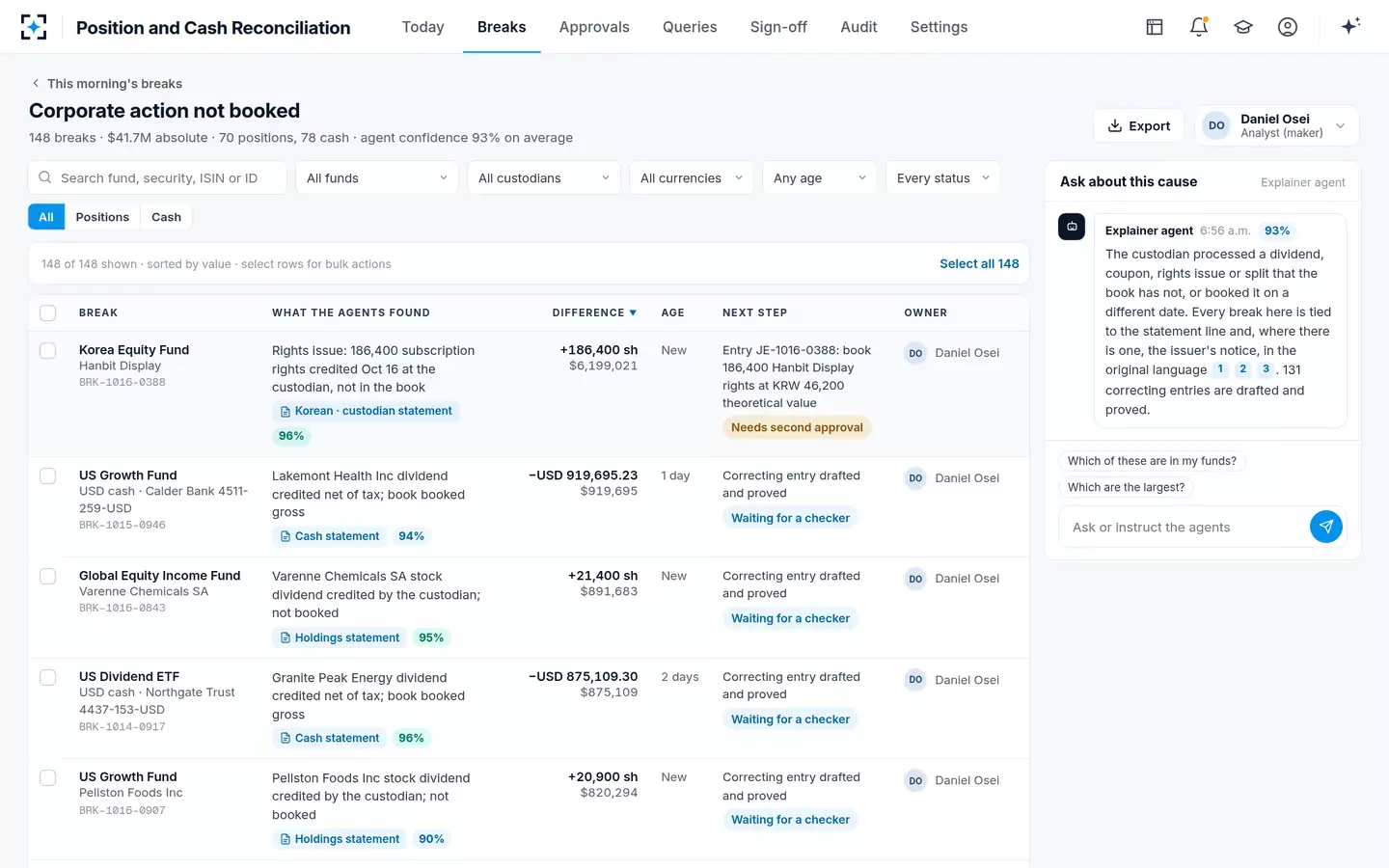
The sample's corporate-action breaks show the range. Quillfield Japan Equity Fund's yen cash at its custodian was JPY 48,202,702 ($322,168) above the book because a dividend was paid on 16 October while the data vendor had recorded 19 October, so the book still held a receivable; the Tokyo sub-custody statement, in Japanese, showed the credit net of 15.315% withholding. In US Growth Fund a dividend was credited net of tax while the book had booked it gross, a USD 919,695.23 difference. In Korea Equity, 186,400 subscription rights were credited by the custodian and not booked at all. All three are the same cause, a corporate action not booked as paid, and all three needed the custodian's statement to prove it. How an event moves from notice to payment is mapped in the corporate actions processing life cycle.
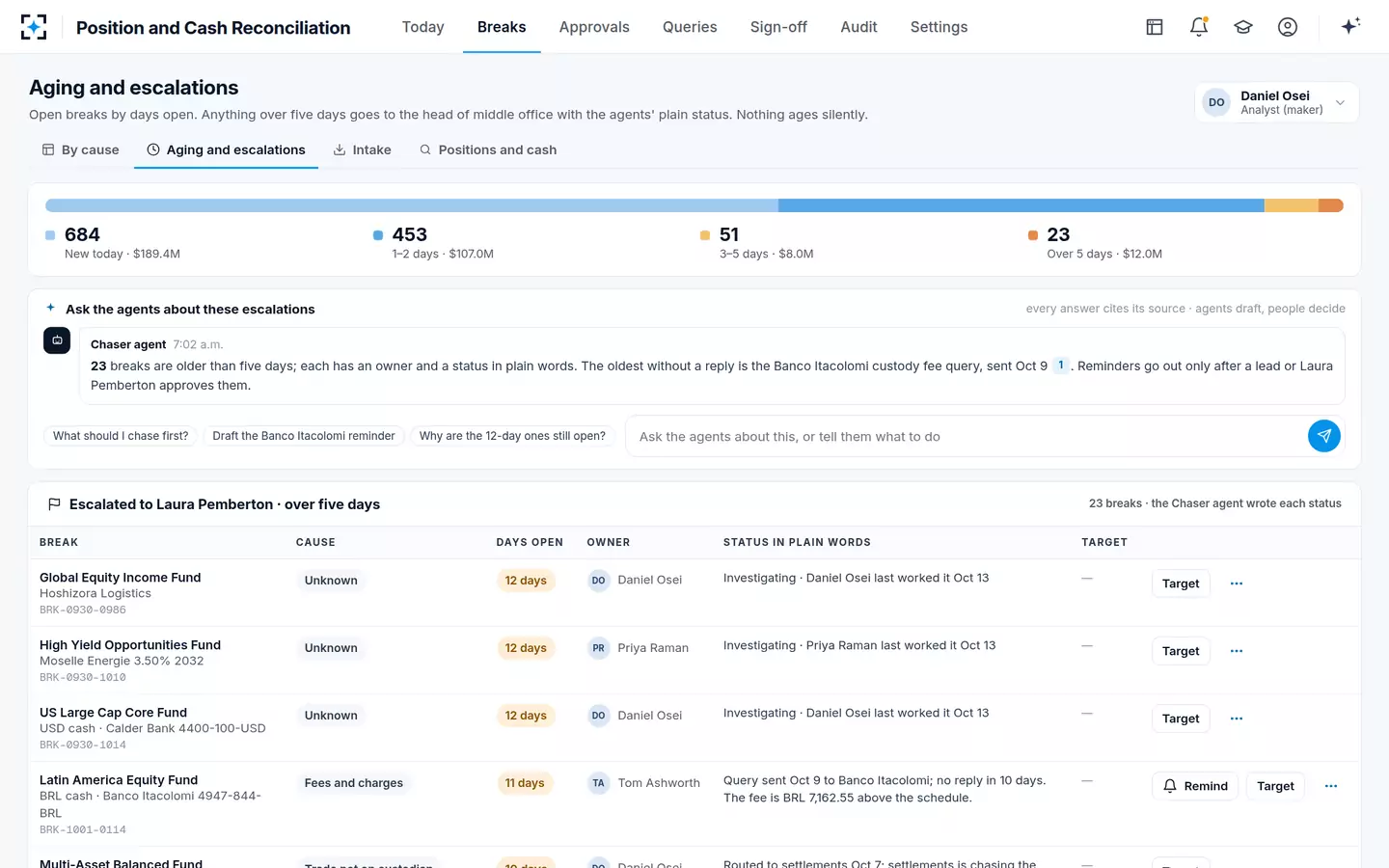
FX breaks are usually small and repetitive. In Korea Equity a won dividend repatriation was dealt by the custodian at 1,389.20 while the book used 1,391.03, leaving USD 1,204.18. Of the 133 sample FX breaks, 111 fell within a proposed FX tolerance that still waits for the head of middle office's approval. Fees are smaller still, but they are where custodian overcharges surface: one sample query concerned a Brazilian custody fee BRL 7,162.55 above the agreed schedule, sent on 9 October and unanswered ten days later.
One cause, every break, each with its proof and next step
What CASS says about suspense accounts and "liquidated stocks"
The UK rules are explicit that two kinds of item which reconciliation teams tend to park are discrepancies in their own right. "Items recorded or held within a suspense or error account fall within the scope of discrepancies", and so do "items recorded in a firm's records and accounts that are no longer recorded by relevant third parties (such as 'liquidated stocks')" (FCA CASS 6.6.52G and 6.6.53G).
Items "no longer recorded by relevant third parties (such as 'liquidated stocks') also fall within the scope of discrepancies".
FCA Handbook, CASS 6.6.53G
That closes two common exits. A suspense account is where a break goes when nobody wants to own it, and the rule treats it as still open. A liquidated stock is a holding the book keeps after the custodian has written it off, perhaps after a bankruptcy or a delisting, and the rule treats the difference as a discrepancy until the book is corrected. For a discrepancy found in a reconciliation, a UK firm must investigate promptly, resolve it without undue delay, and cover any shortfall from its own assets or money in the meantime (CASS 6.6.49R and 6.6.54R). The FCA's own list of what an internal evaluation should catch is a second taxonomy worth borrowing for book-side breaks: "test" and "balancing" entries, negative balances, processing errors, journal entry errors and IT errors (CASS 6.6.20G). How the UK internal check works is set out in the internal custody record check, step by step.
What is an ageing report, and which breaks must be escalated?
An ageing report lists open breaks by how many days they have been open, with their owner and status, so that the old ones reach someone senior before they become a loss or a regulatory issue. Which breaks must be escalated is a firm's own policy; the rules set the outer limits, not the trigger.
The outer limits are clear enough. A UCITS depositary must monitor "the outcomes of the reconciliations and the actions taken as a result of any discrepancies", notify the management company "if a discrepancy has not been corrected without undue delay" and notify the regulator "if the situation cannot be corrected" (Delegated Regulation (EU) 2016/438, Article 10(1)(e)). For uncleared swaps, a swap dealer must report to the CFTC any valuation dispute above $20 million that is not resolved within three business days when the counterparty is also a dealer, or five business days when it is not (17 CFR 23.502(c)).
Inside those limits a policy needs three things: an age at which a break goes to the head of the desk, a value at which it goes regardless of age, and a rule that age is counted from when the break first appeared, not from the last time someone touched it. The sample firm escalates every break older than five days to the head of middle office, with a plain-words status written by the Chaser agent; on the sample morning that was 23 breaks.
Aged breaks reach the head of middle office first, each with a plain status
How do you code a break's cause so it can be counted?
Code each break to one cause from a fixed list, record the document that proves it, and record the reason code of the fix when it is approved. Three fields, captured at the time, are enough to count breaks by cause every day and to see which upstream process produced them.
The fixed list matters more than its exact contents. The six causes above work for most managers, but a firm with a large securities lending programme may split timing into settlement and lending, and one with many private assets may add valuation. What must not happen is a free-text cause, because free text cannot be counted, or a cause chosen after the fix, because then the count measures the fix rather than the break.
The proof field is what makes the count trustworthy. In the sample, the agents give every explained break a source passage (a statement line, a SWIFT field, an issuer's notice, a lending report row) and say "unknown" below 80% confidence rather than guess; 51 breaks stayed unknown, each with a suggested owner. A cause count built on guesses would send the corporate actions team to fix a problem that was really in settlements. The reason code on the fix closes the loop: the sample's codes include CA-PAY for a corrected pay date, CA-ENT for a booked entitlement and FX-CUS for FX booked at the custodian's rate. A US registered fund keeps its cash reconciliations for six years (17 CFR 270.31a-2(a)(2)), so the codes will be read again.
From matching to prevention: what the cause counts tell you
Counted by cause every day, breaks become a measure of upstream quality. A rising count of corporate actions not booked points to the event feed or the data vendor; a run of FX breaks at one custodian points to a standing instruction or a tolerance; trades not on the custodian point to instructions sent late or to the wrong place.
The sample morning shows each pattern. The Japan dividend was a vendor date error, so the drafted fix carried a note to corporate actions and a challenge to the vendor, and the same event was found and fixed in two other funds that held the stock. The 111 FX breaks inside a proposed tolerance are the case for changing the rule, and the proposal carries a 20-day back-test on sample data that closed 2,214 breaks and missed no real error; it still waits for the head of middle office. The 18 failing trades among the trades not on the custodian are the case for a conversation with settlements, which owns fails, and with whoever owns settlement instructions.
That is the change in the team's job: from matching every morning to removing the reasons for tomorrow's breaks. It only works if the counts are honest, which is why the proof field and the unknown category matter more than the taxonomy itself. How accurate an automated close really is, and how to test it, is the subject of automated cash reconciliation and the match rate. The agents that do the coding are described on the Position and Cash Reconciliation page.
Questions people ask
What is a break in a reconciliation report?
It is a line where the two records disagree by more than the tolerance and the matching rules could not pair it. A good report shows each break's cause, the document that proves it, its age and its owner, and it reports both the count and the absolute value of breaks so that offsetting differences cannot hide each other.
Should small breaks be written off?
Only under a written policy, with an approver who did not prepare the reconciliation, and never as a way of closing a break nobody has explained. A small break can be the visible part of a large problem, such as a fee charged above the agreed schedule every month, and the UK rules treat suspense items as unresolved discrepancies.
How many reconciliation breaks are normal?
No regulator or independent study publishes break rates for asset managers, so the useful benchmark is your own trend by cause. In the fictional sample, 1,214 breaks were left from about a quarter of a million positions and roughly 49,000 cash transactions; the figure that matters is how many of them were still unexplained at the cut-off.
What is the difference between a break and an exception?
The words are often used interchangeably. Where they differ, a break is a difference between two records, and an exception is any item a process could not handle automatically, which includes breaks but also files that did not arrive or did not parse. In the sample morning one file arrived late and one came with a new column layout.
Who owns a reconciliation break?
The reconciliation team owns every break until it is resolved, even when another team must act. In the sample, the analyst who owns the fund proposes each fix, a team lead or the fund's controller approves it, corporate actions and settlements receive the breaks that originate with them, and breaks older than five days go to the head of middle office.
Can a reconciliation break affect the NAV?
Yes, when the book side is wrong: a dividend not booked, an FX conversion at the wrong rate or a missing fee accrual all change the fund's assets. Whether a resulting NAV error must be corrected and investors compensated depends on the fund's error policy and the regulator's thresholds, covered in Fund Accounting's NAV error correction policy guide.