A custody reconciliation process compares a firm's own records of the securities and cash it holds for clients or funds with the records of the custodians, sub-custodians and depositories that actually hold them, finds every difference, investigates it and resolves it, and keeps the evidence. The three main regimes ask different questions of it. The SEC's custody rule has an independent accountant verify an adviser's client assets once a year on a date the adviser is not told in advance; the UK's Client Assets Sourcebook makes the firm itself reconcile with every third-party holder at least monthly and fix discrepancies without undue delay; EU law has a fund's depositary reconcile the fund's cash flows every day the cash moves. A manager with funds or clients in all three needs one process that produces evidence each regime will accept. Botminds' Position and Cash Reconciliation is built to run that process every morning and keep the evidence from it.
Custody reconciliation: three regimes, five questions
| Question | US adviser (SEC custody rule) | UK firm holding client assets (CASS 6) | EU fund (UCITS or AIF depositary) |
|---|---|---|---|
| Who reconciles | The adviser keeps the books; an independent accountant verifies them against the custodian | The firm, against each third party holding the assets, and its own records against each other | The depositary, against the fund's records, and against any delegate holding assets |
| How often | Custodian statements at least quarterly; verification once a calendar year, unannounced | No more than one month between external reconciliations and internal checks; daily is best practice for CSD holdings | Cash flows daily where cash moves daily; assets with delegates "as frequently as necessary" |
| Who checks | Independent public accountant; files Form ADV-E within 120 days | The firm's CASS oversight; the auditor's annual client assets report; the FCA | The depositary itself; the national competent authority |
| A difference found | Material discrepancy: the accountant tells the SEC within one business day | Investigate promptly, resolve without undue delay, cover any shortfall meanwhile | Notify the manager if not corrected without undue delay; the regulator if it cannot be |
| Records | Registered funds: cash reconciliations kept six years (Rule 31a-2) | A record of each check and reconciliation, kept five years | Depositary procedures reviewed in full at least once a year |
What is custody reconciliation?
Custody reconciliation is the comparison of the holder's books with the keeper's books. The firm that owes the assets to its clients or funds keeps one record; the custodian, its sub-custodians and the central securities depository keep others; a custody reconciliation checks that they agree, asset by asset and account by account, and treats every disagreement as a problem to be found out, not netted away.
It is related to the daily position and cash reconciliation an asset manager runs before the NAV, and often the same run serves both. The difference is the question. The daily reconciliation asks whether the NAV is right. The custody reconciliation asks whether every asset the firm says a client owns is really there, under the right name, at the right institution. The FCA puts the purpose in one sentence: to ensure "the completeness and accuracy of a firm's internal records and accounts of safe custody assets held by the firm for clients against those of relevant third parties" (CASS 6.6.33G). The search phrase "accounting vs custody reconciliation" is that distinction: one tests values, the other tests existence and ownership.
What does the SEC custody rule require of advisers?
The SEC's custody rule does not tell an adviser to reconcile; it makes an independent party check the result. An adviser with custody of client funds or securities must keep them with a qualified custodian, have a reasonable basis for believing the custodian sends account statements to clients at least quarterly, and have the assets verified by an independent public accountant once each calendar year (17 CFR 275.206(4)-2(a)).
The verification is designed to be a surprise. The accountant picks the date, gives the adviser no notice and varies the timing from year to year; the accountant files Form ADV-E within 120 days and, on finding any material discrepancy, must notify the SEC "within one business day of the finding" (Rule 206(4)-2(a)(4)). Pooled vehicles such as private funds can instead deliver audited financial statements to investors within 120 days of the year end. Where the adviser or a related person is itself the qualified custodian, it also needs a yearly internal control report, and the accountant "must verify that the funds and securities are reconciled to a custodian other than you or your related person" (Rule 206(4)-2(a)(6)).
Compliance is not a formality in exams. When the SEC's examination staff reviewed recent exams with significant deficiencies in 2013, about a third of them, more than 140, included custody-related issues (SEC OCIE risk alert, 4 March 2013). What the accountant is supposed to do with the custodian's confirmations, and what happened when one firm did not, is the subject of the guide to position reconciliation.
The US custody rule runs on a handful of fixed numbers
1a year
unannounced verification of client assets by an independent accountant
Rule 206(4)-2(a)(4)
120days
for the accountant to file Form ADV-E after the examination date
Rule 206(4)-2(a)(4)(i)
1business day
to tell the SEC about a material discrepancy the accountant finds
Rule 206(4)-2(a)(4)(ii)
140+
custody findings among recent significant-deficiency exams, about one in three
SEC risk alert, 2013
What did the SEC propose in October 2026?
On 6 October 2026 the SEC proposed new "Adviser and Regulated Fund Custody Rules", with comments due by 7 December 2026 (91 FR 63870). It is a proposal, not law. It would move the adviser custody rule to a new number, Rule 223-1, and add rules for crypto assets, and it follows the SEC's withdrawal on 17 June 2025 of its 2023 "Safeguarding Advisory Client Assets" proposal (90 FR 25531).
Two passages matter to a reconciliation team. First, the SEC says it expects to revise its 2009 guidance to accountants so that, when testing a custodian's internal controls, the accountant should "observe, inspect, and/or reperform a sample of reconciliations" to check that the data in them comes from unaffiliated custodians and is unaltered. Second, the release describes an alternative it considered and did not propose: replacing the surprise examination with daily reconciliations by the adviser.
"Under this alternative, we would require advisers with custody of client funds and securities to implement daily system-based reconciliations of their internal books and records against the records maintained by qualified custodians, supported by documented exception management procedures that identify, escalate, and resolve discrepancies."
SEC, proposed custody rules, 91 FR 63870 (6 October 2026)
The alternative would also have required advisers to give clients a quarterly summary of custodial balances and "any material reconciliation exceptions", and to report "material reconciliation breaks" to the Commission. The SEC set out why it held back: defining a reportable incident precisely would be hard, and the approach would rely on the adviser itself rather than a custodian or independent third party. Commenters can still argue for it until 7 December. Whatever the final rule says, the passage is a fair description of what a well-run daily reconciliation already is.
How often does CASS require external reconciliations?
At least monthly. A UK firm holding safe custody assets must reconcile its records with those of every third party holding them "as regularly as necessary but allowing no more than one month to pass between each external custody reconciliation", and as soon as reasonably practicable after the date the reconciliation relates to (CASS 6.6.37R). The FCA's guidance calls a reconciliation every business day best practice for assets held at a central securities depository that can report daily (CASS 6.6.39G).
The rule was amended in September 2026. The version in force since 25 September 2026 lets a firm go longer than a month without breach in two narrow cases: when a third party that agreed to send data on time fails to because of something inherent to the asset, such as the issuer's insolvency or a delisting (but not, the FCA says, a systems outage at the third party), and when a third party refuses to send data as often as the firm asks despite reasonable endeavours, in which case the firm must record why, reconcile as often as it can and review the situation every year (CASS 6.6.40AR to 6.6.40CR).
Monthly is the ceiling, not the plan. A firm must choose its frequency with regard to "the frequency, number and value of transactions" and the risks to the assets, record that decision, and review it at least annually unless it already reconciles every business day (CASS 6.6.44R to 6.6.46R). The UK rules also require a separate internal custody record check of the firm's own records, covered in the internal custody record check, step by step. The FCA's £126 million fine against two BNY Mellon entities in 2015 was for external reconciliations done on the wrong basis (FCA final notice, 14 April 2015).
What must a UCITS or AIF depositary reconcile?
An EU fund's depositary reconciles the fund's cash itself, daily, and reconciles the assets it holds through delegates regularly. For a UCITS the depositary must "reconcile all cash flow movements and performs such reconciliations on a daily basis, or, in case of infrequent cash movements, when such cash flow movements occur", identify significant or inconsistent cash flows at the close of each business day, review the whole reconciliation process at least once a year, and check "consistency between its own records of cash positions and those of the UCITS" (Delegated Regulation (EU) 2016/438, Article 10(1)).
The rule for alternative investment funds is the same in substance. The AIF's depositary must "perform such reconciliations on a daily basis or, in case of infrequent cash movements, when such cash flow movements occur", and must notify the manager "if an irregularity has not been rectified without undue delay and also the competent authorities if the situation cannot be clarified" (Delegated Regulation (EU) No 231/2013, Article 86). For assets held in custody through a delegate, the depositary reconciles its records with the delegate's "as frequently as necessary", a frequency set by the fund's normal trading activity, any trades outside it and any trades for other clients in the same account (2016/438, Article 13(1)(c), as amended by Delegated Regulation (EU) 2018/1619; the AIF rule, Article 89(1)(c), was amended the same way).
The manager's side of this is a duty to inform. The management company must tell the depositary about every cash account and send it all instructions and information about accounts at third parties, so that the depositary can run its own reconciliation (2016/438, Articles 9 and 10(2); 231/2013, Article 85). In practice the depositary's daily cash reconciliation is a second reconciliation of the same cash the manager reconciles, and every unexplained manager break becomes a depositary query. How to make sure the manager's cash matching is not quietly closing real differences is covered in automated cash reconciliation and the match rate.
What do broker-dealers count each quarter, and what do registered funds keep?
Broker-dealers and registered funds have their own reconciliation rules in the US, and both bear on what a manager's counterparties and administrators send it. Under Rule 17a-13 a broker-dealer must, at least once each calendar quarter, count the securities it holds, verify those in transfer, loaned, borrowed or failed for more than thirty days, compare the results with its records and record every unresolved difference no later than seven business days after the count (17 CFR 240.17a-13(b)).
A registered fund keeps the book that a custody reconciliation is tested against: a securities record showing for each security where its long positions are held (17 CFR 270.31a-1(b)(3)), and trial balances proving the money balances in its ledgers at least monthly (31a-1(b)(8)). It must keep "bank statements, cancelled checks, cash reconciliation" and the schedules supporting each NAV calculation for at least six years (17 CFR 270.31a-2(a)(2)).
A policy that nobody runs is not a control. In September 2024 the SEC found that a business development company had written into its procedures that it "should also engage in custody reconciliation by obtaining custodial statements from the custodian and comparing the custodial statements with its internal records", and had not done so for its uncertificated securities from at least July 2019 to June 2022. Some of those assets sat with brokers, transfer agents or in self-custody instead of the custodian bank. The order found violations of Section 17(f) and Rule 38a-1; the company had already moved the assets and adopted a weekly custody reconciliation (SEC, In the Matter of SuRo Capital Corp., IC-35331, 23 September 2024).
Can one custody reconciliation process satisfy the US, UK and EU at once?
Yes, if it is designed around the strictest question each regime asks and keeps evidence each one can read. The daily run satisfies the EU cash clock; the monthly CASS ceiling and annual US verification are then met as a matter of course, provided the run is entity-specific, covers every third-party holder, and leaves a record of each discrepancy and what was done about it.
Eight tests a custody reconciliation process should pass in all three regimes
- Entity by entity, not enterprise-wide
Reconcile each legal entity's records with each holder; the BNY Mellon fine was for doing it globally.
- Every third-party holder in scope
Custodians, sub-custodians, prime brokers, transfer agents and depositories, including affiliates.
- The frequency decision written down
CASS asks for the reasoning and an annual review; a written frequency also answers the auditor.
- Assets, not transactions
The FCA says reconciling transactions instead of the assets themselves does not meet the rule.
- Every discrepancy has a record
Date, what was done, the discrepancy and how it was resolved: CASS 6.6.8R lists all three.
- Suspense items count as breaks
Items in suspense or error accounts, and "liquidated stocks", are discrepancies under CASS 6.6.52G and 6.6.53G.
- The person checking is independent
CASS asks, where possible, for someone independent of the records being reconciled.
- The depositary gets what it needs
Every cash account and every third-party instruction, so its daily reconciliation can match yours.
Where Position and Cash Reconciliation fits in the custody reconciliation process
Botminds' Position and Cash Reconciliation runs the daily books-to-custodian comparison and keeps the evidence each regime asks for: every break, its cause and the source line that explains it, the drafted fix, the replay that proved it, and who approved it and when. It does not replace the independent accountant, the depositary's own reconciliation or the firm's CASS oversight; it gives each of them a record to test.
The evidence a custody examiner asks for, kept as the work happens
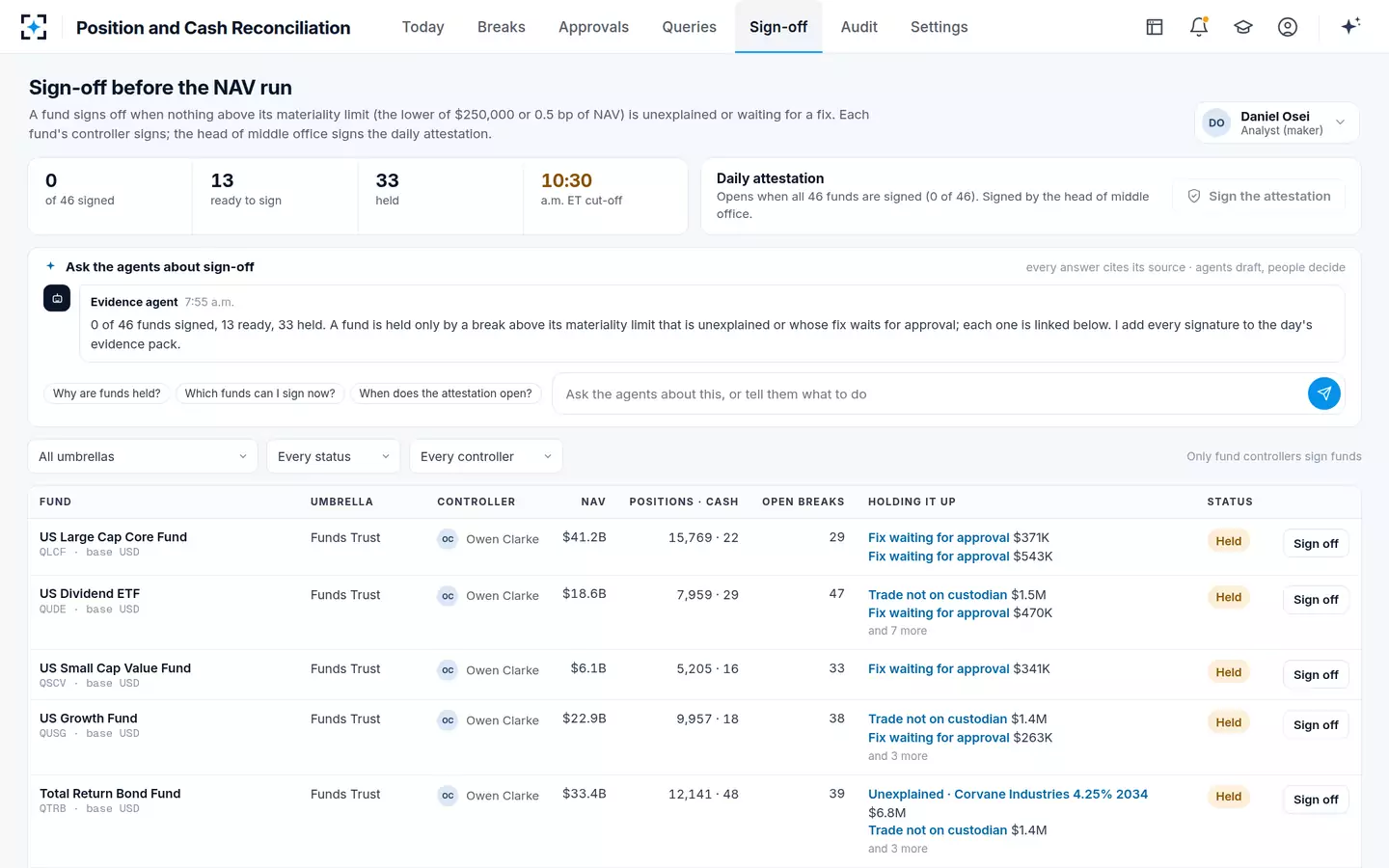
In the sample firm the funds sit in three umbrellas, a US trust, an Irish UCITS and a Luxembourg SICAV, so one morning has to satisfy all three regimes. Each fund is signed off before the NAV run only when nothing above its materiality limit is unexplained or waiting for a fix, and the head of middle office signs the day.
Fund by fund, what holds each one up before the NAV run
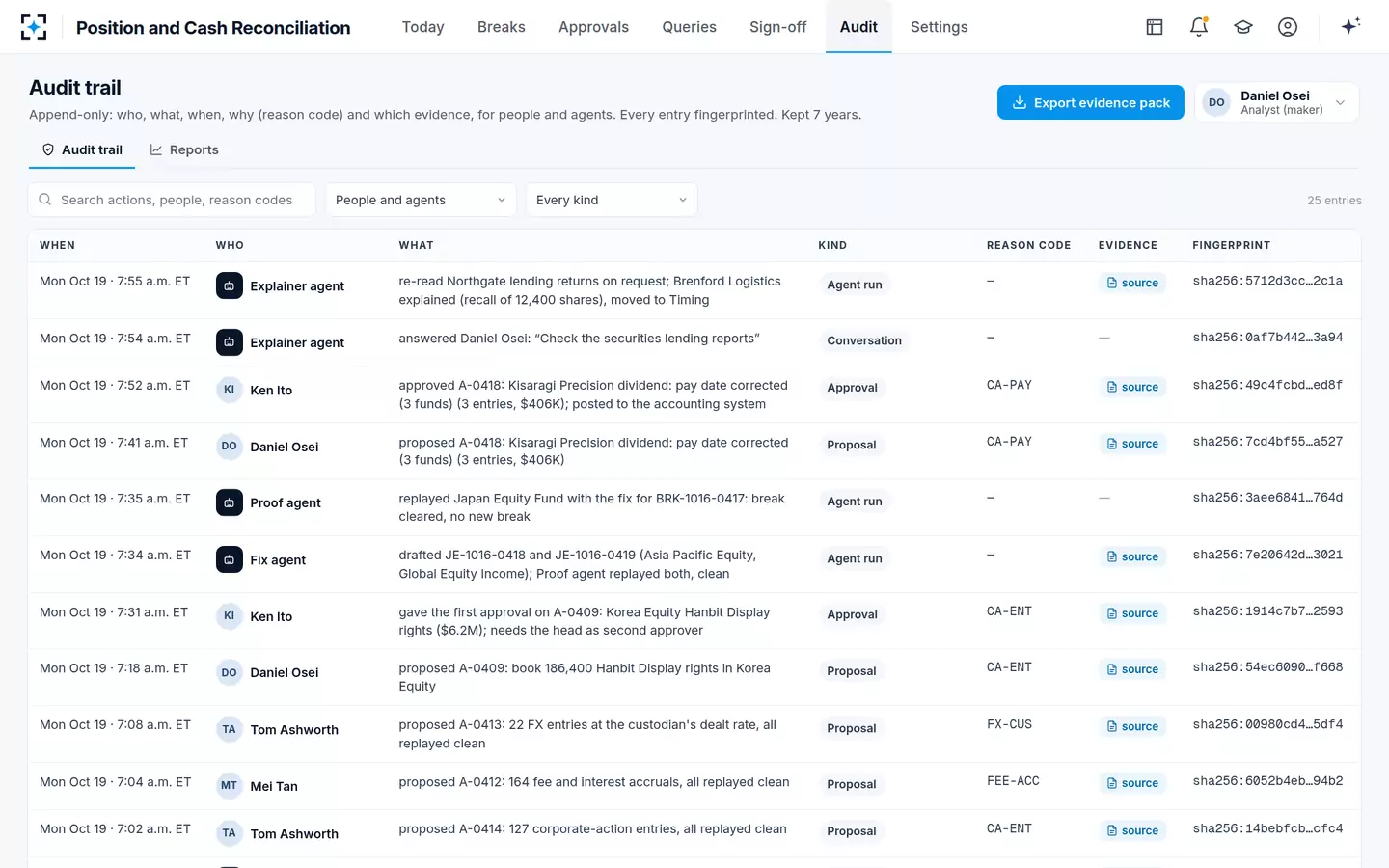
The audit trail is append-only and kept for seven years in the sample settings, longer than the six years Rule 31a-2 asks of a registered fund's cash reconciliations and the five CASS asks of its records. How the agents divide the work, and what each is never allowed to do, is set out on the Position and Cash Reconciliation page.
Questions people ask
What is a surprise custody examination?
It is the annual verification of an adviser's client assets by an independent public accountant under SEC Rule 206(4)-2, on a date the accountant chooses without telling the adviser and varies from year to year. The accountant confirms holdings with the custodians and clients, reconciles the confirmations to the adviser's records and files Form ADV-E with the SEC within 120 days.
Is the SEC's 2026 custody proposal in force?
No. It was published on 6 October 2026 and comments are due by 7 December 2026; the current Rule 206(4)-2 still applies. The proposal would renumber the rule as 223-1 and add crypto custody rules; the SEC withdrew its earlier 2023 safeguarding proposal in June 2025.
What is the difference between an internal and an external custody reconciliation?
Under the UK rules an internal custody record check compares the firm's own records with each other, such as its client-by-client record against its aggregate record, using no third-party data. An external custody reconciliation compares the firm's records with those of the custodians and other third parties holding the assets. Both must be done at least monthly.
Does a fund manager need to reconcile if the custodian already does?
Yes. A depositary's or custodian's reconciliation checks its own records; the manager answers for its funds' books. The FCA's 2016 fine against two Aviva entities made the point for outsourced reconciliations: the firms remained responsible even though third-party administrators did the work.
How long does a custody reconciliation discrepancy have to be fixed?
The UK rule has no fixed number of days: a firm must "promptly investigate" and resolve "without undue delay", and cover any shortfall from its own assets or money while it does (CASS 6.6.49R and 6.6.54R). An EU depositary escalates to the manager when a discrepancy is not corrected without undue delay, and to the regulator if it cannot be.
What do auditors test in a custody reconciliation?
They test that holdings at independent custodians agree with the books and that reconciling items are genuine. The SEC's 2026 proposal says it expects accountants testing a custodian's controls to observe, inspect or reperform a sample of reconciliations, which favours a process where each reconciling item already carries its source document.