Position reconciliation is the daily comparison of what an investment manager's books say each fund owns, security by security and share by share, with what the custodian, the prime broker and the fund administrator say they hold for it. Every difference the matching rules cannot clear is a break, and each break needs a cause, an owner and, where the book is wrong, a correcting entry before the fund's NAV is struck. The work is hard not because matching is hard but because the records disagree for ordinary reasons (a trade booked on trade date and settled the next day, a dividend paid a day early, a security out on loan) and the reason sits in a custodian statement, a SWIFT message or a notice that someone has to open and read. Botminds' Position and Cash Reconciliation exists for that step: agents match the files, find each break's cause in its source and draft the fix, and people approve it.
The worked examples come from a fictional manager as it runs through the solution: Quillfield Capital, 46 funds in a US trust, an Irish UCITS and a Luxembourg SICAV, reconciled against nine custodians, prime brokers and banks and one fund administrator, as of the close on Friday 16 October 2026. The rules are quoted from the SEC, the FCA and EU law, and linked where they appear.
Four rulebooks, four different clocks for the same comparison
Quarterly
custodian account statements an SEC-registered adviser must reasonably believe reach clients
Rule 206(4)-2(a)(3)
1 month
longest gap the FCA allows between external custody reconciliations
CASS 6.6.37R
Daily
cash-flow reconciliation by a UCITS depositary, where cash moves daily
EU 2016/438, Art. 10
500+
open swaps between two dealers that trigger reconciliation every business day
17 CFR 23.502
What is position reconciliation?
Position reconciliation is the check that the holdings in the books match the holdings at the institutions that actually keep the securities. For each fund and each security it compares quantity (or par, for bonds), and for bonds the accrued interest, between three kinds of record: the book of record the portfolio managers trade from, the accounting book the NAV is struck from, and the external statements. Externally that means the custodian's statement of holdings (a SWIFT MT535 or its ISO 20022 equivalent, semt.002), the prime broker's position file for a fund that borrows or shorts, and the fund administrator's accounting positions where an administrator keeps the official books.
For a US registered fund the book side is itself a legal requirement. Rule 31a-1 requires a securities record "reflecting separately for each portfolio security as of trade date all 'long' and 'short' positions" and "showing the location of all securities long and the off-setting position to all securities short" (17 CFR 270.31a-1(b)(3)). That last clause is, in effect, the specification for a position reconciliation: the book must say where each security is, and the place it names must agree.
The comparison runs every business day in most fund complexes because the NAV does. A mutual fund must compute its net asset value at least once each business day (17 CFR 270.22c-1(b)(1)), and a position the book carries but no custodian holds needs an explanation before the NAV values it. Where the NAV error rules bite is covered by Fund Accounting's guide to NAV error materiality thresholds; this page is about the comparison that comes before them.
The daily position reconciliation cycle, and where a person signs
Agent
Collect the filesCustodian, prime broker, bank and administrator files and messages, checked against the expected-file calendar.
Never: Change a source file or guess a missing one
Agent
MatchPairs book and external positions under the firm's tolerances by asset class; what does not pair is a break.
Never: Widen a tolerance or force a match
Agent
ExplainFinds the cause of each break in a statement line, message field, notice or lending report.
Never: State a cause without the passage it came from
A person decides
Propose and approveAn analyst proposes the correcting entry or custodian query; a different person approves it.
A person decides
Sign the fundThe fund controller signs when nothing material is unexplained; the head of middle office signs the day.
A position reconciliation example: five breaks and the documents that explained them
A position reconciliation example is easiest to follow on real-looking breaks. On the sample Friday the matcher paired 250,412 positions and 1,514 cash accounts and left 1,214 breaks, 486 of them on positions. Five of the position breaks show the usual range: two that need no correcting entry, two where the book has to change, and one that has to go to the custodian.
Five sample position breaks, and the document that explained each
| Fund and security | Book vs custodian | What the document said | Outcome |
|---|---|---|---|
| Global Equity Income · Brenford Logistics | Book 406,000 shares; custodian 418,400 | Securities lending returns file, row 412: a recalled loan of 12,400 shares came back on 16 October; the lending agent books it on 19 October | Timing: carried forward, no entry |
| Total Return Bond · US Treasury | Book 25,000,000 more par than the custodian | Bought on 16 October for settlement the next business day; the custodian shows a matching pending instruction | Timing: settles, no entry |
| Korea Equity · Hanbit Display rights | Custodian 186,400 rights; book none | Korean custodian statement: subscription rights credited on 16 October | Book the entitlement; over $5 million, so two approvals |
| Global Equity Income · Varenne Chemicals | Custodian 21,400 more shares | Holdings statement: stock dividend credited, not in the book | Book the stock dividend |
| European Long/Short Equity · short sale | Book shows a short sale of 85,000 shares; custodian does not | No matching instruction at the custodian | Query the custodian; hand off if the trade is failing |
The pattern matters more than the five rows. Two breaks were not errors at all, and the evidence that they were timing (a lending return, a pending instruction) had to be found before anyone could say so. Two were errors in the book caused upstream, by a corporate-action feed that missed the event. Only one needed the custodian to answer. A reconciliation team that treats every break as a query to the custodian will spend most of its week asking questions it could have answered from its own files.
How is position reconciliation different from cash and trade reconciliation?
Position reconciliation checks holdings at a point in time; cash reconciliation checks balances and the movements behind them; trade reconciliation checks each trade's details before it settles. They use different files and catch different failures, and a break in one often shows up in another a day later.
Same books, two different questions
Position reconciliation: Quantity, par and accrued interest of each security, by fund and location
Cash reconciliation: Each cash account balance and the day's movements: trades, income, fees, FX, subscriptions and redemptions
Position reconciliation: Custodian statement of holdings (MT535, semt.002); prime broker position file
Cash reconciliation: Cash statements and entries (MT940, MT950, camt.053); prime broker cash and financing files
Position reconciliation: Stock dividend not booked; loan recalled; trade not yet settled
Cash reconciliation: Dividend paid net of a different tax rate; FX dealt at another rate; a fee charged
Position reconciliation: The auditor and the custody rule examiner, who verify holdings
Cash reconciliation: A UCITS or AIF depositary, who must reconcile the fund's cash flows itself
The search term "position reconciliation in investment banking" usually means the broker-dealer's side of the same job: the stock record. A US broker-dealer must, at least once each calendar quarter, physically examine and count the securities it holds, account for those in transfer, loaned, borrowed or failed, compare the results with its records and record every unresolved difference within seven business days of the count (17 CFR 240.17a-13(b)). The asset manager's version runs daily, but it inherits the same idea: a difference is not resolved because it is old, it is resolved when someone has found out why.
How often must positions be reconciled? Daily in practice, by rule less often
No US rule tells an investment adviser to reconcile positions every day; the daily cycle comes from the daily NAV and from the depositary and swap rules that do set a clock. The rules that apply to a typical multi-jurisdiction manager ask for different things at different intervals.
Under the SEC custody rule an adviser with custody must have reasonable grounds, after due inquiry, to believe the qualified custodian sends each client an account statement at least every quarter, and must have client assets verified once a calendar year by an independent accountant on a date the adviser is not told in advance (17 CFR 275.206(4)-2(a)(3)–(4)). In the UK, a firm holding safe custody assets must reconcile its records with each third party that holds them at least monthly, and more often where its business needs it, and the FCA calls a daily reconciliation best practice for holdings at a central securities depository that can report daily (FCA CASS 6.6.37R and 6.6.39G). In the EU, a UCITS depositary must reconcile the fund's cash flows every day, or whenever they occur if the fund's cash moves only occasionally (Delegated Regulation (EU) 2016/438, Article 10(1)(b)). Swap portfolios between two swap dealers are reconciled every business day once the portfolio reaches 500 swaps (17 CFR 23.502); the collateral side of that is mapped in the margin call process, step by step.
The custody reconciliation process across the US, UK and EU sets the three regimes side by side, including the SEC's October 2026 proposal to rewrite the custody rule, which is open for comment until 7 December 2026 and is not law.
What counts as a break, and what is only a timing difference?
A break is any difference between book and custodian that the firm's matching rules cannot clear within tolerance. A timing difference is a break with evidence that it will clear by itself: a matched pending instruction, a loan return the other side has not booked yet. Without that evidence it is not timing, however likely it looks.
Tolerances decide what is a break in the first place, and for positions they are tight. In the sample firm's rule set, equity quantities must match exactly, bond par exactly with accrued interest within USD 1.00, and listed derivatives by contract with variation margin within USD 5.00. A timing rule sits beside them: a break may be labelled timing only when the custodian shows a matched pending instruction with a settlement date. That rule is what stops "timing" becoming the label for anything nobody has investigated. On the sample Friday, 612 of the 1,214 breaks were timing, and 598 of them were due to settle that day.
The UK rule shows why the distinction matters. Where a firm concludes that a discrepancy is "due to a timing difference between the accounting systems of that other person and that of the firm", it must still take all reasonable steps to resolve it "without undue delay" (CASS 6.6.54R(3)). A timing label is not a closure; it is a promise that the break will be gone tomorrow, and the next morning's run should test it. The cause list for cash and position breaks sets out the six causes the sample desk counts, and what each one usually needs.
Who resolves a break: the middle office or the custodian?
The middle office owns the break; the custodian owns only its own record. The manager decides whether its book is wrong and, if it is, an analyst proposes the correcting entry and a different person approves it. The custodian is asked when the evidence points to its side: an instruction it does not show, a rate it dealt, a fee it charged.
That split is written into the rules in both directions. CASS makes a UK firm resolve a discrepancy "regardless of any dispute with that other person" (CASS 6.6.54R(3)). In the EU, the management company must send the depositary "all instructions and information related to a cash account opened with a third party" so that the depositary can run its own reconciliation (2016/438, Article 10(2)), which means the manager's breaks become the depositary's questions.
In practice the hand-off is where time goes. On the sample Friday, 99 breaks were trades the custodian did not show, which led to 81 drafted queries and 18 failing trades handed to settlements; in all, the desk drafted 96 queries, 23 of them in the custodian's own language. None is sent until a team lead approves it, and a custodian's reply alone never closes a break: the next file has to show the change. Settlement fails, once a break turns out to be one, are explained in what is a failed trade.
Why the custodian's record, not the manager's, is the proof
The law treats the custodian's record as the independent one. The adviser's books are the thing being checked; the custodian's statement is the thing they are checked against, by the auditor once a year and by the SEC's examiners whenever they ask.
The SEC's guidance to the accountants who perform custody rule surprise examinations says their procedures should normally include "confirmation of client funds and securities with qualified custodians and reconciliation of confirmations received from the custodians to the adviser's records". The SEC quoted that guidance in 2022 when it sanctioned an accounting firm and two of its partners whose examinations of two advisers, from 2017 to 2020, had not done it: the engagement partner "obtained confirmations from the qualified custodians but failed to reconcile these confirmations to the adviser's books and records" for one adviser, and for the other accepted the adviser's own reconciliations without checking "the legitimacy of significant reconciling items" (SEC, In the Matter of Farber Hass Hurley LLP, Release 34-95593, August 24, 2022). The firm was censured and both partners were barred from practising before the Commission as accountants, with the right to apply for reinstatement after two years and one year.
The partner knew "the adviser's books and records were not accurately reconciled to the confirmations obtained from qualified custodians in either year".
SEC, Release 34-95593 (2022)
The lesson for an operations team is about evidence, not about accountants. A reconciliation that ends in "agreed" is weaker than one that ends in a list of reconciling items, each with the document that explains it. That list is what the accountant is meant to test, and a registered fund must keep its cash reconciliations and supporting schedules for six years, with the most recent two years kept where they can be produced quickly (17 CFR 270.31a-2(a)(2)).
How T+1 shortens the life of a position break
A shorter settlement cycle shortens the time a break can honestly be called timing. In the US, broker-dealer trades have settled on the first business day after the trade since 28 May 2024 (SEC, Release 34-96930). The EU moves to T+1 on 11 October 2027 (Regulation (EU) 2025/2075), and the UK government has committed to legislate for the same date (HM Treasury); the UK instrument is still a draft.
Under two-day settlement a trade booked on Monday could sit unsettled at the custodian on Tuesday's reconciliation and still be on time. Under one-day settlement, Tuesday is the settlement date, so a trade still pending at the custodian on Wednesday's run is not timing any more: it is a fail, or a trade the custodian never received. The morning also gets shorter, because the custodian files arrive with less of the day left to resolve what they show. The practical change is to age timing breaks by business day against their settlement date, not by calendar day against the trade date, and to hand anything past its settlement date to settlements the same morning.
Where Position and Cash Reconciliation fits in the daily cycle
Botminds' Position and Cash Reconciliation sits on the part of the cycle that is still done by reading: explaining breaks, drafting fixes and building the evidence. It works with the firm's matching rules and tolerances, not its own, and it does not replace the custodian, the administrator or the people who approve and sign.
The morning's position and cash breaks, grouped by the cause the agents can defend
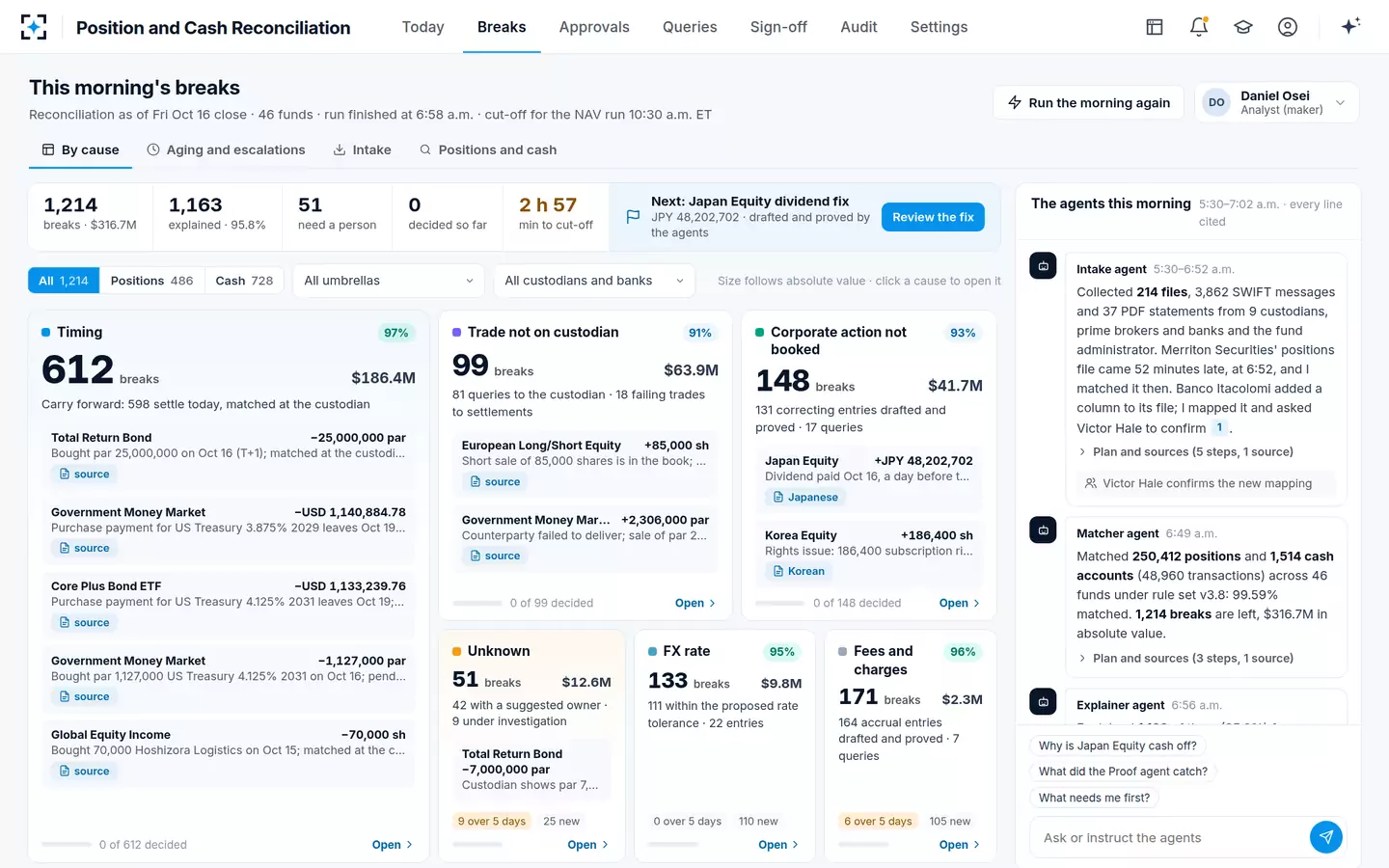
Seven agents divide the work. One collects the files and checks them against the expected-file calendar; one matches under the firm's rules; one explains each break from its source, in the original language beside English, and says plainly when it cannot defend a cause above 80% confidence; one drafts the entry or the query; one replays the whole fund in a sandbox with the drafted entry to prove the break clears and nothing else moves; one runs the reply clocks and escalates breaks older than five days; one assembles the evidence. On the sample Friday that left 1,163 breaks explained with a cited source and 51 with a named owner by 6:58 a.m.
A break the agents could not explain, looked at again on request
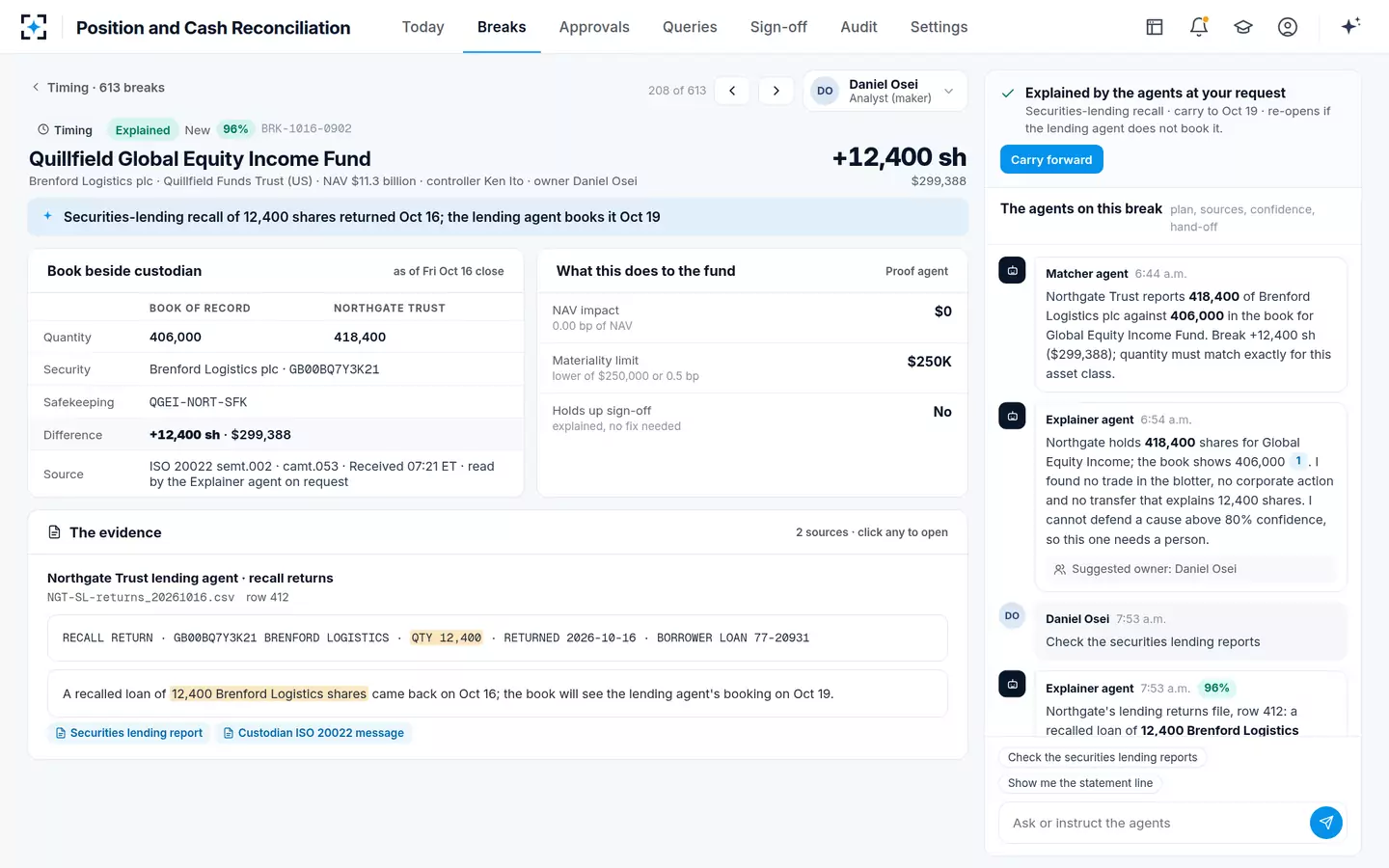
The other boundaries are as important as the work. The agents never post an entry, send a message, widen a tolerance or sign off a fund. An analyst proposes; a team lead, the fund's controller or the head of middle office approves; nobody approves their own proposal. Where the sample's limits sit, and why each one is there, is set out on the Position and Cash Reconciliation page.
Questions people ask
What is the difference between IBOR and ABOR in a reconciliation?
The investment book of record (IBOR) is the position view portfolio managers trade from, usually on trade date and updated during the day; the accounting book of record (ABOR) is the official accounting view the NAV is struck from. A position reconciliation compares both with the custodian, because a difference between IBOR and the custodian misleads the trader and a difference between ABOR and the custodian misstates the NAV.
Does a fund reconcile against the prime broker or the custodian?
Both, where both hold assets. A hedge fund's long positions may sit with a custodian while its shorts, borrowed stock and financing sit with one or more prime brokers, and each holds part of the truth. Deciding which source is authoritative for which field is the subject of reconciliation in asset management as a three-way problem.
What is a position break?
A position break is a difference in quantity, par or accrued interest between the books and an external holder that the matching rules do not clear. In the sample morning 486 of the 1,214 breaks were on positions and 728 on cash. A break stays open until it has a cause backed by a document and, if the book was wrong, an approved entry.
How long must reconciliation records be kept?
It depends on the rule. A US registered fund keeps cash reconciliations and the schedules supporting each NAV for at least six years, the first two easily accessible, and its journals and ledgers permanently (17 CFR 270.31a-2). A UK firm keeps a record of each external custody reconciliation, including the discrepancies and what it did about them, for five years (CASS 6.6.7R and 6.6.8R).
Is position reconciliation the same as a stock record count at a broker?
It is the same idea on the other side of the trade. A broker-dealer counts and verifies its securities at least quarterly and books every unresolved difference within seven business days (Rule 17a-13); an asset manager compares its books with the broker's and custodian's records, usually every business day. Both treat a difference as open until its cause is found.
Who signs off a daily position reconciliation?
Usually the fund's controller or a middle office lead signs each fund, and a senior manager signs that the day is complete. In the sample firm a fund is signed only when no break above its materiality limit (the lower of $250,000 or 0.5 basis points of NAV) is unexplained or waiting for a fix, and the head of middle office signs the daily attestation before the 10:30 a.m. NAV cut-off.