An AI reconciliation agent is software that does a step of a reconciliation on its own: collecting the custodian, prime broker and bank files, matching them to the books, reading statements and messages to find out why a break exists, drafting the correcting entry or the custodian query, and checking that the fix works. Applied to custodian files, agents can take over most of the reading that fills a middle office morning. What they should not take over is any act that moves the books or leaves the desk: posting an entry, sending a query, changing a tolerance, writing off a break or signing a fund. Botminds' Position and Cash Reconciliation uses seven agents, each with a job and a line it never crosses, and leaves every approval with a named person.
The examples come from the solution's sample: a fictional manager, Quillfield Capital, reconciling 46 funds on the morning of Monday 19 October 2026. The regulators' expectations are quoted from the SEC, FINRA, the Bank of England and FCA, and ESMA.
Seven agents, and the line each one never crosses
Agent
Intake agentCollects custodian, prime broker, bank and administrator files, SWIFT and ISO 20022 messages and PDF statements in any language; checks them against the expected-file calendar.
Never: Change a source file or guess a missing one
Agent
Matcher agentPairs book and external records under the firm's rules and tolerances by asset class.
Never: Widen a tolerance or force a match
Agent
Explainer agentFinds each break's cause in statements, message narratives, issuer notices, the order blotter, lending reports and email; groups breaks by cause with a confidence.
Never: State a cause without a source passage; below 80% it says a person is needed
Agent
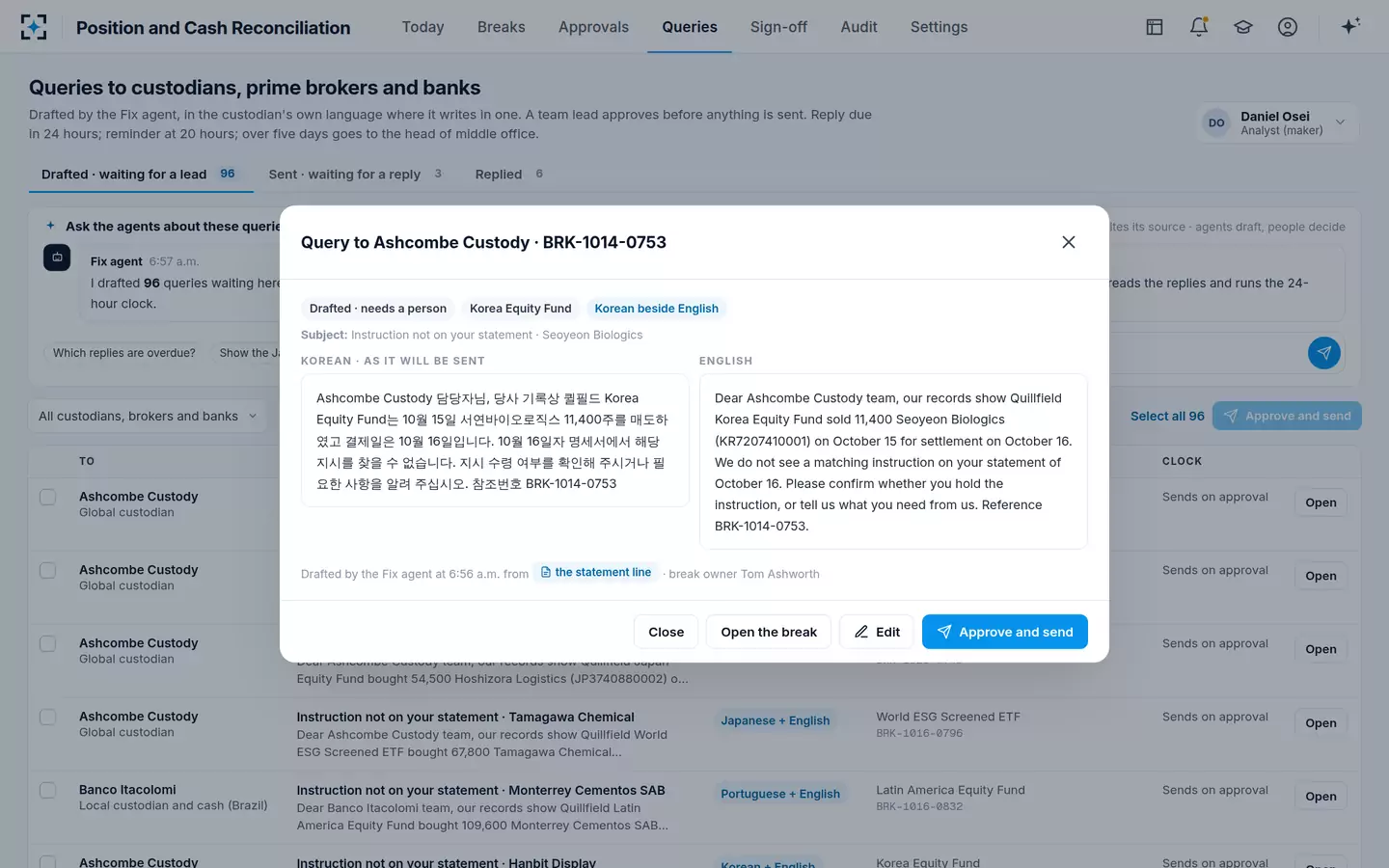
Fix agentDrafts the correcting entry, the custodian query in the custodian's language with English beside, or the hand-off of a failing trade.
Never: Post an entry or send a message
Agent
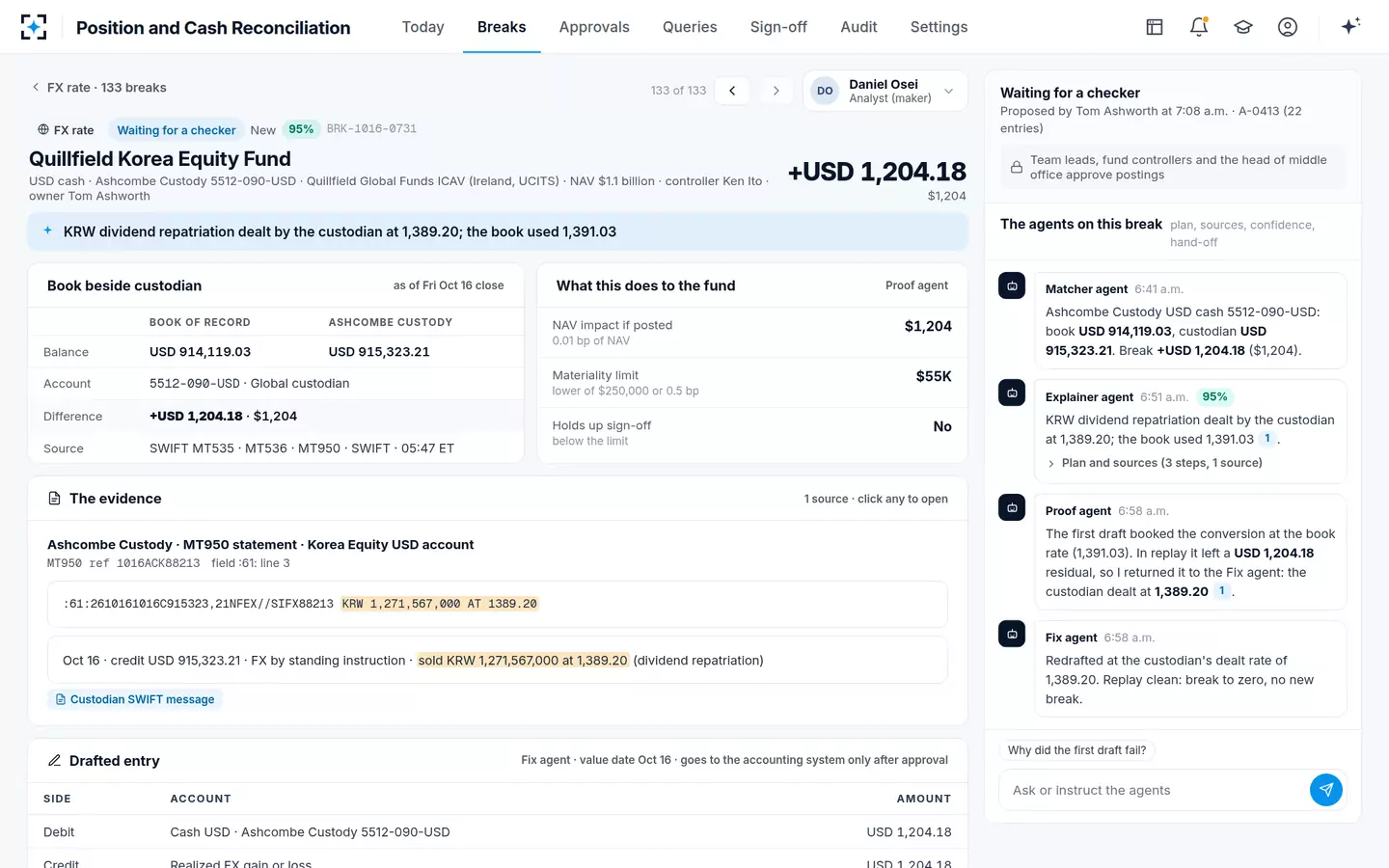
Proof agentReplays the fund in a sandbox with each draft: the break must go to zero, nothing new may break, the NAV impact must be what the entry says.
Never: Approve; a failing draft goes back with the reason
Agent
Chaser agentRuns reply and cut-off clocks, ages breaks, sends approved reminders, reads replies, escalates breaks over five days.
Never: Send anything not approved or close a break on a reply alone
Agent
Evidence agentShows which funds are ready to sign; assembles the sign-off file and the audit export.
Never: Edit a record; exports only for entitled roles
A person decides
Analyst, approver, controller, head of deskPropose, approve, send and sign. Nobody approves their own proposal.
What is an AI reconciliation agent?
An AI reconciliation agent is a program that performs a reconciliation task with some autonomy: it decides which document to read, what a passage means and what to propose, rather than following a fixed matching rule. FINRA's 2026 oversight report describes AI agents generally as systems that can perform and complete tasks on a user's behalf, interact with an environment, plan, decide and act toward a goal (FINRA, 2026 Annual Regulatory Oversight Report).
That autonomy is the difference from a matching engine, and also the risk. A matching engine does what its rules say and nothing else. An agent reading a Japanese custodian statement chooses what to look at and how to explain it. The useful question about any AI reconciliation agent is therefore not how clever it is, but what it is allowed to decide, what it must show for each decision, and which acts are reserved for a person. Search results for "account reconciliation AI agent" are mostly about company bank accounts and the general ledger; a fund's custodian reconciliation adds multiple custodians and currencies, local-language statements, corporate actions and a daily NAV deadline.
Can AI reconcile custodian files?
Yes, for the reading, matching, explaining and drafting; no, for the decisions. An agent can do most of what fills a reconciliation analyst's morning, because most of that time goes on opening documents, and it can do it before the analyst arrives. It should not decide on its own that the book is wrong.
The sample morning gives a sense of scale. Between 5:30 and 6:52 a.m. the Intake agent collected 214 files and 3,862 SWIFT and ISO 20022 messages from ten sources, flagged one file that came late and mapped a new column in another for a person to confirm. The Matcher agent paired 250,412 positions and 1,514 cash accounts, and 99.59% of items matched under the firm's rules. The Explainer agent took the 1,214 breaks that remained and by 6:58 a.m. had explained 1,163 with a cited source, in Japanese, Korean, Portuguese and other languages beside English, and given the other 51 a suggested owner. By then the Fix agent had drafted 317 entries and the Proof agent had replayed every one.
Where agents already sit in financial-services operations
75%
of UK financial firms surveyed were already using AI in 2024
Bank of England and FCA, 118 respondents
~22%
of reported AI use cases were in operations and IT, the largest business area
Bank of England and FCA, 2024
2%
of use cases had fully autonomous decision-making
Bank of England and FCA, 2024
1,163of 1,214
sample breaks explained with a cited source by 6:58 a.m.; 51 sent to a person
Fictional sample data
Which reconciliation steps can an agent do, and which stay with people?
Agents can load, match, explain, draft and prove. People propose, approve, send and sign. The line falls where an act changes something outside the agent's own work: the books, a message to a counterparty, a rule, a fund's status.
Each step has its own safeguard. The Explainer agent must attach the passage it relied on, the statement line or SWIFT field or lending report row, with the original language beside English; without a passage it cannot state a cause, and below 80% confidence it says so and suggests an owner. In the sample, a 12,400-share difference in Brenford Logistics was first an honest unknown; when the analyst told it to check the securities lending reports, it found a recalled loan in the lending agent's returns file and moved the break to timing at 96%. The analyst supplied the judgement about where to look; the agent supplied the reading.
Drafting is not deciding. The Fix agent drafts an entry or a query and stops. When asked in the sample to send all 96 drafted custodian queries, it declined: "I can't do that: agents never approve, post, send or sign." The team lead reviewed and approved them, and only then were they sent; the Chaser agent then started each 24-hour reply clock.
A custodian query drafted in Korean, sent only when a team lead approves
Can an AI agent write off a break or post an entry?
It should not, and in a well-designed system it cannot. A write-off or a posting changes a fund's books, and the person who approves it should be someone other than the person, or agent, who prepared it. An agent that can post its own fix is a preparer and approver in one.
The UK client assets rules express the underlying principle for reconciliations: whenever possible, checks should be done by someone who did not produce or maintain the records being checked (FCA CASS 6.6.47G). An agent that drafts an entry is part of producing the record. In the sample, an analyst proposes each entry with a reason code; a team lead, the fund's controller or the head of middle office approves it; postings above $5 million need the head of middle office as a second approver; and the system will not let anyone approve their own proposal. Entries reach the accounting system only after approval.
Write-offs deserve their own rule. A break written off because nobody explained it is the kind of item the FCA treats as an unresolved discrepancy, and an agent optimised to close breaks will find write-offs attractive. In the sample no agent can close a break by itself: none may force a match, widen a tolerance or close a break on a custodian's reply alone, so a break leaves the list only when a person has approved its fix or the next file shows it gone.
Who approves a matching rule change?
A person senior to the one who proposes it, after seeing what the change would have done to past data. A matching rule or tolerance decides which differences anyone ever sees, so changing it is a bigger decision than any single entry.
In the sample, a change can be proposed by a team lead, or by an agent with a back-test, and must be approved by the head of middle office; only the operations administrator can edit settings at all. The Matcher agent never widens a tolerance on its own. One proposal was waiting on the sample morning: an FX rule allowing a custodian's rate within 0.05% of the 4 p.m. London benchmark, with a 20-day back-test on sample data showing 2,214 breaks it would have closed and no real error missed. A back-test can show that a rule would have hidden no real error in the past; it cannot show that it never will, which is why the approval stays with a person.
When agents check each other: the returned FX draft
One agent should check another's work before any person sees it, for the same reason a team uses maker and checker. In the sample, the Proof agent replays the whole fund with each drafted entry and returns any draft that fails.
It happened once that morning. In Korea Equity, a won dividend repatriation was dealt by the custodian at 1,389.20; the book used 1,391.03. The Fix agent's first draft booked the conversion at the book's rate. In replay it left a USD 1,204.18 residual, so the Proof agent sent it back with the reason, and the redraft at the custodian's dealt rate cleared with no new break. Of 317 drafted entries, 316 passed first time.
The Proof agent returned the first draft; the redraft cleared
How are AI agent decisions logged?
Every agent action and every human decision should be logged in the same trail, with the source it relied on, the agent's version, and who acted when. FINRA lists the practices it has seen: storing prompt and output logs, tracking which model version was used and when, and human-in-the-loop review of model outputs (FINRA, 2026 report).
In the sample, the audit trail is append-only and records who or what acted, the action, the reason code, the evidence and a fingerprint for each entry, for people and agents alike, and keeps it seven years. Each agent's version, model, prompt and confidence threshold is on record, and a new version is evaluated before it goes live: the Explainer agent's current version scored 96.8% on 2,400 resolved breaks in the sample evaluation and was approved by the head of middle office. For a US registered fund, cash reconciliations must be kept at least six years (17 CFR 270.31a-2(a)(2)), and an agent's reasoning is part of how the reconciliation was done.
What do regulators expect of AI in back-office operations?
Supervision, not prohibition. The SEC, FINRA, the UK regulators and ESMA have each said they expect firms using AI to keep human judgement in the loop, to know what their tools do and to be able to explain the outcomes.
The SEC's Division of Examinations says in its fiscal 2027 priorities that registrants are increasingly incorporating what it calls "super intelligence" into their businesses, and that it will examine firms' policies and procedures for monitoring that use, naming back-office operations among the areas (SEC Division of Examinations, Fiscal Year 2027 Examination Priorities, October 2026). FINRA lists among the risks of AI agents that they act autonomously without human validation and approval, act beyond the authority the user intended, and reach outcomes through multi-step reasoning that is hard to trace. ESMA warned in 2024 that both firms and their clients risk leaning on AI for decisions at the expense of human judgement (ESMA public statement, 30 May 2024). The Bank of England and FCA found that only 2% of AI use cases at UK firms were fully autonomous (2024 survey).
What each seat keeps when agents do the reading
Today
Opens statements and messages to find each break's cause; keys the fix.
With agents
Checks the agents' explanations against their sources; tells them where to look when they cannot explain.
Still theirs: Proposing every fix
Today
Approves queries and postings drafted by hand.
With agents
Approves agent-drafted queries and reminders; proposes rule changes with a back-test.
Still theirs: Everything that leaves the desk
Today
Approves entries without seeing their effect on the fund.
With agents
Approves after reading the source and the replay.
Still theirs: What moves the book; the fund sign-off
Today
Learns about old breaks weekly.
With agents
Gets breaks over five days first, with a plain status; approves rule and agent changes.
Still theirs: Rules, second approvals, the daily attestation
What to ask before an AI reconciliation agent touches your books
Ask to see each limit work on your own data, not on a vendor's sample. The questions below turn the regulators' expectations into things a vendor can demonstrate in an afternoon.
Nine questions for any AI reconciliation agent
- Can it post, send or write off anything on its own?
The answer should be no, enforced by the system, not by a setting someone can change.
- Does every explanation show its source passage?
The statement line, message field or report row, in its original language.
- What does it say when it does not know?
A confidence threshold below which it hands the break to a named person.
- Is every fix tested before a person sees it?
A replay of the fund showing the break clears and nothing else moves.
- Who can change tolerances and matching rules?
A proposal with a back-test, approved by someone other than the proposer.
- Can a preparer approve their own work?
Including when the preparer is an agent acting on their instruction.
- What is logged, and for how long?
Each agent action, its source, the agent version and the human decision, in one trail.
- How is a new agent version approved?
An evaluation on resolved breaks, signed off by the head of the desk.
- Where is the data processed, and is it used for training?
Processing in the region the data belongs to; no training on your data.
Agents do not need to replace the matching engine a firm already has; they can sit on the exceptions it leaves, as adding agents to post-trade reconciliation without replacing your engine explains. How to test whether auto-matching and agent explanations are actually right, rather than merely closed, is the subject of automated cash reconciliation and the match rate. The full set of agents is on the Position and Cash Reconciliation page.
Questions people ask
Is an AI reconciliation agent the same as robotic process automation?
No. Robotic process automation repeats fixed keystrokes and breaks when a screen or file changes; an agent reads documents and decides what they mean, which is why it needs source citations and limits. In the sample, the Intake agent mapped a custodian's new file column itself and asked a person to confirm the mapping.
How accurate are AI agents at explaining reconciliation breaks?
No regulator or independent study publishes accuracy figures for this task, so measure it on your own resolved breaks before going live. In the sample firm's evaluation the Explainer agent's current version scored 96.8% on 2,400 resolved breaks; that is sample data, and the 80% confidence line exists for the cases it gets wrong.
Can an AI agent read custodian statements in Japanese or Korean?
Yes; reading local-language statements is one of the jobs agents do best. In the sample a Japanese sub-custody statement explained a JPY 48,202,702 cash break and a Korean statement explained a rights issue, each shown with the original line beside the English so the approver can check it.
Do AI agents need human approval under SEC or FINRA rules?
No rule names reconciliation agents, but existing duties still apply: books and records, supervision, and the custody rule. FINRA lists autonomous action without human validation and approval as a risk of AI agents, and the SEC's examiners say they will review policies for monitoring the use of what they call super intelligence in back-office operations.
What happens when the agent is wrong?
Its draft should fail a check before a person sees it, or be caught by the person who approves it. In the sample the Proof agent returned one FX draft out of 317 for a USD 1,204.18 residual, and an analyst can reject any explanation and ask the agents to look again.