Reconciliation in asset management is the daily check that a fund's books agree with every outside party that holds or owes its assets: the custodian for securities and cash, the prime broker for short positions, borrowed stock and financing, the lending agent for securities on loan, swap counterparties for derivatives, and the fund administrator for the official accounts. For a long-only fund with one custodian it is close to a two-way match. For a hedge fund, or any fund that shorts, borrows or uses a prime broker, every position has at least three records, and the hard question is not whether they match but which one is right for which field when they do not. Botminds' Position and Cash Reconciliation matches the books against all of these files each morning and explains every break from the source that owns the answer.
The worked examples come from a fictional manager, Quillfield Capital, whose 46 funds are reconciled against nine custodians, prime brokers and banks and one administrator in the solution's sample. The rules quoted are the SEC's, the CFTC's, the FCA's and the EU's.
Which source wins: a field-by-field rule for a three-way reconciliation
Authoritative: Custodian statement of holdings
Checked against: Prime broker, where longs sit there; the book
Why: The custodian holds them; the custody rule and the auditor test against it
Authoritative: Prime broker position file
Checked against: The book; the stock loan record
Why: Only the prime broker knows what it lent and what is still open
Authoritative: Custodian or bank cash statement
Checked against: The book; the depositary's own reconciliation
Why: Settled cash is what the bank says; the book can only expect it
Authoritative: Prime broker financing statement
Checked against: The fund's agreement with the broker
Why: The broker calculates them; the agreement decides whether the calculation is right
Authoritative: Lending agent's loans and returns files
Checked against: Custodian holdings
Why: A recall shows at the lending agent before the custodian books it
Authoritative: Issuer's notice, then the custodian's credit
Checked against: The event data feed
Why: The vendor feed is a copy; the issuer and the payment are the originals
Authoritative: The fund's own valuation policy
Checked against: Administrator, custodian and broker marks
Why: No holder of the asset sets its value; a broker's mark is evidence, not the answer
Authoritative: Portfolio reconciliation with the counterparty
Checked against: The fund's own or the administrator's valuation
Why: Two parties value one contract; differences become disputes with their own rules
What is reconciliation in asset management?
It is the set of daily comparisons that keep a manager's records honest: positions and cash against custodians and brokers, trades against confirmations, swaps against counterparties, and the manager's books against the administrator's. Each comparison has a different counterpart and a different failure it is designed to catch.
Custodians sit at the centre for most funds. The SEC described the custodian's role, in its T+1 release, as "the tracking, settling, and reconciling of assets that are acquired and disposed of by the investor", and counted 48 custodian banks among the members of the Depository Trust Company (SEC, Release 34-96930, 2023). An SEC-registered adviser with custody of client assets must keep them with a qualified custodian, a bank or broker-dealer among others (17 CFR 275.206(4)-2), and a prime broker that holds a fund's assets is usually acting as a qualified custodian for them. So a hedge fund with a custodian bank and two prime brokers has three institutions holding its assets, each reporting only what it holds.
The UK rules spell out who the counterparts are. A firm holding client assets must reconcile with every third party that holds them, including, where assets are not deposited with anyone, those responsible for registering legal title; the FCA's examples include central securities depositories, operators of collective investment schemes and administrators of offshore funds (FCA CASS 6.6.35R and 6.6.36G). The full set of regimes is compared in the custody reconciliation process across the US, UK and EU.
What is a three-way reconciliation?
A three-way reconciliation compares three records of the same thing at once (here, the manager's book, the custodian and the prime broker) instead of two at a time. The point is to see in one place which record is out of line, rather than discovering it in two separate two-way matches that each look plausible.
The search phrase has other meanings: in trust accounting a three-way reconciliation compares the bank statement, the trust account record and the individual client records, and in purchasing a three-way match compares order, receipt and invoice. The logic is the same in each: two records agreeing proves little if both were fed from the same source, and the third record is there to catch what the first two share.
Why matching in pairs can miss the record that is wrong
Two two-way matches: Agrees on the long position, because both were booked from the same allocation
One three-way match: Shown beside the prime broker in one row, so a long the broker also reports is visible
Two two-way matches: Agrees on the short, matched on a different day from a different file
One three-way match: Same row: a security that is long at the custodian and short at the broker is an obvious question
Two two-way matches: Never compared directly; neither knows about the other
One three-way match: Compared, so assets moved between them in a transfer are visible on both sides at once
Two two-way matches: Shows as a break in each pair, each closed separately as timing
One three-way match: Shows as one movement with two legs, closed when both legs are seen
Why does a hedge fund reconcile three sides, not two?
Because no single counterparty sees the whole fund. The custodian holds the long book that is not financed; each prime broker holds the financed longs, the shorts, the borrowed stock and the cash and margin that go with them; the lending agent knows what is out on loan. A two-sided match against any one of them can be clean while the fund's total position is wrong.
Transfers make the point. When a fund moves securities from its custodian to a prime broker to finance them, the position leaves one record before it arrives in the other, and the book may show it in either place. In two two-way matches the fund sees two breaks, each of which looks like timing. In a three-way view it sees one transfer with two legs, and if only one leg ever arrives, it sees that too. In the sample morning one prime broker's positions file came 52 minutes late, at 6:52 a.m.; the agents matched it on arrival rather than leaving those positions as breaks against the book.
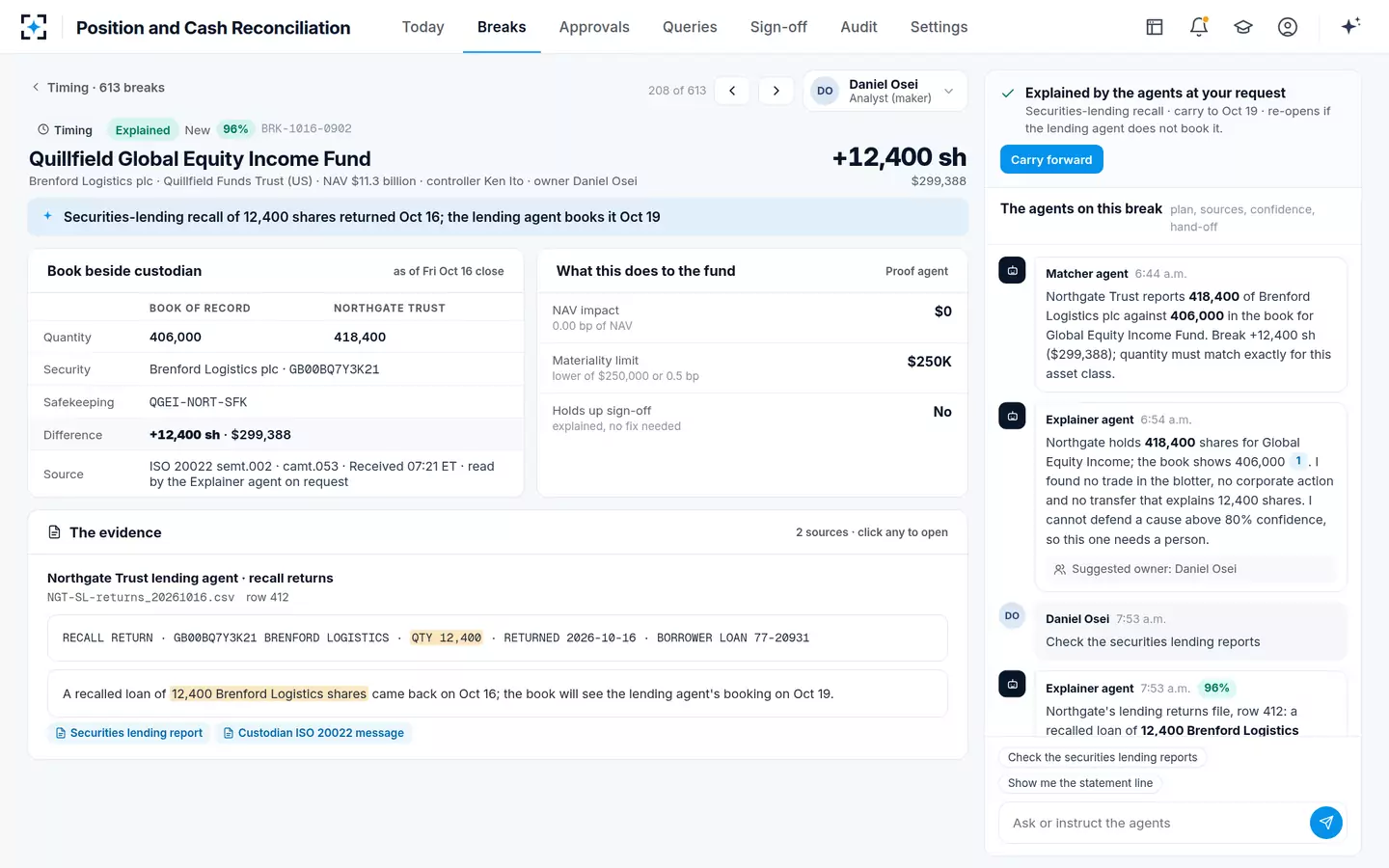
Lending is the same pattern with a third party. In the sample, Brenford Logistics was 12,400 shares long at the custodian against the book. Neither record was wrong: a recalled loan had been returned on 16 October and the lending agent would not book it until 19 October. Only the lending agent's returns file showed it, and the break moved to timing once the agents read row 412.
A difference that only a third record could explain
Which source wins for which field?
The source that holds or creates the fact wins for that fact: the custodian for what it holds, the prime broker for what it lent and financed, the bank for settled cash, the issuer for a corporate-action entitlement, and the fund's own valuation policy for price. Everything else is a check.
The matrix at the top of this page is one version of that rule. Two of its rows deserve a second look. Price is the field where no counterparty is authoritative: custodians, brokers and administrators all supply marks, but the value of the fund's holdings is set under the fund's own valuation policy, and a broker's mark is evidence to check it against. Corporate-action data is the field where the usual source is a copy: the event feed most books rely on is a vendor's reading of the issuer's notice. In the sample, Quillfield Japan Equity Fund's book held a dividend receivable for 19 October because the vendor said so; the issuer's notice and the Tokyo custodian's statement both said 16 October. The originals won, and the fix carried a challenge to the vendor.
Writing the rule down matters for a reason beyond consistency. An analyst who must decide, mid-break, which record to believe will tend to believe the one that closes the break. A policy approved in advance takes that choice away, and tells the auditor why a break was closed against one record and not another.
What do you do when the custodian and prime broker disagree?
Treat it as two breaks against the book, not one difference between them, and resolve each against its own authoritative source. If both claim the same asset, it is a potential duplicate and goes to the top of the list, because one of them is wrong about something it holds.
The order of work follows from the matrix. First, check whether the disagreement is a transfer in flight: a pending delivery from one to the other with a settlement date. Second, check third records: the lending agent, the collateral account, the administrator. Third, query the institution whose record looks wrong, citing the instruction or statement that contradicts it, and have the query approved before it goes. In the sample firm a team lead approves every custodian query, the agents run a 24-hour reply clock, and a custodian's reply alone never closes a break: the next file must show the change.
Outsourcing does not move the responsibility. When the FCA fined two Aviva entities £8.2 million in 2016 for failings in overseeing the third-party administrators to which they had outsourced client money administration and external reconciliations, its enforcement director put it plainly: "Firms are reminded that regulated activities can be delegated but not abdicated" (FCA press release, 5 October 2016).
Swaps, collateral and financing: the fields only a counterparty holds
For derivatives the counterpart is the other party to the contract, and the reconciliation has its own rules. Swap dealers must reconcile portfolios with other dealers every business day at 500 or more swaps, weekly at 51 to 499 and quarterly at 50 or fewer, and with other counterparties quarterly or annually depending on size (17 CFR 23.502); EU counterparties reconcile each business day at 500 or more contracts (Delegated Regulation (EU) No 149/2013, Article 13(3)).
The CFTC rule also says how far apart two valuations may be before they count: with a counterparty that is not a dealer, two marks less than 10% apart, measured against the higher one, need not be treated as a discrepancy (the clocks that start when a gap is bigger are in margin dispute reporting). That is a much wider tolerance than any cash or position rule, and it is the counterparty's tolerance, not the fund's. Valuation disputes and the collateral calls that follow them are worked through in a variation margin calculation, line by line; for the position reconciliation, the swap's existence, notional and terms are the fields to match, and the mark is checked against the fund's own valuation.
The counterparty rules set their own clocks and tolerances
500+
swaps between two dealers: portfolio reconciliation every business day
17 CFR 23.502
<10%
valuation gap with a non-dealer that need not be treated as a discrepancy
17 CFR 23.502(b)(4)
$20M
swap valuation dispute a dealer must report if unresolved after 3 or 5 business days
17 CFR 23.502(c)
Daily
UCITS depositary cash-flow reconciliation, covering every cash account opened for the fund
EU 2016/438, Art. 10
Is the fund administrator's record the tie-breaker?
No. The administrator's accounts are a fourth view, built from the same custodian and broker files the manager receives, so they usually agree with whichever external record they were fed. Where the administrator keeps the official books, its record is the one the NAV is struck from, and that makes it a record to reconcile to, not a record to settle arguments with.
The practical consequence is that the manager's reconciliation and the administrator's should be compared, not merged. If both cleared a break against the custodian, the manager has learned nothing new; if one cleared it and the other did not, one of them applied a different rule. In the sample, the administrator's accounting positions are one of the files matched each morning, beside the custodians and prime brokers. How managers check an administrator's work without keeping a second set of books is covered in Fund Accounting's guide to shadow fund accounting.
Write the rule before the break: a source-of-truth policy
A source-of-truth policy is a short document, approved by the head of operations, that names the authoritative source for each field, the tolerance for each asset class and the order in which conflicting records are investigated. It is the three-way reconciliation's rulebook, and it is what an examiner or auditor will ask for when a break was closed against one record rather than another.
Seven things a source-of-truth policy should settle
- The authoritative source for each field
Holdings, shorts, cash, financing, loans, entitlements, price and swap terms, each with one named source.
- Tolerances by asset class
Exact quantities for equities, par exact and accrued within a small amount for bonds, a cash tolerance in currency and basis points.
- What counts as timing
Only a break with a matched pending instruction or a booked return; nothing else is timing.
- The order of investigation
Transfers in flight first, third records second, a query third.
- Who may change the rule
A proposal with a back-test, approved by someone other than the proposer.
- How a counterparty reply is used
As evidence; the break closes when the next file shows the change.
- What the depositary or administrator receives
Every account and every instruction it needs to run its own reconciliation.
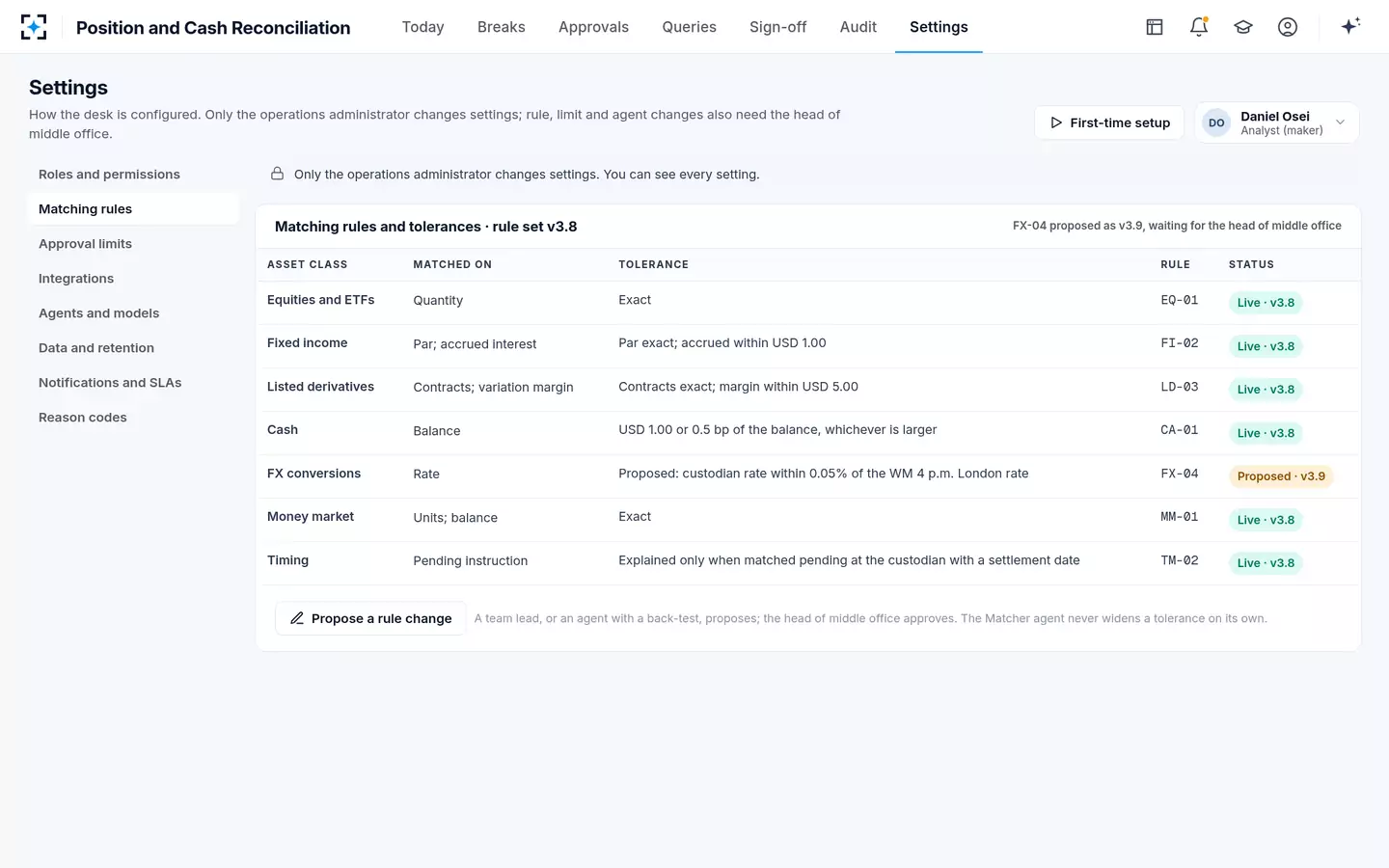
In the sample firm the policy lives in the solution's settings: tolerances by asset class in a versioned rule set, a timing rule that requires a matched pending instruction, and a rule that only a team lead, or an agent with a 20-day back-test, may propose a change, which the head of middle office must approve. The agents apply it; they never widen a tolerance or force a match. Which agent does what is on the Position and Cash Reconciliation page, and the breaks the policy produces are counted in the cause list for cash and position breaks.
The source-of-truth policy, written as versioned matching rules
Questions people ask
How often should an asset manager reconcile?
Every business day for positions and cash wherever a fund prices daily, because the NAV depends on them. The rules set outer limits: no more than a month between external custody reconciliations in the UK, daily cash reconciliation by a UCITS depositary where cash moves daily, and swap portfolio reconciliation daily between dealers with 500 or more swaps.
Is a prime broker a custodian?
For the assets it holds, usually yes: a prime broker that is a registered broker-dealer can act as a qualified custodian under the SEC custody rule. It also holds things a custodian does not, such as short positions, borrowed stock and the fund's financing, which is why it is reconciled as a separate record.
What is the difference between reconciliation in asset management and in a bank?
A bank reconciles its own accounts, such as nostro accounts with correspondent banks. An asset manager reconciles its funds' assets held by others, so the counterparts are custodians, prime brokers and administrators, and the result feeds a NAV that investors deal at.
Who should approve a source-of-truth policy?
The head of operations or middle office, with the agreement of fund accounting and compliance, and the policy should be reviewed at least yearly. Under the UK rules a firm must also record why it chose its reconciliation frequency and review that choice at least annually unless it reconciles every business day.
What happens if two prime brokers both report the same position?
It is a potential duplicate and should be investigated before anything else, starting with any transfer between them. Each broker is authoritative only for what it holds, so one of them is wrong, and the book should not be adjusted until the transfer record or a confirmation from one broker shows which.