Post-trade reconciliation is everything a firm does after a trade is executed to prove that its records agree with everyone else's: trade details against the broker's confirmation, positions and cash against custodians and prime brokers, derivatives against counterparties, and the books against the fund administrator. Most firms already have a matching engine for it, and the engine already clears most items. What it leaves (hundreds or thousands of breaks a day, each needing a document read, a cause found and a fix drafted) is where the cost and the risk are, and that is where newer post-trade reconciliation solutions differ. A firm does not need to replace its engine to change that work. Botminds' Position and Cash Reconciliation puts agents on the explaining, drafting, proving and chasing, applies the firm's own matching rules, and leaves every approval with a person.
The product examples come from the solution's sample, a fictional manager with 46 funds and nine custodians, prime brokers and banks. The go-live plan below is Botminds' illustration for a firm of that size, not a commitment or a measured result.
An illustrative plan for adding agents beside an existing engine
- Connect files and messages; map accounts2 wk
- Load rules, roles and approval limits1 wk
- Back-test on 20 past business days4 wk
- Both processes daily; compare break lists4 wk
- First umbrella, then the rest2 wk
What is post-trade reconciliation?
Post-trade reconciliation is the set of comparisons that run from execution to settlement and after. Before settlement it means matching trade details with the counterparty; after settlement it means reconciling positions and cash with the institutions that hold them, and derivatives with the other party to each contract.
The two halves have been pulled closer by shorter settlement cycles. In the US, broker-dealer trades have settled on the first business day after the trade since 28 May 2024, and the SEC said in adopting the change that eliminating tools that "encourage or require manual processing" was "essential to reducing risk and costs" (SEC, Release 34-96930). The EU moves to T+1 on 11 October 2027 (Regulation (EU) 2025/2075), with new trade-date deadlines for allocations and confirmations under the amended settlement-discipline rules (Delegated Regulation (EU) 2026/1536); the UK government has committed to legislate for the same date (HM Treasury). Each day less to settle is a day less for a reconciliation break to be timing rather than a failure. The pre-settlement half of the work, fails and their causes, is read from the status codes explained in MT548 reason codes.
"Trade reconciliation" in investment banking usually means the sell side's version: the broker's trade and stock records against the exchange, the clearing house and its clients. The asset manager's version, which this page follows, starts from the fund's books and works outward to everyone who holds or owes the fund something.
Do you need to replace your reconciliation system to use agents?
No. A matching engine and an agent do different jobs. The engine pairs records under fixed rules, quickly and predictably; agents read the documents behind what the engine could not pair. Replacing the engine to get the second capability buys a risky migration for a benefit that does not depend on it.
The economics point the same way. In a typical desk most of the time goes on the exceptions, not the matching: in Botminds' estimate for a four-analyst desk, finding the cause of each break takes 7.5 of the 18.5 analyst-days a week spent on reconciliation tasks, and keying and checking entries, chasing custodians and building evidence take most of the rest. None of that is the engine's job. A replacement that matches 1% more items saves little; a layer that explains the remaining items saves most of the week.
What stays, what the agents add, and what people keep
Already there, kept
Book of record and accounting
IBOR and ABOR positions and cash; entries return only after approval
Matching engine and its rules
Your tolerances by asset class, versioned; nothing loosened without approval
Custodian and bank connections
MT535, MT536, MT537, MT940, MT950; semt.002 and camt.053
Prime broker and administrator files
Positions, cash, financing; the administrator's accounting positions
Agents add
Collect and parse local-language PDFs
Explain each break from its source
Draft the entry or the query
Replay the fund with each fix
Run reply clocks and escalations
Assemble the evidence
Never post, send, widen a tolerance or sign
People keep
Analyst
Proposes each fix
Team lead or controller
Approves postings and queries
Head of middle office
Second approvals, rule changes, the daily attestation
Where do agents sit, before or after matching?
Mostly after matching, on the breaks, with one job before it. Before matching, an agent collects the files and reads what the engine cannot: PDF statements from local sub-custodians in their own languages, and files whose layout has changed. After matching, agents explain each break, draft its fix, prove the fix against the whole fund, chase replies and assemble the evidence.
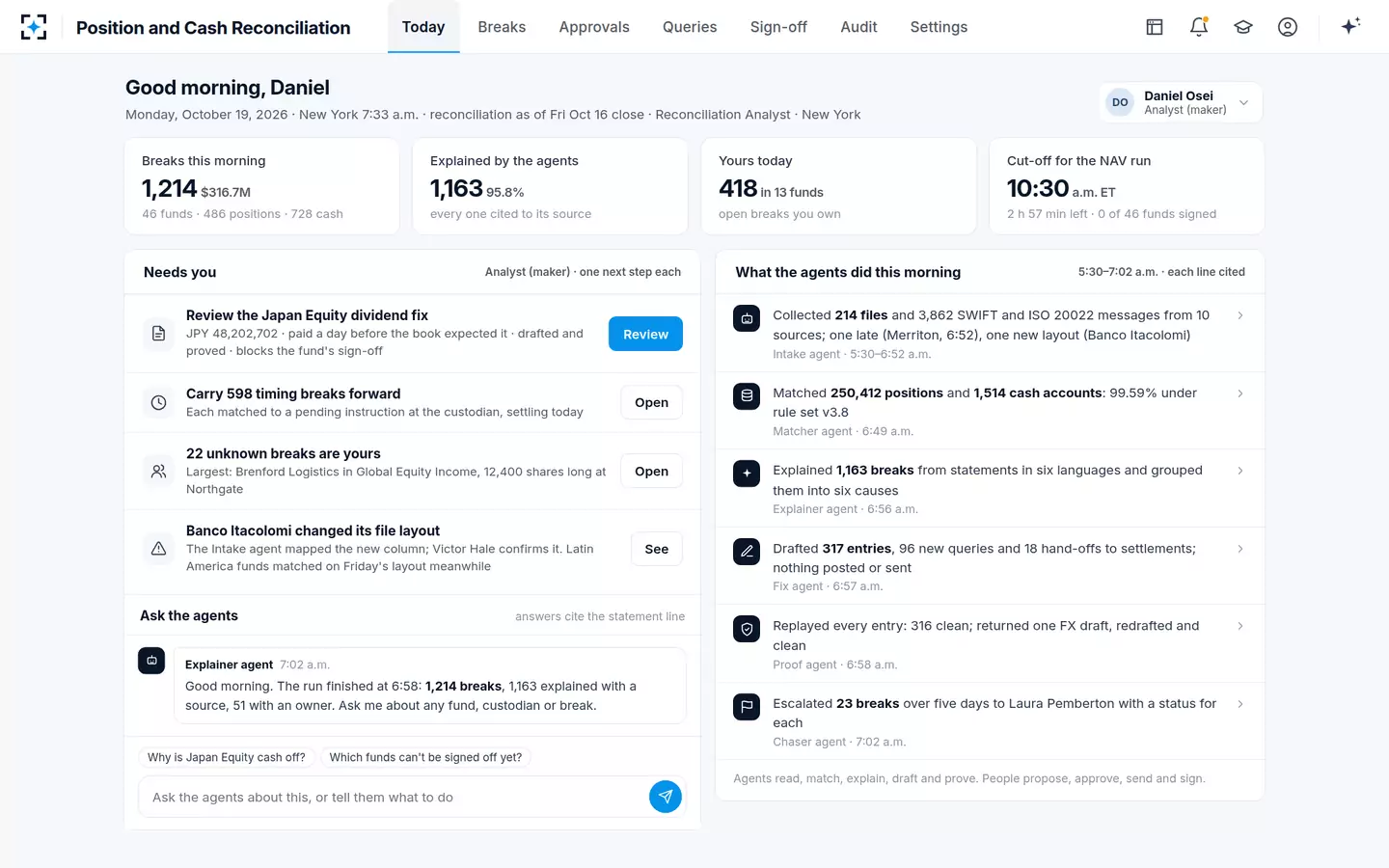
The before-matching job is narrower than it sounds and worth more than it looks. In the sample, the Intake agent collected 214 files and 3,862 SWIFT and ISO 20022 messages from ten sources between 5:30 and 6:52 a.m., noticed that one prime broker's positions file came 52 minutes late, and mapped a new column in a Brazilian bank's file for a person to confirm, so that the affected funds were not left as hundreds of false breaks. It never changes a source file and never guesses a missing one.
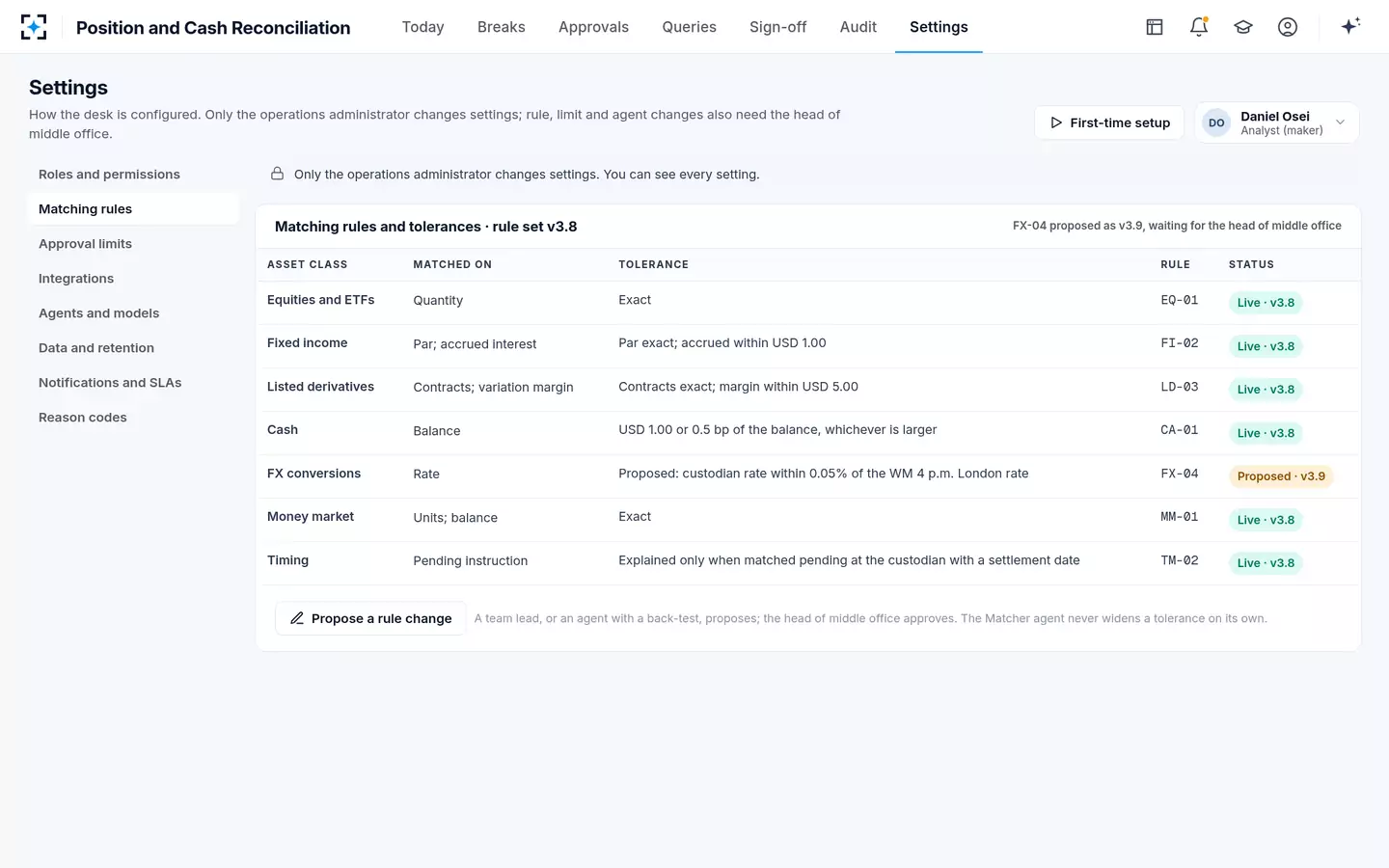
In the sample configuration the solution also includes its own Matcher agent, which pairs records under the firm's rule set and never widens a tolerance. That lets a firm run the two side by side during a parallel period, with the same rules, and compare. Whether the old engine is retired later is a separate decision, made on evidence from the parallel run, not a condition of starting. Any vendor should be asked the same question directly: can its agents work on the breaks your engine leaves, or only on its own matching?
What data feeds do reconciliation agents need?
The same files the reconciliation already runs on, plus the documents analysts open by hand to explain breaks. The second group is what makes agents useful: an agent with only the matching files can do little more than the engine.
The feeds, and what each one lets the agents explain
| Feed | Typical format | What it explains |
|---|---|---|
| Book of record and accounting | IBOR and ABOR extracts, trade and settlement date | What the fund expects to hold and be paid |
| Custodian messages | MT535, MT536, MT537, MT940, MT950; semt.002, camt.053 | What is held, what moved, what was credited |
| Local sub-custodian and bank statements | PDF, in Japanese, Korean, Chinese, German, French, Portuguese | Income, tax and fees in the local market, line by line |
| Prime broker and administrator files | Position, cash and financing files; accounting positions | Shorts, borrowing, financing, and the administrator's view |
| Orders and corporate actions | Order blotter, allocations, broker instructions; event feed and issuer notices | Trades the custodian does not show; events booked on the wrong date |
| Securities lending and the query mailbox | Loans, recalls and returns; custodian replies | Positions out on loan; what the custodian said |
Two feeds are often missing at the start and should be asked for early. The issuer's own corporate-action notice matters because the vendor feed is a copy and sometimes a wrong one: in the sample, a Japanese dividend booked for 19 October from the vendor's data had been paid on 16 October, and only the issuer's notice and the custodian's statement showed it. The lending agent's returns file matters because a recalled loan shows there days before the custodian or the book catches up.
How do you run agents in parallel with the existing engine?
Back-test first, then run both every day for a fixed period, compare the break lists and explanations, and keep the existing process authoritative until agreed criteria are met. The criteria should be written before the parallel run starts.
A back-test on past files shows what the agents would have done on days whose outcome is known. The solution's first-time setup connects the sources, maps the accounts, loads the firm's rules and roles, and back-tests 20 business days before go-live. The same discipline applies to any later rule change: in the sample, a proposed FX tolerance came with a 20-day back-test on sample data showing 2,214 breaks it would have closed and no real error missed, and still waited for the head of middle office.
Exit criteria for a parallel run, agreed before it starts
- Every break on the old list is on the new one
Or the difference is explained: a match the old engine forced, or a rule the new one applies.
- Explanations agree with the analysts' findings
On a sample of breaks the team resolved by hand, the cause and source match.
- Every drafted fix replays clean
Break to zero, nothing new breaks, NAV impact as stated.
- Unknowns go to people
Below the confidence line the agents name an owner instead of guessing.
- Approvals work as designed
No one can approve their own proposal; large postings get a second approver.
- Evidence exports for the auditor
A day's breaks, causes, fixes, approvals and sign-offs in one export.
- The cut-off is met
Every fund signed or explained before the NAV run on each parallel day.
What changes for the reconciliation team?
The seats and approvals stay; the work inside them moves from finding to checking. Analysts stop opening statements to find causes and start checking the agents' explanations against their sources, and spend more time on the breaks nobody can yet explain.
The same desk after go-live
Today
Opens statements, SWIFT messages and notices for three hours to find causes; keys fixes.
With agents
Checks explained breaks against their sources; tells the agents where to look for the rest; proposes fixes.
Still theirs: Owning the funds' breaks
Today
Approves hand-drafted queries and postings; maintains rules informally.
With agents
Approves drafted queries in the custodian's language; proposes rule changes with a back-test.
Still theirs: What leaves the desk
Today
Approves entries without seeing whether they clear.
With agents
Approves after reading the source line and the replay.
Still theirs: The book and the fund sign-off
Today
Maintains the engine's rules and file mappings.
With agents
Also maintains the agents' settings; confirms new file mappings the agents propose.
Still theirs: Who may change what
Outsourcing a task does not move the responsibility for it, and neither does automating it. When the FCA fined two Aviva entities in 2016 for weak oversight of the third-party administrators running their external reconciliations, its point was that the firms stayed responsible for work others did (FCA, 5 October 2016). In the US, the SEC withdrew its proposed adviser outsourcing rule in June 2025 (90 FR 25531), so advisers have no adopted SEC rule written specifically for outsourcing; their existing duties, and a registered fund's compliance programme, still cover reconciliation however it is done. What an agent may and may not do, limit by limit, is set out in the guide to AI reconciliation agents.
How long does it take to add agents to reconciliation?
Weeks rather than months when the matching engine stays, because the work is connection, configuration and proof, not migration. The illustrative plan at the top of this page takes about thirteen weeks from first connection to the last fund group, of which eight are back-testing and parallel running.
Three things lengthen it: the number of distinct file formats, especially local PDF statements; approval roles that are not yet written down, which the solution needs because every posting and query routes to a named approver; and the time internal audit or model risk needs to review the agents before they rely on them. Each agent's version, model and confidence threshold is on record in the solution, and in the sample a new version of the Explainer agent was evaluated on 2,400 resolved breaks before the head of middle office approved it. Operations and IT are where UK financial firms reported the largest share of their AI use cases in 2024, about 22% (Bank of England and FCA), so reviewers are increasingly familiar with the questions.
On the first live morning, the analyst starts from the agents' account of the night
Where Position and Cash Reconciliation fits among post-trade reconciliation solutions
Botminds' Position and Cash Reconciliation covers the asset manager's position and cash reconciliation against custodians, prime brokers, banks and the administrator, from the overnight files to the signed fund. It is not a trade-matching or confirmation platform, and it does not resolve swap valuation disputes, which have their own rules and clocks (17 CFR 23.502); those are the work of failed-trade and margin solutions.
Within its scope, it applies the firm's own rules and tolerances, explains each break from its source in the original language, drafts and proves each fix, and leaves every posting, query and sign-off to a named person. A firm can see it on a few mornings of its own custodian files and books before deciding anything about its engine. How to build the case is set out in the five-number business case, and the agents are described on the Position and Cash Reconciliation page.
Your matching rules and tolerances, versioned, changed only with approval
Questions people ask
What are the main types of post-trade reconciliation?
Trade reconciliation against confirmations before settlement; position and cash reconciliation against custodians, prime brokers and banks after it; derivatives portfolio reconciliation against counterparties; and reconciliation of the manager's books with the fund administrator's. Each has different files, clocks and owners.
Should we buy a reconciliation platform or build one?
Most firms already own the part that is easy to build, the matching engine. The hard part to build is reading unstructured statements and notices in many languages, drafting and proving fixes, and keeping evidence an auditor accepts; that is where buying, or adding a layer, saves the most time.
Can agents work with SWIFT and ISO 20022 messages at the same time?
Yes. Custodians are moving from MT messages to ISO 20022 at different speeds, so a reconciliation often receives both; in the sample the agents read MT535, MT536, MT537, MT940 and MT950 alongside semt.002 and camt.053 from the same morning's files.
What happens to the old matching engine after go-live?
Nothing has to. If the parallel run shows the new process finds every break the old one did and more, a firm may later retire the old engine; if not, the agents keep working on the breaks it leaves. The decision should follow the parallel-run evidence.
Who owns post-trade reconciliation in an asset manager?
Usually the middle office, with fund accounting and the administrator responsible for the official books. The reconciliation team owns each break until it is resolved, and approvals sit with team leads, fund controllers and the head of middle office.