Automated cash reconciliation is software that matches each line on a bank or custodian cash statement with the cash movements a fund's books expect, using rules on amount, date and reference within set tolerances, and leaves only the unmatched items for a person. Its headline measure is the match rate, the share of items it closed. A match rate is a measure of volume, not of accuracy: it counts an item as matched whether or not the match was right, and the tolerances and many-to-one rules that raise it are the same features that can close a real loss against an unrelated timing difference. Accurate automated cash reconciliation needs a second test, of whether auto-closed items were closed correctly. Botminds' Position and Cash Reconciliation adds one to every fix: before anyone approves an entry, an agent replays the whole fund with it and shows that the break clears and nothing else moves.
The product examples come from the solution's sample, a fictional manager reconciling 46 funds as of Friday 16 October 2026. The worked illustrations of matching errors below are our own constructions to show the mechanisms, not measurements of any product or firm.
Five ways an item can be matched and still be wrong
Counted as matched: A $412.80 shortfall on a fee and a $410.15 excess on interest net to $2.65 and close
Matched correctly?: No: two real differences, one of them a charge above the agreed schedule
Counted as matched: Two $250,000 subscriptions on one day matched crosswise by amount
Matched correctly?: No: the cash agrees in total, but each investor's record is now wrong
Counted as matched: A $14,000 debit absorbed by a tolerance of 0.5 basis points on a $400 million account
Matched correctly?: Only if someone has checked what the debit was
Counted as matched: A receipt matched to an expected receipt three days away
Matched correctly?: No, if the expected receipt never arrives and the actual one belonged elsewhere
Counted as matched: Carried forward as timing because trades usually settle tomorrow
Matched correctly?: No, unless a matched pending instruction shows it will
How accurate is automated cash reconciliation?
As accurate as its rules and tolerances, and no more; the match rate does not tell you which. No regulator or independent study publishes error rates for automated cash matching in asset management, so the only reliable figure is one a firm measures on its own data, by re-performing a sample of what the software closed.
The reason is structural. A matching engine is built to close items, and its settings are usually tuned to close more of them: wider amount tolerances, wider date windows, more many-to-one and one-to-many rules. Each change raises the match rate. Some of them also raise the number of items closed wrongly, and the engine cannot tell the two apart, because a wrong match looks exactly like a right one in its own output. In the solution's sample the Matcher agent left 99.59% of items matched under the firm's rules, and that figure is reported beside a different one: of the 1,214 breaks that remained, how many had a cause backed by a source document by the cut-off.
What does a match rate measure, and what does it miss?
A match rate measures the share of statement lines, or of balances, that the rules paired with something in the books. It misses three things: whether each pairing was the right one, whether a difference inside tolerance was a real difference, and whether the items left unmatched were explained or merely aged.
The denominator matters too. A rate computed over statement lines is dominated by the thousands of routine movements that would match under any rule. A rate computed over balances can be perfect while the movements behind it are wrong, if two errors cancel. A useful report gives the match rate, the number and absolute value of breaks left, and the share of breaks with a documented cause, and it shows how each moved after any change to a rule. In the sample, of 1,214 breaks worth $316.7 million in absolute value, 1,163 had a cited cause by 6:58 a.m. and 51 had a named owner.
Can a wrong match close a real break?
Yes. Any rule that allows a match within a tolerance, or allows several items to match one, can pair a real difference with something unrelated and report both as closed. The break disappears from the list; the money does not come back.
The UK client assets rules are a useful test of what "closed" ought to mean. A discrepancy counts as resolved only once it has been investigated in full, corrected, and any shortfall made good (FCA CASS 6.6.48G), and items parked in suspense or error accounts still count as discrepancies (6.6.52G). An automated match that nets two real differences to zero meets none of that: neither has been investigated, and neither has been corrected. The same applies to an agent: an AI that closes breaks by finding plausible pairs is a faster way to produce wrong matches unless every closure carries its evidence.
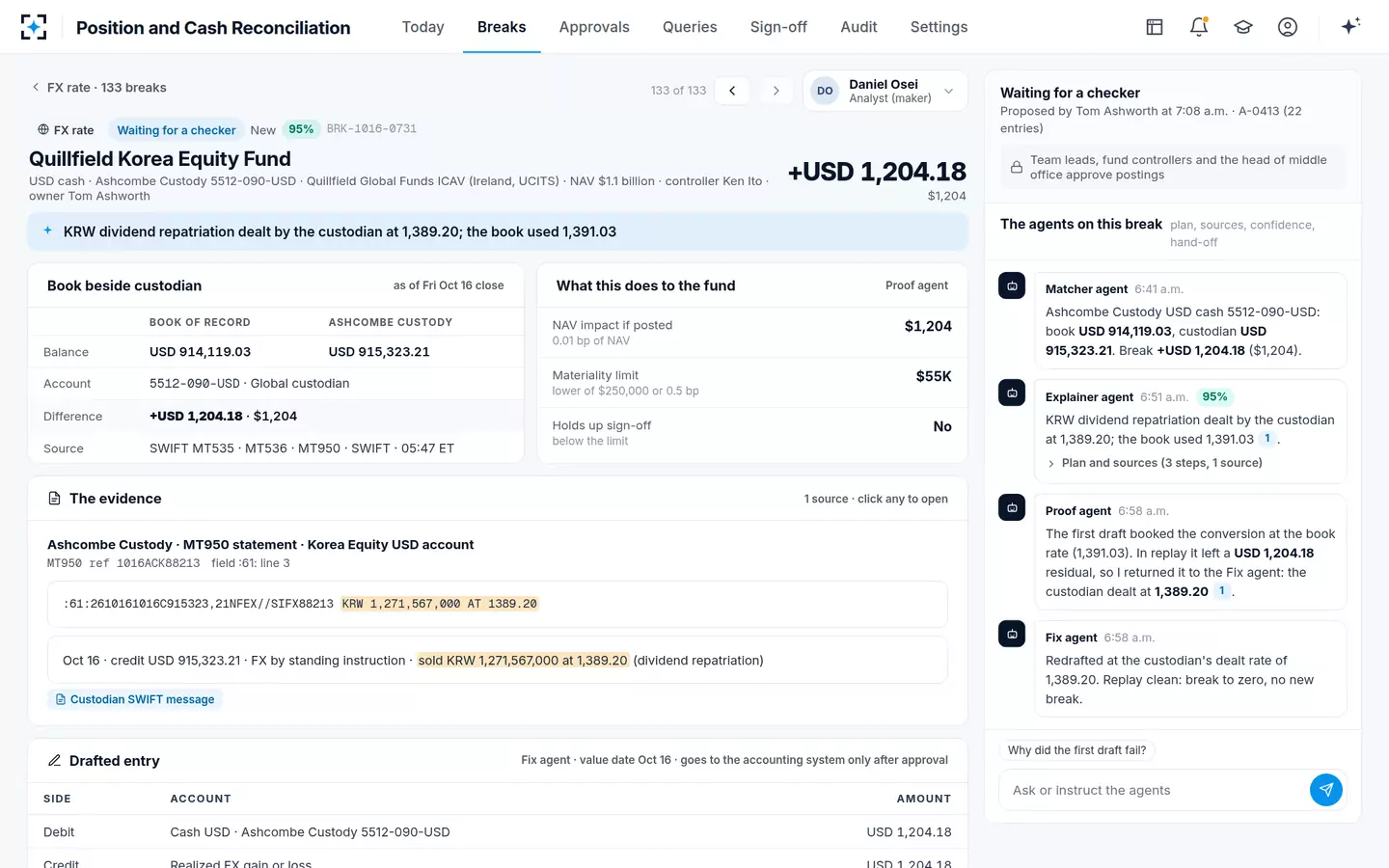
The sample shows the opposite discipline in its fix step. The Fix agent's first draft for a Korean won dividend repatriation used the book's FX rate, 1,391.03, rather than the 1,389.20 the custodian dealt. The amount was small and well inside the fund's materiality limit. But when the Proof agent replayed the fund with the draft it left a USD 1,204.18 residual, so it sent the draft back; the redraft at the dealt rate cleared exactly.
A draft that looked close enough was returned for a USD 1,204.18 residual
Tolerances: the setting that decides what nobody sees
A tolerance is a decision, made once, about which differences no person will ever look at. That makes it the most consequential setting in any automated cash reconciliation, and the one most worth testing.
Relative tolerances deserve particular care. A tolerance in basis points of the balance grows with the account. The sample firm's cash rule is "USD 1.00 or 0.5 bp of the account balance, whichever is larger", sensible for small accounts. Its arithmetic is still worth seeing: on a $400 million cash account, 0.5 basis points is $20,000, so any single difference under that amount is matched without a person seeing it. A fee charged above schedule every month, or a dividend short by a tax difference, can sit inside that band indefinitely.
What a 0.5 basis point cash tolerance lets through, by account balance
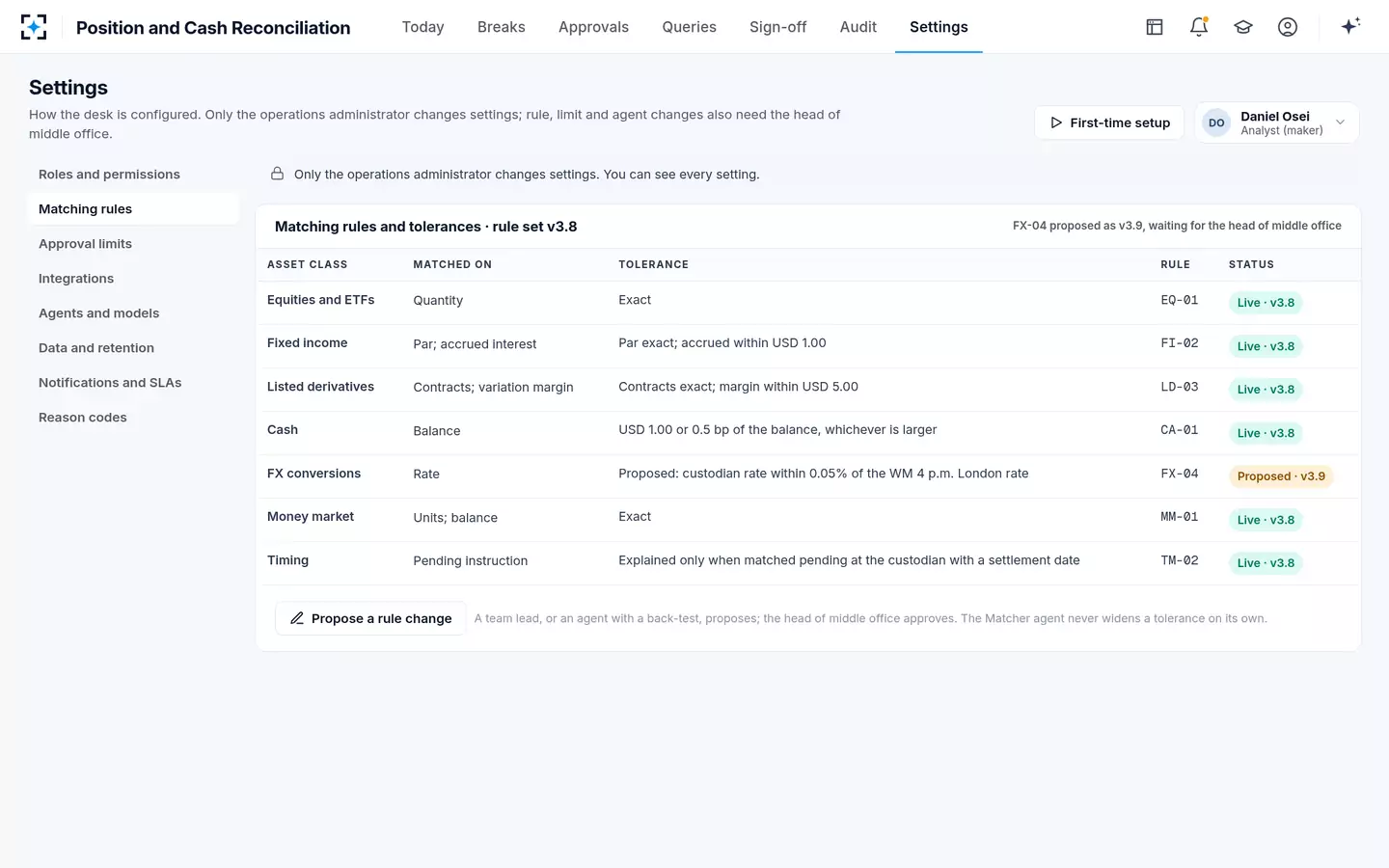
Two controls keep tolerances honest. First, a tolerance should be changed only by a proposal with a back-test and an approval by someone senior to the proposer; in the sample, the Matcher agent never widens a tolerance, and a proposed FX rule waits for the head of middle office with a 20-day back-test on sample data showing 2,214 breaks it would have closed and no real error missed. Second, differences inside tolerance should still be recorded and counted, so that a recurring small difference at one custodian shows up as a pattern even though no single item breaks.
Tolerances by asset class, versioned, and changed only with approval
How do you test auto-matching?
Re-perform it. Take a random sample of items the software closed automatically, have a person who did not set the rules match each one again from the source statements, and count the disagreements. Add a second sample weighted to items closed inside tolerance or by many-to-one rules, where wrong matches concentrate.
This is the same test an auditor applies. The SEC's October 2026 custody proposal says it expects to revise its guidance so that accountants testing a custodian's reconciliation controls should observe, inspect or re-perform a sample of reconciliations (SEC, 91 FR 63870, 6 October 2026, a proposal open for comment until 7 December 2026). A firm that re-performs a sample itself, every month, learns its true error rate before the auditor does. A second technique, planting known breaks and counting how many the process finds, is set out for NAV checks in Fund Accounting's seeded-break test of a NAV validation process, and works the same way for cash.
Testing automated cash reconciliation: seven checks
- Re-perform a random sample of auto-closed items
From the source statements, by someone who did not write the rules.
- Over-sample the risky closes
Items matched inside tolerance, many-to-one, or across a date window.
- Count wrong matches, not just open breaks
A wrong match is an error even though no break is showing.
- Test every rule change on history first
Back-test it: what would it have closed, and was any of that a real error?
- Track inside-tolerance differences
Recurring small differences by custodian and account are a pattern, not noise.
- Require evidence for "timing"
A matched pending instruction or a booked return; nothing else.
- Prove each correcting entry
Replay the fund with it: the break goes to zero and nothing else moves.
Who reviews auto-closed items?
Someone independent of the rules: an operations control or quality team, or internal audit, not the analysts whose queue the rules empty. The FCA asks for reconciliations to be done, whenever possible, by a person independent of the records being reconciled, and the same logic applies to reviewing an automated close.
Reviewing AI-driven closes needs the same evidence as reviewing a person's. FINRA's 2026 report lists, among the practices it has seen, keeping prompt and output logs, tracking which model version was used and when, and human-in-the-loop review of model outputs (FINRA, 2026 Annual Regulatory Oversight Report). In the sample every explanation carries its source passage, every agent run and human decision sits in one append-only trail, and internal audit has read-only access to filter and export it. A registered fund keeps its cash reconciliations for at least six years (17 CFR 270.31a-2(a)(2)), which is long enough for the evidence behind an automated close to be asked for more than once.
What tolerance is safe for cash reconciliation?
None is safe in general; a tolerance is safe for a given account when a back-test shows it would have hidden no real error, when it has an absolute cap, and when differences inside it are still counted. Setting it is a decision for the head of the desk, not for the software.
Some principles hold across firms. Use exact matching where the value is known exactly: equity quantities, bond par, subscription amounts. Use small absolute tolerances for rounding: the sample allows USD 1.00 on bond accrued interest and USD 5.00 on listed-derivative margin. Use relative tolerances only with a cap, and never let a relative tolerance absorb a difference that recurs. For FX, test against the rate the custodian actually dealt rather than a book rate; the sample's proposed rule compares the custodian's rate with a published 4 p.m. benchmark, within 0.05%.
What must a depositary reconcile in fund cash?
Every cash flow, one by one, every day the cash moves, for UCITS and alternative investment funds in the EU. That makes the depositary's daily reconciliation a second, independent check of the same cash a manager's automated matching has closed.
The procedure "should for example compare one by one each cash flow as reported in the bank account statements with the cash flows recorded in the UCITS' accounts".
Delegated Regulation (EU) 2016/438, recital 10
The operative rule requires the depositary to reconcile cash flow movements daily where cash moves daily, to "identify at the close of each business day significant cash flows and cash flows which could be inconsistent with UCITS' operations", to review the whole reconciliation process at least once a year, and to escalate discrepancies not corrected without undue delay (2016/438, Article 10(1)). The AIF rule is the same in substance (Delegated Regulation (EU) No 231/2013, Article 86). For a manager, the implication is that a wrong automated match does not stay hidden: if the depositary compares the same statement line one by one, it will find the difference and ask about it. In the sample, the Irish UCITS and Luxembourg SICAV funds are reconciled in the same morning run as the US trust, with the same evidence. The three regimes are compared in the custody reconciliation process across the US, UK and EU.
Where Position and Cash Reconciliation adds a second test
Botminds' Position and Cash Reconciliation uses the firm's own rules and tolerances for matching, and adds a check the match rate cannot provide: proof that each fix is right before anyone approves it. The Proof agent copies the fund's book into a sandbox, applies the drafted entry and re-runs the match. Three things must hold: the break goes to zero, no new break appears, and the NAV impact is what the entry says.
Every drafted fix is replayed against the whole fund before approval
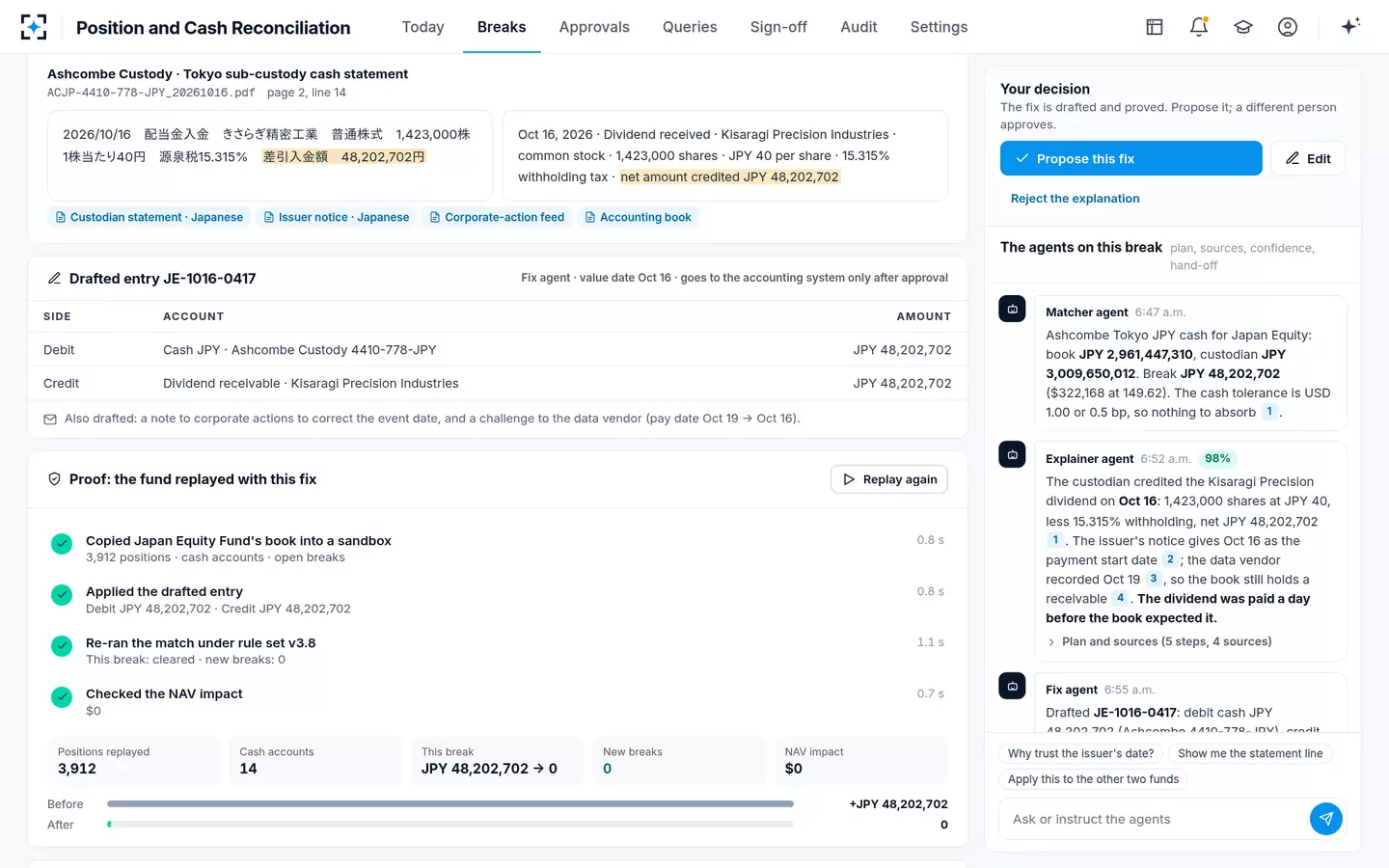
On the sample morning, 317 entries were drafted and replayed; 316 passed first time and one FX draft was returned and redrafted. Each approval then shows the approver the source line and the replay, and records that they reviewed both. Where the agents cannot defend a cause above 80% confidence they say so, and in the sample 51 breaks went to a named person rather than to a guess. How each agent's limits are set is covered in what an AI reconciliation agent may and may not do, and the full design is on the Position and Cash Reconciliation page.
Questions people ask
What is a good match rate for automated cash reconciliation?
There is no benchmark worth quoting, because the rate depends on the rules and tolerances behind it: a firm can raise it by loosening a tolerance without becoming more accurate. Track the match rate beside the error rate from a re-performed sample and the share of remaining breaks with a documented cause.
Should cash reconciliation use many-to-one matching?
Where the business really works that way, yes: one bank credit can settle several trades, and one fee debit can cover several funds. But many-to-one rules are where unrelated items are most easily netted, so restrict them to known patterns, require the references to agree, and over-sample them when testing.
How often should automated matching rules be reviewed?
At least yearly, and whenever a custodian changes a file format or a recurring inside-tolerance difference appears. An EU depositary must review its full reconciliation process at least once a year, and the UK rules require an annual review of reconciliation frequency; a firm's own rule review fits the same cycle.
Is automated cash reconciliation the same as bank reconciliation?
It uses the same techniques, but a fund's cash reconciliation also has to match corporate-action income, FX conversions dealt by custodians, subscriptions and redemptions, and margin, often across dozens of currencies, and its result feeds a daily NAV and a depositary's own daily check.
Can AI improve the accuracy of cash matching?
It can explain more of what the rules leave, by reading statement narratives, notices and emails, and it can test each proposed fix before a person sees it. It does not make a loose tolerance safe, and an agent that closes breaks without citing a source is a faster way to produce wrong matches.