A cash reconciliation automation platform matches a fund's bank and custodian cash statements with its books and works the differences, and the business case for one rests on what it changes in the reconciliation team's day. No regulator or independent study publishes reconciliation costs, break rates or staffing for asset managers, and vendors' own figures are vendors' figures. So the case has to be built from five numbers the firm measures itself: how many breaks the desk handles, how old they get, how many analyst-days go on finding their causes, how many fixes turn out wrong, and what a custody or reconciliation failure would cost. Each can be measured in a month without new software. Botminds' Position and Cash Reconciliation is designed against those five numbers, and this guide sets out its design targets and a sample firm's estimates beside the method.
The product figures come from the solution's sample, a fictional manager with 46 funds and a four-analyst reconciliation desk, and from Botminds' estimates and design targets, labelled as such; none is a customer's measured result. Wage figures are from the US Bureau of Labor Statistics.
Where an estimated 12.7 analyst-days a week come back on a four-analyst desk
What does reconciliation automation save?
Mostly the time spent finding out why breaks exist, which is where a reconciliation desk's week goes. Matching itself has been automated for years; what remains manual is opening statements, SWIFT messages, notices and emails to explain each difference, keying the fix, and assembling evidence afterwards.
In Botminds' estimate for the sample desk, finding causes takes 7.5 of the 18.5 analyst-days a week spent on these tasks by hand, and 2.5 with agents doing the reading. That one line is two-fifths of the saving. The rest comes from keying and checking entries (3 days to 0.8), custodian queries (3 to 1), audit evidence (1.5 to 0.2), file handling (1.5 to 0.3) and sign-off and ageing (2 to 1). The released time does not have to become a headcount reduction; for most desks it becomes the breaks nobody has explained, the rules nobody has reviewed and the upstream causes nobody has fixed.
Savings that are harder to count can be larger. A wrong entry that reaches the NAV, a custody shortfall found by an examiner, or a fund that cannot be signed before the cut-off each cost more than a week of analyst time. They are the fourth and fifth numbers below.
Why no regulator or study publishes the number for you
Reconciliation is internal work. Regulators set rules for its frequency and evidence, and fine firms when it fails, but they do not collect what it costs; the SEC, the FCA and EU authorities publish the rules and the enforcement cases, not the operating data. We know of no independent academic study that measures asset managers' reconciliation costs in a form a business case could use.
What circulates instead are vendor-run trials and vendor-sponsored surveys. They are not useless, but they measure the vendor's product on the vendor's chosen clients, and a board approving a budget should not rely on them. The firm's own baseline, measured before the project starts and again after, is the only figure that will survive the first question. The rest of this guide is how to get it.
Number one: break volume, by cause
Count the breaks left after matching each day, by cause and by absolute value. Volume sets the size of the problem; the cause split shows which part of it automation can touch.
In the sample morning the matcher left 1,214 breaks worth $316.7 million in absolute value: 612 timing, 171 fees and charges, 148 corporate actions not booked, 133 FX rate, 99 trades not on the custodian and 51 unknown. Half were timing, which needs evidence rather than work; the corporate-action and FX breaks need a document read and an entry drafted, which is where agents save the most. A desk whose breaks are mostly unknowns will gain less from automation than one whose breaks are mostly explainable from documents nobody has time to open. How to code causes so they can be counted is set out in the cause list for cash and position breaks.
Number two: break age at the cut-off
Measure how many breaks are still unexplained when the NAV is struck, and how many are older than the firm's escalation threshold. Age is the number regulators care about, because an old break is one nobody has investigated "without undue delay", the phrase both the UK client assets rules and the EU depositary rules use.
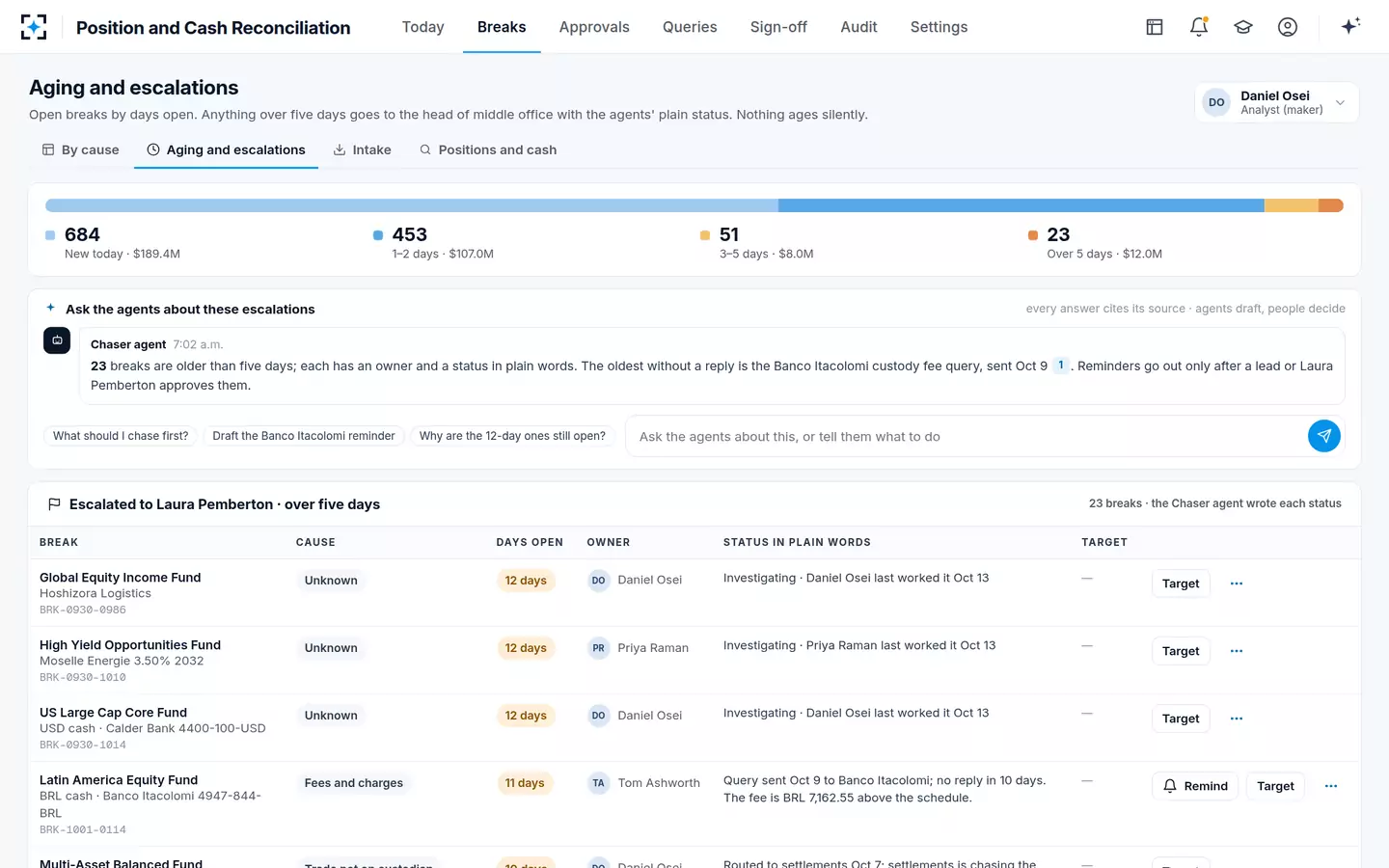
Two measures work. The first is the share of breaks with a documented cause or a named owner at the cut-off; the design target for Position and Cash Reconciliation is 100% by the 10:30 a.m. cut-off, and in the sample it was met by 6:58 a.m., with 1,163 explained and 51 owned. The second is the count of breaks over the escalation age, five days in the sample; that morning 23 breaks were over five days and went to the head of middle office with a plain status.
Breaks by age, with the oldest escalated in plain words
Number three: analyst-days spent finding causes
Time-sample the desk for two weeks: each analyst records, in half-hour blocks, which of six tasks they were doing. Multiply by a loaded day rate. It is tedious, and it is the number the business case will be judged on.
The day rate should be the firm's own fully loaded cost. For a reference point, the Bureau of Labor Statistics records a median annual wage of $65,750 for brokerage clerks, the occupation closest to reconciliation work, and a mean of $72,850, in May 2025 (BLS OEWS 43-4011); financial and investment analysts had a median of $102,740 (BLS OEWS 13-2051). At the clerks' mean and about 250 working days a year, a day's wages are roughly $290 before benefits, overhead and location. On that rate, the estimated 12.7 analyst-days a week above are worth about $3,700 a week in wages alone, or roughly $180,000 over 48 weeks. That is our arithmetic on an estimate, and the firm's own loaded rate will be higher.
The return on a cash reconciliation automation platform, term by term
Analyst time
days saved a week × weeks × loaded day rate
From a two-week time sample before and after
Head of middle office
Wrong fixes avoided
reversed entries a year × cost to find and reverse each
Count reversals and corrected NAVs for twelve months
Fund controllers
Evidence and exams
days preparing for audit and examination × rate
Internal audit and compliance time on reconciliation requests
Internal audit
Running cost
licence + integration + oversight time
Include the people who approve rule and agent changes
COO
Number four: wrong fixes and write-offs
Count, over twelve months, the correcting entries that later had to be reversed or corrected, the breaks written off, and the NAV corrections that traced back to a reconciliation entry. These are the cost of a fix keyed by hand and checked by eye, and the number most desks have never added up.
A wrong entry costs more than the time to reverse it. It can open a new break while closing the old one, mislead the approver who trusted it, and, if it reaches the NAV, start a correction process with its own thresholds and compensation rules, covered in Fund Accounting's NAV impact and the cost of an error. The design target for Position and Cash Reconciliation is zero postings without a clean replay of the fund and a second person's approval. In the sample, the Proof agent replayed 317 drafted entries; 316 passed and one FX draft, booked at the book's rate instead of the custodian's dealt rate, was returned before anyone saw it.
Number five: the cost of a custody or reconciliation failure
It cannot be estimated as an expected value, but its size can be described from public enforcement. A business case should say what the controls protect against and leave the probability to the risk committee.
What reconciliation failures have cost, in regulators' own records
£126M
FCA fine on two BNY Mellon entities for custody records and reconciliations not done entity by entity
FCA, 14 April 2015
£8.2M
FCA fine on two Aviva entities for weak oversight of outsourced reconciliations and client money
FCA, 5 October 2016
3 years
a BDC's custody reconciliation policy went unperformed for some assets, July 2019 to June 2022
SEC order, September 2024
1 in 3
significant-deficiency adviser exams that included custody issues (over 140)
SEC risk alert, 2013
The cases differ in size but share a pattern: the reconciliation existed on paper and was not done on the right basis, or not done at all, or done by a third party nobody checked. The BNY Mellon firms reconciled on an enterprise-wide basis instead of entity by entity; Aviva outsourced external reconciliations without adequate oversight; SuRo Capital's procedures called for custody reconciliation against custodial statements that did not happen for its uncertificated securities. The SEC's SuRo order imposed no penalty; the FCA's two fines were £126 million and £8,246,800. A platform that runs the reconciliation fund by fund every day and keeps a record of each discrepancy addresses the pattern, not just the cost.
How do you baseline reconciliation work today in one month?
Collect the five numbers for four weeks from the systems and people already in place, before any vendor demonstration. The table sets out a method that needs no new tools.
Baselining the five numbers in a month
| Number | How to measure it | Source | Watch out for |
|---|---|---|---|
| Break volume by cause | Daily count and absolute value of breaks after matching, coded to a fixed cause list | The matching engine's exception report, coded by the analysts | Netted values, which hide offsetting breaks |
| Break age at cut-off | Share of breaks with a documented cause or owner at the NAV cut-off; count over the escalation age | Exception report snapshot at the cut-off | Age reset when a break is re-opened or re-coded |
| Analyst-days by task | Two-week time sample in half-hour blocks across six tasks | The analysts, with a simple form | Recording what people think they did, not what they did |
| Wrong fixes and write-offs | Reversed or corrected entries and write-offs, with reasons, over twelve months | Accounting system journal history; NAV error log | Corrections booked as new entries rather than reversals |
| Failure exposure | Open custody findings, audit points and regulator questions on reconciliation | Internal audit, compliance and the auditor's letters | Findings closed on paper without a changed process |
What does a cash reconciliation platform cost to run, and how long is the payback?
Vendors rarely publish prices, so ask for a quote against your own volumes and add the costs that sit outside the licence. Payback is then the total first-year cost divided by the monthly benefit measured from your baseline.
Five things move the cost of any platform: the number of funds and accounts, the number of custodians, prime brokers and banks to connect, the formats and languages of their statements, the integration with the book of record and the accounting system, and whether the platform replaces the matching engine or sits beside it. Two internal costs are easy to forget: the time of the people who must approve rule and agent changes, and the time internal audit and model risk will spend validating a tool that decides what counts as a break. Keeping the existing matching engine and putting agents on its exceptions usually costs least and goes live fastest, as adding agents to post-trade reconciliation describes.
Measure the benefit the same way as the baseline, after the platform is running: the same five numbers, the same time sample. A pilot on a few mornings of the firm's own files and books, with the outcomes held back and compared, is the cheapest way to see whether the estimates hold before signing for all funds.
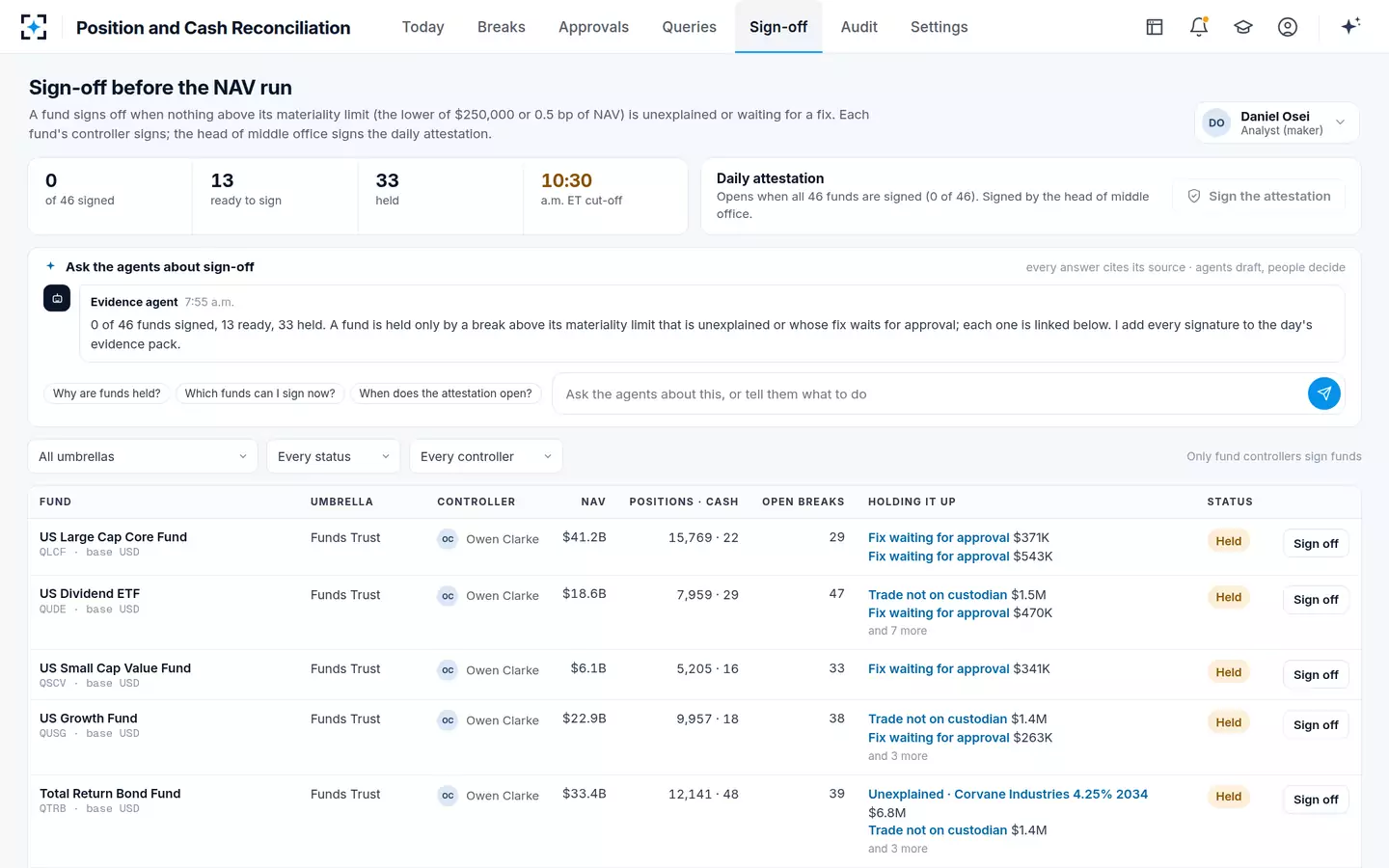
The number the board will ask about: funds signed before the NAV run
What to ask in a cash reconciliation software comparison
Compare platforms on the five numbers, measured on your data, not on feature lists. The questions below force each vendor to show the effect on the numbers the business case depends on.
Eight questions for a cash reconciliation software comparison
- What share of our breaks does it explain, with a source?
On a month of our files, with our outcomes held back.
- What does it do with the ones it cannot explain?
A named owner and an honest unknown, not a guess.
- How is each fix proved before approval?
A replay of the fund, or only a rule check on the entry?
- Who can change a tolerance?
And what back-test does the change need?
- Does it read our custodians' local statements?
PDFs and messages in the languages our sub-custodians use.
- Does it replace our matching engine or sit beside it?
The answer drives cost, risk and time to go live.
- What evidence does it keep, and for how long?
Per break: cause, source, fix, replay, approver, time.
- What will our people still do?
Every approval, query sent and sign-off should remain a person's act.
Position and Cash Reconciliation is built to answer each of these on a customer's own files: the agents read and draft, the Proof agent replays each fix, and every approval, query and sign-off stays with a named person. The targets behind the business case (every break with a cited cause or owner by the cut-off, no posting without a clean replay and a second approval, and 50–75% less analyst time investigating breaks) are design goals to be measured in the live solution. The agents and limits are on the Position and Cash Reconciliation page, and the people whose week changes are described in the middle office, seat by seat.
Questions people ask
Is a reconciliation platform worth it for a small manager?
It depends on the third number. A manager with a few funds and one custodian may spend only a few analyst-days a week on breaks and gain little; one with several custodians, prime brokers and local-language statements will spend most of its reconciliation time on reading, which is what automation removes. Measure first.
How long does a cash reconciliation automation project take?
A replacement of the matching engine is a project of many months, with parallel running. Adding agents on the exceptions the existing engine leaves is shorter, because the engine and its rules stay in place; the work is connecting the files, loading the rules and approval roles, and back-testing on a few weeks of past data.
Which KPIs should a reconciliation team report?
Breaks by cause and absolute value, the share with a documented cause or owner at the cut-off, the count over the escalation age, reversed or corrected entries, and the error rate from a re-performed sample of automated closes. A match rate alone says how much was closed, not how much was closed correctly.
Do vendors publish reconciliation automation results?
Some publish trial results and sponsored surveys. Treat them as the vendor's figures, measured on clients the vendor chose, and ask for a pilot on your own files with your outcomes held back instead.
Does reconciliation automation reduce regulatory risk?
It can, if it changes how the work is done rather than only how fast. The public enforcement cases are about reconciliations done on the wrong basis, not done, or outsourced without oversight; a platform that reconciles each fund every day, records each discrepancy and its resolution, and keeps every approval with a named person addresses those failures directly.