A middle office analyst in an asset manager sits between the trading desk and the fund accountants and makes sure that what was traded is what the books, the custodian and the prime broker show. Much of the job is the morning reconciliation: matching positions and cash against the overnight files, finding out why each break exists, proposing the correcting entry or the custodian query, and getting every fund ready to sign before the NAV is struck. The analyst rarely works a break alone. A team lead approves what leaves the desk, a fund controller approves what moves the book, the head of middle office takes the old and the large, and internal audit reads it all afterwards. Botminds' Position and Cash Reconciliation is built for that desk: agents do the reading and the drafting, and every seat keeps its approvals.
The people on this page are the fictional reconciliation team of Quillfield Capital, a sample manager with 46 funds, as the solution runs on the morning of Monday 19 October 2026. The labour statistics are the US Bureau of Labor Statistics' own.
Five seats around one break, before and with the agents doing the reading
Today
Starts before 7 a.m. and spends the first three hours opening statements, SWIFT messages and notices to find out why each break is there.
With agents
Opens breaks already explained, each with its statement line; asks the agents about the rest; proposes the fixes they drafted.
Still theirs: Owning the fund's breaks and proposing every fix
Today
Approves custodian queries and keyed postings for a group of funds while watching the cut-off.
With agents
Approves drafted queries, some in the custodian's own language with the English beside; proposes rule changes with a back-test.
Still theirs: Approval of everything that leaves the desk
Today
Approves postings without seeing whether an entry clears its break or opens another.
With agents
Reads the statement line and the replay of the fund with the entry before approving; signs the fund.
Still theirs: Approval of what moves the book; the fund sign-off
Today
Hears about aged breaks at the weekly escalation, then reports ageing upwards.
With agents
Sees breaks over five days first, each with a plain status; gives second approvals over $5 million.
Still theirs: Rule and tolerance changes; the daily attestation
Today
Rebuilds reconciliation evidence for the auditor and the custody examination from screenshots and email.
With agents
Filters the append-only trail and exports a day's evidence in one step.
Still theirs: Independent review; read-only access
What does a middle office analyst do?
A middle office analyst checks, every day, that trades and holdings agree across the systems and institutions that record them, and fixes or chases what does not. In a reconciliation role that means owning a set of funds, working their breaks from the overnight run to a cause and a fix, and having those funds ready for sign-off before the NAV cut-off.
The working day is shaped by two deadlines. The first is the arrival of the custodian, prime broker and bank files, usually overnight or in the early morning; in the sample firm 214 files and 3,862 SWIFT and ISO 20022 messages arrived between 5:30 and 6:52 a.m. The second is the cut-off for the NAV run, 10:30 a.m. Eastern in the sample. Between them, the analyst Daniel Osei owns 418 open breaks across 13 funds. By hand, most of those three and a half hours went on finding out why each break existed. With the agents, the explanations are there when he arrives, each tied to the statement line it came from, and his first job is to check and propose.
Middle office roles also cover trade support. Under US T+1 settlement, an adviser must keep each allocation and affirmation it sends or receives, time-stamped, for every trade subject to the same-day affirmation rule (17 CFR 275.204-2(a)(7)(iii)). The SEC's then Chair said in June 2024 that the share of trades affirmed on trade date had been around two-thirds before the change and was about 95% by 9 p.m. on the day after the switch to T+1 (SEC, remarks, 20 June 2024). The trade-matching side of the desk is followed in the T+1 settlement desk; this page follows the reconciliation seat.
What is the middle office in asset management?
The middle office is the group between the front office, which decides and trades, and the back office or fund administrator, which settles, accounts and reports. In an asset manager it typically owns trade support and affirmation, position and cash reconciliation, corporate-action oversight, collateral, and the data the portfolio managers trade from.
"Middle office vs back office" is a common search because the line moves from firm to firm. A useful test is whose record the work protects. The back office, or the administrator for most funds, keeps the official books and strikes the NAV. The middle office protects the manager's own record of what it owns and the decisions taken on it, and checks that the official books agree. That is why reconciliation sits in the middle office even when an administrator also reconciles: the manager answers for its funds whichever firm does the work. What stays with the manager when an administrator is appointed is covered by Fund Accounting's guide to what a fund administrator does.
Seat one: the reconciliation analyst, who proposes
The analyst owns the break and proposes its fix, and in a well-run desk cannot approve it. The proposal is the analyst's judgement made visible: the cause, the document that proves it, and the entry or query that resolves it, with a reason code that tells everyone downstream what kind of fix it is.
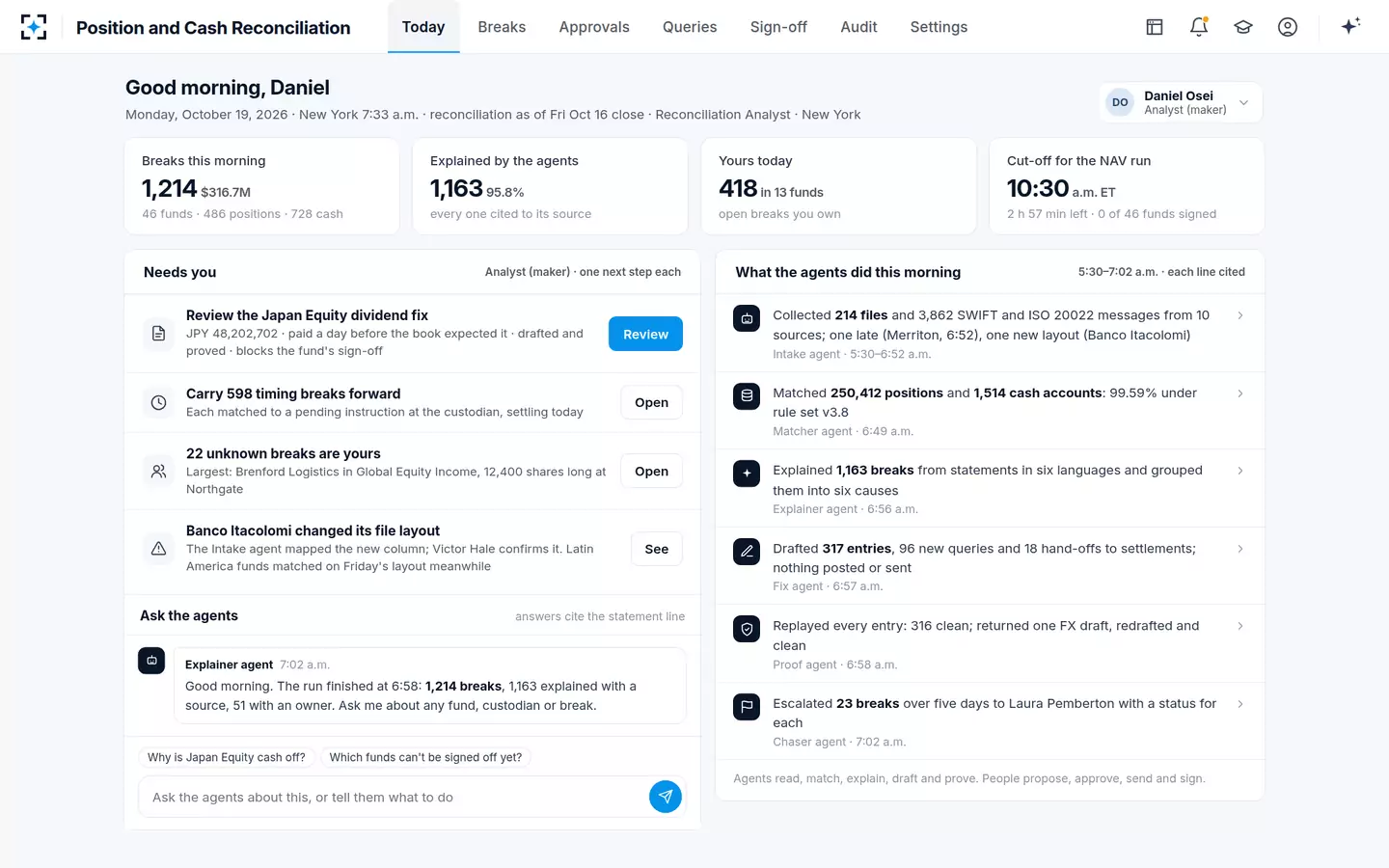
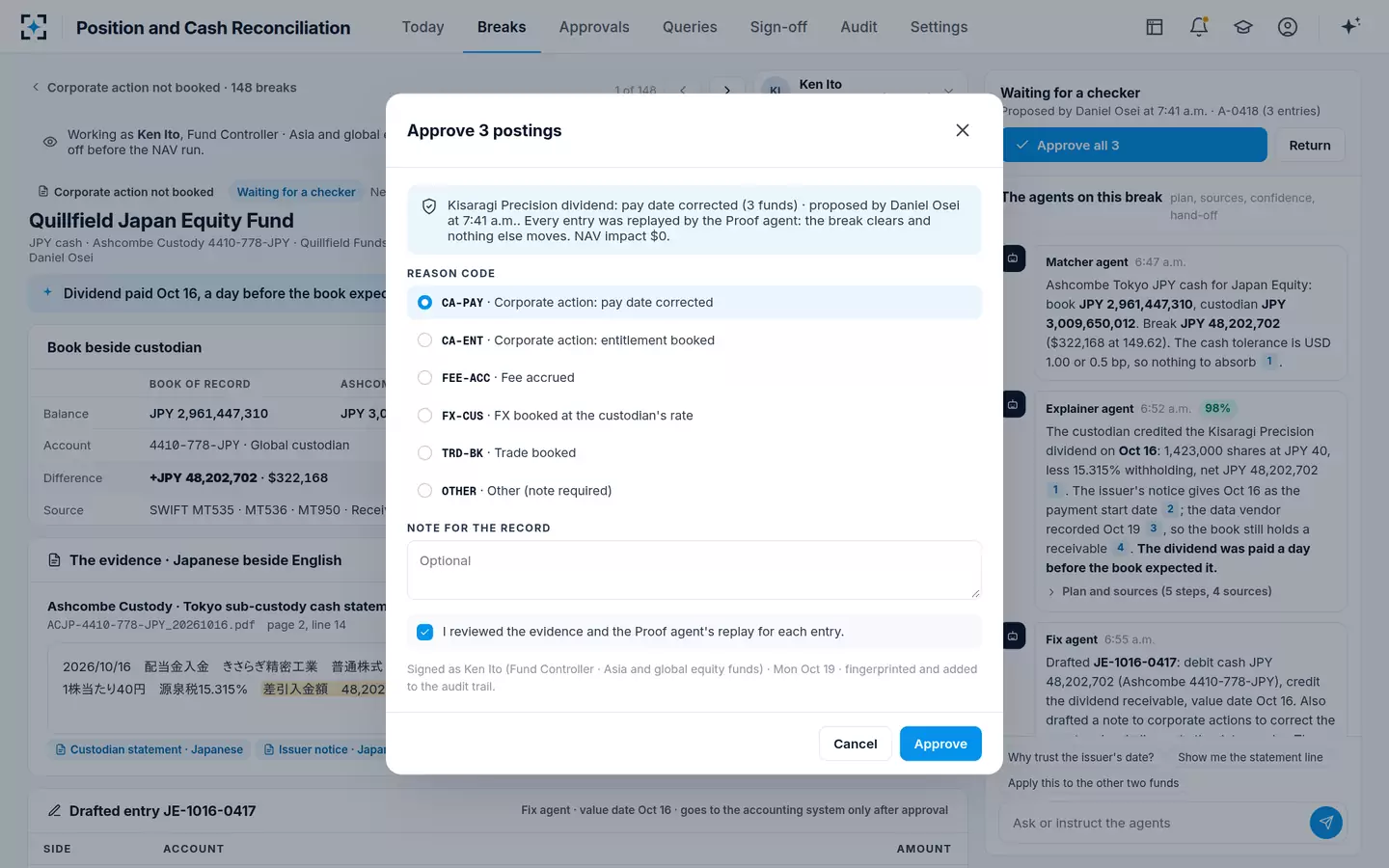
The sample morning's first fix shows the shape. Quillfield Japan Equity Fund's yen cash at the custodian was JPY 48,202,702 ($322,168) above the book. The agents had already found the cause: a dividend paid on 16 October while the book, fed by a data vendor that recorded 19 October, still held a receivable. They had drafted the correcting entry and replayed the whole fund with it in a sandbox: the break cleared, no new break appeared, and the NAV impact was nil. The same event sat in two other funds. At 7:41 a.m. Daniel proposed all three entries with reason code CA-PAY, corporate action: pay date corrected. The screen told him he was the maker and someone else must approve.
The analyst's other job is the breaks the agents cannot explain. Of the sample's 1,214 breaks, 51 had no cause the agents would defend above 80% confidence, and each came with a suggested owner. One was a 12,400-share difference in Brenford Logistics. Daniel told the agents to check the securities lending reports; they found a recalled loan returned on 16 October and moved the break to timing. Knowing where to look is still the analyst's skill.
The analyst's morning starts with the agents' account of the night
Seat two: the team lead, who approves what leaves the desk
The team lead approves custodian queries and reminders and many routine postings, and proposes changes to matching rules. Nothing goes to a custodian, prime broker or bank that one person did alone.
On the sample morning the agents drafted 96 custodian queries, 23 of them in the custodian's own language with the English beside: Korean to a global custodian about a sale it did not show, Japanese about a purchase, Portuguese to a Brazilian bank about a fee. Asked to send them all at once, the agent declined, because sending is a person's act. The team lead, Sofia Marin, reviewed and approved them, and the agents then ran a 24-hour reply clock on each, with a reminder at 20 hours that also needs a lead's approval.
The team lead also owns the rules. A proposal to change a tolerance comes from a lead, or from an agent with a back-test, and is approved by the head of middle office; the matching agent never widens a tolerance on its own. In the sample a proposed FX rule came with a 20-day back-test on sample data showing 2,214 breaks it would have closed and no real error missed, and it still waited for approval.
Seat three: the fund controller, who approves what moves the book
A fund controller approves postings to the funds he or she controls and signs each fund off before the NAV run. The approval is the control that matters most, because a wrong entry booked to clear one break can open another, or misstate the fund.
The sample's controller for the Asia and global equity funds, Ken Ito, opened Daniel's proposal at 7:52 a.m., read the Japanese statement line and the replay for each of the three funds, ticked that he had reviewed both, and approved. Eleven minutes passed from proposal to approval. By hand the same hand-off often takes much longer, because the controller has to rebuild the analyst's reasoning from an email before trusting a keyed entry.
A different person approves, after reading the evidence and the replay
Seat four: the head of middle office, who takes the old and the large
The head of middle office owns what has aged, what is large and what changes the rules. In the sample firm, any break open more than five days goes to her first, every posting over $5 million needs her as second approver, every rule or tolerance change needs her approval, and she signs the daily attestation once all funds are signed.
On the sample morning 23 breaks were over five days old. The agents escalated them to Laura Pemberton at 7:02 a.m., each with its owner and a status written in plain words, such as a break still under investigation and last worked on 13 October, or a query sent on 9 October with no reply in ten days. She approved a reminder to a Brazilian bank about a custody fee BRL 7,162.55 above the agreed schedule, and gave the second approval on a $6.2 million rights posting in Korea Equity. Fund controllers signed their own funds; she signed the day before the 10:30 cut-off.
Separation of these seats is not only good practice. The UK client assets rules ask that, whenever possible, reconciliations are performed by someone "independent of the production or maintenance of the records to be checked and/or reconciled" (FCA CASS 6.6.47G), and a desk where the analyst proposes, a controller approves and audit reads only is built to that pattern.
What does the BLS count for middle office roles?
The Bureau of Labor Statistics publishes no occupation called middle office analyst. The closest it counts are brokerage clerks, whose O*NET description covers checking trades, moving securities in and out, paying out dividends and recording each day's transactions and positions (O*NET 43-4011.00), and financial and investment analysts, under which many firms place analyst-titled operations staff.
The closest BLS counts to a middle office desk, May 2025
35,940
brokerage clerks employed in the US, all industries
SOC 43-4011
$65,750
median annual wage of brokerage clerks; the mean was $72,850
SOC 43-4011
$102,740
median annual wage of financial and investment analysts (361,980 employed)
SOC 13-2051
$186,910
mean annual wage of financial managers, the category that includes controllers and treasurers
SOC 11-3031
Two cautions on the numbers. The analyst category covers people who never touch a reconciliation, and many reconciliation teams sit in lower-cost locations that a national US median does not describe. The bookkeeping, accounting and auditing clerks category is larger still, 1,373,680 people with a mean wage of $53,560 (BLS OEWS 43-3031), and covers some fund accounting support roles. For a business case the useful number is the firm's own loaded cost per analyst-day, which the five-number business case for reconciliation automation shows how to measure.
Where the delay lives: the hand-offs between seats
Most of a break's life is spent waiting between seats, not being worked in one. The analyst waits for the evidence, the controller waits for the analyst's reasoning, the custodian waits for a query someone has not approved, and the head of desk hears about the break only when it is old.
One corporate-action break in the sample, seat by seat
Agent
Explain and draft (6:52–6:55 a.m.)Cause found on the Tokyo statement, page 2, line 14; entry drafted; a note to corporate actions and a challenge to the vendor.
Never: Post the entry or contact the vendor
Agent
ReplayThe fund copied into a sandbox with the entry: the break goes to zero, no new break, NAV impact nil.
Never: Approve; a failing draft goes back with the reason
A person decides
Analyst proposes (7:41 a.m.)Checks the source and proposes the entry for three funds with reason code CA-PAY.
A person decides
Controller approves (7:52 a.m.)Reads the statement line and each replay; approves; the entries post.
A person decides
Controller signs the fundJapan Equity no longer holds up sign-off before the NAV run.
How do middle office roles change with agents?
The seats stay; the hours inside them move. Agents take the opening of documents, the matching of messages to breaks, the drafting of entries and queries and the assembling of evidence. People keep every decision that moves the book or leaves the desk, and spend more of their time on the breaks nobody can yet explain.
Regulators expect exactly that division. FINRA's 2026 oversight report lists the risks of AI agents acting autonomously without human validation and approval, or beyond the authority a user intended, and names human-in-the-loop review of model outputs among the practices it has seen (FINRA, 2026 Annual Regulatory Oversight Report). A desk where agents never approve, post, send or sign meets that expectation by design rather than by policy.
Where a four-analyst desk's week goes, by hand and with the agents
- Finding causes7.5
- Keying entries3
- Queries3
- Files and audit3
- Sign-off2
- Checking causes2.5
- Entries and queries1.8
- Sign-off, files, audit1.5
The design target behind the estimate is 50–75% less analyst time spent investigating breaks. The estimate is not a staffing plan. A desk that stops opening statements has time to fix the reasons breaks recur (a vendor's dates, a custodian's FX instruction, a late settlement instruction) and to do the work that rarely got done: reviewing tolerances, chasing old breaks, preparing for the auditor before the auditor asks. How the agents and their limits are set up is on the Position and Cash Reconciliation page, and what an AI reconciliation agent may and may not do takes each limit in turn.
Questions people ask
What skills does a middle office reconciliation analyst need?
Knowledge of how trades settle and how corporate actions, FX and fees reach a custodian statement; the ability to read SWIFT statements such as MT535 and MT950 and their ISO 20022 equivalents; and the judgement to know where to look when the obvious explanations fail. Increasingly it also means checking an agent's explanation against its source rather than finding the source by hand.
Who approves write-offs and correcting entries in the middle office?
A person other than the one who prepared them, usually a team lead or the fund's controller, with a second approver above a value threshold. In the sample firm postings over $5 million also need the head of middle office, and nobody can approve their own proposal; every approval carries a reason code.
How does the middle office work with fund accounting and the custodian?
The middle office checks the manager's books against the custodian and the administrator, fixes the manager's side and raises queries on theirs. Fund accounting, in-house or at the administrator, strikes the NAV, so the middle office aims to have every material break explained or fixed before the NAV run.
Is middle office analyst an entry-level job?
Often it is, because reconciliation teaches how every part of the trade life cycle can go wrong. The BLS records brokerage clerks, the nearest operations category, at a median of $65,750 in May 2025, and financial and investment analysts at $102,740; titles and pay vary widely by firm and location.
Will AI agents replace middle office analysts?
Not the seats. Agents can read statements, match and draft, but the decision that an entry is right, that a query can go out or that a fund can be signed stays with a named person. In the sample firm's estimate a four-analyst desk moves from 18.5 to 5.8 analyst-days a week on these tasks, and the rest of the week goes to the breaks nobody can yet explain.
What does internal audit look for in a reconciliation team?
Evidence that each break was explained from a document, that the person who approved a fix did not prepare it, and that old breaks were escalated. In the sample firm audit has read-only access to an append-only trail and exports a day's breaks, causes, fixes, replays, approvals and sign-offs in one step.