An internal custody record check is a check, required by the FCA's client assets rules, that a firm's own records of the safe custody assets it holds correspond to what it owes each client. It uses only the firm's internal records, never a custodian's statement, and must be done at least monthly. It is one of two questions CASS 6.6 asks every month: the internal check asks whether the firm's books add up to its obligations to clients; the external custody reconciliation asks whether those books agree with the custodians, depositories and registrars that actually hold the assets. Most managers outside the UK run something like the second and have never run the first. Botminds' Position and Cash Reconciliation runs the books-to-custodian side every morning and keeps a record of each discrepancy and what was done about it, which is the record CASS asks for.
The CASS 6.6 cycle, from the internal check to the FCA, with the rule behind each step
A person decides
Internal custody record check (CASS 6.6.11R)Compare the firm's internal records of client assets with its obligations to each client, using internal records only. At least monthly.
Agent
External custody reconciliation (CASS 6.6.37R)Compare internal records with each third party holding the assets. At least monthly; daily is best practice at a depository.
Never: Close a discrepancy on the third party's say-so
A person decides
Investigate and resolve (CASS 6.6.49R)Promptly investigate each discrepancy and resolve it without undue delay; record what was done (6.6.8R).
A person decides
Cover any shortfall (CASS 6.6.54R)Set aside the firm's own assets or money for the affected clients until the discrepancy is resolved.
A person decides
Tell the FCA when it fails (CASS 6.6.57R)Notify without delay if records are materially out of date or a check or reconciliation cannot be done.
What is an internal custody record check?
The FCA defines it as "a check as to whether the firm's records and accounts of the safe custody assets held by the firm (including, for example, those deposited with third parties under CASS 6.3 (Depositing safe custody assets with third parties)) correspond with the firm's obligations to its clients to hold those safe custody assets" (CASS 6.6.10G(2)). It is one of the ways a firm meets Principle 10 and its duties to keep accurate records that can distinguish one client's assets from another's and from the firm's own.
The defining restriction is the data. A firm "must only use its internal records (for example its depot and client-specific ledgers for safe custody assets or other internal accounting records)" (CASS 6.6.14R), and the guidance spells out that it must not base the check on records obtained from custodians or registrars (6.6.15G). The internal check tests the firm's own bookkeeping; the custodian's view is the external reconciliation's job.
The rules apply to UK firms when they hold safe custody assets for clients, which includes custodians, platforms, wealth managers and investment managers with custody permissions. A manager whose clients' assets are held by a separately appointed custodian in the client's own name may not hold safe custody assets at all, and should confirm its position with its compliance team before assuming the rules apply or do not.
How is it different from an external custody reconciliation?
The internal check compares the firm's records with each other and with its obligations; the external reconciliation compares the firm's records with the third parties holding the assets. One catches bookkeeping that does not add up; the other catches books that add up but disagree with reality.
Two monthly questions about the same client assets
Internal custody record check: Do our records of client assets match what we owe each client?
External custody reconciliation: Do our records match what the custodian, depository or registrar holds?
Internal custody record check: Internal records only: depot and client-specific ledgers, internal accounts
External custody reconciliation: Internal records against statements or data from each third party
Internal custody record check: CASS 6.6.11R: no more than one month between checks
External custody reconciliation: CASS 6.6.37R: no more than one month, with narrow exceptions since 25 September 2026
Internal custody record check: A client record that sums to more than the aggregate; a "balancing" entry; a negative balance
External custody reconciliation: A holding the custodian does not show; a stock the custodian has written off
Internal custody record check: Whether the assets are really at the custodian
External custody reconciliation: Whether the right client is credited inside the firm's books
The two checks fail in different places. A firm can pass every external reconciliation, with each custodian account agreeing in total, and still have one client's record overstated and another's understated by the same amount. A firm can pass every internal check, with its client records summing exactly to its aggregate, and still hold less at the custodian than its books say. That is why the FCA requires both and why neither can stand in for the other. The rest of the custody regimes, US and EU, are set side by side in the custody reconciliation process across the US, UK and EU.
How often must an internal custody record check be done?
"As regularly as is necessary but without allowing more than one month to pass between each internal custody record check", and "as soon as reasonably practicable after the date to which the internal custody record check relates" (CASS 6.6.11R). A firm that holds only physical assets checks at least as often as its physical asset reconciliations.
Monthly is a ceiling. The firm must choose its frequency having regard to how often its clients' assets are traded, how many transactions there are and how much they are worth, and to the risks the assets face, keep a record explaining that decision (retained indefinitely, or for five years once superseded), and review the frequency at least annually unless it already runs the check every business day (CASS 6.6.44R to 6.6.46R). A firm trading daily for thousands of clients that checks once a month will find that choice hard to defend.
Two methods, and the one rule about mixing them
The check can be run in one of two ways, and a firm "must not use a combination of these methods" (CASS 6.6.13R). The internal custody reconciliation method compares two internal records; the internal system evaluation method tests the systems that keep them.
The internal custody reconciliation method is available only to a firm that keeps both "an aggregate safe custody asset record and a client-specific safe custody asset record" and can compare them; it requires a comparison of the two as at the date of the check (CASS 6.6.16R and 6.6.17R). The internal system evaluation method is open to any firm. It requires a process that evaluates whether the firm's records are complete and accurate enough to identify each client's assets and the total, and whether its systems "correctly identify and resolve all discrepancies", run on the date of each check, with any causes found investigated promptly and resolved without undue delay (CASS 6.6.19R).
The FCA lists what the evaluation should be able to catch, and the list doubles as a good cause code set for book-side breaks: entries that overstate or understate holdings, such as "test" and "balancing" entries; negative balances; processing errors; journal entry errors such as omissions and unauthorised entries; and IT errors (CASS 6.6.20G). The cause list for cash and position breaks sets out the causes on the external side.
What counts as a discrepancy under CASS 6.6?
Any difference a check or reconciliation finds, plus two kinds of item that are easy to overlook: anything sitting in a suspense or error account, and anything still in the firm's records that the relevant third parties no longer record, such as "liquidated stocks" (CASS 6.6.52G and 6.6.53G).
A discrepancy is not resolved until "it is fully investigated and corrected, and any associated shortfall is made good", so that the firm holds every asset it ought to hold for each client and its own records and those of any third party correspond (CASS 6.6.48G). On finding one, the firm must "promptly investigate the reason for the discrepancy and resolve it without undue delay" (6.6.49R). For every internal check, physical asset reconciliation and external reconciliation it must record the date, the actions it took and "a list of any discrepancies the firm identified and the actions the firm took to resolve those discrepancies" (6.6.8R), and keep the record for five years (6.6.7R). Where possible, the person doing the check should be independent of the records being checked (6.6.47G).
What must a firm do about a shortfall?
Cover it until the discrepancy is resolved. Where a discrepancy reveals a shortfall, the firm must set aside enough of its own assets, or its own money held as client money, or a mix, to cover the value of the shortfall for the affected clients, record what it set aside and update the record when it is released (CASS 6.6.54R(2)).
The rule bends only where someone else is at fault or the difference is timing. If the firm concludes that another person is responsible, whether or not that person disputes it, or that the difference is a timing difference between its systems and the other person's, it must take all reasonable steps to resolve it without undue delay, consider telling the affected client, and may cover the shortfall in the meantime (CASS 6.6.54R(3)). The shortfall is valued at the previous day's closing price and revalued as often as necessary (6.6.56G). A firm must tell the FCA without delay if its records are materially out of date or inaccurate, or if it cannot carry out the checks, reconciliations or shortfall cover the rules require (6.6.57R).
A monthly internal custody record check, in eight steps
- Fix the date and the method
One method only: reconciliation of the aggregate and client-specific records, or system evaluation.
- Use internal records only
Depot and client-specific ledgers and internal accounts; nothing from a custodian or registrar.
- Compare, or evaluate, as at the date
Aggregate against client-specific totals, asset by asset; or the evaluation process run on that date.
- Treat suspense and error items as discrepancies
And any holding the custodian no longer records.
- Investigate each discrepancy promptly
Record its cause, the actions taken and the resolution.
- Cover any shortfall at once
Own assets or money set aside for the affected clients, revalued as needed.
- Keep the record five years
Date, actions, discrepancies and resolutions, for each check.
- Review the frequency yearly
With the written reasons, unless the check already runs every business day.
What did the FCA fine BNY Mellon for?
For keeping custody records and running reconciliations at the level of the whole group instead of each legal entity. The FCA fined The Bank of New York Mellon London Branch and The Bank of New York Mellon International Limited £126 million on 14 April 2015 for breaches between 1 November 2007 and 12 August 2013 (FCA final notice).
The notice lists nine failings. Three go to the heart of this page: the firms kept "records and accounts on a global, rather than entity-specific level"; they did not conduct external reconciliations with affiliate group companies they had appointed as sub-custodians, and with other sub-custodians reconciled "on an enterprise-wide basis only"; and before July 2012 they had no entity-specific process to identify discrepancies for which they were responsible. The others included commingling some of the firms' own assets with clients' in omnibus accounts, using clients' assets to settle other clients' trades without consent, and inadequate CASS governance and training. The rules then in force were numbered CASS 6.5; the same requirements now sit in CASS 6.6.
Under the custody rules "firms are required to maintain records and conduct reconciliations at regular intervals on a legal entity-specific basis. The Firms failed to do this."
FCA final notice to BNY Mellon London Branch and BNY Mellon International, 14 April 2015
The BNY Mellon case in four numbers
£126M
financial penalty, after a 30% discount for settling early
FCA, 14 April 2015
£180M
the penalty the FCA would have imposed without the discount
Final notice, 1.2
£1.3T
peak custody asset balance at the London branch during the period
Final notice, 4.1
6,089
UK clients the two firms provided custody services to
Final notice, 2.2
The point for a manager outside the UK is the basis of the check, not its frequency. A reconciliation that agrees in total across a group can hide a shortfall in one legal entity, and in an insolvency each entity's clients claim against that entity. The same logic applies to a manager with funds in several umbrellas: reconciling at umbrella level, or at manager level, proves less than reconciling each fund against each custodian account. A year later the FCA fined two Aviva entities £8,246,800 for failing to oversee the administrators to which they had outsourced client money administration and external custody reconciliations (FCA, 5 October 2016); outsourcing the work did not move the responsibility.
Where Position and Cash Reconciliation fits, and where it does not
Botminds' Position and Cash Reconciliation, as configured in its sample, runs the external side: the firm's books against each custodian, prime broker and bank account, fund by fund, every morning. It does not, in that configuration, run the internal custody record check, which is a comparison of the firm's own records with each other and must use internal data only. What it contributes to a CASS regime is the record 6.6.8R asks for, kept as the work happens: each discrepancy, its cause and source, the actions taken, who approved them and when.
Each discrepancy, the action taken and who approved it, as it happens
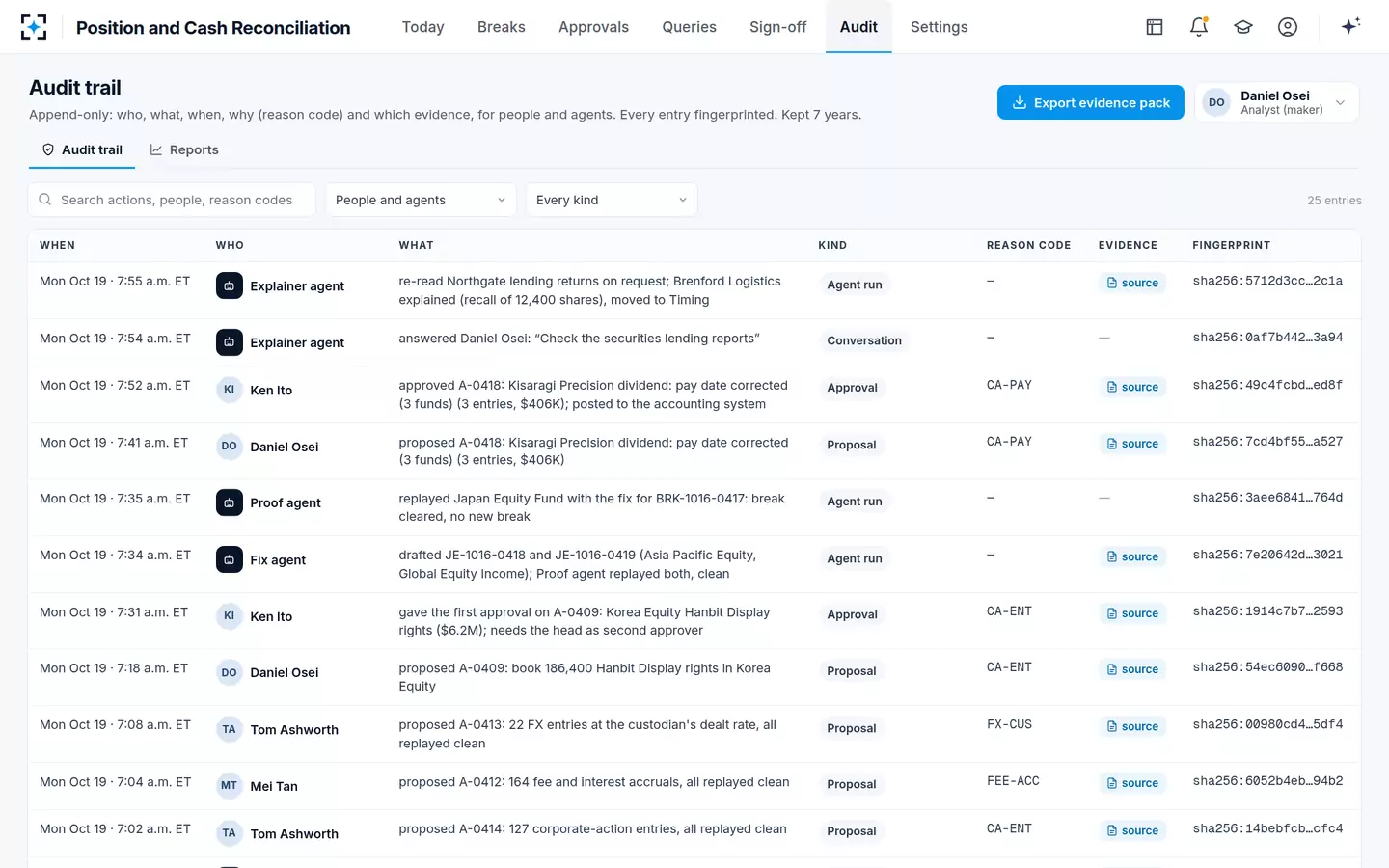
Two other features match CASS expectations. Every reconciliation in the sample is entity-specific by construction, because breaks are matched and signed fund by fund and account by account, never at umbrella level. And no single person both prepares and approves: the analyst proposes, a different person approves, and internal audit reads the trail without being able to change it, which is close to the independence the FCA asks for "whenever possible". The agents' own limits, and why each one exists, are set out in what an AI reconciliation agent may and may not do and on the Position and Cash Reconciliation page.
Questions people ask
What is the internal custody reconciliation method?
It is one of the two ways to perform the internal custody record check: a comparison, as at the check date, of the firm's aggregate safe custody asset record with its client-specific safe custody asset record. Only a firm that keeps both records separately, in a form that can be compared, may use it (CASS 6.6.16R and 6.6.17R).
Can a firm use custodian statements in its internal custody record check?
No. CASS 6.6.14R requires the check to use internal records only, and the guidance says it must not be based on any records obtained from third parties such as custodians or registrars. Custodian data belongs in the external custody reconciliation.
Does a CASS reconciliation have to be done every day?
No; the rules set a maximum of one month between internal checks and between external reconciliations. The FCA describes a daily external reconciliation as best practice for assets held at a central securities depository that can report daily, and a firm that already reconciles every business day is spared the annual frequency review.
Who should perform the internal custody record check?
Whenever possible, someone independent of producing or maintaining the records being checked, under CASS 6.6.47G. The firm's procedures, which SYSC 6.1.1R requires, should name who performs it, how discrepancies are resolved and how shortfalls are treated.
When must a firm tell the FCA about a custody record problem?
Without delay when its records of client assets are materially out of date, inaccurate or invalid, or when it will be unable, or materially fails, to perform an internal check, an external reconciliation or the shortfall cover the rules require (CASS 6.6.57R).
Does CASS 6 apply to a fund's depositary?
A firm acting as trustee or depositary of an authorised fund is covered by parts of CASS 6, and for an authorised AIF the FCA's guidance expects the depositary to reconcile with any delegate holding the fund's assets at least monthly (CASS 6.6.43G). EU depositaries have their own rules: daily cash-flow reconciliation where cash moves daily, under Delegated Regulation (EU) 2016/438 for UCITS and 231/2013 for alternative investment funds.