The corporate actions processing life cycle has five stages: the issuer announces an event, the announcement is turned into one trusted set of terms, the holders entitled on the record date are identified, any election is made and instructed before the deadline, and the proceeds are paid and checked. Each event runs on two clocks at once. The issuer's clock is set by law and market standards: ten days' notice before the record date in the US, same-day transmission along the custody chain in the EU. The fund's clock is its own, and it always runs out first, because the portfolio manager must decide before the custodian's cut-off. Botminds' Corporate Actions Processing is an agentic solution built to give the fund back time on that second clock: its agents read and reconcile every notice overnight, value each option and work back every deadline, while people approve, elect and release.
One event from the solution's sample data runs through this guide: a rights-based scrip dividend from Aldeora Energia SA, a fictional Spanish issuer, held in three accounts at Quillfield Capital, a fictional asset manager. Rules and market standards are linked where they appear.
One elective event, two clocks: the market's dates and the fund's deadline
- Provisional terms14–22 Oct
- Final terms22–27 Oct
- Election periodto 2 Nov
- Cash paid5 Nov
- Shares delivered12 Nov
- No final terms8 days
- Decideto 28 Oct, 13:00
- Custodian bufferto 2 Nov
- Wait for proceedsto 12 Nov
How do corporate actions work, from announcement to payment?
A corporate action is an event decided by the issuer that changes what a holder owns or receives. ESMA's definition lists "dividend/interest distributions, redemptions and reorganisations" and says participation "may be optional ... or mandatory". The information starts with the issuer, which should inform its central securities depository "as soon as it has been publicly announced"; it "must then reach the end investor through the chain of CSDs and relevant intermediaries" (ESMA, T+1 assessment report, November 2024, §73).
For an asset manager, the chain has at least four links before the portfolio manager: the issuer or its agent, the depository, the global custodian with its local sub-custodians, and the data vendors that publish their own reading of the announcement in parallel. Every link adds a copy of the terms, and every copy can differ. The life cycle below is the work of turning those copies into one decision and one payment, on time.
Five stages of the corporate actions life cycle, and who does what in Corporate Actions Processing
Agent
Announcement capturedThe Intake agent reads vendor feeds, custodian MT564 and seev.031 messages, emails, portal PDFs and the issuer's own notice in its language, and links the event to the security.
Never: drops a notice it cannot read; it queues it for a person
Agent
Golden record builtThe Scrub agent compares every field across sources, takes each economic term from the most authoritative one and cites it. Any disagreement on an economic field goes to a person.
A person decides
Golden record approvedAn analyst prepares it; a senior analyst or team lead approves it. Nobody approves their own work.
Agent
Entitlement and optionsThe Holdings agent finds every affected account at the record date, including failed trades and loans; the Election agent values each option per account; the Deadline agent works back the internal cut-off.
A person decides
Election and releaseThe portfolio manager elects per account with a reason; one person submits the drafted instruction and another releases it.
Agent
Payment checkedThe Confirmation agent matches acknowledgments and payments against what was sent and expected, and drafts fixes and client notices.
Never: posts to accounting, writes off or sends a client notice
Stage 1, announcement: how much notice must a US issuer give?
A US issuer must give notice of a dividend or other distribution, a stock split or reverse split, or a rights offering no later than ten days before the record date. SEC Rule 10b-17 makes a failure to do so a "manipulative or deceptive device", and the notice goes to FINRA (the rule's text still names its predecessor, the National Association of Securities Dealers). Rights offerings where ten days is impractical may give notice on or before the record date (17 CFR 240.10b-17).
The rule also lists what the notice must contain, and that list is the first draft of a golden record: the title of the security, the declaration date, the record date, the payment or delivery date, the amount or rate per share, the method of settling fractions, and any condition or government approval the payment depends on. An issuer whose shares are listed may give notice through its exchange's procedures instead, if they are "substantially comparable".
For securities that trade over the counter, FINRA processes the notices under its Rule 6490 and charges for lateness on a sliding scale: USD 200 for a timely notification, USD 1,000 if it arrives at least five calendar days before the corporate action date, USD 2,000 at least one calendar day before, and USD 5,000 on or after it (FINRA Rule 6490(c)). The fee table says what the timing means in practice: late notices are common enough to price.
How fast must EU intermediaries pass on a corporate event?
For shares within the Shareholder Rights Directive, the issuer must give intermediaries the information "no later than on the same business day on which it announces the corporate event", and each intermediary must pass it to the next "without delay and no later than by the close of the same business day as it received the information". Information received after 16:00 must go on by 10:00 the next business day (Implementing Regulation (EU) 2018/1212, Art. 9).
The legal clock on announcements and deadlines
10days
notice before the record date for US dividends, splits and rights offerings (Rule 10b-17)
16:00
EU cut-off: information received later goes on by 10:00 next business day (2018/1212 Art. 9)
3days
earliest a last intermediary may set a shareholder deadline, in business days before the issuer deadline (Art. 9(4))
20days
minimum business days a US tender offer stays open (Rule 14e-1)
Two further duties are easy to miss. If positions change after the first transmission, intermediaries must send the information again to new shareholders "according to end of day positions on each business day, until the record date". And Article 8 sets the order the dates must follow: on an event with options, the last participation date and the buyer protection deadline "should precede, in this order, the issuer deadline". The annex of the same regulation lists the key dates a notice must carry, from the last participation date and the ex-date to the issuer deadline, stated in UTC.
Same-day transmission is the regulator's view of how long each hop should take, and it is short. A notice that takes a day per link through four links has used most of a week before anyone at the fund reads it. That is the gap the sample event shows: provisional terms had circulated for eight days and the final terms for six before the fund's deadline arrived.
Stage 2: one golden record from many notices
Before anyone can value an option, the terms must be settled. In the sample, four sources disagree: Data vendor A says 52 rights per new share, Data vendor B 55, and the custodian and the issuer 53. Vendor B is still carrying the provisional estimate from 14 October; vendor A's figure appears in no source at all. The issuer's final terms, filed with the Spanish regulator on 22 October, are the newest primary document, so the golden record takes 53 and cites the page.
This is the stage where time disappears unnoticed. A team that waits for vendors and custodians to agree before starting the valuation loses the days it most needs, and a team that trusts the first feed it sees inherits that feed's errors. Measuring corporate actions data providers' accuracy sets out how to decide, field by field, which source to believe.
Stage 3, entitlement: what are the ex-date, record date and payable date?
The record date is when entitlement is fixed: the European standards define it as the date on which rights are determined "based on the settled positions struck in the books of the issuer CSD or other first intermediary by book-entry at the close of its business". The ex-date is the first day the security trades without the right. The payment date, or payable date, is when the proceeds are due (AMI-SeCo T+1 guide, 2026).
The gap between ex-date and record date exists because of settlement. A buyer on the last day before the ex-date must have the trade settled by the record date to be on the books; so the ex-date sits one settlement cycle before the record date, less a day. ESMA puts it plainly: under T+2 the gap is one business day, and "In a T+1 environment, this will mean that 'ex-date' and 'record date' would be the same day" (ESMA, §75). The US already made that change: since 28 May 2024, FINRA's rule sets the ex-dividend date for ordinary distributions on the record date itself, if it is a business day (FINRA Regulatory Notice 24-04).
Key dates before and after T+1, as the European standards set them
| Event type | Key date rule under T+1 | What it means for the fund |
|---|---|---|
| Mandatory distribution | Ex-date on the same date as the record date; payment one day after the record date (KD1, KD2). | A purchase on the day before the ex-date must settle the next day to be on the books. Late settlement becomes a market claim. |
| Mandatory reorganisation | Last trading date one business day before the record date; payment one business day after (KD3, KD4). | Positions are fixed one day after trading in the old security stops. |
| Elective event | Guaranteed participation date at least one business day before the buyer protection deadline; payment one business day after the market deadline (KD5, KD7). | A buyer whose trade has not settled must send buyer protection by the deadline, at the latest 11:00 on the market deadline date (BP4). |
| Transition to T+1 | Avoid key dates between 4 and 15 October 2027; no ex-dates on Monday 11 October 2027. | Events announced for that fortnight need their dates checked by hand. |
Large distributions are the exception in the US. Where a distribution is worth 25% or more of the security, FINRA sets the ex-date on "the first business day following the payable date", so the right trades with the shares, carried by due bills, until it is paid (FINRA Rule 11140(b)(2)). Due bills and market claims covers that case and its European equivalent.
Stage 4: the election window and the guaranteed participation date
On an elective event, the guaranteed participation date is the "last date to buy the underlying security with the right attached to participate", the buyer protection deadline is the last moment a buyer still waiting for delivery can tell the seller which option it wants, and the market deadline is the issuer's or depository's deadline for instructions (AMI-SeCo T+1 guide, §2.3 and §6.1). Between those dates sits the election period, which the EU regulation says "should be sufficiently lengthy as to allow the shareholders and intermediaries reasonable time to react" (2018/1212, Art. 8(2)(c)).
The fund's deadline is not the market's. Each custodian sets a response deadline earlier than the market deadline, and for EU shares the last intermediary may not set it more than three business days before the issuer's deadline or the record date (Art. 9(4); the rule's text is quoted in mandatory vs voluntary corporate actions). The fund then sets its own internal cut-off earlier again, so that operations can instruct after the portfolio manager decides. In the sample, the market deadline is Monday 2 November, the custodian's cut-off Wednesday 28 October at 15:00 London, three business days earlier, and the internal cut-off 13:00 the same day.
Tender offers in the US run on their own clock: at least twenty business days, at least ten more after any change in price or the share sought, and an extension announced by 9:00 a.m. Eastern time on the business day after the scheduled expiry (Rule 14e-1). For some voluntary reorganisations the US depository has long offered a "cover/protect" process; the SEC's T+1 release describes it as letting participants allow investors "to make or change their final elections until the end of an offer's expiration date", with later delivery where the offer allows guaranteed delivery (SEC, T+1 adopting release, 2023, note 465).
The morning screen: what needs a person, ranked by the cut-off that comes first
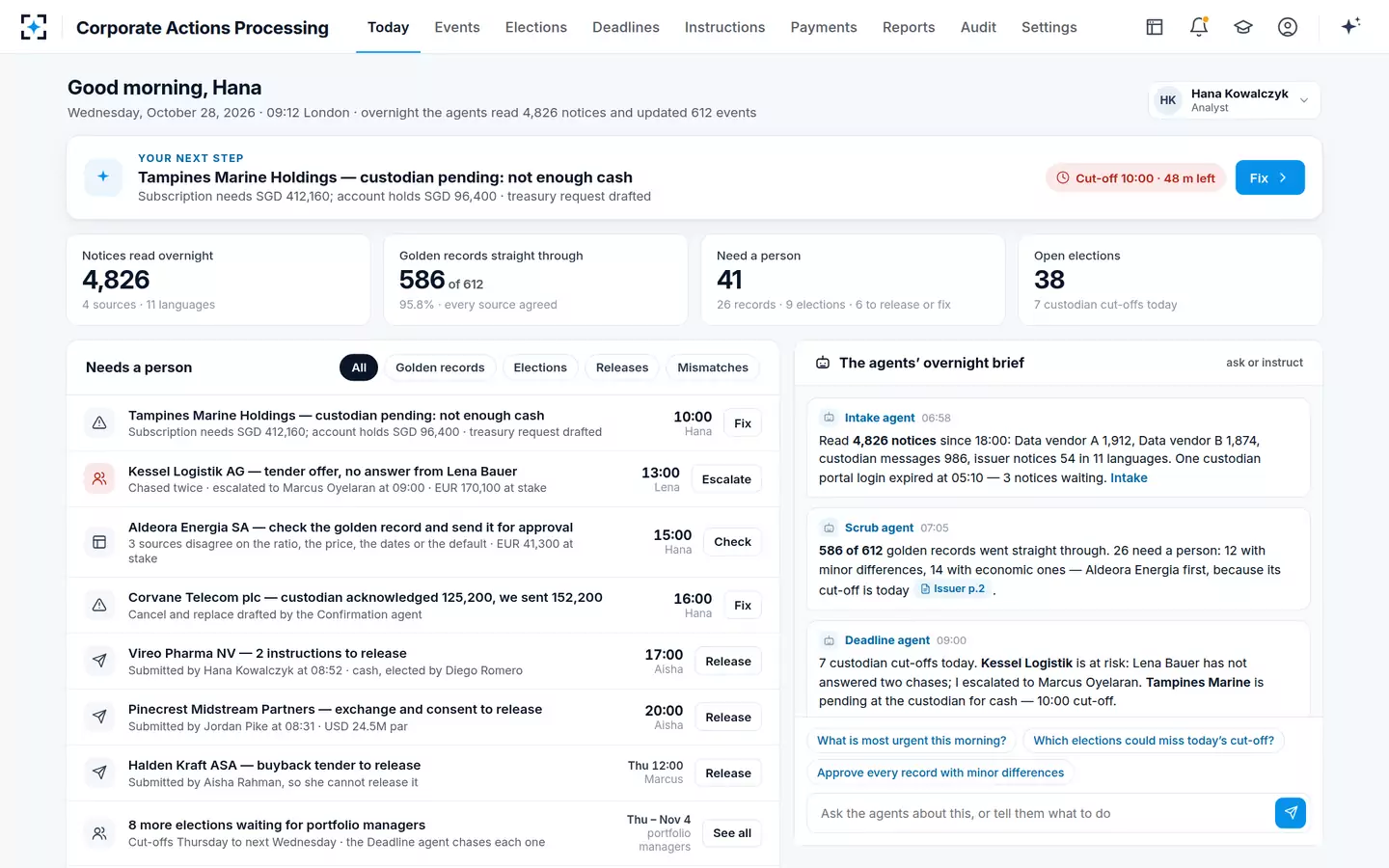
Stage 5: instruction, payment and the checks after
Once the portfolio manager has decided, the instruction goes to each custodian, as an MT565 or its ISO 20022 equivalent seev.033, and the custodian acknowledges it. The work is not finished there. After the payment date, EU intermediaries must pass back "the outcomes based on the shareholder action in a corporate event with options, the entitled or settled positions, any proceeds received, as well as the outcomes regarding any market claims" (2018/1212, Art. 8(3)). That is the information a fund needs to prove it received what it chose.
In the sample, the portfolio manager elects new shares for all three accounts at 11:20. Four instructions are drafted, three for new shares and one buyer protection instruction for 40,000 rights on a purchase that failed to settle by the record date. One analyst submits and a senior analyst releases at 11:31; both custodians acknowledge at 11:46, 3 hours 14 minutes before the cut-off. The expected entitlement is 64,936 new shares on 12 November, with 92 residual rights sold in the market.
After the election: the entitlement, the claim and the posting, prepared before the payment
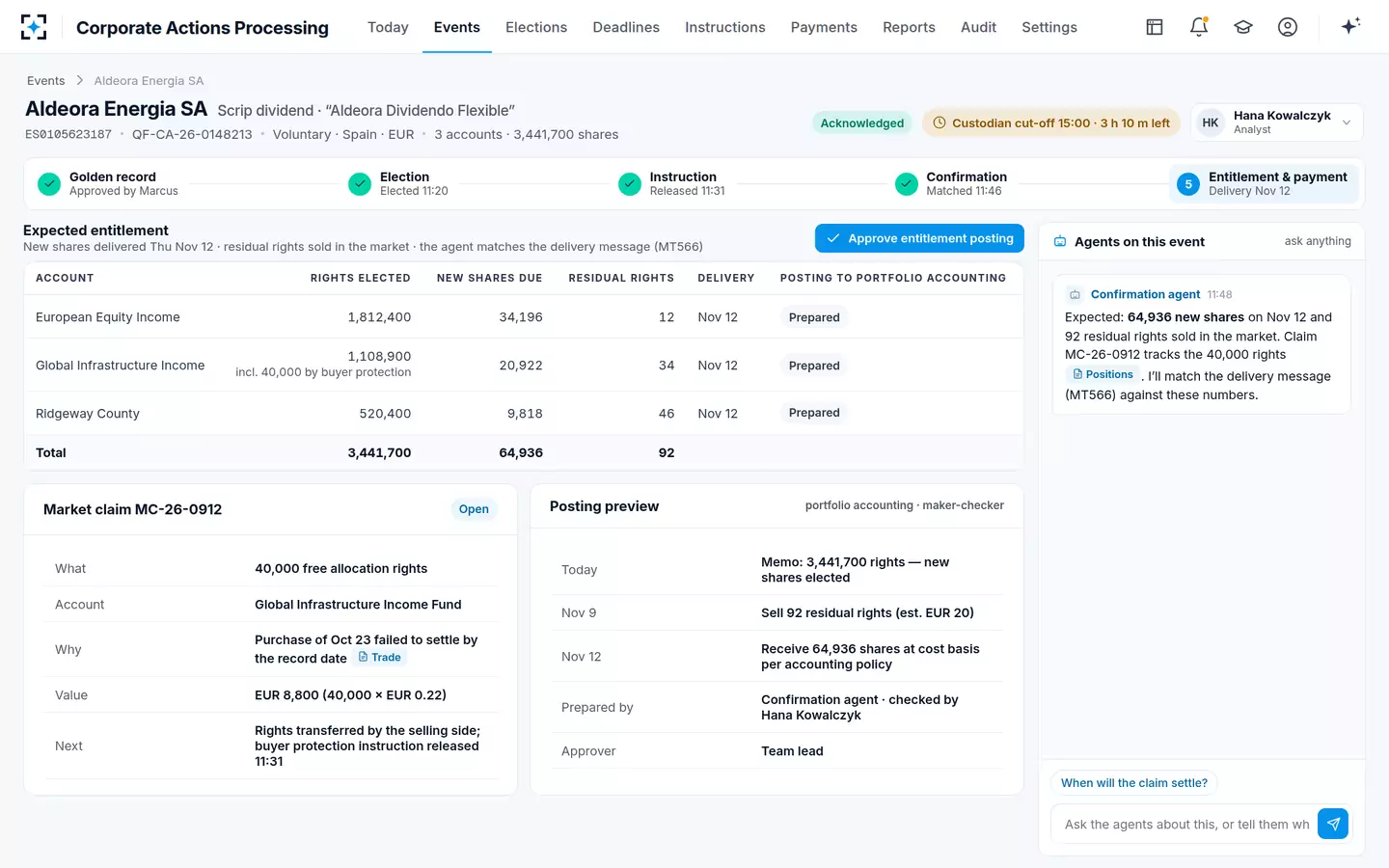
Where does the corporate actions life cycle break under T+1?
T+1 breaks the life cycle wherever a day used to absorb a delay. With the ex-date and the record date on the same day, any purchase made on the day before the ex-date that does not settle the next morning lands on the wrong books, and the proceeds have to be claimed back. The buyer protection deadline moves closer to the market deadline. And the time from final terms to the custodian's cut-off, already only days, has to hold the reading, checking, valuing and deciding that used to spill into a spare day.
The dates are fixed. The US moved on 28 May 2024. The EU moves on 11 October 2027 under Regulation (EU) 2025/2075, and the UK government has committed to legislate for the same date, with the statutory instrument still in draft (HM Treasury, accelerated settlement). Securities traded in both markets suffer most in between: ESMA notes that the US move "has created a misalignment of the ex-dates of corporate events of securities listed or traded in both jurisdictions", handled differently by different depositories (ESMA, §78).
The response that works is to move the fund's own clock earlier, not to ask for longer deadlines. That means reading every notice the night it arrives, settling the golden record by the morning and putting each option's value in front of the portfolio manager the day final terms are published. In the sample's reports, the median time a portfolio manager had to decide, from final terms to the custodian's cut-off, rose from 1.4 days to 3.8 days over six months, on fictional data; the solution's design target is three days or more. Planning a corporate actions automation go-live sets out the order in which to get there.
Who owns each deadline: a working map for the operations team
Every date in the life cycle has an owner, and most of them sit outside the fund. The issuer owns the declaration, the record date and the market deadline. The depository owns the event reference, the default option it passes down and, in Europe, the market claims and transformations it creates for pending trades. The custodian owns its response deadline and its own default, which may differ from the issuer's. The fund owns only two dates, the internal cut-off and the portfolio manager's decision, and those are the two it can still move.
That is the practical case for working back from the custodian's cut-off rather than forward from the announcement. In Corporate Actions Processing the internal cut-off is a setting, two hours before the custodian's by default, and the Deadline agent reminds the named portfolio manager 24 hours and 3 hours before it, then escalates to the team lead, the head of asset servicing and the chief investment officer's office. The meetings and votes that run through the same chain are a separate process; proxy voting research covers them.
Questions people ask
What are the stages of corporate action processing?
Announcement, terms (one golden record from all the notices), entitlement at the record date, election and instruction for events with options, and payment with reconciliation of what was received. In the EU the first and last stages carry legal duties: same-day transmission of the event and reporting of outcomes after the payment date under Regulation 2018/1212.
What is the difference between record date and ex-date?
The record date fixes who is entitled, from settled positions at the close of business; the ex-date is the first trading day without the right. Under T+1 they fall on the same day for ordinary distributions, as FINRA's Rule 11140 has provided in the US since 28 May 2024.
Does every corporate action have a record date?
No. Tender offers and other voluntary reorganisations run to a market deadline instead, and some events have neither, such as a name change. The European collateral rulebook still asks issuer depositories to include the record date field in every notice, with the value "UKNW" when it is not yet known.
Who sets the corporate action response deadline?
The issuer or offeror sets the market deadline; each custodian sets its own response deadline before it; the fund sets an internal cut-off before that. For EU shares, a last intermediary may not ask for instructions more than three business days before the issuer deadline or record date.
What happens to a corporate action when a trade has not settled?
For a distribution, the depository or central counterparty creates a market claim moving the proceeds to the buyer. For a reorganisation, the pending trade is transformed into the new terms. For an elective event, the buyer can send buyer protection telling the seller which option it wants, before the buyer protection deadline.