AI can handle most of the work in voluntary corporate actions: reading every notice in any language, reconciling vendors, custodians and the issuer into one set of terms, finding every affected account, valuing each option for each fund and chasing the portfolio manager before the custodian's cut-off. It should not make the election. The agent that matters most is therefore the one that prepares the decision, and the test of any AI for voluntary corporate actions is whether that agent puts a valued, cited choice in front of a person early enough, and stops there. Botminds' Corporate Actions Processing is an agentic solution built on that line: seven agents read, scrub, value, chase, instruct and check every event, and people approve, elect and release.
The walk-through uses the solution's sample data: Quillfield Capital, a fictional asset manager, and an Aldeora Energia SA scrip dividend held in three accounts. Regulators' statements on AI are linked where they appear.
Can AI handle voluntary corporate actions?
Yes, for everything except the decision and the signatures. A voluntary or elective event is mostly reading and arithmetic under time pressure: several versions of the same terms, a position spread across custodians, a price that moves, and a deadline that comes days before the market's. Those are tasks agents do well. What they must not do is choose for the fund, release an instruction or let a default apply without a named person deciding.
The regulators' own data shows where firms already draw the line. In the Bank of England and FCA survey of UK financial services, operations and IT was the largest area of AI use, at about 22% of reported use cases; 55% of use cases had some degree of automated decision-making, but only 2% were fully autonomous (Bank of England and FCA, Artificial intelligence in UK financial services, November 2024). The SEC's examinations division has said it will examine firms' policies for monitoring what it calls "super intelligence (SI)", including its use in back-office operations (SEC, Fiscal Year 2027 Examination Priorities).
Where AI in financial operations stands, in regulators' own numbers
22%
of AI use cases in UK financial services are in operations and IT, the largest area
55%
of use cases have some degree of automated decision-making
2%
of use cases make decisions fully autonomously
FY2027
the SEC examines policies for monitoring "super intelligence" in back-office operations
Which agent makes an election? None, it drafts
No agent makes the election. In Corporate Actions Processing the Election agent values every option for every account and recommends one; only the fund's portfolio manager, or a delegate named in the fund's procedures, elects, per account and with a reason. That is not only a design preference. In the EU, an intermediary that exercises a shareholder's rights does so "upon the explicit authorisation and instruction of the shareholder" (Directive (EU) 2017/828, Art. 3c); an agent's output is neither.
Inside the Election agent: inputs, steps, and the one thing it never does
Agent
Start from the approved golden recordTakes the terms only after a second person has approved them: in the sample, 53 rights per new share, EUR 0.208 per right in cash, the issuer's and the custodian's defaults.
Agent
Take positions per accountUses the Holdings agent's record-date positions, including a 40,000-share purchase that failed to settle and needs buyer protection.
Agent
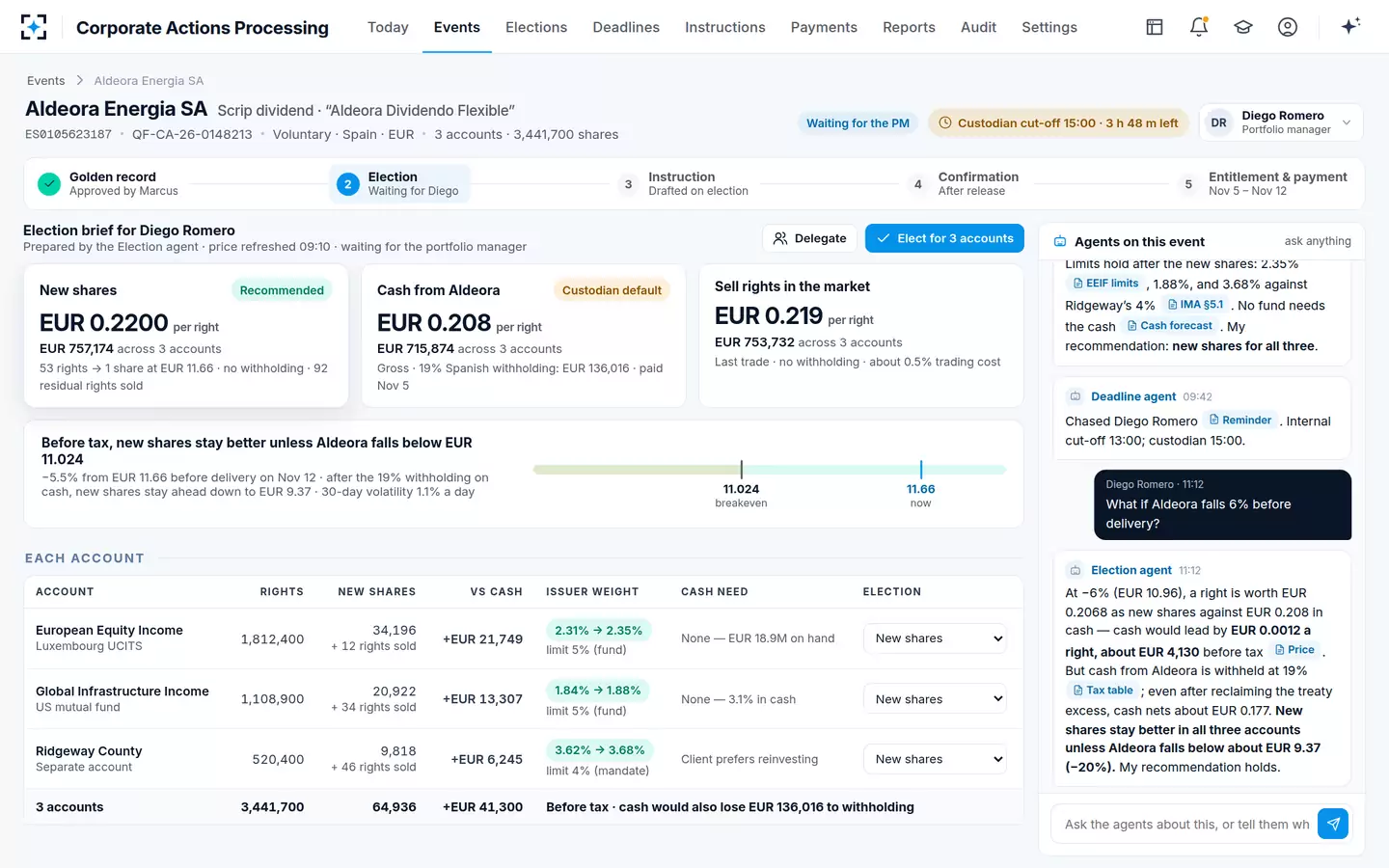
Value every option, after tax and limitsNew shares at EUR 0.2200 a right, cash at EUR 0.208 with 19% withheld in the sample, rights sold at EUR 0.219; per account, against 5% fund limits, a 4% mandate limit and cash needs.
Agent
Recommend and answer what-ifsNew shares stay better before tax unless the share falls below EUR 11.024, and after withholding down to about EUR 9.37.
Never: elects, applies a default or instructs
A person decides
The portfolio manager electsPer account, with a reason code, after asking what happens if the share falls 6% before delivery.
The design choice inside the agent is what it shows, not what it decides. A portfolio manager who receives the notice, or even a summary of it, still has to do the valuation. A portfolio manager who receives each option valued for each of his funds, after tax, with the breakeven price and the limits, can decide in minutes and can ask a follow-up question in plain words. In the sample, Diego Romero asks what happens if Aldeora falls 6% before delivery; the agent answers that cash would then lead by about EUR 4,130 before tax, but that after withholding new shares still win down to about EUR 9.37, and he elects new shares for all three accounts at 11:20.
The election screen: every option valued for every account, and a what-if answered
How does an election agent know which funds hold the security?
It asks the books, not the notices. Custodian notices state each account's eligible balance as the custodian sees it, which misses the fund's own pending trades. In Corporate Actions Processing the Holdings agent compares the settled position at the record date with the traded position, pending and failed trades and shares on loan, for every account in every fund. In the sample it finds three accounts holding 3,441,700 shares and one purchase of 40,000 shares, made on 23 October, that failed to settle by the record date, so the rights went to the seller.
The agent turns that gap into proposals, not actions: a buyer protection instruction electing new shares for the 40,000 rights, and a market claim to track them until they arrive. It never changes a position or recalls a loan. Due bills, market claims and buyer protection explains the mechanisms it is choosing between.
How does it chase the portfolio manager before the deadline?
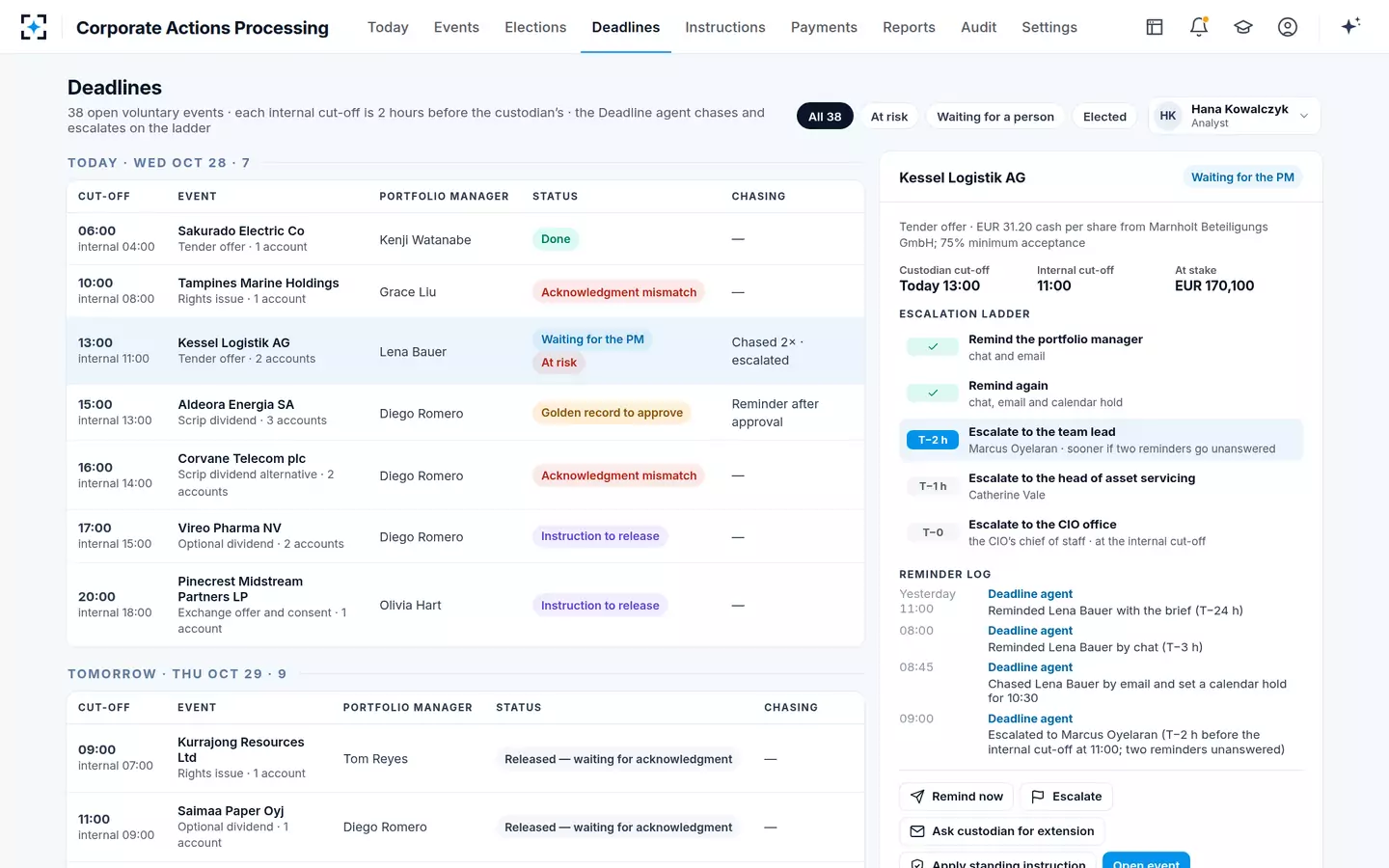
It works back from the custodian's cut-off, not forward from the announcement. The Deadline agent sets an internal cut-off, two hours before each custodian's by default, reminds the named portfolio manager 24 hours and 3 hours before it, and then escalates: to the team lead two hours before, the head of asset servicing one hour before, and the chief investment officer's office at the internal cut-off itself, sooner if two reminders go unanswered. It never instructs and never lets a default apply silently.
One election's morning, minute by minute, against a 15:00 custodian cut-off
- Golden record approvedto 09:41
- Valued, waiting for the PMto 11:12
- Elect, release, confirmto 11:46
The same ladder runs on every open event at once. On the sample morning, the Deadlines screen lists 38 open voluntary events, seven with a custodian cut-off that day. Kessel Logistik's tender offer is the one at risk: Lena Bauer, its portfolio manager, did not answer a reminder the day before, a chat at 08:00 or an email at 08:45, so the agent escalated to the team lead at 09:00, two hours before the 11:00 internal cut-off, with EUR 170,100 at stake.
Every cut-off worked back, every chase logged with who, when and how
What does the AI do when two notices disagree?
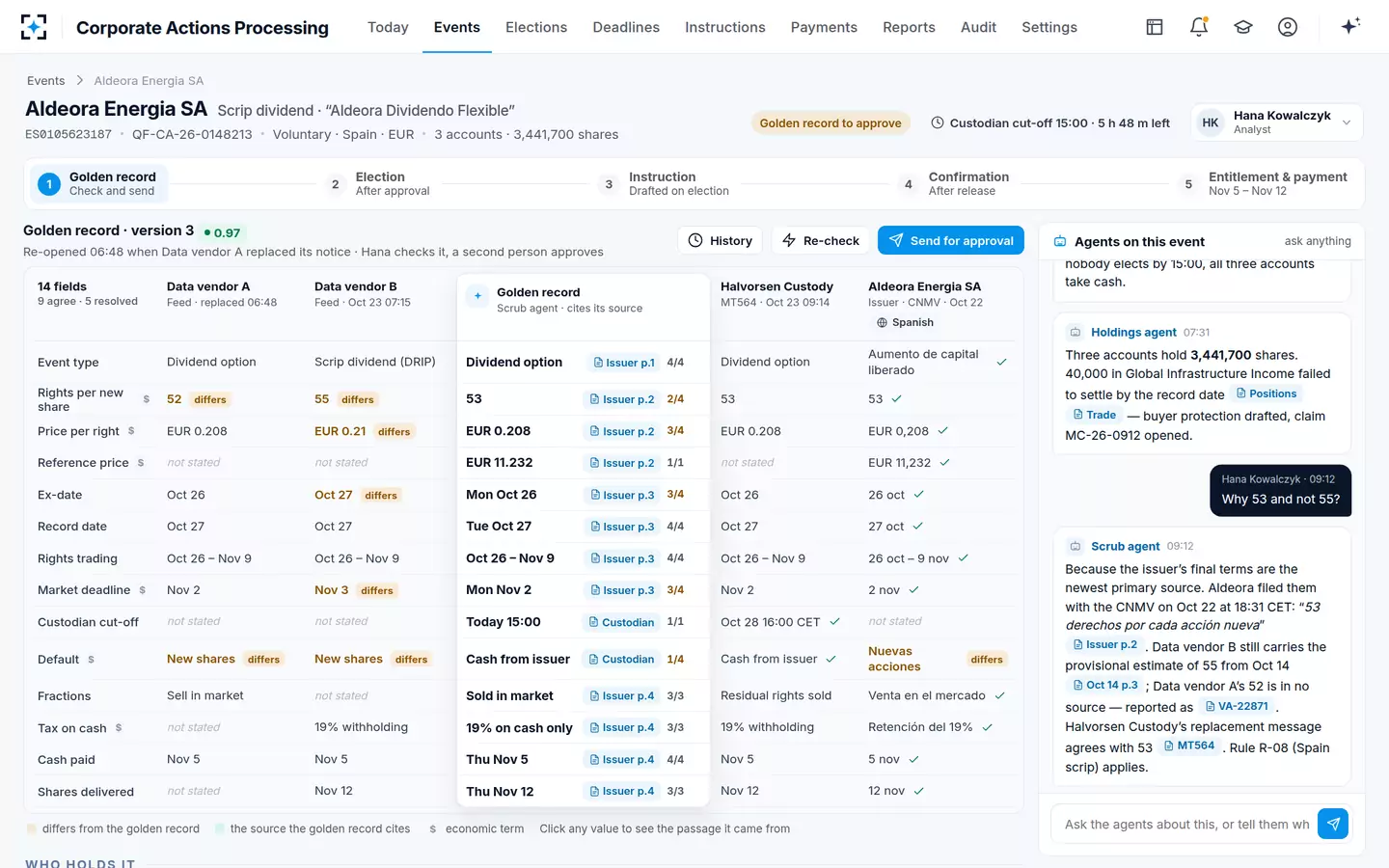
It escalates the disagreement, with its reasons, rather than resolving it silently. In Corporate Actions Processing the Scrub agent compares each field across both vendors, every custodian's notice and the issuer's own document, applies the firm's source rules and says why it trusts the source it chose. Any disagreement on an economic field goes to a person, and the person who prepared the golden record cannot approve it.
Reading the issuer's own document matters more than it seems, especially across languages. In Finnish rights issues, Rantapuska and Knüpfer found that the investors who left the most money on the table included those "who know neither of the official languages in Finland" (Review of Finance, 2008). An agent that reads the Spanish, Japanese or Korean original, and shows the passage beside an English translation with the figures taken from the original, removes that disadvantage from the asset servicing desk.
Ask the agent why: every statement links to the passage it came from
What is logged, and why examiners will ask
Everything an agent does should be logged as if an examiner will read it, because one may. FINRA's 2026 oversight report lists the risks of AI agents in terms an asset servicing head will recognise: agents acting without human validation and approval, agents acting beyond the scope and authority their user intended, multi-step reasoning that is hard to trace or explain, and general-purpose agents lacking the domain knowledge for industry-specific tasks (FINRA, 2026 Annual Regulatory Oversight Report). ESMA warned in 2024 of the risk that firms and clients over-rely on AI and neglect human judgement (ESMA, public statement on AI and investment services, May 2024).
The answer to each risk is a control that leaves evidence. In Corporate Actions Processing every action by a person or an agent is logged with who, what, when, why, the evidence and a fingerprint, in an append-only trail kept seven years in the sample configuration; the agent and model versions used are part of the export. A new agent version is evaluated on 1,200 historical events before it runs live, every change to rules or agents is proposed by one person and approved by another, and an agent can be rolled back in one step.
What to look for in AI for voluntary corporate actions
The questions that separate a useful election agent from a risky one are about limits and evidence, not intelligence. A buyer should ask for each of them to be shown on the firm's own past events, not on a demonstration set.
Eight things to test before trusting AI with corporate action elections
- It cannot elect
Ask to see the permission model: which roles can elect, release and apply a standing instruction, and that no agent holds any of them.
- It cites every value
Every ratio, price, date and default links to the passage, message or ticket it came from, in the original language.
- It says when it cannot value an option
An option it cannot price is shown as such, not filled with a guess.
- It values per account, after tax
Different domiciles, withholding and limits produce different answers for different funds holding the same security.
- It finds the positions the custodian cannot see
Pending and failed trades and shares on loan, turned into buyer protection or claims for a person to approve.
- It works back from the custodian's cut-off
Internal cut-offs, reminders and escalations by name, with every chase logged.
- It replays the past
A shadow run on last quarter's events, compared field by field with what the team actually did.
- It leaves an evidence file
One export per event, day or quarter: notices, golden record versions, election, instructions, acknowledgments, payments and agent versions.
Where AI for voluntary corporate actions does not fit
An election agent values options on the inputs it is given, and its limits are the limits of those inputs. It does not know the portfolio manager's view of the issuer, so on a tender offer it can value tendering against holding at today's price but cannot judge whether the offer undervalues the company. It does not know a fund's full tax position beyond the rates and treaties it is configured with, and it does not know a client's preference unless the mandate or a note records it; in the sample, the election screen shows Ridgeway County's preference for reinvesting only because it is held with the account's details. When an input is missing, the agent should say the option cannot be valued rather than fill the gap.
It also does not replace the custodian or the issuer's agent. The custodian still announces, accepts instructions and pays; the agent works on the fund's side of that relationship, reading what arrives and preparing what goes back. And it does not decide whether to take part in a takeover, oppose a merger or join litigation: those are investment and legal decisions that belong to people with the authority to make them. A corporate actions automation go-live plan sets out how to introduce agents event type by event type, and the scrip dividend guide works the valuation in full. The screens are in Corporate Actions Processing.
Questions people ask
Is AI allowed to make corporate action elections for a fund?
No rule names AI, but the election is the fund's decision and is exercised on the holder's instruction; in the EU, intermediaries exercise rights "upon the explicit authorisation and instruction of the shareholder". A firm that let an agent elect would have to show who authorised each choice, which is why the agent should recommend and a named person elect.
Can AI read corporate action notices in other languages?
Yes. In the sample day, the agents read 4,826 notices overnight, including 54 issuer notices in 11 languages, and show each figure in the original beside an English translation. The figures are always taken from the original document, never from the translation.
How do you test an AI agent on corporate actions before go-live?
Replay it on your own past events and compare its golden records and recommendations with what your team did. In Corporate Actions Processing, a new agent version is evaluated on 1,200 historical events before it works live, and first-time setup includes a shadow run.
What is the difference between a rules engine and an AI agent for corporate actions?
A rules engine applies fixed precedence to structured feeds; an agent can also read unstructured notices, explain its choice and value options. In the solution's sample reports, golden records going straight through rose from 71.2% in May, with a rules engine only, to 95.1% in October with agents, on fictional data.
Does AI replace the custodian's corporate actions service?
No. The custodian still announces, collects instructions and pays. The agents work on the fund's side of that relationship: reading what every custodian sends, checking it against the issuer, preparing the fund's decision and checking what comes back.