Corporate actions data providers sell structured announcements of dividends, splits, mergers, tender offers and every other corporate event, compiled from issuers, exchanges, depositories and agents, so that a fund's systems can load them before anyone reads the issuer's notice. How accurate they are is the question every buyer asks and no one answers in public: no regulator or independent study publishes field-level error rates for corporate actions feeds. The answer has to be measured, per field and per event type, against the one document each field copies, the issuer's own. Botminds' Corporate Actions Processing is an agentic solution that does that measurement as a by-product of daily work: its Scrub agent builds one golden record per event from every vendor, custodian and issuer source, cites the source of each field, and keeps a score of how often each source was right.
The figures for individual sources below are the solution's sample data for Quillfield Capital, a fictional asset manager, with its two vendors called Data vendor A and Data vendor B. The findings on market-wide data quality come from the European Central Bank's market-standards group and EU regulators.
How accurate is corporate actions data?
Nobody knows market-wide, and the problem starts upstream of the providers. The ECB's Advisory Group on Market Infrastructures for Securities and Collateral (AMI-SeCo) describes "the lack of a single, trusted and fully verified source of definitive information" on securities as "an overarching barrier in asset servicing", and notes that "Different suppliers of financial data to the European markets also have their own variations in how CA-related information is reported and distributed" (AMI-SeCo, Remaining barriers to integration in securities post-trade services, September 2025, Barrier 8).
The same group's annual monitoring shows how often the source data itself is wrong in form. In the 2025 exercise, two of 40 markets were fully compliant with the European market standards for corporate actions, and the group found "Widespread issues of non-compliance by investment funds regarding the announcement of the key dates of a corporate action", including dates reported in the wrong sequence (AMI-SeCo, Corporate Events Compliance Report, December 2025). A provider that faithfully copies a non-compliant announcement delivers accurate data about a defective event.
The state of corporate event data at the source, in Europe
2of 40
markets fully compliant with the European corporate actions standards in 2025
1of 28
markets fully compliant with the T2S corporate actions standards
Same day
by when an EU issuer must give intermediaries the information about a corporate event
None
of the regulators' and independent studies we found publishes field-level error rates for corporate actions feeds
Why no one publishes a corporate actions data error rate
An error rate needs a definition of the right answer, and the market does not agree on one. AMI-SeCo observes that market players perceive data from "numbering agencies, CSDs, trading venues and data vendors, as having varying degrees of authority", and that which source counts as authoritative "may vary" by local practice. Providers compete on coverage and speed; depositories are measured on compliance with standards; issuers are measured, in the EU, on timeliness. No party is measured on whether a given ratio, on a given day, matched the issuer's document.
That leaves each fund to measure for itself, which is less burdensome than it sounds, because a fund that reconciles sources daily already has the data. Every time two sources disagree and a person settles the field against the issuer's document, the result says which source was right. Counting those results by source, field, market and event type is an accuracy measurement. The only discipline needed is to log each resolution with its reason, rather than overwriting the field.
Which corporate actions data fields matter most?
The fields that matter most are the ones that change what the fund receives or when it must act: the event and participation type, the ratio or rate, the price and currency, the key dates, the options and the default, and the deadlines. The European notice standard lists the same core set as the minimum information an EU intermediary must pass on: event identifier and type, ISIN, key dates from the last participation date to the payment date, and the options available (Implementing Regulation (EU) 2018/1212, Annex, Table 8).
Weight them by consequence, not by count. A misspelled issuer name costs nothing; a ratio off by one costs the difference across every position; a market deadline a day late can cost the whole election. The European collateral rulebook singles out three fields as critical: if the event type, the participation type or the security identifier changes, the old event must be cancelled and a new one started (AMI-SeCo SCoRE corporate actions rulebook, 2019). Those three, plus the economic terms and the dates, are the fields to score.
What is a golden record in corporate actions?
A golden record is one version of an event's terms, built from all available sources, in which each field carries the value from the most authoritative source and says which source that was. Regulators and market bodies have asked for the upstream version of the same thing. In 2023 ESMA and the EBA reported that a harmonised obligation on issuers to give their depository a "golden operational record" in machine-readable form "with all the information necessary to initiate any corporate event" was "largely indicated as the first measure to adopt" (ESMA and EBA, report on SRD2 implementation, July 2023, §101).
AMI-SeCo has since proposed that issuers be required to provide complete corporate event data to their depository "using the ISO 20022 standard as soon as such information becomes available", and that the depository pass it on without delay (AMI-SeCo, Facilitating the exercise of investor rights, June 2026, Measures 3 and 4). Until something like that is law, the golden record is assembled downstream, by each fund or its servicer, from copies, the same discipline a security master applies to instrument terms (see golden copy).
What happens when the custodian and the vendor disagree?
Each source is authoritative for something different, and a golden record should take each field from the party that decides it. The issuer decides the economic terms. The custodian decides its own response deadline, its own default for the account and the eligible balance on its books. The vendor decides nothing; it is fast, structured and broad, and it copies. When a vendor and a custodian disagree on a ratio, the issuer's document settles it; when they disagree on the deadline, the custodian's message does.
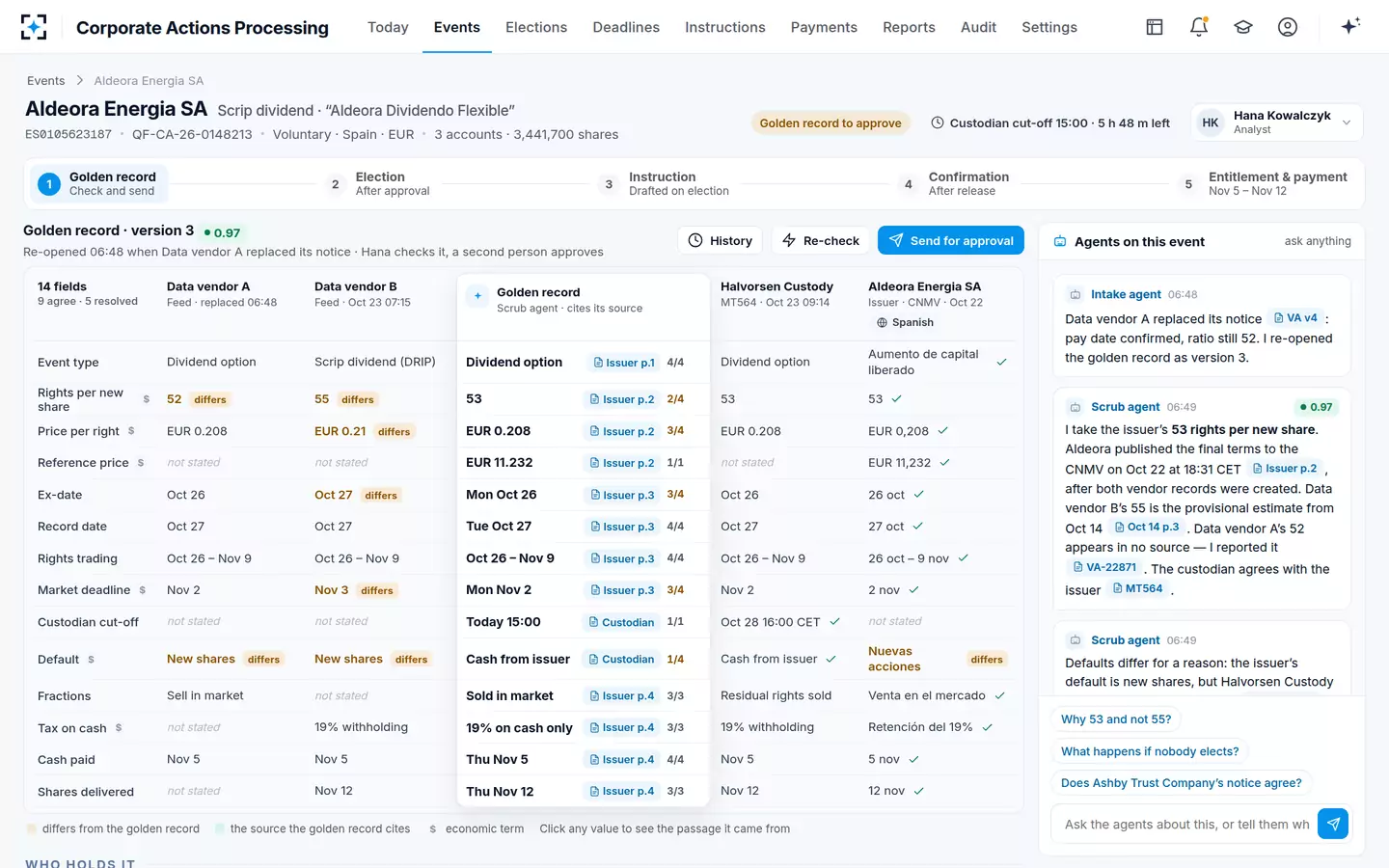
The sample event shows each kind of disagreement. On Aldeora Energia's scrip dividend, the custodian and the issuer agree on 53 rights per new share; Data vendor B still carries the provisional estimate of 55 from 14 October; Data vendor A's 52 appears in no source and is reported back to the vendor as ticket VA-22871. On the default, the issuer says new shares and the custodian says cash, and both are right about different things: the golden record takes the custodian's default because it is the custodian that will apply it to the fund's accounts.
The golden record: four sources, one value per field, each citing its source
How to score corporate actions data accuracy per field and per event type
Score every source on every field it supplied, against the value finally confirmed from the authoritative source, at the time the fund used it. That last condition is the one most scorecards miss: a vendor that corrects a ratio after the custodian's cut-off was wrong when it mattered, however clean its data looks a week later.
A corporate actions data scorecard: what to measure, per source
| Measure | How to compute it | Cut it by | Why it matters |
|---|---|---|---|
| Field accuracy | Fields matching the confirmed value ÷ fields supplied, at the time of use | Field, market, event type | The core number; a single average hides the market where a source is weak. |
| Conflicts won | Disagreements where this source held the confirmed value | Field and market | Shows which source to trust first when sources split. |
| Staleness | Fields still on provisional terms after final terms were published | Market and event type | The commonest vendor error on scrip dividends and offers. |
| Timeliness | Hours from the issuer's publication to the source's first and corrected notice | Source and market | An accurate notice after the cut-off is no use. |
| Completeness | Required fields present ÷ required fields, using the EU minimum set as the list | Event type | Missing defaults and deadlines force a manual chase. |
| Errors reported and fixed | Tickets raised with the source and days to correction | Source | Evidence for the vendor review and the contract. |
Cut every measure by market and event type before averaging. In the sample quarter, Data vendor B is right on 96.2% of economic fields overall, but on Spanish scrip dividend ratios its accuracy is 91.4%, because it takes provisional terms; Data vendor A's weakest area is Japanese tender offer dates, at 95.0%. A single average would have hidden both, and both are precisely where the firm's source rules need a market override.
Economic fields right, by source, in one sample quarter
How to compare corporate actions data providers before you buy
Compare providers on your own past events, not on their coverage claims. Take a quarter of events your funds actually held, with the issuer's documents, and score each candidate's historical notices with the measures above. A provider that will not supply its notices as they stood at each point in time, including the provisional versions, cannot be scored on staleness or timeliness, and that is itself an answer.
Nine questions to put to any corporate actions data provider
- How do you mark provisional and final terms?
And how quickly does a field move from one to the other after the issuer publishes?
- Can you show the source of each field?
A link or reference to the issuer document, depository notice or exchange notice it came from.
- Do you keep every version of a notice?
With timestamps, so accuracy can be scored at the time of use, not after correction.
- How do you report the default option?
As a coded field on every event with options, as the European standards require of notices.
- Which markets and event types are weakest?
Ask for the provider's own error statistics by market and event type, and compare with yours.
- How do clients report errors, and how fast are they fixed?
A ticket reference and a correction time you can measure.
- Do you cover issuer documents in their original language?
Including national gazettes and regulator filings, not only English summaries.
- Do you deliver in ISO 20022 as well as your own format?
Mapped to the same fields your custodians send.
- What do you warrant, and what do you not?
The licence says who carries the cost of an error; read it before the feed drives an election.
The comparison with pricing is useful because the habit already exists. Under the SEC's fair value rule, a fund's valuation designee must oversee its pricing service providers, with a process to approve, monitor and evaluate each one and to challenge prices where appropriate (17 CFR 270.2a-5(a)(4)). No rule asks the same of corporate actions data, but the risk is similar: an outside source feeding numbers that become the fund's money.
Using the accuracy scores in a vendor review
Scores are only useful if they change something: the source rules, the contract or the provider. In Corporate Actions Processing the source rules are settings the firm owns, proposed by one person and approved by the head of asset servicing, and any change is replayed on last quarter's events before approval. The default order for economic terms is the issuer's primary document, then the custodian, then each vendor, with market overrides where the scores justify them, such as Spain's rights-based scrip dividends and Japanese tender offers.
The quarter's scores by source, ready for the vendor review
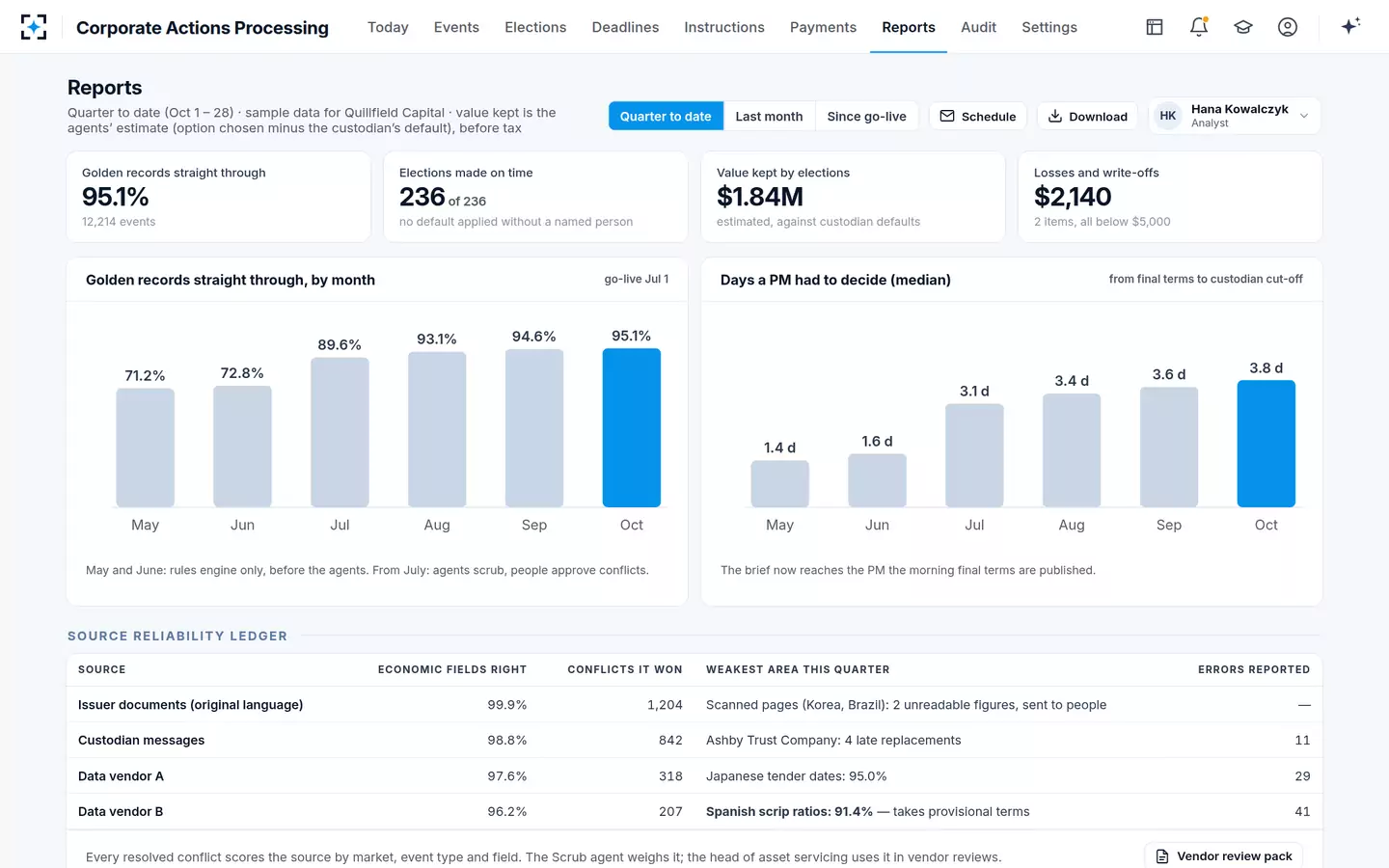
The same scores tell the agents which source to weigh. The Scrub agent uses them when sources disagree and explains its weighting in the golden record, and any disagreement on an economic field still goes to a person. The MT564 field map lists the fields to score and the source of truth for each, and the automation go-live plan uses a shadow run to produce the first quarter of scores before the agents work live. The screens are in Corporate Actions Processing.
Questions people ask
What is corporate actions data?
It is the structured record of each corporate event on a security: the event type, whether holders must choose, the ratio or rate, the price, the key dates, the options and default, and the deadlines. Funds receive it from data providers, custodians and depositories, and the issuer's own announcement is the document all of them copy.
What is the most reliable source of corporate action information?
For the economic terms, the issuer's own document; in the sample quarter, issuer documents were right on 99.9% of economic fields. European market bodies want the issuer's depository to become the single trusted source, fed by issuers in ISO 20022, but that is a proposal, not yet a requirement.
Should a fund use one corporate actions data provider or two?
Two providers give a disagreement signal that one cannot: where they differ, someone checks the issuer's document. The cost is more conflicts to resolve, which is manageable only if resolution is fast and every resolution is counted in the scorecard.
Is a corporate action's ex-date set by the issuer?
Not always. In the EU notice standard the record date and the payment date come from the issuer, but the ex-date and the last participation date come from the first intermediary, usually the issuer's depository. In the US, FINRA or the exchange sets the ex-date under its rules.
How often should corporate actions data accuracy be reviewed?
Continuously in operation and formally each quarter: each resolved conflict updates the scores, and a quarterly review decides whether any source rule, market override or contract term should change. Any change to source rules should be replayed on past events before it goes live.