A scrip dividend gives shareholders a choice: take the dividend in cash, or take new shares of the same company instead. For a fund, the election is a small piece of arithmetic, comparing what the shares are worth with the cash, after tax, for each account, but it comes with a default that applies to anyone who does not answer by the deadline. The cost of a missed or default election is the difference between the two alternatives multiplied by the position, and it can be computed for every scrip dividend the fund has ever held. Botminds' Corporate Actions Processing is an agentic solution that does the computation before the deadline rather than after: its Election agent values both alternatives for every account, after tax and against fund limits, and the portfolio manager elects.
The worked example is the solution's sample event: a rights-based scrip dividend from Aldeora Energia SA, a fictional Spanish issuer, held in three accounts by Quillfield Capital, a fictional asset manager. Rules and research are linked where they appear.
What is a scrip dividend?
A scrip dividend is an elective stock dividend: the company declares a dividend and lets each shareholder take it as new shares instead. Feito-Ruiz, Renneboog and Vansteenkiste describe them as dividends that "give investors the choice between receiving new shares or the equivalent value as a cash dividend", and found that UK firms paying them "are more likely to be financially constrained", with cash preservation "the most important corporate incentive" (Journal of Corporate Finance, 2020). The issuer keeps the cash that shareholders choose to leave in the company.
Designs differ in how the share alternative is priced. Where the shares offered are worth more than the cash, HM Revenue and Customs calls it "an enhanced stock dividend (or enhanced scrip dividend)" (HMRC Statement of Practice 4 (1994)). In the rights-based design used in the sample, each share receives a free allocation right; the holder can convert rights into new shares, sell them to the issuer at a fixed price, or sell them in the market. In the sample, the issuer's notice sets the fixed price as its reference price of EUR 11.232 divided by the number of rights needed plus one: EUR 0.208 a right.
How is a scrip dividend different from a stock dividend or a DRIP?
A scrip dividend involves a choice; a stock dividend does not; a dividend reinvestment plan buys existing shares instead of creating new ones. The industry's event codes keep the three apart. The European collateral rulebook codes the dividend option, where "Shareholders may choose to receive shares or cash", as mandatory with choice, and distinguishes it from reinvestment "as the company creates new share capital in exchange for the dividend rather than investing the dividend in the market"; a stock dividend paid in shares to everyone is coded mandatory (AMI-SeCo SCoRE corporate actions rulebook, 2019).
Scrip dividend vs stock dividend vs dividend reinvestment
| Scrip (dividend option) | Stock dividend | Dividend reinvestment plan | |
|---|---|---|---|
| Holder chooses? | Yes: cash or new shares | No: shares to every holder | Yes: cash or reinvested |
| Where the shares come from | New shares issued by the company | New shares issued by the company | Existing shares bought in the market |
| Event code and participation type | DVOP, mandatory with choice (CHOS) | DVSE, mandatory (MAND) | DRIP, mandatory with choice (CHOS) |
| If nobody answers | The default applies, set by the issuer and by each custodian | Nothing to answer | The default applies; check which option it is |
| What a fund must check | Value of shares against cash, after tax, per account | Ratio, fractions, cost basis | Purchase price and timing against cash |
How do you compare the cash and share alternatives of a scrip dividend?
Compare them per unit of entitlement, at a price you can defend, after tax. On a rights-based scrip, the unit is one right. The share alternative is worth the share price divided by the number of rights needed for one new share; the cash alternative is the fixed price per right; selling in the market is worth the right's trading price less costs. The share alternative wins as long as the share price stays above the breakeven, the cash price times the ratio.
Valuing one right in the sample scrip dividend, three ways, and the breakeven
EUR 0.2200
as new shares: share price EUR 11.66 ÷ 53 rights per new share
EUR 0.208
as cash from the issuer, gross; about EUR 0.177 net in the sample after withholding and reclaim
EUR 0.219
sold in the market at the last trade, before about 0.5% trading cost
EUR 11.024
breakeven share price before tax: EUR 0.208 × 53
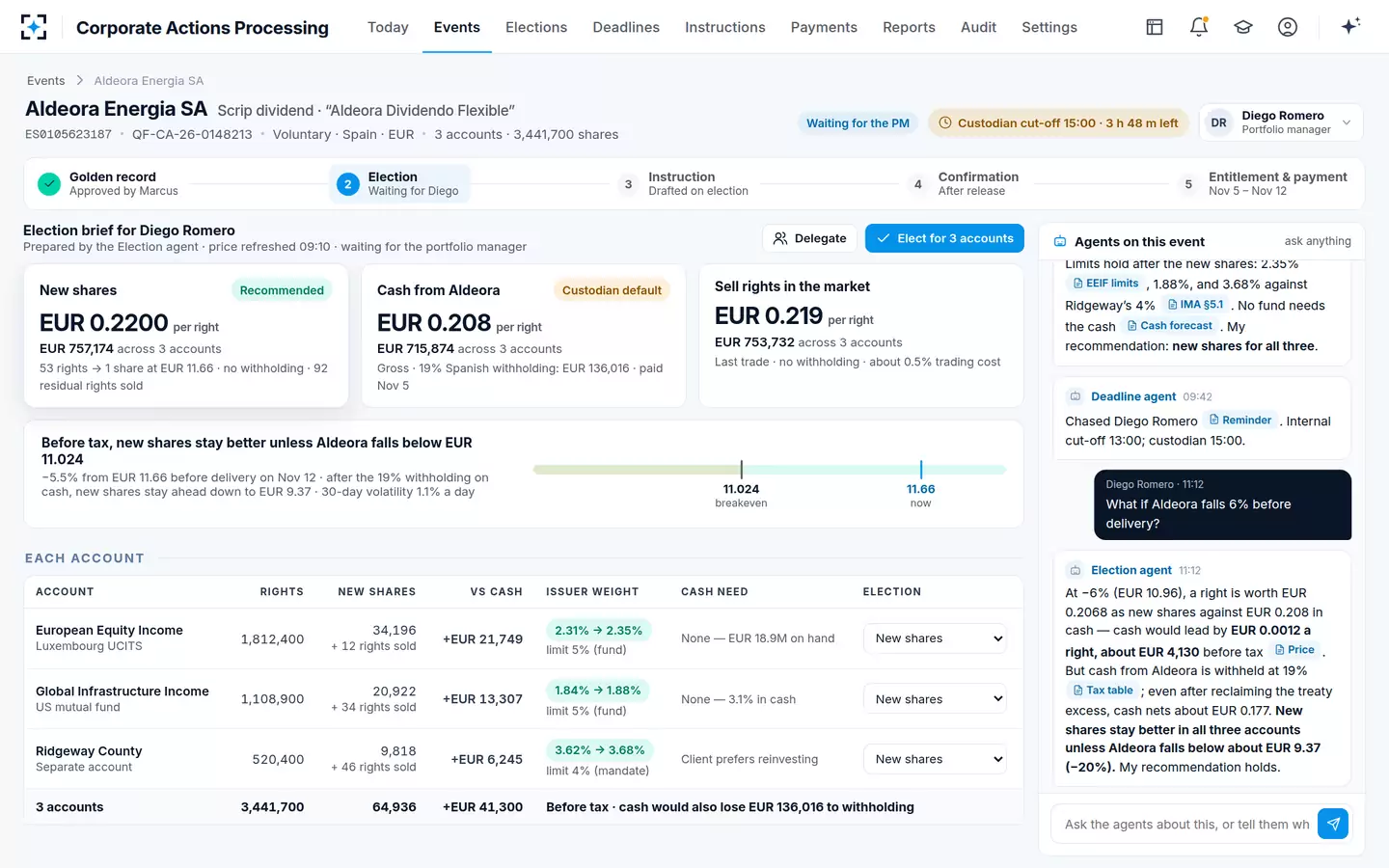
The breakeven turns a judgement into a threshold. Before tax, new shares are better unless Aldeora falls more than about 5.5% from EUR 11.66 before delivery on 12 November; after the withholding on cash, they stay ahead down to about EUR 9.37, roughly 20% lower. A portfolio manager who would hold the shares anyway has a clear answer; one who wants to reduce the position may still prefer cash, and the reason should say so.
What one right is worth under each choice, and where the lines cross
What happens if a fund makes no scrip election?
If no election is made, the default applies, and on a scrip dividend there are two to read: the issuer's and the custodian's. The European standards require every notice of an event with options to identify the default, and the default identified by the issuer's depository to be "transmitted unchanged through the custody chain" (SCoRE rulebook, Standard 11). A custodian may still apply its own default to its clients' accounts under its service terms, and in the sample it does: Aldeora's default is new shares, but the custodian applies cash to Quillfield's accounts if nobody instructs by 15:00.
For trades still settling at the deadline, the European T+1 rules state the outcome directly: a mandatory reorganisation with options that nobody elects on falls into the issuer CSD's default option (AMI-SeCo T+1 guide, 2026, BP16). Doing nothing is a decision, made by a party that does not know the fund.
The time to avoid the default is short. For shares of EU companies, the last intermediary may not ask for instructions earlier than three business days before the issuer deadline (Implementing Regulation (EU) 2018/1212, Art. 9(4)), and custodians tend to use the room. In the sample, the issuer's final terms were filed on Thursday 22 October in the evening, the market deadline is Monday 2 November, and the custodian's cut-off is Wednesday 28 October at 15:00 London. The fund's own internal cut-off, two hours earlier, leaves the portfolio manager three working days in which to decide, provided the terms are settled and valued the morning after they are published.
Worked example: one rights-based scrip dividend across three accounts
Take the sample scrip dividend as it runs through Corporate Actions Processing on Wednesday 28 October 2026. Three accounts hold 3,441,700 Aldeora shares and therefore 3,441,700 rights. New shares are worth EUR 0.012 a right more than the issuer's cash, so new shares beat the custodian's cash default by about EUR 41,300 before tax, and cash would also lose EUR 136,016 to withholding in the sample.
The election, account by account: what new shares are worth against the cash default
| Account | Rights | New shares (residual rights sold) | Value against cash, before tax | Issuer weight after, and limit |
|---|---|---|---|---|
| European Equity Income (Luxembourg UCITS) | 1,812,400 | 34,196 (12) | +EUR 21,749 | 2.31% → 2.35%, limit 5% |
| Global Infrastructure Income (US mutual fund) | 1,108,900 | 20,922 (34) | +EUR 13,307 | 1.84% → 1.88%, limit 5% |
| Ridgeway County (separate account) | 520,400 | 9,818 (46) | +EUR 6,245 | 3.62% → 3.68%, mandate limit 4% |
| Total | 3,441,700 | 64,936 (92) | +EUR 41,300 | All within limits |
The numbers show why a per-account view matters. The total gain is EUR 41,300, but Ridgeway County's account moves from 3.62% to 3.68% of the issuer against a 4% mandate limit, closer than the funds' 5% limits; a larger holding or a lower share count would have breached it and changed the answer for that account alone. The cash need differs too: one fund holds EUR 18.9 million of cash, another 3.1%, and the separate account's client prefers reinvesting. An election note that shows only the total would hide all three.
The election screen: both alternatives valued for every account, and the default named
How tax changes the scrip dividend comparison
Tax can reverse the answer, in either direction, and it depends on the issuer's country, the fund's domicile and the treaty between them. In the sample, cash from the issuer is withheld and new shares are not, which widens the gap in favour of shares from EUR 0.012 to about EUR 0.043 a right. Other markets treat the two alternatives the same, and some tax the shares as if they were cash.
The US and UK show the second pattern for holders taxed there. Under the US Internal Revenue Code, a distribution of stock that is, "at the election of any of the shareholders", payable either in stock or in property is treated as a distribution of property, not a tax-free stock dividend (26 U.S.C. 305(b)(1)). In the UK, the taxable amount of a stock dividend is the cash dividend alternative, unless that differs from the market value of the shares by 15% or more of that value, in which case it is the market value (Income Tax (Trading and Other Income) Act 2005, s.412). The withholding on the cash leg, and how much of it can be reclaimed, starts from the rates in dividend withholding tax rates by country.
Who bears the loss of a wrong scrip election?
The fund's investors bear it, as value that never arrives, unless the manager's error policy or the mandate says otherwise. A missed election does not produce a loss on any statement; it produces cash where shares would have been worth more, or the reverse, and the difference is visible only to someone who computes it. That is why the cost of default elections so often goes unmeasured.
It can be measured, for every past event. For each scrip dividend the fund held, take the position, the value of each alternative on the election deadline, the option actually received and the one the portfolio manager would have chosen; the difference times the position is the cost. The solution reports exactly that as value kept: in the sample quarter to 28 October, an estimated $1.84 million across 236 elections, against the custodians' defaults and before tax, on fictional data. Mandatory events with options explains why the default, not the label, is where that value is decided.
How should a scrip dividend election be recorded?
Record the decision with its inputs, so that anyone can see later why it was right at the time. That means the person who elected and their authority, the time, the option per account, the prices and tax assumptions used, the limits checked, and a reason. In the EU, the intermediary must report back after payment what the shareholder's choice produced (Implementing Regulation (EU) 2018/1212, Art. 8(3)), which a fund can match against its own log of the election.
Some mandates require more. In the sample, Ridgeway County's investment management agreement requires a client notice within five business days of any voluntary election; the Confirmation agent drafts it from the election and the team lead approves it before it is sent. In Corporate Actions Processing, the portfolio manager elected new shares for all three accounts at 11:20 with the reason code "Higher value for the fund", 3 hours 40 minutes before the custodian's cut-off.
The custodians' acknowledgments matched, and the client notice the mandate requires
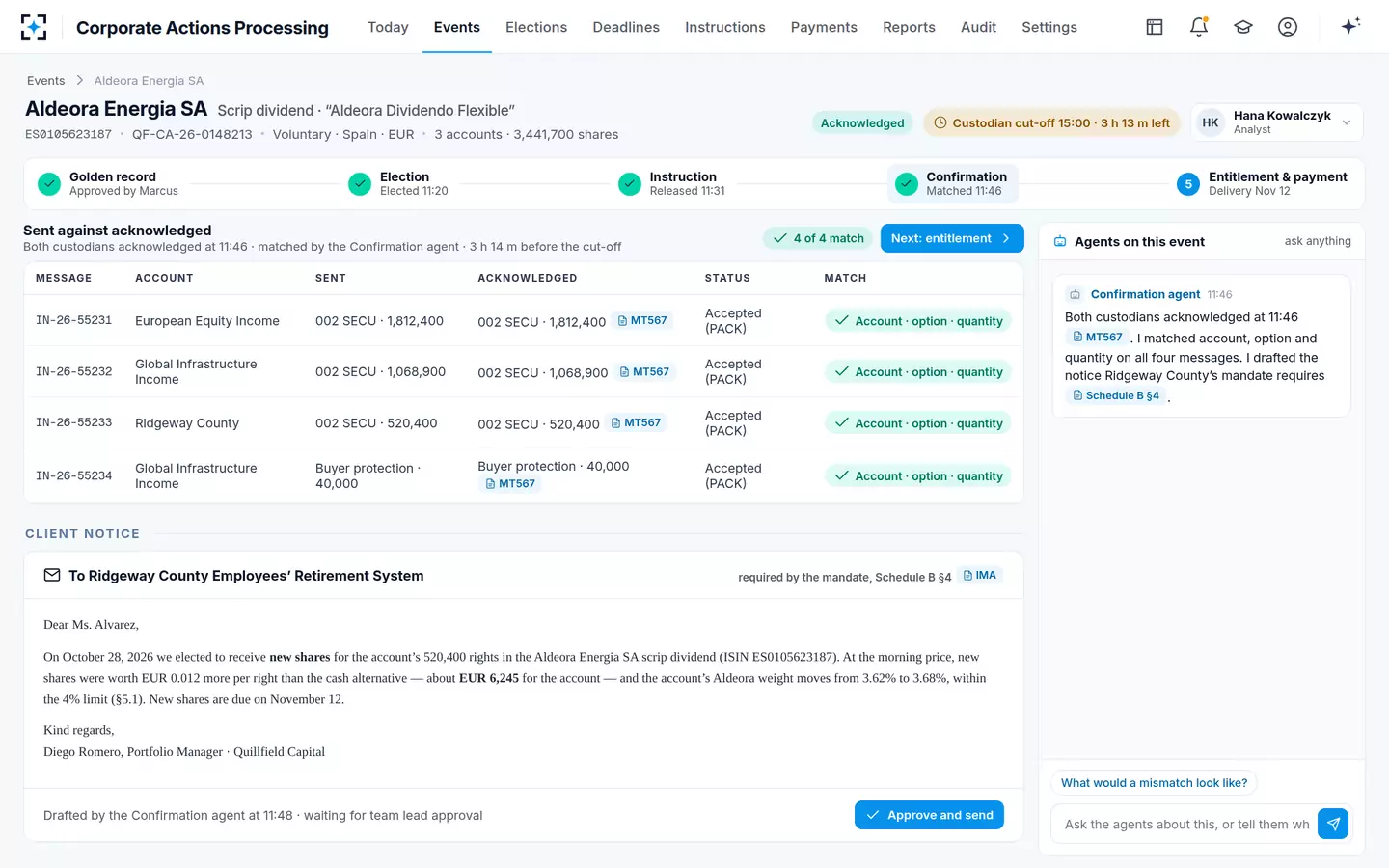
The processing life cycle places the election between the golden record and the payment, and the election agent guide shows how the valuation is prepared. The screens are in Corporate Actions Processing.
Questions people ask
Why do companies offer scrip dividends?
Mainly to keep cash. Feito-Ruiz, Renneboog and Vansteenkiste found that UK firms paying scrip dividends are more likely to be financially constrained, use them more when external financing is costly, and often pay them alongside dividend cuts or large debt-financed acquisitions.
Is a scrip dividend better than cash?
It depends on the price and tax on the day. The share alternative is better while the share price stays above the breakeven, the cash per unit times the ratio, after tax for the fund's domicile; in the sample that was EUR 11.024 before tax against a price of EUR 11.66.
Is a scrip dividend taxable?
Usually, for taxable holders. In the US an elective stock dividend is treated as a distribution of property under 26 U.S.C. 305(b)(1); in the UK the taxable amount is the cash alternative, or the market value of the shares if the two differ by 15% or more. Funds' own tax status and withholding at source vary by country.
What happens to fractions in a scrip dividend?
The issuer's terms say. In the sample, new shares are rounded down and the residual rights are sold in the market: 92 rights across three accounts. Under the European T+1 rules, market claims in shares are also rounded down, with cash for the fraction only if the issuer compensates fractions.
Can a fund set a standing instruction for scrip dividends?
Yes, with custodians that support it, but it replaces a decision with a rule that does not know the price on the day. In the sample configuration there is no standing instruction for scrip and optional dividends: the portfolio manager always elects, and a standing instruction can only be applied by a team lead, by name, with a reason.