An MT564 is the corporate action notification an account servicer, usually a custodian, sends to its client under the ISO 15022 securities messaging standard: it announces an event on a holding, gives its terms, dates and options, states the client's eligible balance and, on events with a choice, the default and the deadline to answer. Its ISO 20022 counterpart is seev.031, the Corporate Action Notification. Every field in it is a copy, made somewhere up the custody chain, of a decision the issuer took, and the copies do not always agree. Botminds' Corporate Actions Processing is an agentic solution that reads each custodian's MT564 or seev.031 next to both data vendors' feeds and the issuer's own notice, and builds one golden record in which every field cites the source it trusts.
The worked example is from the solution's sample data: a scrip dividend from Aldeora Energia SA, a fictional Spanish issuer, held by Quillfield Capital, a fictional asset manager, at a fictional custodian, Halvorsen Custody.
What is an MT564 message?
The MT564 is the notice in a family of ISO 15022 corporate action messages, a standard first published in 1999 (ISO 15022-1:1999). It travels from each account servicer to its account owner, so a fund with nine custodians receives up to nine MT564s for one event, each describing the same event in that custodian's words, for that custodian's account.
The message is structured, but not all of it is used as structure. The ECB's market-standards group lists among the barriers to integrated post-trade services that corporate action information is often "provided in free text fields in ISO 15022/ISO 20022 messages or via proprietary communication channels and formats (e.g. by fax or email)", or has to be extracted from sources such as "national gazettes used to announce CAs in local language" (AMI-SeCo, Remaining barriers to integration in securities post-trade services, September 2025). A system that reads only the coded fields of an MT564 misses whatever the custodian put in the narrative.
What are MT565, MT566 and MT567?
They are the rest of the conversation. The MT565 is the client's instruction, the election sent back to the custodian. The MT567 is the custodian's status and processing advice, acknowledging or rejecting an instruction. The MT566 is the confirmation that cash or securities have moved. ISO 20022 splits the same flow into more specific messages, which the European collateral rulebook lists with their identifiers: seev.031 notification, seev.032 event processing status advice, seev.033 instruction, seev.034 instruction status advice, seev.035 movement preliminary advice, seev.036 movement confirmation, seev.037 reversal advice and seev.039 cancellation advice (AMI-SeCo SCoRE corporate actions rulebook, 2019).
One elective event as messages, and which agent handles each in Corporate Actions Processing
Agent
Notification: MT564 or seev.031The Intake agent reads every custodian's notice, and any replacement, next to the vendors' feeds and the issuer's document, and links them to one event.
Never: decides which source is right
Agent
Golden recordThe Scrub agent compares each field across sources, takes the most authoritative value and cites it; any disagreement on an economic field goes to a person.
A person decides
ElectionThe portfolio manager chooses per account after the record is approved by a second person.
Agent
Instruction: MT565 or seev.033The Instruction agent drafts each instruction from the election and checks quantity, option, account, settlement details and deadline.
Never: submits or releases an instruction
A person decides
ReleaseOne person submits, a different person releases.
Agent
Status and payment: MT567 and MT566, or seev.034 and seev.036The Confirmation agent matches each acknowledgment and payment against what was sent and expected, and flags quantity, option, withholding, fraction and claim breaks.
Which MT564 fields carry the economic terms?
The economic terms are the fields that change what the fund receives: the event type and participation type, the security, the ratio or rate, the price, the key dates, the options with their default, the deadlines and the eligible balance. The table maps each to the party whose decision it copies, using the European notice standard where it names an originator, and to the check that catches a bad copy.
The MT564 field map: each economic field, its source of truth and its check
| Field | Sample value (Aldeora) | Source of truth | Check |
|---|---|---|---|
| Event type (CAEV) | Dividend option | The issuer's announcement | If it changes, the old event must be cancelled and a new one started. |
| Mandatory/voluntary indicator (CAMV): MAND, CHOS or VOLU | Choice offered: cash or new shares | The issuer's terms: does the holder choose? | Same rule: a change means a new event, with its own deadline. |
| Security (ISIN) | The Aldeora share | The issuer and its numbering agency | Matches the fund's security master and the position. |
| Ratio | 53 rights per new share | Issuer's final terms, page 2 | Vendors said 52 and 55; the provisional estimate had been superseded. |
| Price or rate | EUR 0.208 gross per right | Issuer's final terms | Gross or net stated; currency stated. |
| Ex-date and record date | Mon 26 Oct and Tue 27 Oct | EU notice standard: ex-date from the first intermediary, record date from the issuer | Sequence matches the market standard for the settlement cycle. |
| Options and default | Cash or new shares; default differs | Issuer for the options; issuer depository for the default, passed on unchanged | Compare the issuer's default with the custodian's own service default. |
| Response deadline | 28 Oct, 15:00 London | The custodian (account servicer) | For EU shares, no earlier than three business days before the issuer deadline. |
| Market deadline and payment date | 2 Nov; cash 5 Nov, shares 12 Nov | The issuer | Payment set close to the deadline, as the EU regulation asks. |
| Eligible balance | 3,441,700 shares across three accounts | The custodian's books at the record date | Reconcile with the fund's own position, pending trades and loans. |
Two columns of that table do most of the work. The source column says that most economic fields have exactly one authoritative origin, the issuer, and that everything else is a copy. The check column says that a copy can be tested without trusting the copier: against the issuer's document, against the sequence the market standard requires, or against the fund's own positions.
Which fields does EU law require intermediaries to pass on?
For shares of companies registered in the EU and admitted to an EU regulated market, the notice of a corporate event other than a general meeting must carry the data elements of Table 8 in the annex of Implementing Regulation (EU) 2018/1212 (2018/1212, Art. 8(4) and Annex). They are a unique identifier for the event, its type, the ISIN of the share and of any interim security, a link to the issuer's full information, the key dates and the options available to the shareholder.
The key dates are listed with the party that originates each: the last participation date and the ex-date come from the first intermediary; the record date, the start and end of the election period, the issuer deadline and the payment date come from the issuer; the buyer protection deadline comes from the intermediary. The issuer deadline is stated in coordinated universal time. And the transmissions between intermediaries must use "electronic and machine-readable formats" that deploy "internationally applied industry standards such as ISO or methodology compatible with ISO" (Art. 2(3)).
The regulation has a gap that explains many MT564 surprises. Where the issuer publishes the full information on its website, the notice need only carry the first block of Table 8, the identification of the event, "as well as the URL hyperlink to the website where the information can be found". ESMA and the EBA reported that this possibility to fill in the table only partially "is reported to significantly affect the efficiency of the STP flow of information", because intermediaries then have to resort to other sources (ESMA and EBA, report on SRD2 implementation, July 2023, §99).
What happens when two notices disagree?
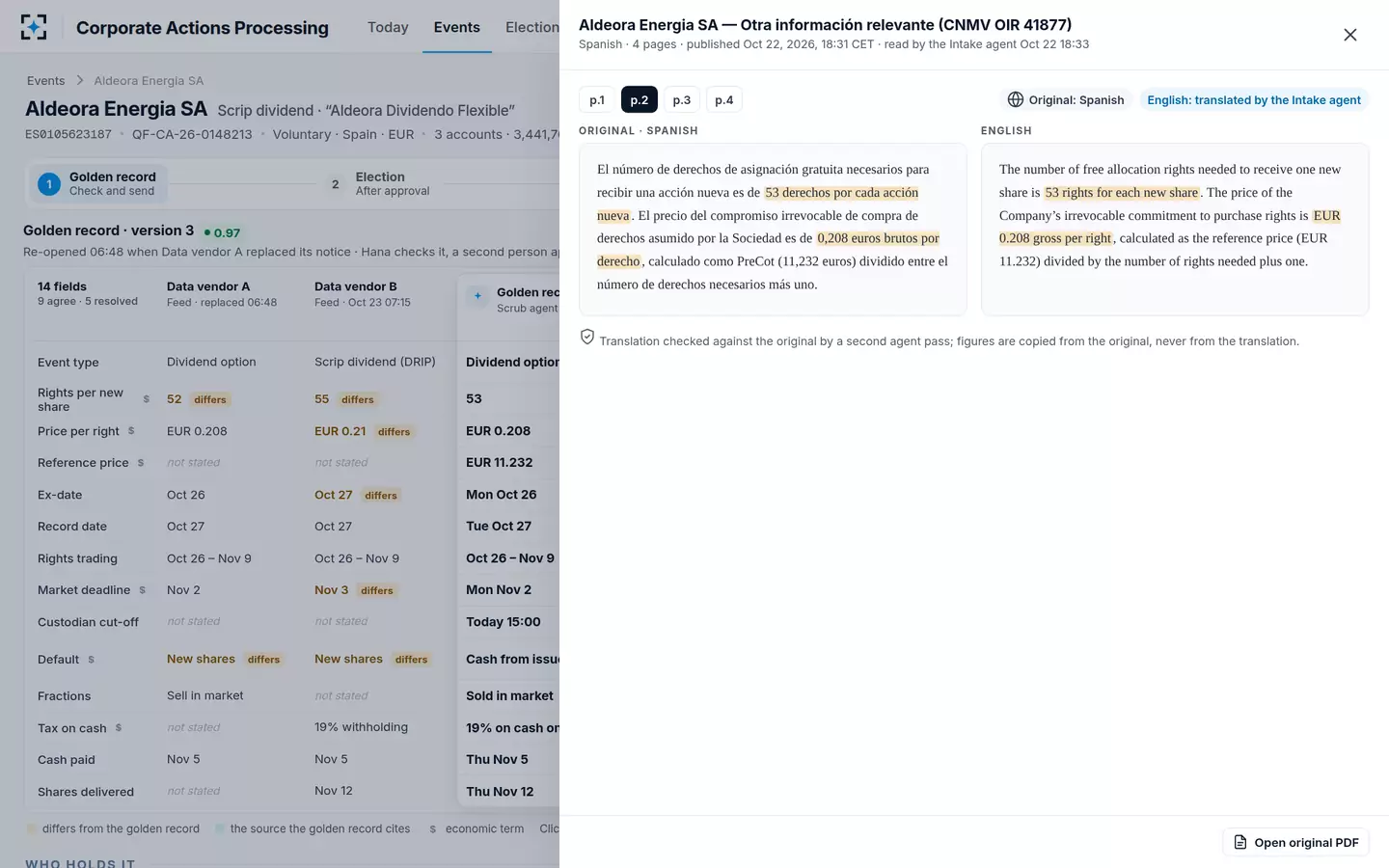
When two notices disagree, the question is not which custodian to believe but which document both were copying. In the sample, the four sources split three ways on the ratio. Halvorsen Custody's MT564 and the issuer's Spanish notice say 53 rights per new share; Data vendor A says 52 and Data vendor B 55. The issuer's final terms, filed with the Spanish regulator on 22 October at 18:31 CET, are the newest primary document, and vendor B is still carrying the provisional estimate from 14 October; vendor A's figure appears in no source and is reported back to the vendor.
Four notices around one golden record, every field citing its source
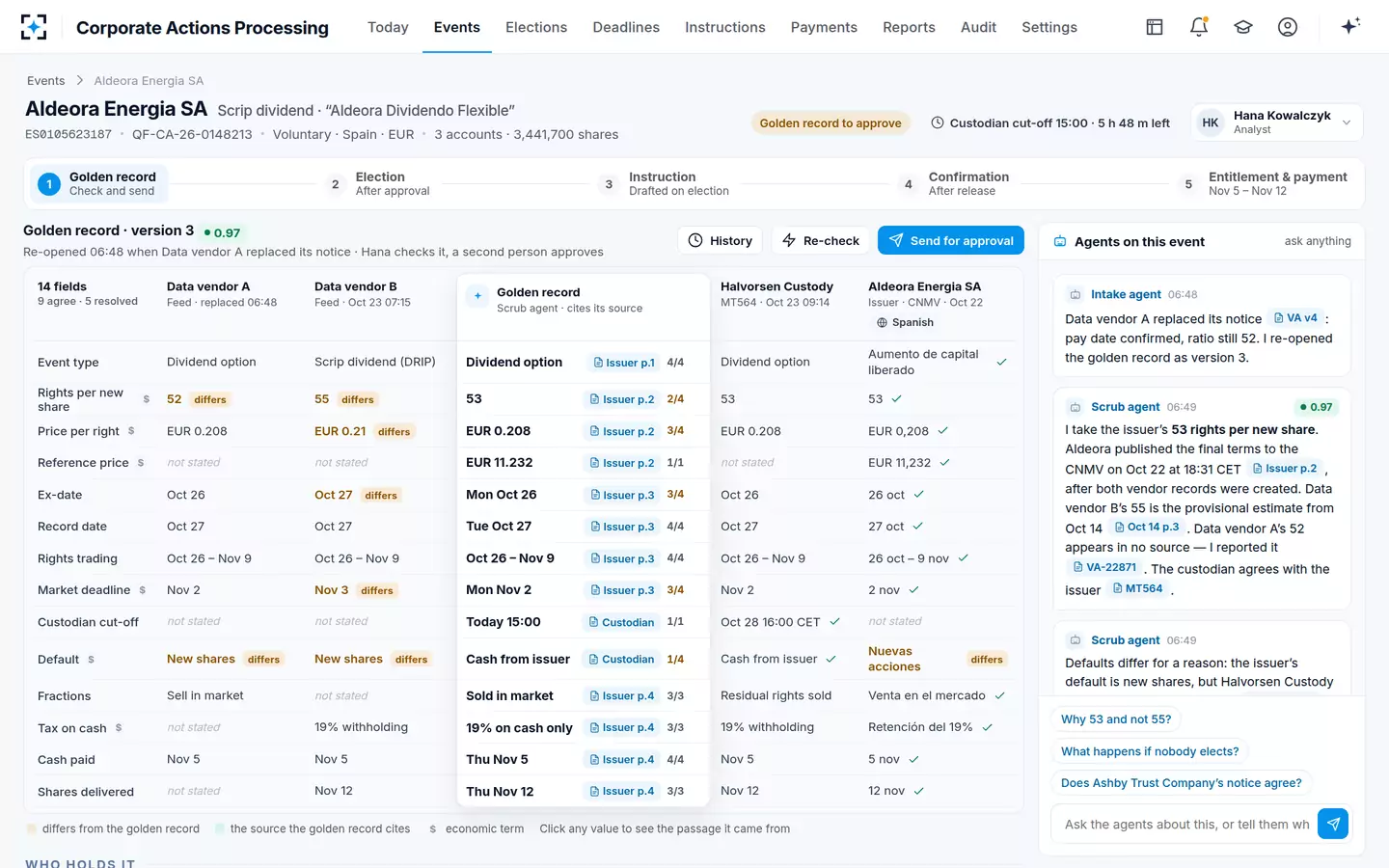
Some disagreements are not errors at all. The custodian's default and the issuer's default differ on this event because the custodian applies cash to these accounts, which is the custodian's service rule, not a mistake in its message. The European standard asks the issuer depository's default to pass "unchanged through the custody chain" (SCoRE rulebook, Standard 11); a custodian's own default for its clients is a separate fact, and a fund needs both. A golden record should keep each fact with its own source rather than flatten them into one value.
One click on a value opens the issuer's page, original language beside English
Replace, remind, cancel: reading the notice's own status
A notice tells you how far to trust it. In the ISO 20022 notification, the notification type is NEWM for a new notice, REPL when it replaces an earlier one and RMDR for a reminder; a completeness status says whether the event details are complete (COMP) or incomplete (INCO); and a confirmation status says whether the event's occurrence is confirmed (CONF) or not (UCON) (SCoRE rulebook, Table 1). An incomplete, unconfirmed notice is a warning that a replacement will follow.
Replacements are where errors hide. A field-level comparison between each version and the last is the only reliable way to see what changed, and a change to one of three fields is not a replacement at all: if the event type, the participation type or the security changes, the rulebook says "the old event must be cancelled by the account servicer and a new one started". In the sample, Data vendor A replaced its notice at 06:48, the ratio still wrong, and the golden record reopened as version 3 with the difference shown.
Timing matters as much as content. In the ECB group's 2025 compliance report, the Spanish market's entry notes that not every issuer announces through the depository as soon as the event is public, that "Sometimes the market gets this information first instead of the issuer CSD", and a custodian's comment that MT564 announcements arrive after publication in official bulletins (AMI-SeCo, Corporate Events Compliance Report, 2025). For Spanish events, that makes the issuer's own filing the earliest primary source, and the MT564 a later confirmation of it.
What is the ISO 20022 replacement for MT564?
The ISO 20022 replacement is seev.031, the Corporate Action Notification, part of a family that replaces the four main MT messages with more specific ones (ISO 20022). The data is richer and better defined: the European rulebook, for instance, requires every notification to identify the default option and to carry a record date, with the value "UKNW" when it is not yet known.
ISO 15022 and ISO 20022 for corporate actions: the same conversation, two vocabularies
ISO 15022 (MT): MT564, with replacements and reminders as message functions.
ISO 20022 (seev): seev.031 notification; seev.039 cancellation advice as a message of its own.
ISO 15022 (MT): MT565.
ISO 20022 (seev): seev.033.
ISO 15022 (MT): MT567, for instructions and event processing.
ISO 20022 (seev): seev.034 for instructions; seev.032 for event processing.
ISO 15022 (MT): MT566 confirmation.
ISO 20022 (seev): seev.035 preliminary advice, seev.036 confirmation, seev.037 reversal advice.
ISO 15022 (MT): Still widely used for asset servicing.
ISO 20022 (seev): Recommended in Europe; no global agreement on retiring ISO 15022 for securities.
For a fund, the practical position is coexistence. The ECB group describes "the parallel use of the older ISO 15022 and the newer ISO 20022 messaging standards" as a barrier in every domain, with asset servicing showing "the absence of uniform usage practices, limitations on character sets and length" (AMI-SeCo, Barrier 39). Some custodians send MT564, some seev.031, some both, and the same event can arrive in each. The fund's job is to map both onto one set of fields, the golden record, and never to let the message format decide what the terms are.
There is a need for a "golden operational record", i.e. clear and uniform rules on a single centralised source for securities reference data for any given security that is widely accessible to issuers, intermediaries and investors.
AMI-SeCo, Remaining barriers to integration in securities post-trade services, 2025
Mapping each MT564 field to its source of truth, as a working method
A field map is only useful if it runs on every event. In Corporate Actions Processing it is configured as source rules the firm owns: for economic terms, the issuer's primary document first, then the custodian, then each data vendor, with market-specific overrides such as Spain's rights-based scrip dividends. A golden record goes straight through only when every source agrees on every economic field and the agents' confidence is at least 0.95; any disagreement on an economic field always goes to a person, and the person who prepared the record cannot approve it. On the sample night, 586 of 612 golden records went straight through.
The instruction that answers the MT564, drafted from the election
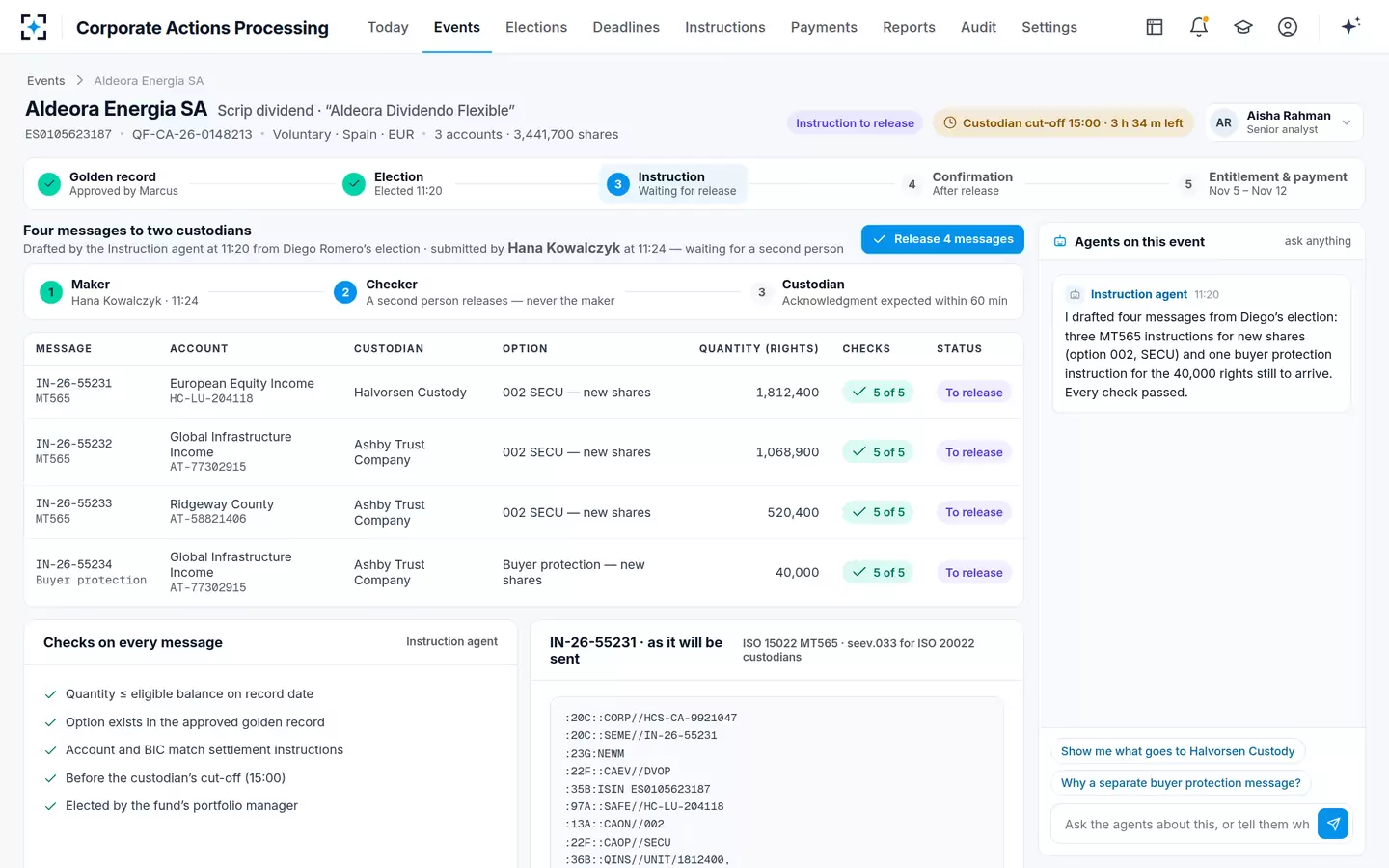
The same map runs in reverse when the answers come back. Each MT567 is matched on account, option and quantity against the instruction it acknowledges, and each MT566 against the expected entitlement. Scoring corporate actions data providers uses the field map to measure each source's accuracy, and the three participation types explains what MAND, CHOS and VOLU mean for a fund. The full set of screens is in Corporate Actions Processing.
Questions people ask
What is the difference between MT564 and MT566?
The MT564 announces an event and its terms before anything moves; the MT566 confirms that cash or securities have actually been credited or debited. A fund matches the MT566 against the entitlement it expected from the MT564 and its election.
What does CHOS mean in an MT564?
CHOS is the participation code for a mandatory event with choice: every holder is affected, and each may choose among options, with a default for those who do not. The other two codes are MAND, for mandatory events, and VOLU, for voluntary ones.
Is SWIFT retiring the MT564?
Not on a fixed date. The ECB's AMI-SeCo reported in September 2025 that no global agreement has yet been reached in the securities ecosystem on phasing out ISO 15022, so MT564 and seev.031 continue side by side and a fund must be able to read both.
Who sends an MT564?
The account servicer, usually a custodian or sub-custodian, sends it to its account owner for each account holding the security. A fund with several custodians receives several notices for one event, and each can differ in timing, wording and default.
What is the ISO 20022 equivalent of MT565?
seev.033, the Corporate Action Instruction. Its status advice is seev.034, the counterpart of the MT567, and the movement confirmation is seev.036, the counterpart of the MT566.