Corporate actions automation means letting software, and now agents, do the capture, scrubbing, entitlement, valuation, chasing, instruction and reconciliation work of asset servicing, while people keep approvals, elections and releases. The hard part is not the technology but the calendar. A go-live that lands in the April to June dividend season, or in the fortnight around the EU and UK move to T+1 on 11 October 2027, meets the highest volumes with the least slack. The plan that works starts with mandatory income events outside the season, moves to elections once the sources have been scored, and finishes the UK's T+1 claims changes by 31 December 2026. Botminds' Corporate Actions Processing is an agentic solution built to go live that way: it first replays the firm's own past events in a shadow run, so the team sees how the agents compare before they work live.
Product examples come from the solution's sample data for Quillfield Capital, a fictional asset manager. The dates and obligations come from HM Treasury's published industry plan, EU law and the ECB's market-standards group, linked where they appear.
How do you automate corporate actions?
You automate corporate actions one stage and one event type at a time, measuring each before adding the next. The stages are the same for every event: capture the notices, settle the terms into one golden record, find the entitled positions, value and decide any election, instruct, and reconcile the payment. Rules engines have long automated the first stage for clean, structured feeds; agents extend automation to unstructured notices in any language, to valuation, and to chasing.
Regulators expect the push. The UK industry plan for T+1, published by HM Treasury, asks all market participants to consider automated solutions "for processes that are currently carried out manually and are inevitably time consuming and error prone", naming "entitlement calculation, corporate action claims and tax reporting" (Accelerated Settlement Technical Group report, February 2025). They also expect control. The SEC's examinations division has said it will examine policies for monitoring "super intelligence (SI)", including its use in back-office operations (SEC, Fiscal Year 2027 Examination Priorities). A go-live plan has to deliver both.
The corporate actions go-live plan, in order, with the calendar constraint on each step
- 1. Shadow run on last quarter's events
Replay the firm's own past events and compare golden records and recommendations with what the team did. Any month; best finished before December.
- 2. Source rules and thresholds approved
Precedence of issuer, custodian and vendors, market overrides, straight-through threshold, internal cut-offs and escalation ladder, proposed by one person and approved by another.
- 3. Mandatory income events live
Cash dividends, interest, redemptions: high volume, little judgement, easy to measure. Go live in January to March, not April to June.
- 4. Claims and pending trades
Market claims, due bills and buyer protection from record-date positions. In the UK, claims processes must be T+1-compatible by 31 December 2026.
- 5. Elections live
Scrip and optional dividends, rights, tender and exchange offers, after a quarter of source scores. Go live July to September, after dividend season.
- 6. Freeze for the T+1 fortnight
No cutover between 4 and 15 October 2027, when the European standards advise against key dates at all.
- 7. Quarterly review
Straight-through rate, elections on time, value kept, losses, days the portfolio manager had to decide and source accuracy, reviewed and rules adjusted.
What should go live first, mandatory income events or elections?
Mandatory income events should go live first. They are the bulk of the volume, they have no decision to make, and the right answer is easy to check: the cash received against the entitlement expected. Automating them frees the most hours and builds the measurement habit before anything with a decision attached is touched.
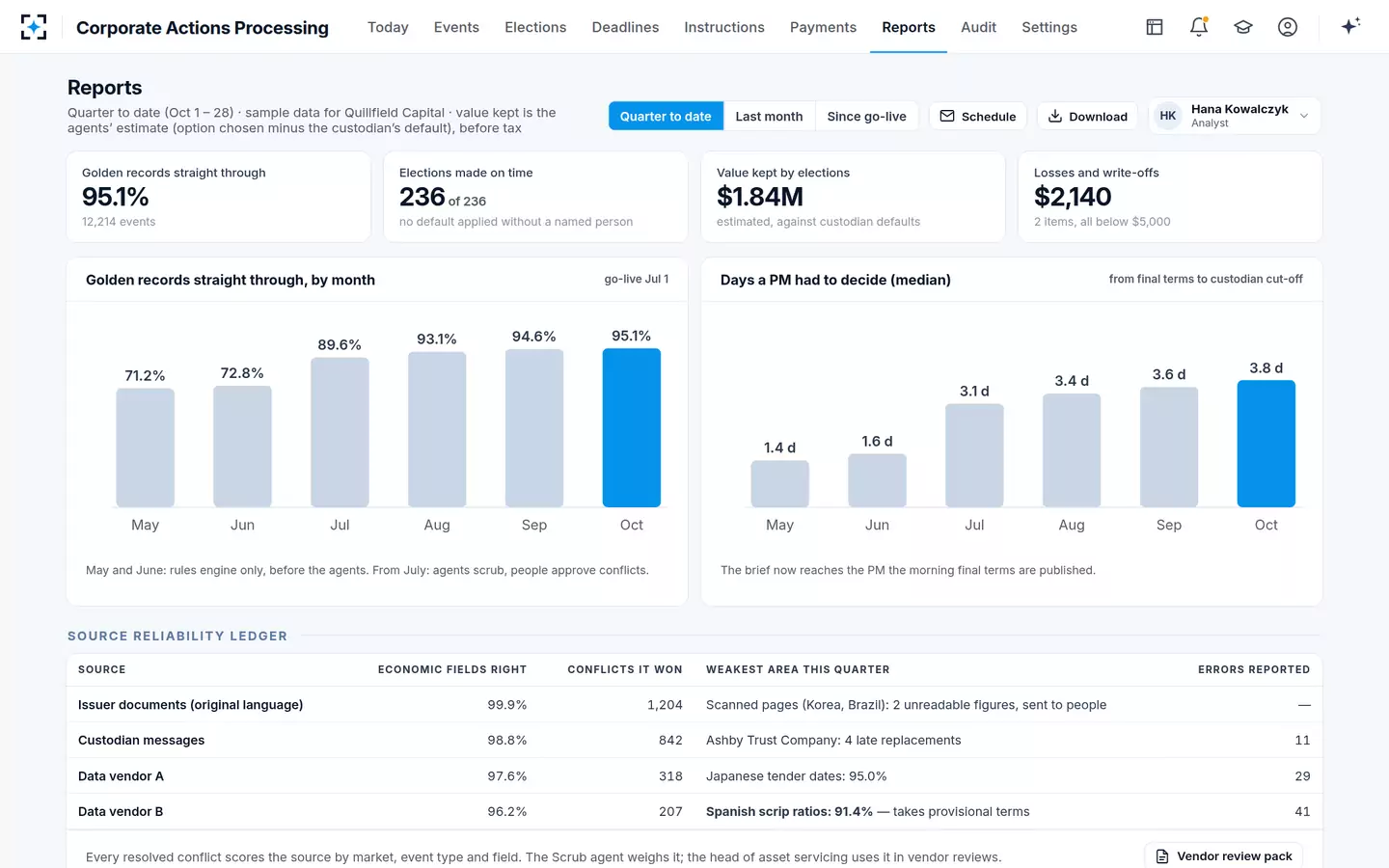
Elections come second, for a reason that is easy to miss: an election is only as good as the golden record it starts from, and the golden record is only as good as the source rules behind it. A quarter of live income events produces the first real accuracy scores for each vendor and custodian, by market and field, and those scores are what the source rules for elections should be built on. In the sample, Data vendor B turned out to be weakest on Spanish scrip dividend ratios, at 91.4%, because it takes provisional terms; that became a market override before the first Spanish scrip election ran live.
The sample's reports show the shape to expect, on fictional data. With a rules engine alone in May and June, 71.2% and 72.8% of golden records went straight through. After the agents went live on 1 July, the rate rose to 89.6% in July and 95.1% in October, and the median time a portfolio manager had to decide, from final terms to the custodian's cut-off, rose from 1.6 days in June to 3.8 days in October.
How do you avoid going live in dividend season?
Put the go-live dates on the calendar before the project plan, and keep April to June clear. When the UK Technical Group chose its own T+1 date, it listed the periods of high activity to avoid: calendar year end, index rebalance days, "The main corporate action dividend season (April-June)", futures and options expiries and public holidays, adding the annual messaging standards release, quarter-ends and holiday periods when "technical freezes might be imposed" (UK Technical Group report, §1.1). The same list is a good one for any corporate actions cutover.
A go-live calendar from November 2026 to October 2027, with dividend season kept clear
- Shadow runNov–Dec 2026
- Income events liveJan–Mar 2027
- Dividend season: measureApr–Jun
- Elections liveJul–Sep
- FreezeOct 2027
- UK claims deadline31 Dec 2026
- EU discipline rulesfrom 7 Dec 2026
- Main dividend seasonApr–Jun 2027
- T+1 preparationJul–Sep
- T+1Oct 2027
A season can also be used. Dividend season is when a shadow run produces the most evidence in the shortest time: every income event the agents process in parallel with the team is a comparison. Running in shadow from April to June and going live with elections in July gives the elections the benefit of a full season of scores.
What data feeds does corporate actions automation need?
It needs every source of terms, every source of positions, and every number used to value an option. Missing any one of them sends the agents back to a person, which is the right behaviour but not automation. The list below is what Corporate Actions Processing works with in the sample configuration.
The inputs a corporate actions go-live needs connected on day one
2feeds
data vendor announcement feeds, about 1.2 million notices a year in the sample
9custodians
ISO 15022 MT564 to MT567 and ISO 20022 seev messages, emails and portal PDFs
11languages
issuer notices and regulator filings read in the original, sample night
3books
portfolio accounting, order management and the securities lending agent, for positions, pending trades and loans
Two inputs are usually forgotten. The first is the issuer's own document in its own language, which is the source of truth for every economic term and arrives outside every feed; in the EU, issuers must give intermediaries the information the same business day they announce, but a fund often finds the filing faster itself (Implementing Regulation (EU) 2018/1212, Art. 9(1)). The second is the set of fund and mandate limits and cash forecasts, without which an election agent can value options but cannot tell the portfolio manager whether taking shares breaches a limit or leaves the fund short of cash.
Who approves the rules in corporate actions automation?
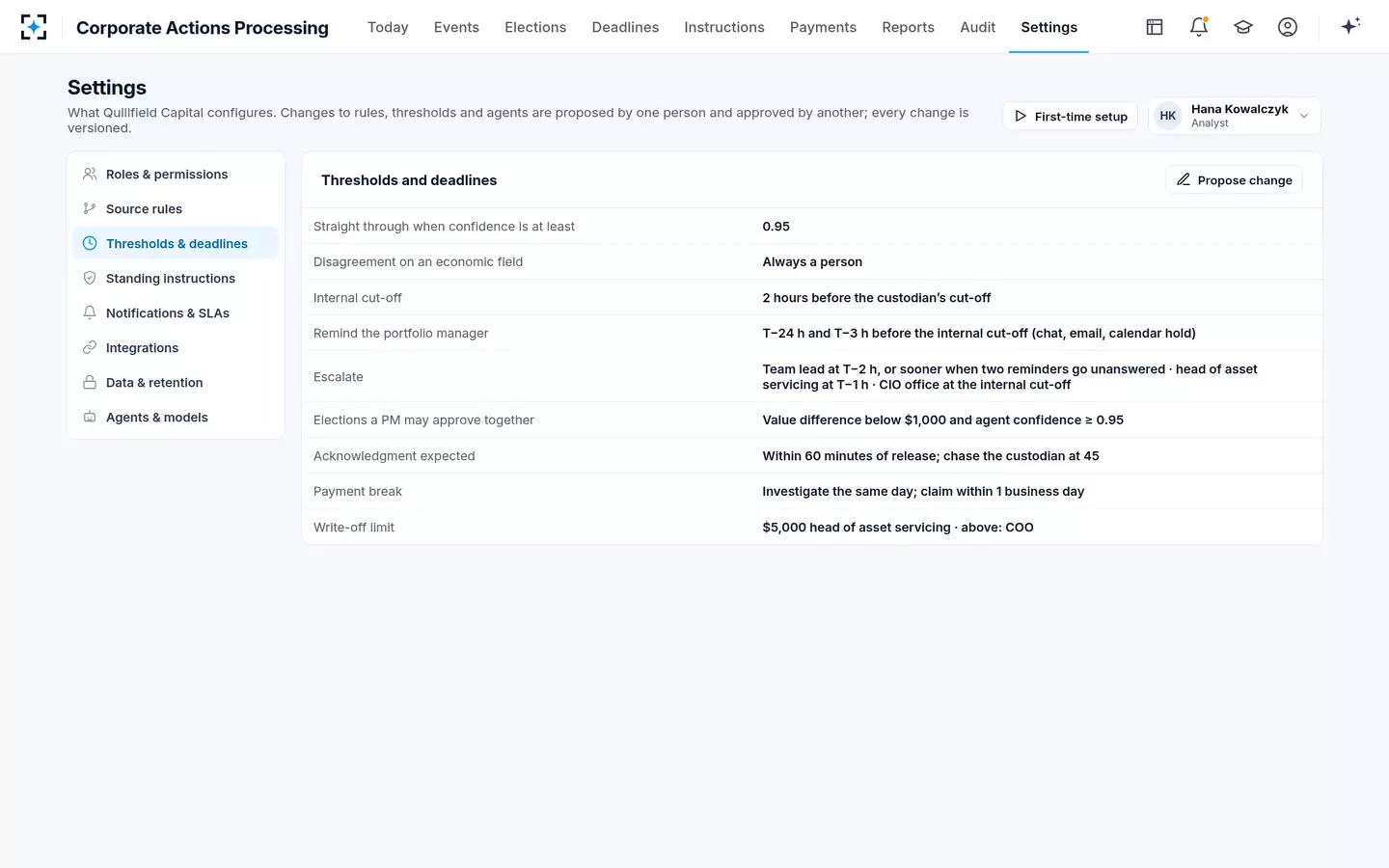
The head of asset servicing approves the rules; one person proposes them, a different person approves them, and every change is versioned. In Corporate Actions Processing the rules are settings: the straight-through threshold (0.95 confidence, with every source agreeing on every economic field), the order of sources, market overrides, the internal cut-off, the reminder and escalation ladder, standing instructions and write-off limits. Any change is replayed on last quarter's events before approval, and a new agent version is evaluated on 1,200 historical events before it works live.
The rules as settings, each change proposed by one person and approved by another
Who owns what in a corporate actions go-live
Today
Signs off a vendor's configuration once, at go-live, and inherits its defaults.
With agents
Approves each rule and threshold as a versioned setting, replayed on past events first, and reviews it quarterly.
Still theirs: approval of rules, thresholds and agent versions
Today
Tests the new system on a sample of events chosen in a hurry.
With agents
Compares the shadow run with the team's own work, event by event, and signs off each event type before it goes live.
Still theirs: approval of golden records and the go-live of each event type
Today
Learn about the project when the notices change format.
With agents
Agree the reminder ladder and the reason codes, and see their first valued election before going live.
Still theirs: every election
Today
Maintains feeds and mappings by hand.
With agents
Connects feeds, custodians and books, and manages roles and separation of duties.
Still theirs: access and roles, never approvals
What changes for UK T+1 claims processes by the end of 2026?
By 31 December 2026, UK market participants are expected to have upgraded their corporate action claims policies, processes and systems "to ensure they are compatible with the T+1 settlement cycle". That is action COAC 02b of the UK Technical Group's plan, following a review, COAC 02a, due by the end of 2025; trading venues have a parallel action to adopt a standardised dividend process by the same date (UK Technical Group report, Corporate Actions). These are industry actions accepted by the government, not law; the government has committed to legislate for T+1 from 11 October 2027 and published a draft statutory instrument (HM Treasury, accelerated settlement).
The same report recommends electronic election entitlement for UK listed issuers, using an interim security that "clearly demarcates corporate action entitlement separate from the ordinary listing" and creates an election period after the record date. For a fund, the practical work by the end of 2026 is the same whichever recommendations are adopted: find every pending trade at each record date, raise and track every claim, and match every claim payment. Due bills, market claims and buyer protection sets out the mechanics.
The T+1 fortnight: corporate actions dates to keep clear in October 2027
The European standards ask issuers to keep corporate events away from the switch. AMI-SeCo's T+1 guide advises issuers "not to announce corporate events with key dates falling during the transition to the T+1 settlement cycle, i.e. between Monday 4 October 2027 and Friday 15 October 2027", and, where that is unavoidable, sets the ex-date rules: a record date on Monday 11 October takes an ex-date of Friday 8 October, a record date on Tuesday 12 October takes the same day as its ex-date, and no ex-dates apply on Monday 11 October (AMI-SeCo T+1 guide, July 2026, §2.3.1).
The lesson for a go-live is to freeze the same fortnight. Any event that does fall in it needs its dates checked by hand against those rules, and no system change should land beside it. The ECB group's 2025 report adds a reason to expect trouble in the months after as well: its in-depth analysis found market claims and transformations "not being created in all scenarios as expected" in several markets, including some previously reported compliant, and it planned guidance for the first quarter of 2026 (AMI-SeCo, Corporate Events Compliance Report, December 2025).
Measuring the first quarter after a corporate actions go-live
Measure outcomes, not activity. Six numbers tell a head of asset servicing whether automation is working: the share of golden records straight through, elections made on time, value kept against the custodians' defaults, losses and write-offs, the median days the portfolio manager had to decide, and how often each source was right. Each should be reported by month from the shadow run onward, so the before and after are on the same chart.
The first quarter's numbers: straight-through rate, elections on time, value kept
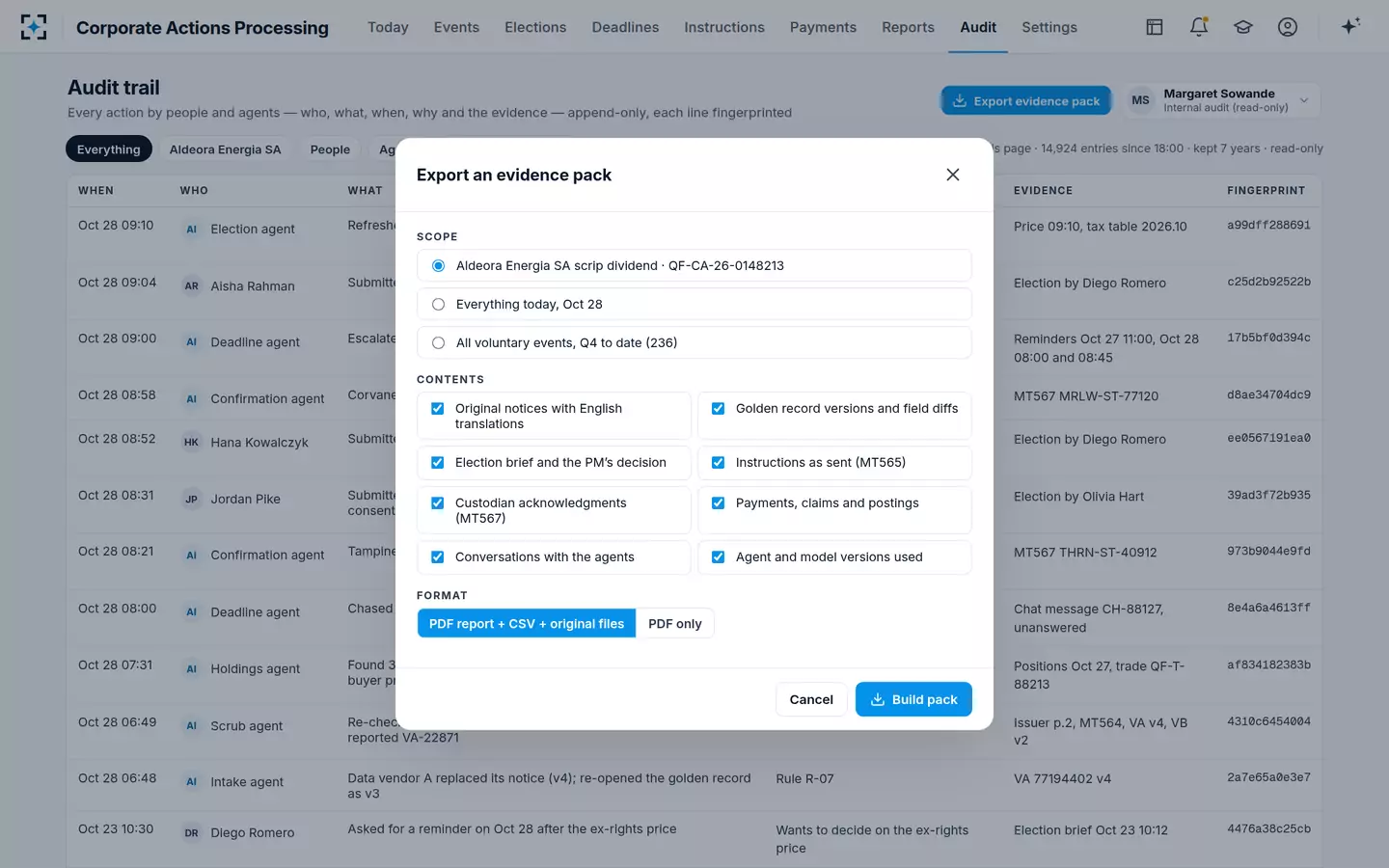
The evidence has to be exportable, because the auditors will ask for it in the first year. Corporate Actions Processing logs every action by a person or an agent, with the evidence and a fingerprint, and exports it for one event, one day or a whole quarter, including the agent and model versions used. Scoring corporate actions data providers explains the accuracy measures, and the election agent guide what to test before elections go live. The screens are in Corporate Actions Processing.
One evidence export per event, per day or per quarter
Questions people ask
What is straight-through processing in corporate actions?
It is an event processed from notice to payment without a person touching it. In the solution's sample configuration a golden record goes straight through only when every source agrees on every economic field and the agents' confidence is at least 0.95; any disagreement goes to a person.
How long does a corporate actions automation project take?
No regulator or independent study publishes a benchmark, and the answer depends on the number of custodians, feeds and event types. The calendar sets the outer limits: avoid April to June, finish UK claims changes by 31 December 2026, and avoid 4 to 15 October 2027.
Can voluntary corporate actions be automated?
Everything except the decision can be: capture, scrubbing, positions, valuation, chasing, instruction drafting and matching. The election should stay with the portfolio manager or a named delegate, and a release with a second person.
What is a shadow run in corporate actions?
It is a period in which the new process runs on real or past events in parallel with the team, without sending anything, so its golden records and recommendations can be compared with what people did. In Corporate Actions Processing, first-time setup includes one on the firm's past events.
Should a firm change corporate actions systems before T+1?
Yes, if it can finish well before October 2027, because T+1 removes the spare day manual processes rely on. Plan to be live on income events and claims by the end of 2026 and on elections by the end of September 2027, and change nothing in the T+1 fortnight itself.