A securities class action claim is the form an investor files with a settlement's claims administrator to receive its share of the money paid to settle a securities fraud case. Membership of the class is automatic for anyone who bought in the class period and does not opt out, but payment is not: a fund that never files gets nothing, and its share goes to the class members who did. That makes a claim the mirror image of a corporate action with options. There is a deadline and a decision, but the default is zero. Cox and Thomas, in the best-known study of the subject, found that "less than 30% of institutional investors with provable losses perfect their claims". Botminds' Corporate Actions Processing is an agentic solution for corporate actions, not a claims-filing service; but the habits it enforces on elections, from positions by date to cited terms and deadlines worked back, are exactly what an unfiled claim lacks.
What is a securities class action claim?
It is a request for payment from a fund created by a settlement or judgment in a class action under Rule 23 of the US Federal Rules of Civil Procedure. In a damages class, the court must direct "the best notice that is practicable under the circumstances, including individual notice to all members who can be identified through reasonable effort", and the notice must state the time and manner for requesting exclusion (FRCP Rule 23(c)(2)(B)). A member who does not ask to be excluded is bound by the judgment whether it files a claim or not.
For securities cases, the Private Securities Litigation Reform Act adds what the settlement notice must say. It must state the amount to be distributed "determined in the aggregate and on an average per share basis", the average recoverable damages per share where the parties agree on it, and the fees counsel will seek, also per share (15 U.S.C. 78u-4(a)(7)). The per-share figure is the number an operations team can multiply by a position. The claim itself is a form listing the fund's purchases, sales and holdings in the class period, from which the administrator computes each claimant's recognised loss.
The custody industry already treats the event as a corporate action. The European collateral rulebook lists a code for it, CLSA, "Class Action/Proposed Settlement", coded voluntary, and notes that abstaining is the default and that the account owner may reply directly to the legal representative rather than through the custodian (AMI-SeCo SCoRE corporate actions rulebook, 2019).
How many institutions actually file class action claims?
Few, on the evidence published. In a pilot study of 53 settlements, Cox and Thomas found that "only 25-33% of institutions that we can identify as having claims to file in these settlements are actually filing claims" (SSRN working paper, 2002). Their follow-up, on 118 further settlements and a survey of institutions, put the figure below 30% (Stanford Law Review 58, 2005, 411–454).
Fewer than a third of institutions with provable losses filed
The studies are two decades old, and claims filing has become a service industry since. But no regulator or independent study has published a newer institutional filing rate, so the honest position for a fund is to measure its own: list every settlement in which it held the security during the class period, and count the claims it filed and was paid. The authors' explanations for the gap have not gone out of date. They ranged "from mechanical failures in the notification and recordkeeping processes" to "portfolio managers' beliefs that only investment activities produce significant returns for their clients".
Who files claims for a fund, the custodian or the manager?
Either can, but someone must own it, and the studies found that often no one did. The 2005 survey found that "most institutions relied on their custodian banks to file claims for them", that "many of these institutions did little monitoring of whether the custodian actually performed these services", and that "custodians had financial disincentives to file claims on behalf of their clients" (Cox and Thomas, 2005).
Simply stated, many defrauded beneficiaries are not compensated for their losses, while others are unjustly enriched.
Cox and Thomas, Stanford Law Review, 2005
In practice, an asset manager chooses one of three routes: the custodian's class action service under the custody agreement, a specialist filing firm, or its own operations team. The choice matters less than the monitoring. Whoever files, the manager needs its own list of eligible settlements to check the filer against, because a filer that misses a case leaves no trace in any statement. The earlier paper named the plainest failure mode: "there are no internal personnel at the institutions that are responsible for filing the claims, and thus they never get made".
What evidence does a class action claim need?
A claim needs the fund's complete trading and holding history in the security over the class period, in a form the administrator can recompute. The notice's per-share amounts are only averages; each claimant's recognised loss depends on when it bought and sold, and the administrator will ask for proof.
What a fund's claim file should hold before the deadline
- Every purchase and sale in the class period
Trade date, quantity, price and account, for every account and fund that held the security.
- Holdings at the start and end of the class period
Opening and closing positions, so the administrator can match sales against earlier purchases.
- Corporate-action adjustments
Splits, mergers, ticker or identifier changes inside the period, with the ratio applied, so share counts reconcile.
- Proof of authority
Evidence that the filer may claim for the beneficial owner, from the custody agreement or a power of attorney.
- The settlement terms as filed
Class period, eligible securities, per-share amounts and the claim deadline, from the notice and the court filing.
- A filing receipt and the expected payment
What was submitted, when, by whom, and what the fund expects to receive, so the payment can be checked.
The third item is where corporate actions and claims meet. A class period that spans a stock split or a merger needs the holdings restated on one basis, or the claim's share counts will not reconcile. A team that already keeps an evidenced history of every corporate action on every holding can produce that restatement; a team that rebuilds it from custody statements years later often cannot.
What deadlines apply to a securities class action claim?
Each settlement sets its own dates, and the court approves them, so the only reliable source is the notice and the filing in that case. Three dates recur: the deadline to request exclusion, which the notice must state under Rule 23; the hearing on the settlement; and the claim deadline, after which late claims may be rejected. Settlements in SEC enforcement cases follow the same pattern. A plan for an SEC Fair Fund must include "procedures for making and approving claims, procedures for handling disputed claims, and a cut-off date for the making of claims" (17 CFR 201.1101(b)(4)).
Where a claim is lost, stage by stage
| Stage | Who controls it | How the fund loses the claim |
|---|---|---|
| Notice | Claims administrator, banks and brokers holding for the fund | The notice reaches a nominee and goes no further, or reaches an inbox nobody owns. |
| Eligibility | The fund or its filer | No one matches the class period and the security against the fund's holdings history. |
| Exclusion decision | The fund, if it wants to sue separately | Usually not a loss: a member who does nothing stays in the class. |
| Claim deadline | The court-approved settlement | The form is never filed, or filed after the cut-off. |
| Documentation | The administrator | Trades or adjustments cannot be evidenced, and the claim is reduced or rejected. |
| Payment | The administrator and the custodian | The payment arrives without a reference and is never matched to the claim. |
Is filing class action claims part of the adviser's duty?
US law does not name claims filing as a specific duty, but the SEC's interpretation of the adviser's fiduciary duty makes the answer depend on what the adviser has agreed to do. The duty cannot be contracted away, but an agreement can shape how it applies, and the specific obligations "depend upon what functions the adviser, as agent, has agreed to assume for the client" (SEC, Commission interpretation regarding standard of conduct for investment advisers, 2019). An agreement that gives the manager responsibility for corporate actions or for class actions brings the claim inside the duty.
The academic view goes further. Cox and Thomas concluded that "institutional investors have a duty to file claims in settlements, except what we believe are rare instances where their cost-benefit calculations show filing to be unjustified", and that trustees must "insure that their fund has an adequate system in place to identify and process the fund's claims", with a monitoring mechanism to check it works. That is a scholarly argument, not a rule. It is also the standard a board is likely to ask about after a large settlement is missed.
How do you know which settlements the fund is eligible for?
Eligibility is a join between two lists: the settlements, each with a security and a class period, and the fund's holdings history, each position with a security identifier and dates. A fund is eligible where a purchase falls inside a class period. The join fails in three predictable places: the security changed identifier during or after the period, the holding sat in an account or vehicle the matching did not cover, or the fund relied on notices reaching it rather than searching for settlements itself.
The first failure is a corporate actions problem. Mergers, spin-offs, name changes and reorganisations change the identifiers a holdings system uses, and a class period years in the past may be described in terms of a security that no longer trades. A team that keeps every corporate action on every holding, with the before and after identifiers and the source that confirmed them, can answer the eligibility question for any past date. Corporate Actions Processing keeps that history for every event it processes, with an append-only trail kept seven years in the sample configuration.
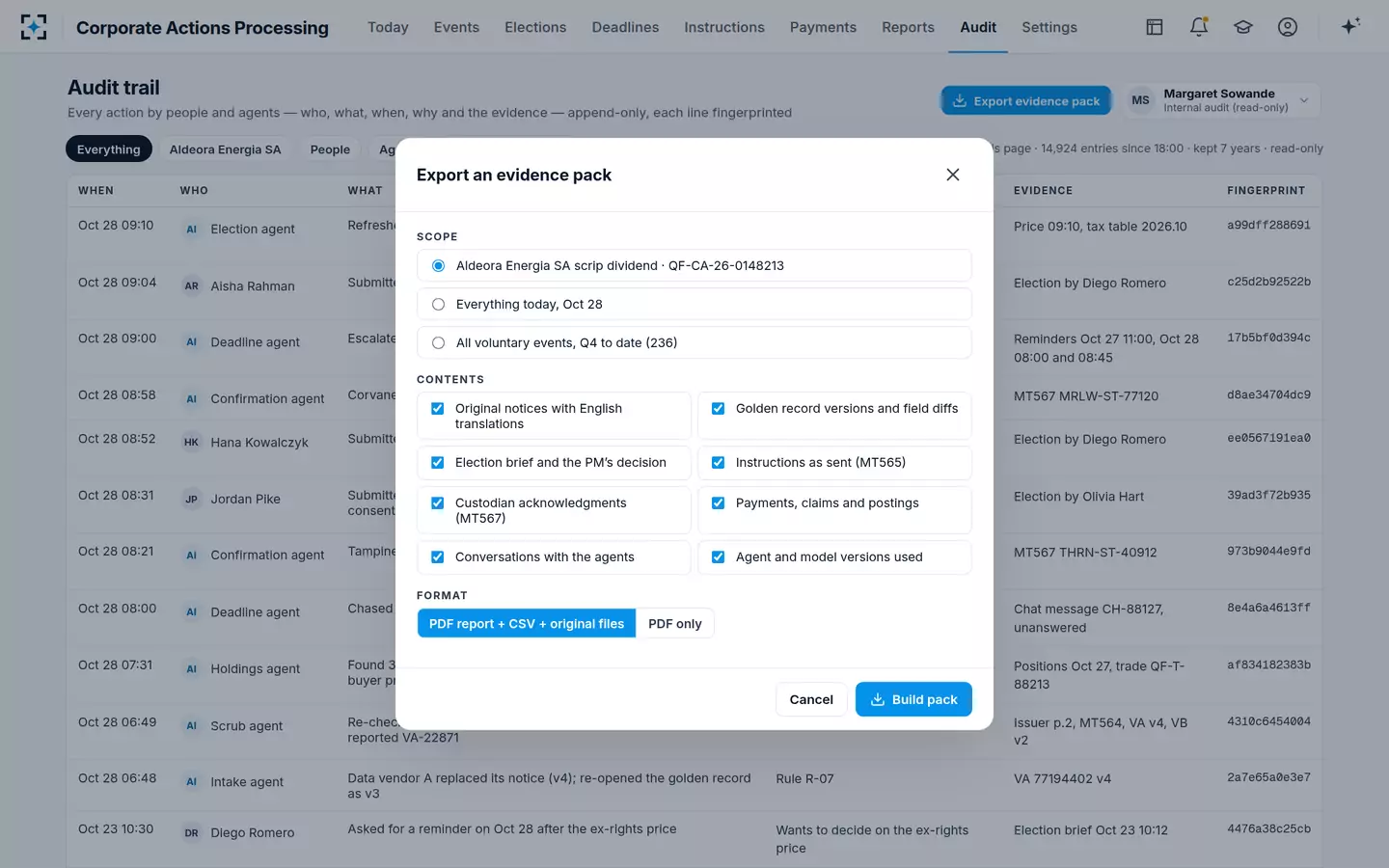
Every event's evidence, exported for one event, one day or a whole quarter
Running class action claims like a corporate action with no default
The useful frame is to treat each settlement as an elective event whose default is zero. Every control a good asset servicing team applies to a scrip dividend or a tender offer applies here, and the only thing missing is a custodian deadline forcing the issue. The comparison shows where the two line up and where a claim needs more.
An elective corporate action and a class action claim, step by step
Elective corporate action: Pushed down the custody chain, by law the same day in the EU.
Class action claim: Sent to identifiable class members and nominees; the fund may need to find it.
Elective corporate action: Ratio, price, dates and default, checked against the issuer's document.
Class action claim: Class period, eligible securities, per-share amounts and deadline, checked against the court filing.
Elective corporate action: Settled position on the record date, plus pending trades.
Class action claim: Every purchase and sale in the class period, restated for corporate actions.
Elective corporate action: An option the issuer or custodian applies.
Class action claim: Nothing. No filing, no payment.
Elective corporate action: Custodian cut-off, worked back to an internal one.
Class action claim: Claim cut-off set by the settlement, worked back the same way.
Elective corporate action: Acknowledgment and payment matched to the instruction.
Class action claim: Filing receipt and payment matched to the claim.
Where does a corporate actions solution fit? It fits where the claim depends on corporate actions data: the holdings history adjusted for every split, merger and identifier change, the cited terms, the internal deadline and the maker-checker discipline on anything sent out. It does not replace the claims administrator's process, the legal judgement on whether to opt out and sue, or a filing service a fund already uses. In Corporate Actions Processing, the agents prepare and chase; people approve and submit, as they do for an election. The three kinds of corporate action explain why the default is where money is lost, and the processing life cycle shows the deadline discipline in full.
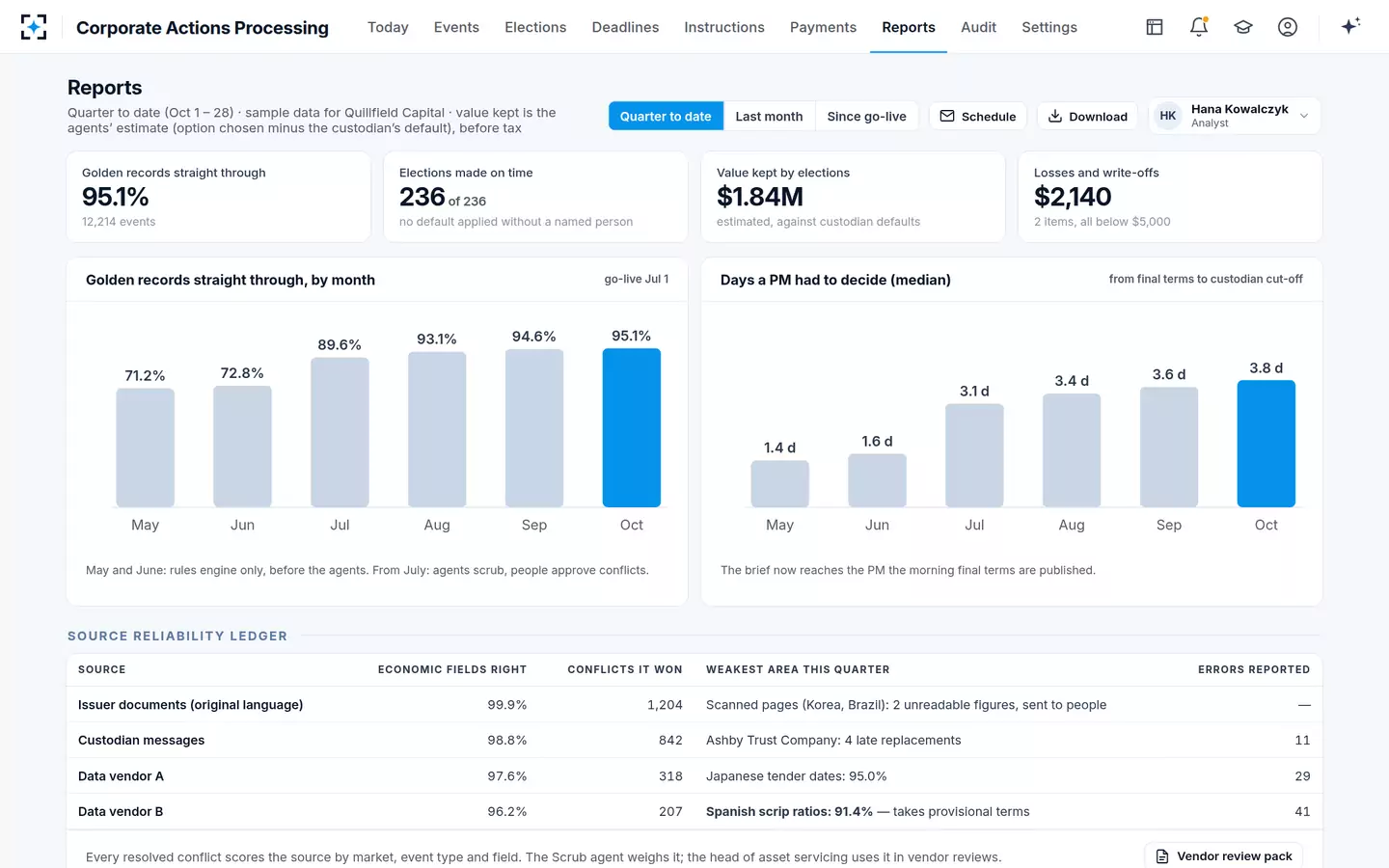
Value kept and losses, reported as numbers a board can read
Questions people ask
What happens if a fund does not file a class action claim?
It receives nothing from the settlement and is still bound by the judgment, unless it asked to be excluded by the deadline in the notice. Under Rule 23(c)(3), the judgment in a damages class covers members who received notice and did not request exclusion.
How much is a securities class action claim worth?
The settlement notice gives an average: the PSLRA requires it to state the recovery on an average per share basis, and the fees sought per share. A fund's actual payment depends on its own trades in the class period and on how many other members file, so the average is a starting estimate, not a promise.
Are SEC Fair Fund distributions the same as class action settlements?
No. A Fair Fund comes from an SEC enforcement action, not a private lawsuit, but it also pays only those who claim. Its distribution plan must set procedures for making claims and a cut-off date under the SEC's Rule of Practice 1101.
Do custodians file class action claims automatically?
Some offer it as a service, but it is not automatic or universal, and Cox and Thomas found custodians had financial disincentives to file. In custody messaging the event is coded voluntary, with abstaining as the default, so a custodian that does nothing has followed the default.
Can a fund opt out of a class action?
Yes, in a damages class under Rule 23(b)(3): the notice must state the time and manner for requesting exclusion. A fund that opts out keeps its own claim against the defendant but gives up any payment from the class settlement, so the decision belongs with counsel and the portfolio manager, not operations alone.