A due bill is the seller's written obligation to hand over a dividend or other distribution that the buyer is entitled to by contract but that the issuer will pay to the seller, because the seller was still the holder on the record date. In the US, due bills attach to trades in a security whose distribution is worth 25% or more of its value: FINRA's rule then sets the ex-dividend date after the payable date, so for a week or more the shares trade with a dividend that will be paid to someone else. Europe solves the same problem with market claims, and elective events with buyer protection. All three exist because a trade and a record date can sit on opposite sides of each other. Botminds' Corporate Actions Processing is an agentic solution that finds those trades before the money moves: its Holdings agent compares record-date positions with traded positions, failed trades and loans, and drafts the protection or the claim for a person to approve.
What is a due bill?
FINRA's Uniform Practice Code defines a due bill as "an instrument employed for the purpose of evidencing the transfer of title to any security", here the right to a distribution, and makes it non-transferable by the buyer. For cash, the instrument is a due-bill check: "a due-bill in the form of a check payable on the date of payment of a cash dividend", treated as a due bill for that amount until the payment date (FINRA Rule 11630).
The rule also says when one is owed. A seller that delivers a security too late for the buyer to be registered by the record date must deliver it "accompanied by a due-bill for the distribution to be made". And where no due bill was given, the general claims rule applies: a buyer who could not be registered in time may ask the seller, which must "use its best efforts to collect the same for the buyer" (FINRA Rule 11640). The due bill turns a best-efforts chase into a fixed obligation.
When are due bills used? The 25% rule
Due bills are used in the US when a distribution is large: a cash dividend, stock dividend, split or warrant distribution worth 25% or more of the security's value. For those, FINRA sets the ex-dividend date as "the first business day following the payable date" (FINRA Rule 11140(b)(2)). Between the record date and that late ex-date, the shares trade with the distribution attached, but the issuer pays whoever was on the books at the record date. Every sale in that window therefore carries a due bill from seller to buyer.
An ordinary dividend and a large one: when trades stop carrying the payment
- Trades carry the dividendto the day before
- Ex = record date
- Trades are ex; issuer pays the holder of recordto payable date
- Trades carry the dividendto the record date
- Record date to payable date: sales carry due billsdue bill window
- Ex-datenext day
For ordinary distributions the opposite holds. Since the US moved to T+1, the ex-dividend date is the record date itself, if it is a business day, so a buyer on the day before the ex-date settles in time to be on the books (SEC Release 34-99075, December 2023). Only a failed or late settlement leaves the dividend with the seller, and that is a claim, not a due bill.
What is the due bill redemption date?
The redemption date is the day the seller must make good. For a due-bill check on a cash dividend, it is the payment date. For a due bill on shares or rights, FINRA's rule makes it redeemable "on the date on which the security or rights are issued by the corporation", or as soon after as the signer of the due bill can obtain them in the denominations needed (FINRA Rule 11630(e)). In practice the payable date of the distribution and the due bill redemption date coincide, and the ex-date follows one business day later.
The US due bill rules in four numbers
25%
distribution size at which the ex-date moves after the payable date (Rule 11140(b)(2))
+1day
ex-date: the first business day after the payable date for large distributions
0days
gap between ex-date and record date for ordinary distributions since 28 May 2024
10%
stock dividend size from which the buyer holds back part of the price until the due bill is redeemed (11630(c))
Why does a large distribution change the ex-date?
The ex-date is the day the market price stops including the distribution; FINRA defines it as "the date on and after which the security is traded without a specific dividend or distribution" (FINRA Rule 11120(d)). For a small dividend, setting it on the record date costs little if anyone gets the timing wrong. For a distribution worth a quarter or more of the share, the rule keeps the right attached to the shares until the money has actually been paid, and uses due bills to route it to whoever owns the shares at that point. Our reading is that this protects buyers from paying a pre-distribution price for shares that have already been stripped of a large payment.
For an operations team, the practical consequence is a window in which positions on the issuer's books and positions by contract differ by design. A fund that sells in that window will receive the distribution and must pass it on; a fund that buys will not receive it from the issuer and must collect it through the due bill. Both sides need to know before the payable date, or the cash lands in the wrong fund's accounts.
How do market claims work in Europe?
A market claim moves the proceeds of a distribution from the party that received them to the party entitled to them, and in Europe the depository does it automatically. ESMA describes the trigger: "When there is a settlement fail at record date, the seller maintains the right attached to the security", and for an economic right "the buyer can start a market claim in order to receive a monetary compensation corresponding to the lost right" (ESMA, T+1 assessment report, November 2024, §76). There is no compensation for an administrative right, such as attending a meeting.
When a European depository must create a market claim under T+1
| Scenario | Security type | Condition | Claim moves |
|---|---|---|---|
| 1 | Nominal (bonds) | Intended settlement on or before the record date, but not settled by it | Seller to buyer |
| 2 | Units (shares) | Traded before the ex-date, not settled by the record date | Seller to buyer |
| 3 | Units (shares) | Traded on the ex-date, but settled by the record date | Buyer to seller (a reverse market claim) |
The rules leave little to the parties. The trade date of the claim is the trade date of the underlying transaction; the tax rate is set by the issuer's depository and "always be the same for a given ISIN and corporate event"; and a claim is not created only if both parties opted out with the indicator "NOMC" (AMI-SeCo T+1 guide, MC3, MC4, MC14). The rules are also not yet followed everywhere. In its December 2025 report, the ECB's market-standards group found market claims "not being created in all scenarios as expected", not created across depositories, or "not being processed by the CSD at all", including in markets previously reported compliant (AMI-SeCo, Corporate Events Compliance Report, 2025).
Buyer protection: the elective-event version of a claim
On an event with options, a cash claim is not enough: the buyer may want shares, or the other option, and the seller holds the right to choose. Buyer protection lets a buyer "who has yet to receive the underlying securities subject to an elective corporate action" instruct its account servicer which proceeds it wants (AMI-SeCo T+1 guide, §3). The EU regulation defines the buyer protection deadline as the last day and time by which such a buyer "must instruct the seller regarding the choice between the options", and requires it to come before the issuer deadline (Implementing Regulation (EU) 2018/1212, Art. 1 and Art. 8(2)(d)).
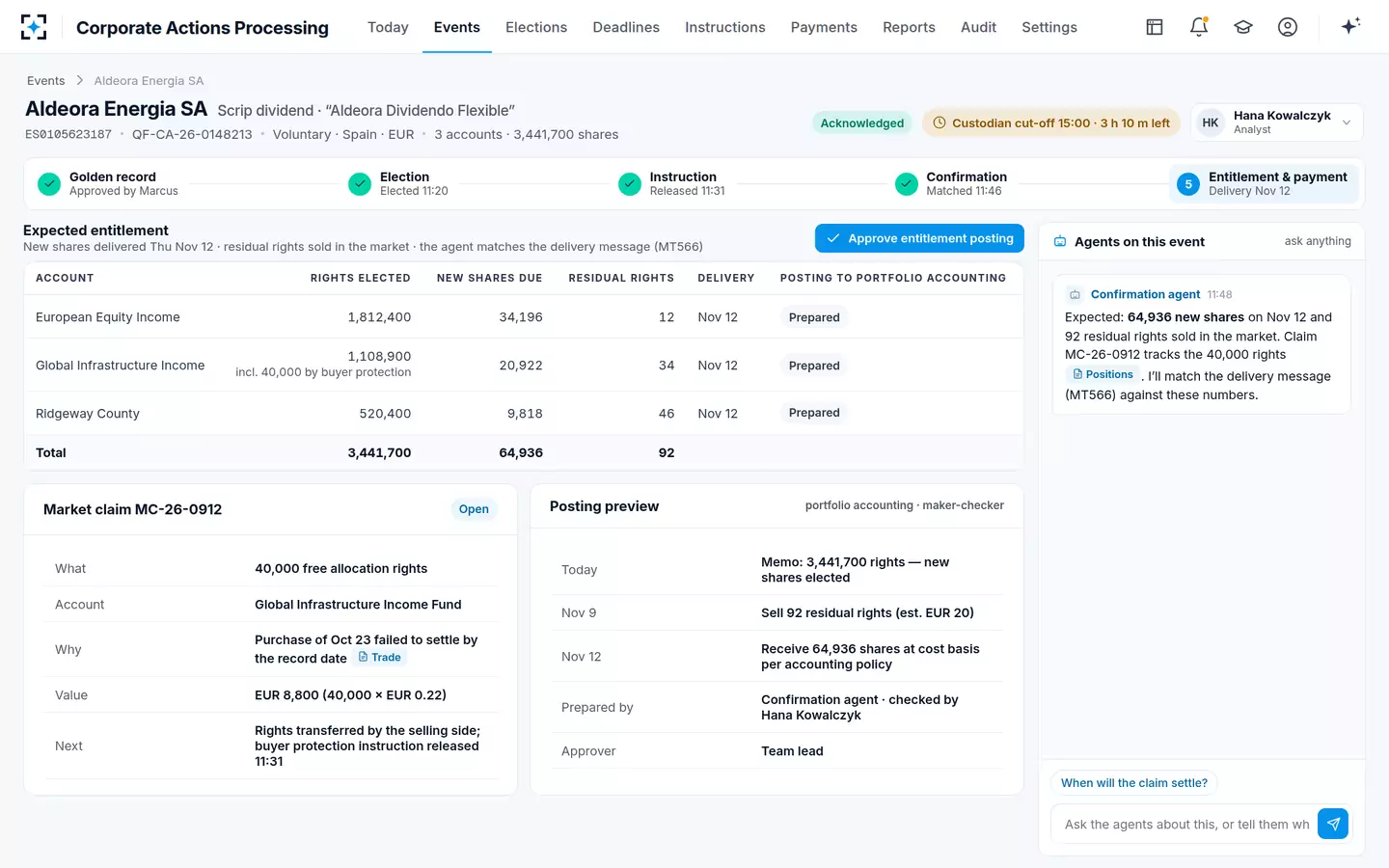
The sample day in Corporate Actions Processing shows both mechanisms on one event, using fictional data. Quillfield Capital's Global Infrastructure Income fund bought 40,000 Aldeora Energia shares on 23 October, and the purchase failed to settle by the record date of 27 October, so the 40,000 free allocation rights of Aldeora's scrip dividend were credited to the seller. The Holdings agent found the gap, drafted a buyer protection instruction electing new shares for those rights, and opened market claim MC-26-0912 to track them, worth about EUR 8,800 at EUR 0.22 a right.
A failed purchase becomes a buyer protection instruction and a tracked claim
A US due bill and a European market claim solve the same problem differently
US due bill: A sale between the record date and a late ex-date on a distribution of 25% or more, or a delivery too late for transfer by the record date.
EU market claim: A trade on the wrong side of the record date: pending at the record date, or traded on the ex-date but settled in time.
US due bill: The selling firm delivers it with the shares, under FINRA's Uniform Practice Code.
EU market claim: The depository or central counterparty, automatically, at the record date and hourly for 10 business days.
US due bill: On the payment date of the distribution, or when the shares are issued.
EU market claim: Settles on the payment date of the event.
US due bill: Handled through the offer's own procedures and the depository's processes.
EU market claim: Buyer protection: the buyer instructs which option it wants, before the deadline.
What changes for due bills and market claims when settlement shortens to T+1?
In the US, T+1 moved the ordinary ex-date onto the record date, which removed one day in which a correctly settled purchase could still miss the books. The large-distribution rule did not change: the ex-date is still the business day after the payable date, so the due bill window is as long as the issuer makes it. In Europe the same alignment comes with T+1 on 11 October 2027: under the harmonised rule KD1, the ex-date "must be on the same date as the record date" (AMI-SeCo T+1 guide).
The transition itself creates claims. Where US and EU settlement cycles differ, ESMA found depositories handling securities traded in both markets in two ways, one of which, adopting T+1 key dates while still settling T+2, "implies a potential increase in market claims since trades concluded on Ex Date-1 (thus still with the entitlement) will be settled after Record Date" (ESMA, §127). The UK plan gives firms until 31 December 2026 to bring their claims policies, processes and systems into line with a one-day cycle (Accelerated Settlement Technical Group report, COAC 02b).
The volume of claims depends on the fail rate, which no regulator publishes per corporate event. What can be measured is a fund's own count: purchases settling after a record date, claims raised, claims received, and how long each took. The processing life cycle shows where each check sits, and mandatory, mandatory with options and voluntary events explains which events can carry buyer protection.
Catching due bills and claims before the payment date
A claim caught on the payment date is a reconciliation break; a claim caught on the record date is a booking. Corporate Actions Processing makes the second the normal case. On every event, the Holdings agent compares the settled position at the record date with the traded position, pending and failed trades and shares on loan, and proposes what each gap needs: a buyer protection instruction on an elective event, a market claim to track, or a note that a due bill should arrive with a delivery. It never changes a position or recalls a loan; it proposes, and a person approves.
The buyer protection instruction drafted beside the three elections
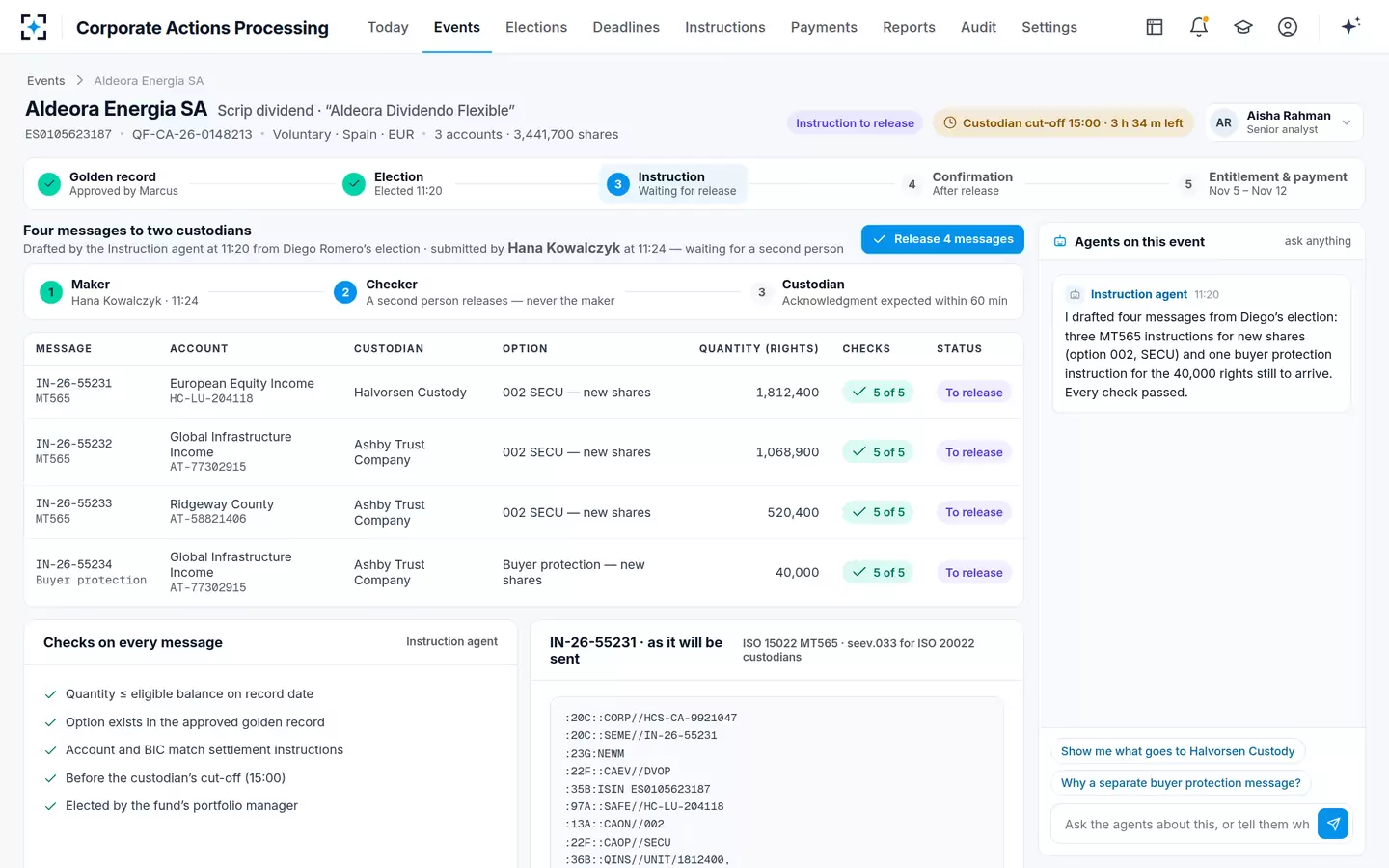
The Confirmation agent closes the loop. When the delivery message arrives, it matches quantities, fractions and cash in lieu against the expected entitlement, including the claim, and flags any break with a drafted fix. Postings to portfolio accounting wait for a person's approval. The full set of screens is in Corporate Actions Processing.
Questions people ask
What is the difference between the ex-date and the pay date?
The ex-date is the first trading day without the distribution; the pay date, or payable date, is when the issuer pays it. For ordinary US dividends the ex-date has been the record date since 28 May 2024, days or weeks before payment; for distributions of 25% or more it is the business day after the pay date.
Do due bills apply to stock splits?
They can. FINRA's 25% rule covers stock dividends and splits as well as cash, so a large split also moves the ex-date after the payable date, and sales in between carry due bills for the new shares. Where a due bill covers stock, the buyer prorates the contract value and pays the balance when the due bill is redeemed, except on stock dividends under 10%, spin-offs and rights (Rule 11630(c)).
What is a reverse market claim?
It is a claim from buyer to seller, when the buyer received a distribution it was not entitled to: the trade was made on the ex-date but settled by the record date, so the buyer appears on the books. The European T+1 rules require depositories to create it automatically.
Who pays a market claim, and when?
The party that received the proceeds pays the party entitled to them, through the depository or central counterparty that created the claim. Under the European T+1 rules the claim settles on the payment date of the underlying event, as a free-of-payment delivery for securities or a payment free of delivery for cash.
Are due bills still used under T+1?
Yes, for large distributions. T+1 put the ordinary ex-date on the record date, but FINRA kept the rule that distributions worth 25% or more go ex on the business day after the payable date, so the due bill window remains for those events.