Mandatory corporate actions happen to every holder without an instruction: a cash dividend is paid, a stock split is applied, a bond is redeemed. Voluntary corporate actions happen only to holders who choose to take part, as in a tender offer. Between the two sits a third kind that the mandatory vs voluntary split hides, the mandatory event with options, where every holder is affected but may choose the form, and a default applies to anyone who stays silent. That is where funds lose money without noticing, because silence is an answer. Corporate actions processing is the asset servicing work that turns each announcement into the right outcome for every fund. Botminds' Corporate Actions Processing is an agentic solution built for that work: agents read every notice, value every option and chase every deadline, and people approve, elect and release.
The examples below use the solution's sample data: Quillfield Capital, a fictional asset manager, and fictional issuers and custodians. The rules and research come from regulators, the European Central Bank's market-standards group and peer-reviewed studies, linked where they appear.
What is the difference between mandatory and voluntary corporate actions?
The difference is whether the holder has to act. A mandatory event changes the position on its own; a voluntary event changes nothing unless the holder instructs. Europe's market standards add the third case explicitly. The harmonised T+1 guide published by the ECB's Advisory Group on Market Infrastructures for Securities and Collateral (AMI-SeCo) says participation in a corporate event "can be mandatory, mandatory with choices or voluntary" (AMI-SeCo, T+1 Corporate Events Harmonised Implementation Guide, July 2026).
The same guide defines a mandatory distribution as one where the issuer pays cash or securities to all holders "automatically without requiring any action or choice". It then groups the other two together as elective events, in which the holder "must actively respond or instruct their custodian/intermediary if they wish to participate in the event; otherwise, a default option is applied." Read carefully, that sentence is the whole subject: on every elective event, somebody's choice gets made, whether or not anyone made it.
Three kinds of corporate action, sorted by who has to decide
| Kind | Does the holder act? | If nobody answers | Typical examples |
|---|---|---|---|
| Mandatory | No. The terms apply to every holder. | Nothing to miss. Proceeds arrive on the payment date, if the position was settled on the record date. | Cash dividend, stock dividend or bonus issue, stock split, redemption, distribution of rights |
| Mandatory with options | Only to change the outcome. Every holder is affected either way. | The default option applies, and it may not be the better one. | Optional (scrip) dividend, currency choice on a cash dividend, dividend reinvestment, conversion, exercise of rights |
| Voluntary | Yes, to take part at all. | The holder stays out and keeps the security. | Tender offer, issuer repurchase offer, exchange offer, consent solicitation |
Mandatory with options: the category the two-way split hides
A mandatory event with options is one where the event will happen to every holder, but each holder may pick the form the proceeds take. A scrip dividend is the clearest case: the dividend is paid either way, and the only question is whether it arrives as cash or as new shares. The industry code for this participation type, CHOS, is short for "mandatory with choice".
What defines the category is the default. The AMI-SeCo collateral rulebook makes it a standard: "A default option should be present in all CA events that have more than one option," and the default identified by the issuer's central securities depository "must be transmitted unchanged through the custody chain" (SCoRE corporate actions rulebook, Standard 11). The T+1 guide applies the same logic to trades still settling at the deadline.
For mandatory reorganisations with options, non-elected transactions should transform into the default option set by the issuer CSD.
AMI-SeCo, T+1 Corporate Events Harmonised Implementation Guide, 2026
On a voluntary event, silence costs an opportunity. On a mandatory event with options, silence is a choice with a price, because the default is set by someone who does not know the fund. In the solution's sample day, the Spanish issuer Aldeora Energia SA names new shares as the default of its rights-based scrip dividend, but the custodian applies cash to Quillfield's accounts if nobody instructs. Before tax, the difference across three accounts is about EUR 41,300, the gap between EUR 0.2200 and EUR 0.208 a right on 3,441,700 rights. What a missed scrip election costs works that arithmetic through account by account.
That is why the useful question for an operations team is not "mandatory or voluntary?" but "what happens if we do nothing, and is that what the fund would choose?" A label on a notice answers the first question. Only the terms, the fund's position and a price answer the second.
What are examples of voluntary corporate actions?
Voluntary corporate actions are events a holder joins only by instructing: tender offers by a third party, repurchase offers by the issuer, exchange offers and consent solicitations are the common ones, and the AMI-SeCo rulebook codes each of them VOLU. The no-action option, NOAC, is defined there as the "Option for the account owner not to take part in the event."
In the United States the tender offer rules decide how long a holder has and what a tender commits it to. An offer must stay open at least twenty business days from launch, and at least ten business days after any change in the price or the share of the class sought (Rule 14e-1). A holder who has tendered may withdraw for as long as the offer remains open (Rule 14d-7). If a partial offer is oversubscribed, shares are taken up "as nearly as may be pro rata" (Rule 14d-8), so tendering a whole position does not mean selling it.
The US tender offer clock, in the rule's own numbers
20days
minimum business days a tender offer stays open (Rule 14e-1(a))
10days
minimum business days left after a change in price or percentage sought (14e-1(b))
3days
minimum business days of a subsequent offering period, with no withdrawal rights (14d-11)
<100
shares: odd lots an issuer may buy in full before prorating everyone else (13e-4(f)(3))
Two details change how a fund should answer. During a subsequent offering period, which a bidder may add after the initial twenty days, there are no withdrawal rights (Rule 14d-11), so an instruction given then is final. And an issuer buying back its own shares may accept odd lots of fewer than one hundred shares in full before prorating everyone else (Rule 13e-4(f)(3)), which matters to a fund with a small residual position and to nobody else.
The sample day carries one voluntary event at risk. Kessel Logistik AG has a cash tender offer of EUR 31.20 a share with a 75% minimum acceptance; the custodian's cut-off is 13:00, the fund's own internal cut-off 11:00, and the portfolio manager has not answered two reminders. The difference between tendering and not tendering 486,000 shares is EUR 170,100. If nobody answers, the fund keeps its shares; if the offer then succeeds and moves to a squeeze-out, the event the fund ignored as voluntary comes back as mandatory.
Are rights issues voluntary corporate actions?
A rights issue is two events, and only the second is voluntary. The first, the distribution of the rights, is mandatory: every holder on the record date receives them. The AMI-SeCo rulebook codes it as an intermediate securities distribution that "gives the holder the right to take part in a future event". The second, exercising those rights, is an elective event with options that include exercise, sale, purchase of more rights and lapse. Where lapse is the default, doing nothing lets valuable rights expire.
That is not a theoretical risk. Holderness and Pontiff found that "shareholder participation in valuable domestic rights offerings averages only 64%", and that non-participation transfers wealth to participating holders averaging 7% of the offering, more in non-transferable offers (Journal of Financial Economics, 2016). In Finland, Rantapuska and Knüpfer traced at least EUR 9.9 million lost between 1995 and 2002 by exercising rights too early, selling them below intrinsic value or leaving them unexercised (Review of Finance, 2008).
Valuable rights go unused far more often than holders assume
The Finnish study adds who loses most: investors with small portfolios, inactive accounts, those living abroad, and those "who know neither of the official languages in Finland". A fund is not a household, but the last group should make any asset servicing team uneasy. A notice that arrives only in the issuer's language, read late by someone who does not speak it, is the institutional version of the same failure.
What happens if no election is made?
If no election is made, the default applies on a mandatory event with options, and the holder simply does not take part in a voluntary one. The harder question for a fund is whose default. The issuer sets one, but the custodian's service terms and the fund's own standing instructions can each apply something else to the account, and the fund only finds out which on the payment date.
EU law limits how far ahead of the market a custodian may ask for an answer. For shares within the Shareholder Rights Directive, the last intermediary in the chain "shall not set a deadline requiring any shareholder action earlier than three business days prior to the issuer deadline or record date" (Implementing Regulation (EU) 2018/1212, Art. 9(4)). Three business days is the outer limit, not a promise: the fund's own internal cut-off sits earlier still, because the portfolio manager has to decide before operations can instruct. In the sample, the Aldeora market deadline is Monday 2 November, the custodian's cut-off is Wednesday 28 October at 15:00 London, and the internal cut-off is two hours before that.
A buyer whose purchase has not settled has its own route. Buyer protection lets a buyer who has not yet received the securities instruct the seller which option it wants, before a buyer protection deadline that the EU standards place after the guaranteed participation date. Due bills, market claims and buyer protection follows a late-settling trade through each.
Who decides the election for a fund?
The portfolio manager decides, or a delegate named in the fund's procedures; the operations team prepares the decision and carries it out. The intermediaries in the chain act on instruction. Under the Shareholder Rights Directive, an intermediary that exercises rights for a shareholder does so "upon the explicit authorisation and instruction of the shareholder and for the shareholder's benefit" (Directive (EU) 2017/828, Art. 3c). No instruction, no exercise: the default applies.
For a fund, three people usually touch an election before it reaches a custodian. An analyst confirms the terms and the eligible position. The portfolio manager chooses, ideally with each option valued for the fund, not with a forwarded notice. A second person checks the instruction before it is released. Some mandates add a fourth step: in the sample, Ridgeway County's separate account requires a client notice within five business days of any voluntary election.
How the three kinds are coded in custodian messages
Every corporate action notice carries the participation type as a code, so a system can sort events before anyone reads them. In the ISO 20022 notification, seev.031, a "Mandatory/Voluntary Indicator" takes one of three values: MAND, CHOS or VOLU. The options block, present only on CHOS and VOLU events, carries the option number and type, a default option indicator, an indicator of whether a change of instruction is allowed, the response deadline set by the account servicer and the market deadline set by the issuer or its agent (SCoRE corporate actions rulebook, Table 1).
The code is also where errors start. The same rulebook treats the event type, the participation type and the security identifier as critical: if any of them changes, the account servicer must cancel the event and open a new one. A notice first sent as mandatory and later corrected to mandatory with options is therefore a new event with a new deadline, not an amendment. The MT564 field by field maps each of these codes to the document it should be checked against.
The codes help sort, but they do not decide. ESMA's description of the European chain is blunt about where the information starts: the issuer should inform its central securities depository as soon as an event is announced, and from there it has to pass down every CSD and intermediary to the end investor (ESMA, T+1 assessment report, November 2024; each link is mapped in the corporate actions processing life cycle). A code set wrongly at the top of the chain travels all the way down.
How Corporate Actions Processing sorts events by the decision they need
Corporate Actions Processing treats the participation code as a hint and the default as the fact that matters. The Scrub agent builds one golden record per event from both data vendors, each custodian's message and the issuer's own notice, and the default is one of its fields. Where the issuer's default and the custodian's differ, the record says so and explains why, before anyone is asked to decide.
The golden record shows two defaults, and which one applies to the fund
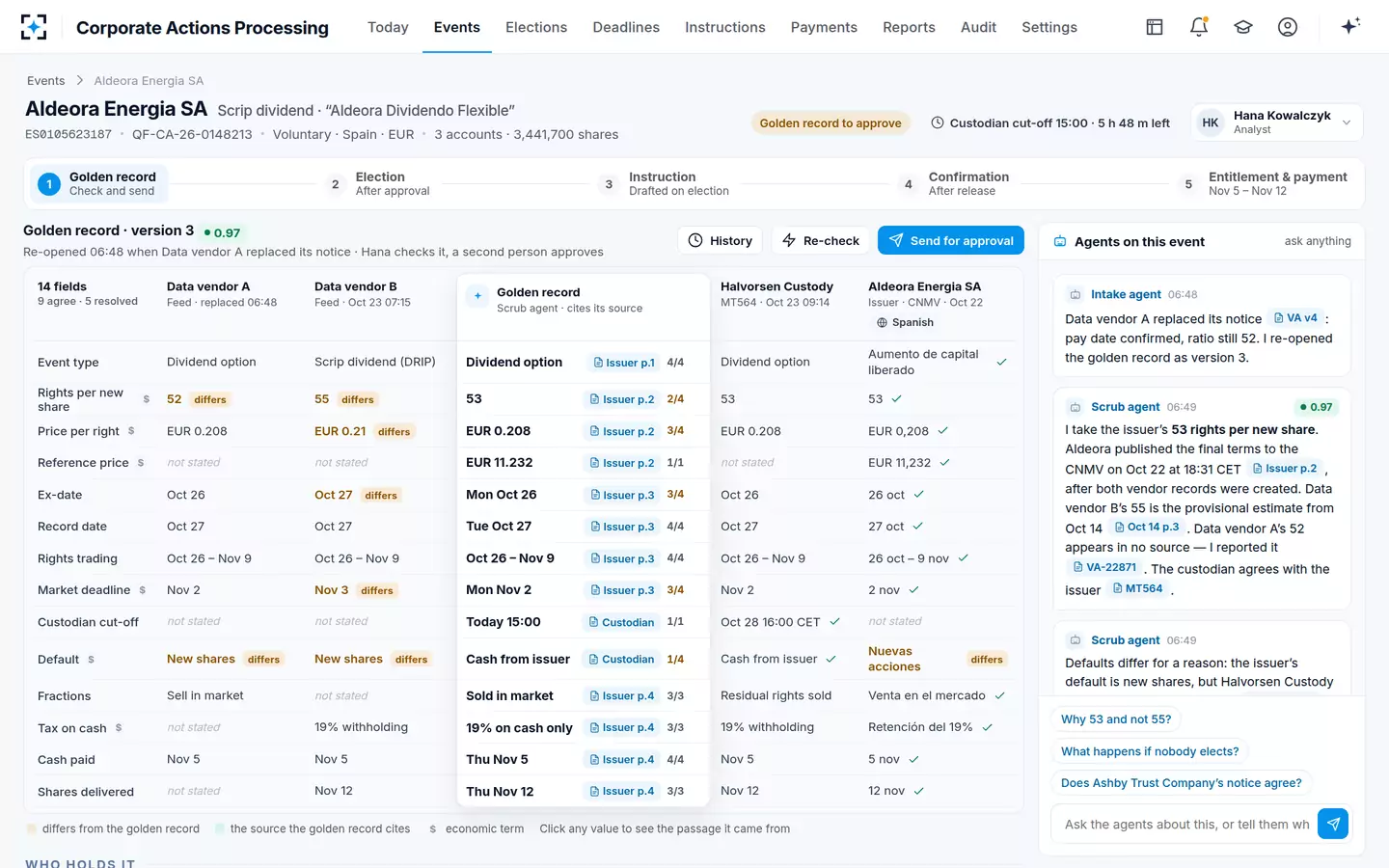
From there the event is routed by what it needs. A mandatory event whose sources agree on every economic field can go straight through; the sample day's overnight run sent 586 of 612 golden records through that way. A mandatory event with options goes to the Election agent, which values every option for every account and recommends one, and to the Deadline agent, which works back an internal cut-off from each custodian's and chases the named portfolio manager. A voluntary event gets the same treatment, with "do not take part" valued as an option like any other.
Every open election, sorted by the cut-off that matters to the fund
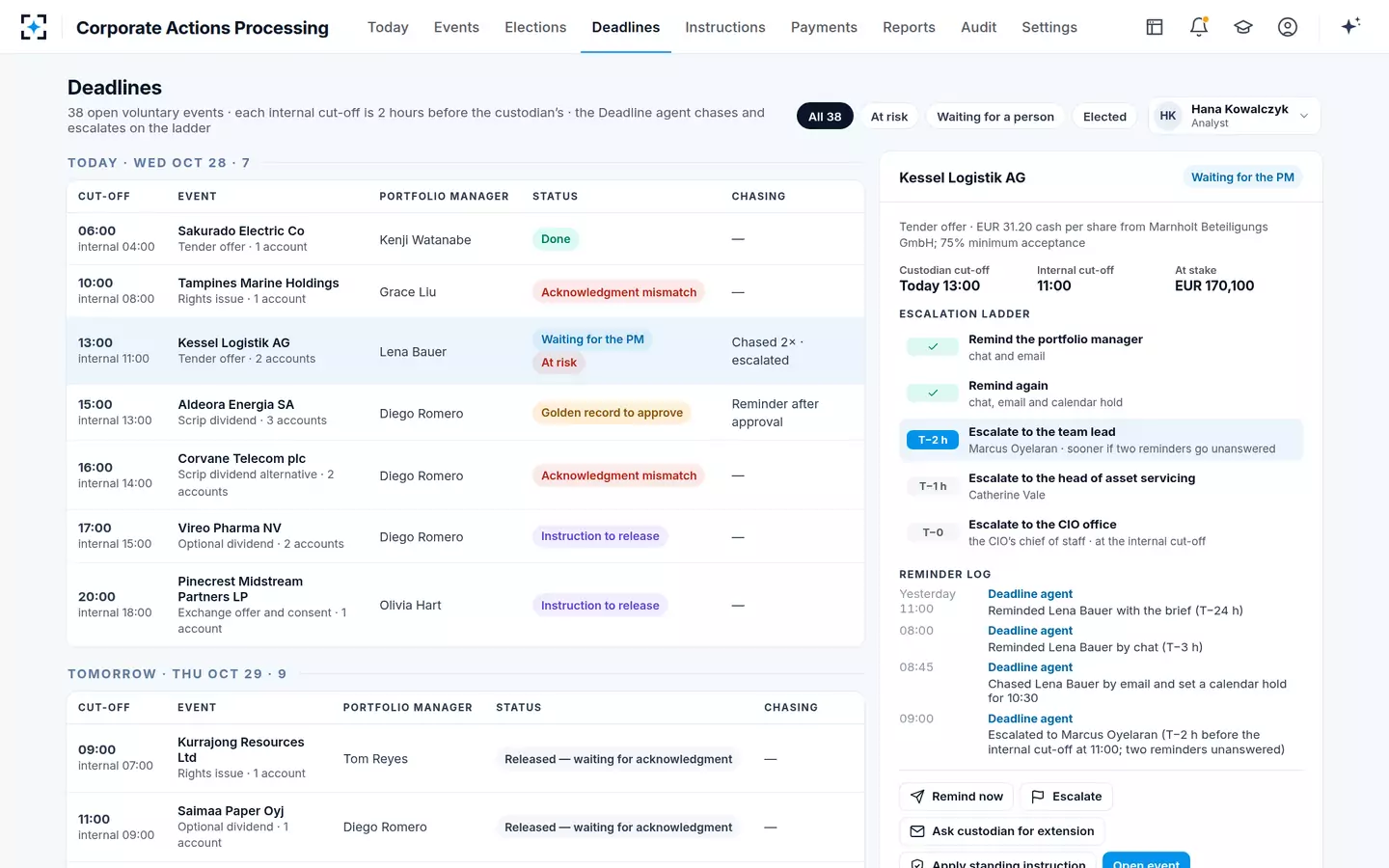
Two rules hold across all three kinds. The agents never elect: only the fund's portfolio manager or a named delegate does, per account and with a reason. And a default never applies silently: a standing instruction can be applied only by a team lead, by name, with a reason that is logged. The corporate actions processing life cycle shows where each of those steps sits between announcement and payment, and Corporate Actions Processing shows the screens in full.
Questions people ask
Is a stock split a mandatory or a voluntary corporate action?
A stock split is mandatory. The AMI-SeCo T+1 guide lists stock splits and redemptions as its examples of mandatory reorganisations, which affect every holder "without requiring any action or choice". In the US, an issuer must still give notice of a split to FINRA no later than ten days before the record date under SEC Rule 10b-17.
Is a dividend reinvestment plan voluntary?
A dividend reinvestment option is a mandatory event with choice: the dividend is paid either way, and the holder chooses cash or reinvestment. The AMI-SeCo rulebook distinguishes a reinvestment plan, where the company buys shares in the market, from a dividend option, where it creates new shares; both are coded CHOS.
What is a mandatory corporate action with options?
It is an event that happens to every holder but lets each choose the form of the proceeds, with a default for anyone who does not choose. Optional dividends, currency choices on a cash dividend and conversions are common examples. The European standards require the notice to identify the default option and every intermediary to pass it on unchanged.
Can you change a corporate action election after submitting it?
Sometimes. In a US tender offer a holder may withdraw tendered shares while the offer remains open, but not during a subsequent offering period. In ISO 20022 notices a "change allowed" indicator says whether a change of instruction is accepted, and custodians set their own deadlines for changes.
Is a takeover offer mandatory or voluntary?
A takeover offer is voluntary for each holder: tendering is a choice. The AMI-SeCo rulebook notes that when a tender reaches the squeeze-out stage it becomes mandatory, so holders who did not tender are bought out on the same terms anyway, usually later.