A corporate actions analyst, also called a corporate actions specialist or associate, takes each corporate event that touches the firm's funds from announcement to payment: confirms the terms, finds every affected account, gets an election from the portfolio manager where one is needed, instructs the custodians and checks that the right cash and shares arrive. The work is hard less because of any single step than because of the number of other parties each step depends on, each with its own deadline and its own version of the terms. Botminds' Corporate Actions Processing is an agentic solution for that desk: its agents read every notice in any language, build one cited golden record, value each option per fund and chase each deadline, so the analyst spends the day checking and deciding rather than collecting and waiting.
The day described here comes from the solution's sample data: Hana Kowalczyk, a fictional asset servicing analyst in London at Quillfield Capital, a fictional asset manager, on Wednesday 28 October 2026. Official statistics and rules are linked where they appear.
What does a corporate actions analyst do?
A corporate actions analyst turns notices into outcomes for each fund. On a typical event that means six jobs: capture every notice of the event, settle the terms into one golden record, find the positions entitled on the record date (including trades that have not settled and shares out on loan), put the options in front of the portfolio manager, instruct the custodians, and reconcile what is paid against what was expected.
The US occupational database describes the nearest occupation, brokerage clerks, in the same terms. Its task list includes checking ownership, transaction details and dividend distribution instructions against regulatory requirements, and computing holdings, dividends, interest and fees to allocate payments to customers (O*NET OnLine, 43-4011.00). What the task list does not show is the order of the day. Most of it is spent between steps, waiting for someone else.
Who sends the analyst event notices?
Notices come down the custody chain and from the side. Down the chain, the issuer informs its central securities depository, which informs its participants, which inform their clients through sub-custodians and global custodians, as MT564 or seev.031 messages, portal entries, emails and PDFs. From the side, two or more data vendors publish their own reading of the same announcement, usually first and sometimes wrong. And the issuer's own notice, in its own language, sits on its website or with its regulator.
In the EU the law sets the pace of the chain. For shares within the Shareholder Rights Directive, each intermediary must pass the information on without delay, by the end of the business day it arrives, or by 10:00 the next business day if it arrives after 16:00 (the whole chain is mapped in the corporate actions processing life cycle) (Implementing Regulation (EU) 2018/1212, Art. 9). The regulators' own review found the result still uneven. In their 2023 report, ESMA and the EBA recorded investors saying that "At times shareholders either do not receive information in relation to corporate actions or GMs or receive it too late for it to be actionable", worse across borders where the chain is longer (ESMA and EBA, report on SRD2 implementation, July 2023, §102).
The top of the chain is the weakest link. The ECB's market-standards group reported in December 2025 that progress on electronic communication from issuers to their depositories is "too slow", and that complete and accurate issuer information "is critical to the efficient and effective functioning of the entire corporate event process" (AMI-SeCo, Corporate Events Compliance Report, 2025). The analyst downstream inherits every gap.
Who must answer before the deadline?
On an event with options, five parties must answer the analyst before the custodian's cut-off, and only one of them works for the analyst's own team. The table sets out who they are, what the analyst needs from each, and the rule or clock that governs the answer.
Five parties a corporate actions analyst waits on, and the clock each one runs on
| Party | What the analyst needs | The clock |
|---|---|---|
| Issuer or its agent | Final terms: ratio, price, dates, default, conditions. | US: notice to FINRA ten days before the record date (Rule 10b-17). EU: to intermediaries the same business day it announces. |
| Data vendors | A structured announcement the systems can load. | No legal clock. Vendors may carry provisional terms after final terms are published. |
| Custodian and sub-custodians | The notice for each account, the eligible balance, their response deadline and their default. | EU: same-day transmission; a response deadline no earlier than three business days before the issuer deadline (Art. 9(4)). |
| Portfolio manager or delegate | A decision per account, with a reason. | The fund's internal cut-off, set before the custodian's. |
| Settlement and lending desks | Failed purchases to protect, loans to recall if the shares must be held. | Buyer protection deadline; under T+1 in Europe, no later than 11:00 on the market deadline date. |
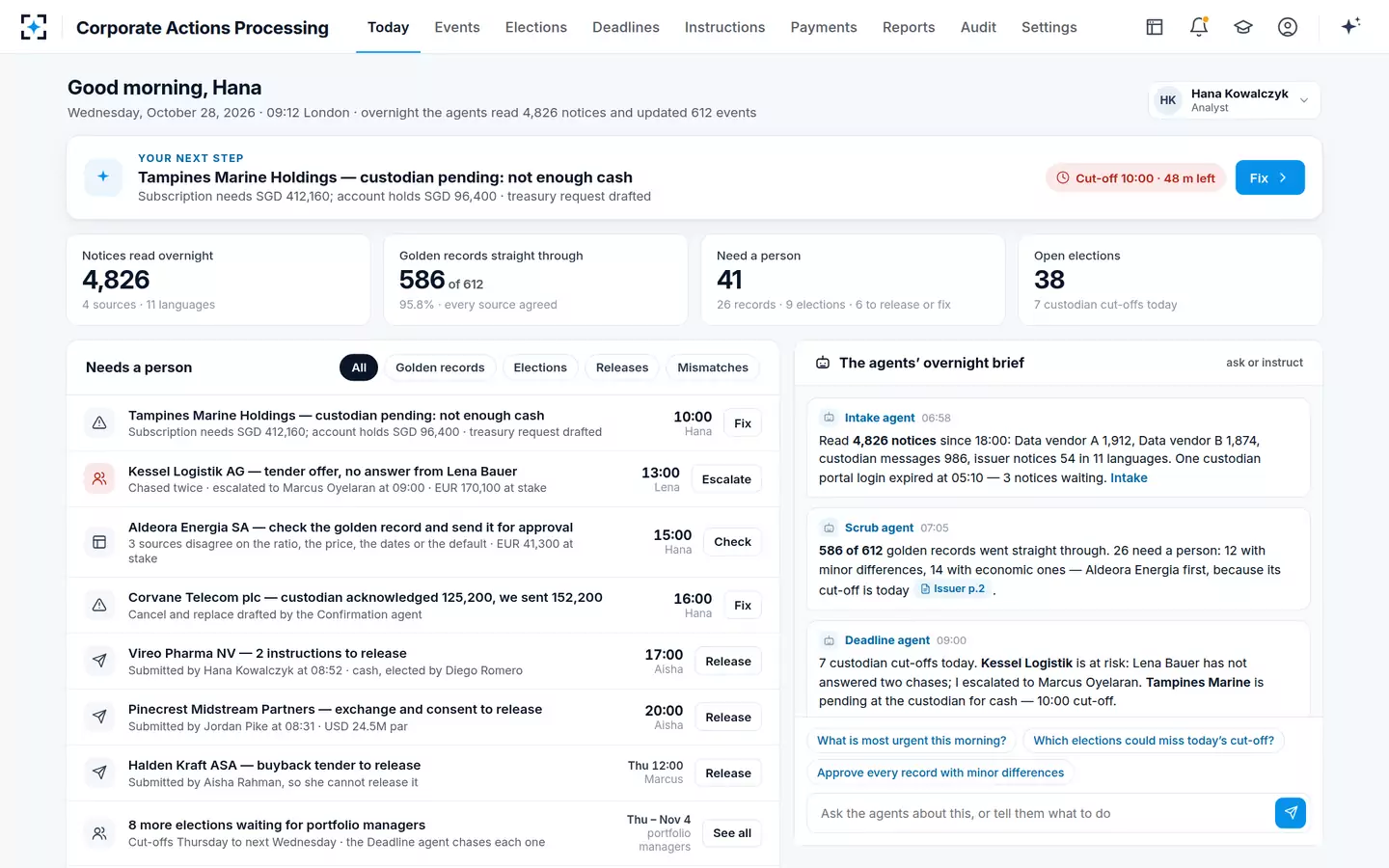
Only the first row comes with a legal deadline that protects the analyst. Vendors have none. Custodians have one that protects themselves. The portfolio manager has whatever deadline the fund sets, and the settlement and lending desks have deadlines the analyst must tell them about. In the sample, the analyst's most urgent wait is not a vendor: Lena Bauer, the portfolio manager on Kessel Logistik's tender offer, has not answered a reminder the day before, a chat at 08:00 or an email at 08:45, with EUR 170,100 at stake and an internal cut-off at 11:00.
Which waits cost the most time?
The longest waits are the ones that need judgement: valuing the options for each fund so the portfolio manager has something to decide, and then chasing the decision. In Botminds' estimate for one contested voluntary event, those two steps take half of about five hours of analyst work when done by hand. Collecting notices, which feels like the core of the job, takes about 45 minutes of it.
Where one contested voluntary event's hours go, by hand and with Corporate Actions Processing
By hand · about 5 hours
- Capturing and scrubbing notices · 21%
- Holdings, failed trades, loans · 10%
- Valuing options, preparing the PM · 29%
- Chasing the election · 20%
- Instruction and payment checks · 20%
With the agents · about 50 minutes
- Capturing and scrubbing notices · 18%
- Holdings, failed trades, loans · 12%
- Valuing options, preparing the PM · 23%
- Chasing the election · 12%
- Instruction and payment checks · 35%
The split also shows what stays. With the agents doing the reading and valuing, the largest share of the remaining time is checking instructions and payments, the work where a second person is required anyway. That is the intended shape: fewer hours, spent where a person's signature matters.
What does the BLS call the corporate actions analyst job?
The US Bureau of Labor Statistics publishes no occupation called corporate actions analyst. The closest is brokerage clerks (SOC 43-4011), whose O*NET definition includes paying out dividends and keeping the daily record of transactions and holdings. Senior roles that value options and advise portfolio managers sit closer to financial and investment analysts (13-2051), a much larger and better-paid group.
The nearest official occupation: brokerage clerks, May 2025
35,940
brokerage clerks employed in the US
$65,750
median annual wage
$72,850
mean annual wage
O*NET rates the occupation Job Zone Three, "Medium Preparation Needed", with one or two years of training on the job. That matches how most corporate actions teams are built: people learn the event types, the market conventions and each custodian's habits by doing the work.
How T+1 changes the corporate actions analyst's day
T+1 removes the spare day the analyst used to absorb surprises. With the ex-date and the record date on the same day, any purchase from the day before that does not settle overnight produces a market claim, and the buyer protection deadline on elective events moves to no later than 11:00 on the market deadline date under the European standards (AMI-SeCo T+1 guide, 2026). The US moved in May 2024; the EU moves on 11 October 2027, and the UK government has committed to the same date.
The UK industry plan, published by HM Treasury, names the processes it expects to be automated. It asks all market participants to consider automating the manual, slow and error-prone parts of asset servicing, entitlement calculation, claims and tax reporting among them, and it sets 31 December 2026 for claims processes to be compatible with T+1 (Accelerated Settlement Technical Group report, February 2025). For the analyst, that means claims become daily work rather than an exception queue at month end.
The analyst's morning: what needs a person, ranked by cut-off
What the corporate actions analyst keeps when agents do the reading
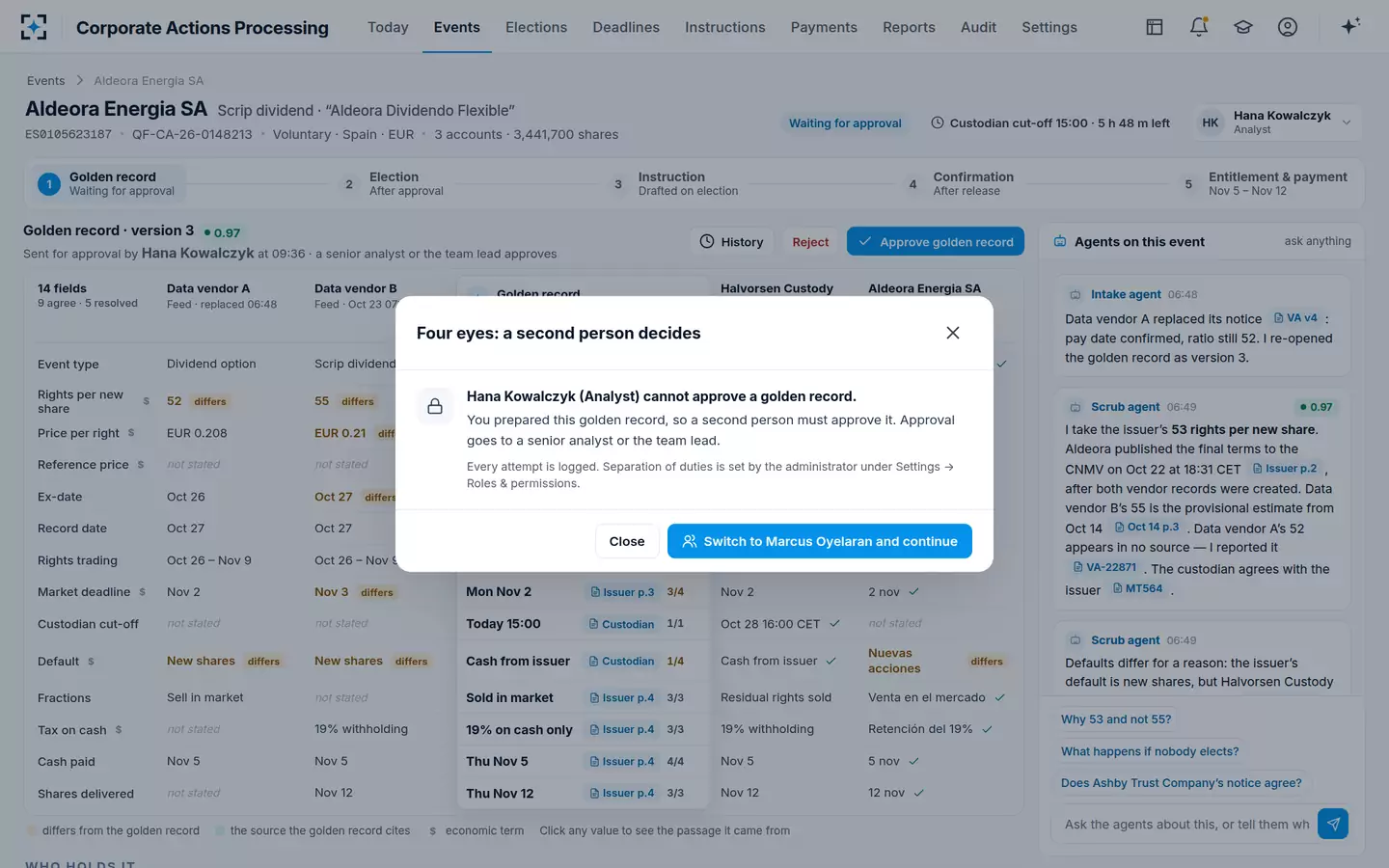
The analyst keeps every judgement and every signature. Agents read, compare, value and chase; they do not approve a golden record, elect, release an instruction, post to accounting or write anything off. The solution enforces separation of duties as a rule, not a habit: the person who prepared a golden record cannot approve it, and the person who submitted an instruction cannot release it.
Five people who carry one corporate action, before and after the agents
Today
Compares four versions of every contested notice by hand, some in languages she cannot read, then rekeys the election.
With agents
Checks a golden record already built and explained, clicks through to the issuer's page, and submits instructions drafted from the election.
Still theirs: preparing every golden record and submitting every instruction
Today
Approves what he can see the proof for, with the proof scattered across inboxes.
With agents
Approves golden records, client notices and postings with every conflict and its source on one screen.
Still theirs: approval; he can never approve his own work
Today
Receives a notice to read, not a decision to make.
With agents
Gets each option valued per fund after tax, asks what-ifs in plain words, and elects with a reason.
Still theirs: the election itself
Today
Does the four-eyes check on a screenshot.
With agents
Releases messages that show the election, the golden record and five passed checks.
Still theirs: release; never of a message she submitted
Today
Answers "was anything missed?" from email after the fact.
With agents
Sees straight-through rates, elections on time, value kept and losses, and how often each source was right.
Still theirs: the rules, thresholds and vendor reviews
Four eyes, enforced: the preparer cannot approve the golden record
Skills a corporate actions specialist needs now
The skills that matter are moving from keying to judging. When agents draft the golden record and value the options, the specialist's value is in knowing when the draft is wrong and being able to show why. Regulators expect that capacity to exist: FINRA's 2026 oversight report lists autonomy without human validation and approval among the risks of AI agents, and describes validation and human review of model outputs among the practices firms use (FINRA, 2026 Annual Regulatory Oversight Report).
Six skills that separate a corporate actions specialist from a notice processor
- Reading the primary document
Finding the ratio, price and default in the issuer's own notice, including in another language with a translation beside it.
- Valuing an option
Cash against shares against selling the rights, per account, before and after tax, with the breakeven price.
- Following a pending trade
Knowing when a failed purchase needs buyer protection, a market claim or a due bill, and by which deadline.
- Reading the messages
ISO 15022 and ISO 20022 notices, instructions, acknowledgments and payments, and what a replacement or cancellation changes.
- Challenging an agent
Asking why a value was chosen, opening the cited passage, and rejecting a draft with a reason.
- Leaving evidence
Every approval, election and override tied to a person, a time, a reason and the source behind it.
Each of those skills has a guide of its own in this series: reading an MT564 field by field, valuing a scrip election and the full processing life cycle. The screens they describe are in Corporate Actions Processing.
Questions people ask
What qualifications does a corporate actions analyst need?
No licence is required for the role itself, and the BLS has no occupation of that name. O*NET rates the nearest occupation, brokerage clerks, as Job Zone Three, with one or two years of training on the job; analysts who value options and advise portfolio managers usually need the finance background of an investment analyst.
How much does a corporate actions analyst earn in the US?
The closest official figure is for brokerage clerks: a median of $65,750 and a mean of $72,850 a year in May 2025, across 35,940 jobs (BLS OEWS, 43-4011). Senior roles that sit nearer financial and investment analysts compare with that group's May 2025 median of $102,740 (OEWS, 13-2051).
What is the difference between income processing and corporate actions?
Income processing handles mandatory cash distributions such as dividends and interest, where nothing is elected and the work is checking that the right amount arrives. Corporate actions in the narrower sense covers reorganisations and events with options, where terms must be confirmed and someone must decide.
Will AI replace corporate actions analysts?
AI agents can take over the reading, comparing and chasing, but not the decisions or the signatures. In the 2024 Bank of England and FCA survey, operations and IT was the largest area of AI use in UK financial services, at about 22% of use cases, while only 2% of use cases had fully autonomous decision-making.
Is corporate actions a good career?
It is a specialist operations career with a clear path from processing to judgement: analyst, senior analyst who releases instructions, team lead who approves, head of asset servicing who sets the rules. T+1 in the EU from October 2027, with the UK committed to the same date, makes people who can run claims, deadlines and agents more valuable, not less.