Dividend withholding tax rates by country differ widely: on dividends paid to a foreign fund, Switzerland withholds 35%, Denmark 27%, Germany 26.375%, France 25% for a recipient that is a legal entity, Canada 25% and the United States 30%, while the US tax treaties with all six cap the tax on a portfolio dividend at 15%. The difference between the two rates is what a fund can reclaim, and it is only worth anything if the claim is filed before each country's deadline. Botminds' Withholding Tax Reclaims, built for fund tax teams, holds each country's statutory rate, treaty rate, deadline and form as versioned rules, and checks every dividend the fund receives against them.
The rates below come from each country's tax authority or statute and the treaty rates from the IRS treaty table, linked under each figure. The worked examples use fictional sample data from Quillfield Capital, an invented manager with 120 funds.
What are the dividend withholding tax rates by country?
For a US fund, the statutory rates on portfolio dividends from six large markets run from 25% to 35%, and the treaty rate in each is 15%. The table gives each country's rate in the authority's own terms, because the quoted number often hides a condition: France's 25% is the rate for legal-entity recipients, Germany's is two taxes added together, and Switzerland's applies to bond interest as well as dividends.
Six countries: what is withheld, what the treaty allows, and how a US fund gets the difference
| Country | Statutory rate | Treaty rate, US resident | Gap | How the gap comes back | Deadline |
|---|---|---|---|---|---|
| Switzerland | 35% on investment income, interest and dividends alike | 15% | 20 pts | Refund only; for a US regulated investment company, Form 82 R | 3 years after the end of the year the payment fell due |
| Denmark | 27% for foreign companies other than parent and group companies | 15% | 12 pts | Online refund claim | 5 years from the time the tax was withheld |
| Germany | 25% capital yield tax plus 5.5% solidarity surcharge on it: 26.375% | 15% | 11.375 pts | Refund from the Federal Central Tax Office; 15% at source for a fund whose status certificate the withholding agent holds | 4 years from the end of the year received |
| France | 25% for legal-entity recipients; 12.8% for individuals | 15% | 10 pts | Form 5000 before payment, or Form 5000 with Appendix 5001 after | 31 December of the second year after payment |
| Canada | 25% statutory rate | 15% | 10 pts | Form NR301 to the payer, or Form NR7-R refund | 2 years from the end of the year the tax was remitted |
| United States | 30% where no treaty applies | 15% for most European treaty partners | n/a | Form W-8BEN-E to the withholding agent, before payment | Relief at source is the usual route |
Read across a row and the work appears. Switzerland's gap is the largest, but it can only be recovered by a refund. France's can be avoided entirely if a form reaches the paying bank before the payment date. Germany's has two routes with two deadlines. A rates table that stops at the second column tells a fund what it lost, not what it can get back.
How much of each dividend can a fund reclaim?
A fund can reclaim the gap, in percentage points of the gross dividend, wherever the full statutory rate was withheld: 20 points in Switzerland, 12 in Denmark, 11.375 in Germany and 10 in France and Canada for a US fund at the 15% treaty rate. On a portfolio that earns the same dividend everywhere, a Swiss dividend is worth almost twice as much in reclaims as a French one.
Reclaimable tax on every 100 of dividend, for a US fund at the treaty rate
The figures also show why a relief-at-source failure is expensive. If a French paying bank does not receive Form 5000 before the payment date, the fund pays 25% and must file Appendix 5001 to recover 10 points, by 31 December of the second year after payment (DGFiP, notice to Form 5000). The tax is the same; the cost is the claim and the wait.
Why is the withholding tax rate higher than the treaty rate?
The withholding rate is higher because the paying agent applies the country's domestic law at the moment of payment, and a treaty rate applies only once the recipient has proved it is entitled to it. A treaty limits what the source country may tax; it does not tell a bank in Frankfurt or Zurich who the fund is. Until the proof arrives, the domestic rate is the safe one for the withholding agent.
Switzerland states the default plainly: anticipatory tax "generally constitutes a final charge for benefit/payment recipients domiciled abroad", and a resident of a treaty country is "entitled to a full or partial anticipatory tax refund, depending on what is provided for in the agreement" (Swiss Federal Tax Administration). Germany goes further. Its Income Tax Act says the withholding rules apply even where a treaty stands in the way of the tax, and it issues an exemption certificate for treaty relief at source only to a company holding at least a tenth of the payer (§50c EStG). A fund with portfolio holdings gets the treaty rate by refund.
Where each rate comes from, and who has to prove what
Statutory rate: The source country's domestic law, such as §43a of Germany's Income Tax Act.
Treaty rate: A bilateral treaty, Article 10 in most US treaties.
Statutory rate: The paying agent, by default, on every payment.
Treaty rate: The paying agent if proof arrives in time; otherwise the tax authority, by refund.
Statutory rate: None.
Treaty rate: Residence for the period, beneficial ownership and the country's form.
Statutory rate: The source country amends its law, as France's legal-entity rate follows its corporate tax rate.
Treaty rate: A protocol or a new treaty enters into force.
Statutory rate: It is final.
Treaty rate: It is lost after the deadline.
What is the treaty rate on dividends for a US fund?
For a US fund, the treaty rate on portfolio dividends is 15% under the US treaties with Austria, Belgium, Canada, Denmark, Finland, France, Germany, Ireland, Italy, the Netherlands, Norway, Spain, Sweden, Switzerland and the United Kingdom, and 10% under the treaty with Japan, according to the IRS treaty table. The table lists the rates the United States applies to residents of each treaty country, and treaties are generally reciprocal.
The IRS adds a caution worth keeping beside any rates table: it "should not be relied on to determine whether a U.S. tax resident is entitled to the listed rate of tax from a foreign treaty country, although generally the treaty rates of tax are the same" (IRS Tax Treaty Table 1). The table also flags rates that differ for particular holders. Several treaties, including those with Germany and Denmark, exempt dividends paid to certain pension funds altogether, which turns a 15% reclaim into a reclaim of the whole tax for a pension investor.
Funds raise their own questions. France says that for "investment funds or firms in the US" covered by the treaty, treaty benefits "are granted for all earned income of French origin, subject to certain conditions set out in the treaty" (DGFiP). Switzerland has a refund form only for US regulated investment companies, Form 82 R (Swiss Federal Tax Administration, USA forms). A fund that files on the wrong form, or as the wrong kind of entity, is not paid.
Which countries give relief at source, and which make you reclaim?
Of the six, France, Canada and the United States give treaty relief at source when the paperwork reaches the payer in time; Switzerland and Denmark generally refund afterwards; Germany refunds treaty relief to portfolio holders but taxes a fund at 15% at source when the withholding agent holds the fund's investment-tax status certificate (§7 InvStG). Relief at source is better for the fund in every case, because the money never leaves.
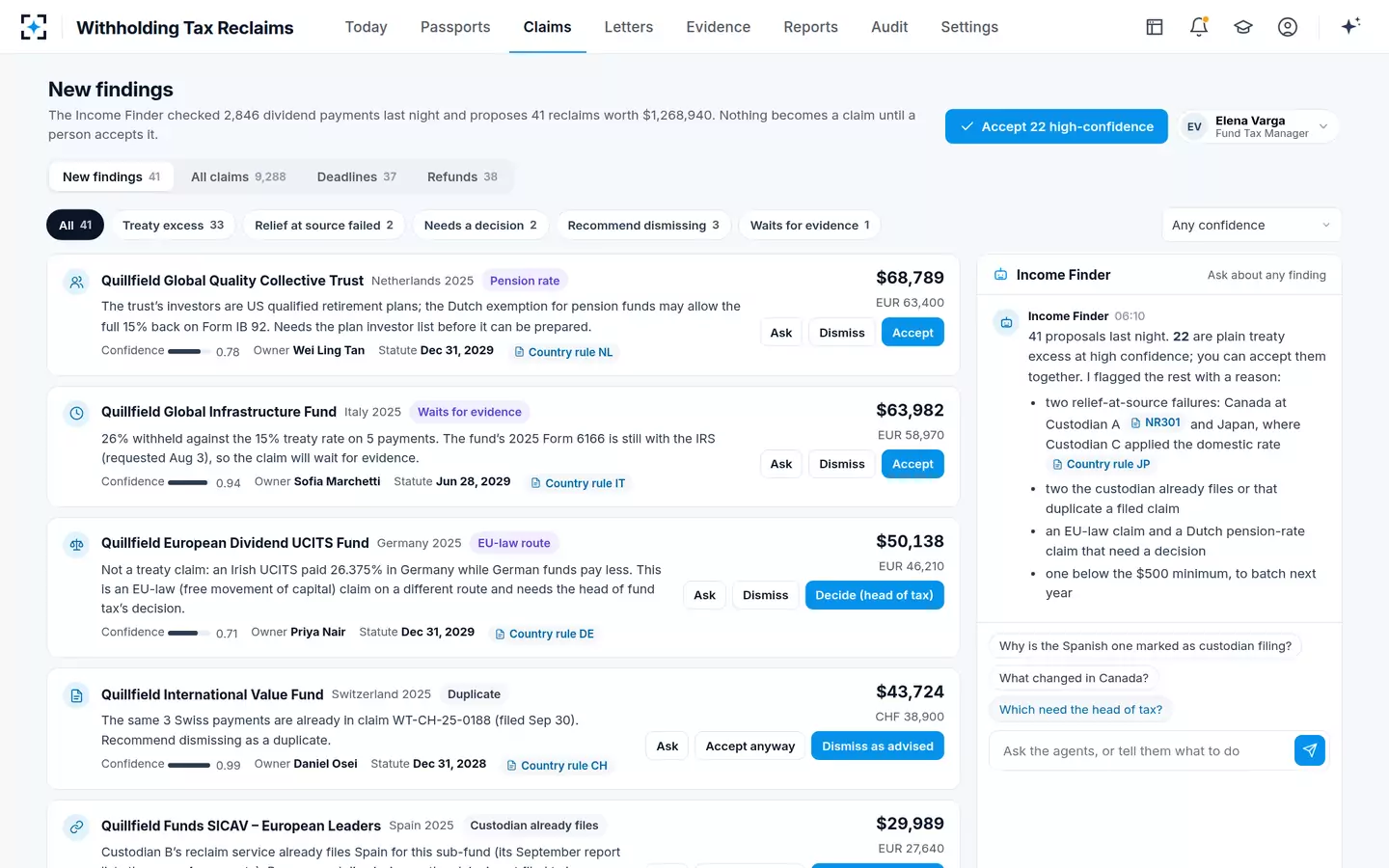
Relief at source fails quietly. Canada's guidance on Form NR301 says a draft form "expires when there is a change in eligibility for treaty benefits" or "three years from the date it was signed, whichever is earlier", and that where a non-resident refuses to certify, "the full statutory rate should be withheld" (Canada Revenue Agency). The refund then has to be claimed on Form NR7-R within two years from the end of the year the tax was sent to the agency. A fund whose form lapsed in March may not notice the 25% until the custodian's statements are reconciled months later.
Relief at source that failed, found the night it happened
How long is each country's claim window?
Claim windows among these six run from two to five years, and they start from different events: the end of the year of receipt in Germany, the end of the year the payment fell due in Switzerland, the date of withholding in Denmark, the end of the year the tax was remitted in Canada. Two dividends paid on the same day can lapse three years apart.
Windows change, too. The Danish Tax Agency now applies five years "from the time the dividend tax was withheld", after the Danish Supreme Court ruled in June 2026 that its earlier three-year limit was wrong, and it will reopen claims it rejected as late (Danish Tax Agency). A rates table that does not carry the window, and the date the window was last confirmed, will mislead whoever uses it next. How to reclaim withholding tax, step by step sets out seven windows in full.
Is there a gap to reclaim in every country?
No: there is nothing to reclaim where relief at source worked, where the treaty rate equals the domestic rate, or where the fund does not qualify for the treaty. The gap is real money only where the full statutory rate was taken and the fund can prove its entitlement. That is why a reclaim begins with each payment and its voucher, not with a rates table.
The gap can also be larger than the table suggests. Where a country exempts its own investment funds but taxes foreign ones, EU law has supported claims for the whole tax, not just the treaty excess; Fokus Bank claims under EU law covers those cases. And Germany's 11.375 points has a statute and a deadline of its own, set out in reclaiming German withholding tax on dividends.
What unclaimed gaps add up to in the EU
EUR 4.83bn
a year of tax relief investors are entitled to but do not claim, in the Commission's 2022 estimate
2%
of the refundable amount: the Commission's assumption for what a reclaim costs to file
1 year
the average delay the Commission assumed between withholding and refund
Where do I find the official withholding tax rate?
The official rate is in the source country's statute and its tax authority's guidance; the official treaty rate is in the treaty text. Rate tables from data vendors, custodians and advisers are compilations of those sources, useful for coverage but only as current as their last update. For a claim that will be signed and filed, the rate should trace to the authority's own text.
Three habits keep a rates table honest. Keep each rate with the provision it comes from: §43a of the German Income Tax Act and §4 of the Solidarity Surcharge Act together make 26.375%, and either can change on its own (§4 SolZG). Note the date each rate and window was last checked against the authority. And note who approved the change when the rate moves, because every claim drafted on the old rate needs redrafting.
How Withholding Tax Reclaims keeps the rates
In Withholding Tax Reclaims, each country's domestic rate, treaty rate, statute rule, form, language and route under the FASTER directive are settings, versioned and approved by the head of fund tax. A tax rate data feed can propose a change, but it does not take effect until the head of fund tax approves it, and claims drafted on the old version are redrafted.
Country rules as approved, versioned settings
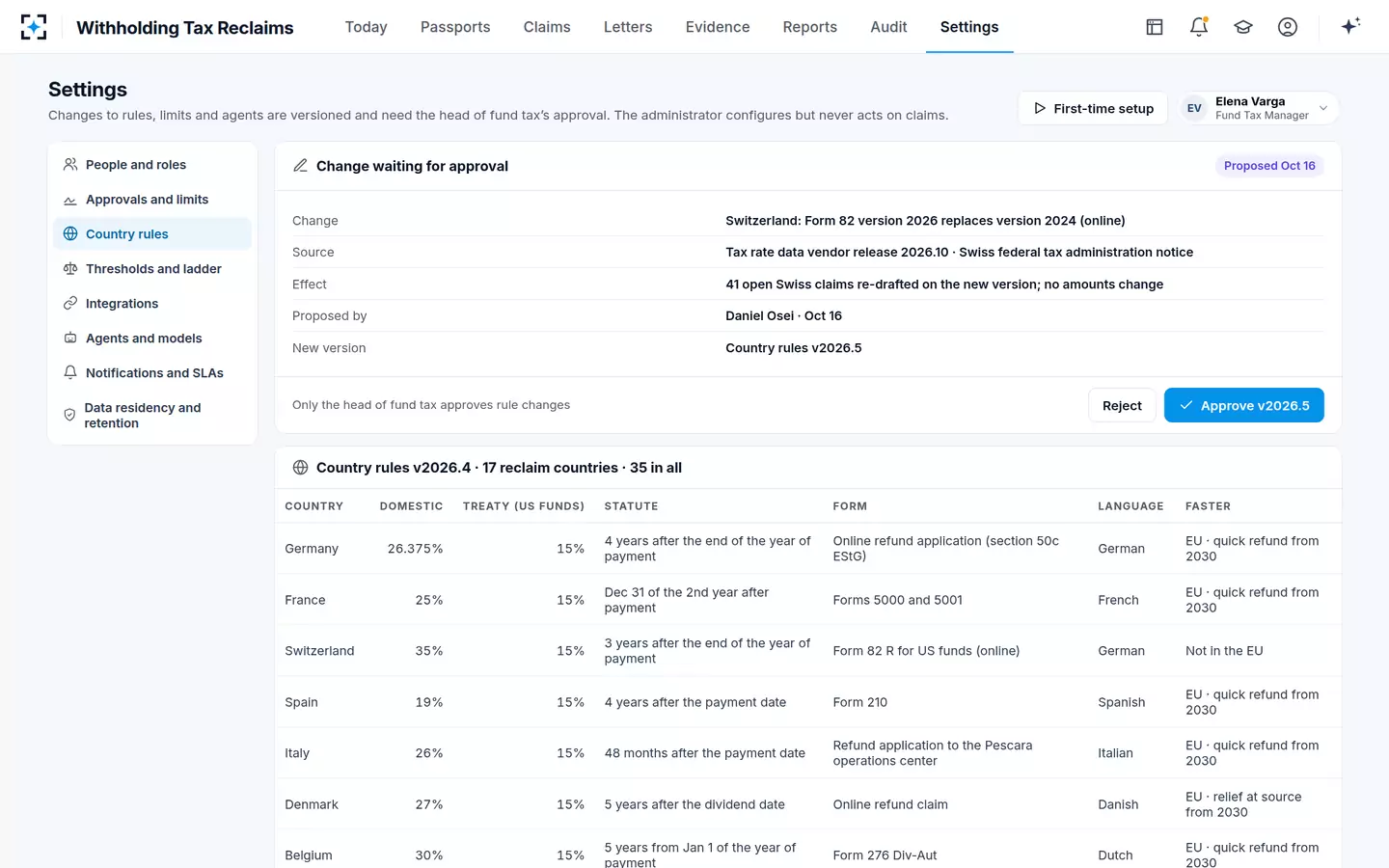
The Income Finder applies those rules to every dividend the night it is booked, compares the result with the custodian's voucher, and shows the rule version it used. When a person asks why a rate applies, the answer cites the country rule, the treaty article and the voucher. The Withholding Tax Reclaims page shows the same rules at work on one German claim.
Questions people ask
What is the US dividend withholding tax rate for foreign investors?
The US withholds 30% on dividends paid to foreign persons where no treaty applies, according to the IRS treaty table. Treaty residents who document themselves on Form W-8BEN-E, or W-8BEN for individuals, get the treaty rate at source, 15% on portfolio dividends for most European treaty partners.
Why does Germany withhold 26.375% and not 25%?
Germany's capital yield tax is 25% of the dividend under §43a of the Income Tax Act, and the solidarity surcharge adds 5.5% of that tax under §4 of the Solidarity Surcharge Act. 25% × 1.055 is 26.375%.
Does Switzerland's 35% apply to bond interest?
Yes. The Swiss Federal Tax Administration levies anticipatory tax on "the revenue from movable capital assets (particularly interest and dividends)" at 35%. The IRS treaty table shows a 0% rate on interest under the US–Switzerland treaty, subject to its footnotes, so a qualifying US fund may be able to reclaim the whole 35% on Swiss bond interest.
Is the French dividend withholding rate 12.8% or 25%?
Both, for different recipients. The DGFiP says dividends to non-residents are subject to 12.8% for individuals and 25% for legal entities, with 15% for non-profit organisations and 75% for payments to non-cooperative states, and it excludes certain undertakings for collective investment from the rule.
Do treaty rates differ for pension funds?
Often. The IRS treaty table flags several treaties, including those with Germany and Denmark, under which dividends paid to certain pension funds are exempt. A pension investor's reclaim can therefore be the whole tax withheld, not the gap above 15%.