The FASTER directive is Council Directive (EU) 2025/50 "on faster and safer relief of excess withholding taxes", adopted on 10 December 2024, which Member States must transpose by 31 December 2028 and apply from 1 January 2030. It gives every EU taxpayer a digital tax residence certificate, lets registered financial intermediaries claim relief at source or a quick refund for their clients, and keeps today's standard refund as the fallback. For a fund tax team it changes the reclaim process from 2030, not before: every dividend paid until then is reclaimed under each country's current rules, on current deadlines. Botminds' Withholding Tax Reclaims runs today's reclaims and keeps, for each EU country, the route its dividends will take once the directive applies.
Every provision quoted here is from the directive as published in the Official Journal or from the Commission's proposal and impact assessment, linked where they appear. Where the guide illustrates a point, it uses fictional sample data from Quillfield Capital, an invented manager with 120 funds.
From adoption to application: five years in which nothing changes for a reclaim
- Adopted, published, transposed10 Dec 2024 to 31 Dec 2028
- Not yet applied2029
- Appliesfrom 1 Jan 2030
- Paid2029
- Germany's four-year window after year-end2030 to 2033
What is the FASTER directive?
FASTER is the EU's common framework for relieving withholding tax that a source country took in excess of what an investor owed on publicly traded shares, and optionally bonds. It has three working parts: a common digital tax residence certificate, called the eTRC; national registers of certified financial intermediaries that must report the payment chain; and two fast-track procedures, relief at source and a quick refund, which those intermediaries request on an investor's behalf.
The directive gives two reasons in its first recital. Procedures to relieve excess tax are "inefficient and disproportionately burdensome", and the current situation "has proven to be inadequate in preventing recurrent risks of tax fraud", "as shown by numerous cases of multiple tax reclaim schemes and fraud involving the use of dividend arbitrage or dividend stripping (Cum/Ex and Cum/Cum)" (Directive (EU) 2025/50). Every fast-track feature is paired with a control: speed in exchange for information about who held the shares, through which chain, and with what financial arrangements.
Its cost argument is stated in the Commission's proposal: "The overall costs of WHT procedures are estimated to be EUR 6.62 billion" (COM(2023) 324). The impact assessment breaks that figure down, and most of it is relief investors never claim, which is the part a fund tax team controls today.
When does the FASTER directive apply?
The FASTER directive applies from 1 January 2030. Article 25 requires Member States to "adopt and publish, by 31 December 2028, the laws, regulations and administrative provisions necessary to comply with this Directive" and states: "They shall apply those provisions from 1 January 2030." It entered into force on the twentieth day after its publication in the Official Journal on 10 January 2025.
Not every Member State will run the fast-track chapter. The rules on registers, reporting and fast-track relief bind a Member State that lacks a "comprehensive relief-at-source system" or whose market capitalisation ratio, as published by the European Securities and Markets Authority (ESMA), is 1.5% or more of the Union's in each of the four latest publications available on 31 December 2028 (Article 2). A small market with a working relief-at-source system may keep it. Once the chapter applies to a Member State, "it shall remain applicable", even if its market later shrinks. ESMA must publish the ratios each year from 2026 at the latest (Article 20).
What is an eTRC, the digital tax residence certificate?
An eTRC is a tax residence certificate that every Member State must issue through "an automated process" to its residents, "within 14 calendar days of the submission of a request" (Article 4). It names the taxpayer, its tax identification number and, for an entity, its EU unique identifier or legal entity identifier where available, the period covered and any treaty under which residence is claimed. It covers no more than one calendar or fiscal year, and every other Member State must accept it as proof of residence.
The eTRC is for EU residents. A US fund will still prove residence with its own country's certificate, Form 6166, which the directive treats as "a proof of tax residence in a third country deemed appropriate by the source Member State" (Article 12(2)). A source Member State may accept such a certificate where its content matches the eTRC's and it meets the directive's technical requirements. Form 6166 and how to keep it valid covers the US side.
What is the quick refund deadline under FASTER?
Under a quick refund, a certified intermediary files the request "within the second month following the month of the payment date", and the Member State must process it "within 60 calendar days after the end of the period to request the quick refund" (Article 14). Where national rules provide for it, interest runs "for each day of delay after the 60th day", at the rate the Member State pays on other late withholding tax refunds (Article 16). A dividend paid in May can be refunded by the end of September.
The Member State can still say no. It may reject a quick refund if the request is incomplete, if the information needed "to reconstruct the relevant securities payment chain" is missing, or if "based on risk assessment criteria" it opens a verification or audit (Article 14(4)). A rejection for missing information "shall not preclude a request for a refund under the standard refund system", so the old route survives as the backstop.
A dividend's relief, today and under FASTER
Today: Each country's own certificate or stamped form, often on paper.
Under FASTER, from 2030: eTRC within 14 days for EU residents; third-country certificates as the source state accepts them.
Today: The investor or its custodian, country by country, in each country's form.
Under FASTER, from 2030: A certified financial intermediary, in a standard computerised form.
Today: Relief at source where offered; otherwise a refund claim.
Under FASTER, from 2030: Relief at source or quick refund, with at least one available to all investors.
Today: Months to years; the Commission assumed one year on average.
Under FASTER, from 2030: Quick refund processed within 60 days of the request window closing.
Today: What the claimant chooses to send.
Under FASTER, from 2030: The payment chain, each intermediary's position and any financial arrangements.
Today: None.
Under FASTER, from 2030: The standard refund system, which must stay in place.
What is a certified financial intermediary?
A certified financial intermediary is a bank, broker or other intermediary in a securities payment chain that is listed in a Member State's national register and so can request fast-track relief and must report the payment chain. Registration is compulsory for "all large institutions that handle payments of dividends" on securities issued in that Member State and for central securities depositories acting as withholding agents (Article 7). Other intermediaries may register voluntarily.
The obligations are substantial. A certified intermediary reports the payment, the registered owner and its own position in the chain "within the second month following the month of the payment date" (Article 10), must keep the supporting documentation "for 10 years" (Article 10(7)), and can be held liable "for all or part of the loss of withholding tax revenue" if it falls short (Article 18). Before requesting relief it must obtain the registered owner's declaration of entitlement, beneficial ownership where required, and any financial arrangement on the share not settled before the ex-dividend date (Article 12).
The Commission put the cost to intermediaries at "implementation costs and annual recurring costs of EUR 75.9 million and EUR 13 million respectively" (COM(2023) 324). Custodians will pass some of that work to their fund clients as data requests: the declaration, the residence proof and the lending position on each record date.
Which dividends can Member States keep out of the fast-track procedures?
Member States may exclude six kinds of request from relief at source and quick refund, sending them to the standard refund system instead (Article 11(2)). Two of them matter most to funds: dividends above EUR 100,000 per owner and payment date, and shares linked to a securities loan or similar arrangement over the ex-dividend date.
Six cases a Member State may keep on the standard refund route
| Article 11(2) | What may be excluded | What it means for a fund |
|---|---|---|
| (a) | A dividend on a share acquired "within a period of five days before the ex-dividend date" | Late purchases before a dividend go to a full refund claim. |
| (b) | A dividend linked to "a financial arrangement that has not been settled, expired or otherwise terminated before the ex-dividend date" | Securities lending and derivatives over the dividend date need their own handling. |
| (c) | A chain with an intermediary that is not certified, and no certified one has taken its place | A sub-custodian outside the register can push a whole holding to the slow route. |
| (d) | A claimed exemption from withholding tax | Pension-fund and other exemptions stay on the standard route. |
| (e) | A reduced rate "not deriving from double tax treaties" | Domestic-law and EU-law rates stay on the standard route. |
| (f) | A dividend that "exceeds a gross amount of at least 100 000 EUR, per registered owner and per payment date" | Large holdings of a non-EU fund can stay on the standard route; a UCITS or EU alternative investment fund cannot be excluded on this ground. |
The threshold row is the one a non-EU fund should read twice. The exclusion in point (f) does not apply where the investor entitled to relief is a UCITS, an EU alternative investment fund or an EU fund manager, nor to EU statutory pension schemes and occupational pension institutions (Article 11(3)). It can apply to a US mutual fund. A large non-EU fund may therefore still file standard reclaims in 2030 for every big dividend, under each Member State's existing deadline.
What does FASTER change for non-EU funds?
For a non-EU fund, FASTER changes the channel more than the evidence. Its custodian, if certified, can request relief at source or a quick refund for it, and the fund must supply a declaration of entitlement and a residence certificate its source country accepts. The fund does not get an eTRC, may face the EUR 100,000 exclusion, and keeps the standard refund route for every case the fast track excludes.
Indirect holdings get their own rules. Article 15 lets a certified intermediary request relief for "a collective investment undertaking which holds securities for the account of investors entitled to relief", provided it collects declarations from the fund or its investors and passes on the amounts attributable to each. For a fund whose own treaty status depends on its investors, that article will decide how much of the paperwork moves to the custodian.
Interest is optional. A Member State "may apply" the fast-track chapter to interest on publicly traded bonds (Article 2(5)). A fund with large holdings of EU government bonds should not assume its interest reclaims will change in 2030.
What does FASTER cost, and what does it save investors?
The Commission estimated that the directive will save investors "approximately at EUR 5.17 billion per year, including EUR 730 million per year related to a decrease in paperwork", against a baseline cost of EUR 6.62 billion a year. Most of the saving is relief that investors now forgo, which the Commission expects to be claimed once procedures are fast and cheap.
The Commission's arithmetic for FASTER
EUR 5.17bn
a year in estimated savings for investors
EUR 75.9m
one-off implementation cost for financial intermediaries
EUR 13m
a year in recurring costs for financial intermediaries
EUR 2.2bn
estimated reduction in Member States' tax revenue
The revenue line explains the politics. A Member State loses EUR 2.2 billion a year in the Commission's estimate because investors start claiming what they are owed. The impact assessment says the same thing in other words: the baseline cost is largely relief that "some investors do not claim", because of the complexity and cost of today's procedures (SWD(2023) 216). A fund that claims everything it is owed today gets that benefit five years early. What tax reclaim services return to investors puts numbers on the comparison.
What should a fund tax team do before 2030?
A fund tax team should keep reclaiming under today's rules, which govern every dividend paid until the end of 2029, and prepare the data the fast track will ask for. The checklist sets out the work in the order it pays off.
Five things to do between now and 1 January 2030
- Clear the backlog under today's rules
Dividends paid up to 2029 are reclaimed on current forms and deadlines, some running into 2033 and beyond. Nothing in the directive revives a lapsed claim.
- Map each EU source country's route from 2030
Relief at source, quick refund, both, or a retained national system under Article 2. Note the transposing law when it is published, not before.
- Ask each custodian whether it will be certified, in which Member States
Large institutions must register; a sub-custodian outside the register can push holdings to the standard route under Article 11(2)(c).
- Know your lending position on every ex-date
Article 11(2)(b) and Article 12(1)(c) turn securities loans over the dividend date into a disclosure and, possibly, a slower route.
- Prepare the declaration and the residence evidence once a year
Article 12(3) lets Member States accept the registered owner's declaration and checks on an annual basis, unless circumstances change.
How Withholding Tax Reclaims tracks the FASTER directive
Withholding Tax Reclaims treats each EU country's route under FASTER as part of that country's rule, alongside its rate, deadline and form, approved and versioned by the head of fund tax. When a Member State publishes its transposing law, the rule changes once, with its source, and the recovery report shows which of the fund's countries will move to relief at source or a quick refund from 2030.
Recovery by country, months to refund and each EU country's route from 2030
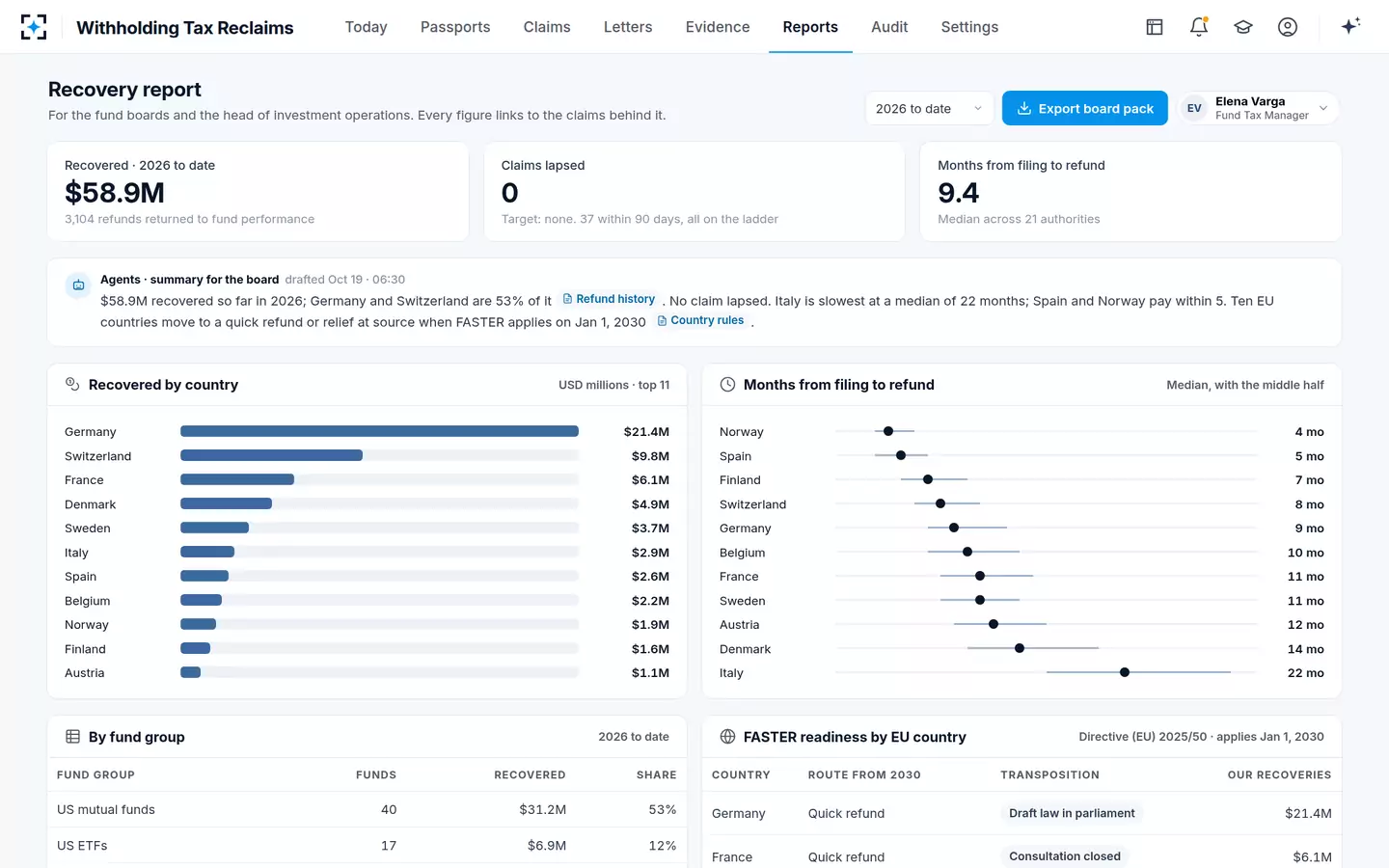
Until 2030, the work is the same as it has always been: find every excess, prove it, file it and chase it before the deadline. The Withholding Tax Reclaims page follows one German claim through that work, and dividend withholding tax rates by country sets out what each country takes today.
Questions people ask
Is the FASTER directive in force?
Yes, as EU law: it entered into force twenty days after its publication in the Official Journal on 10 January 2025. Its rules reach investors only through national law, which Member States must adopt by 31 December 2028 and apply from 1 January 2030.
Does FASTER replace the standard refund procedure?
No. Article 17 requires every Member State to keep a standard refund system for requests excluded from relief at source and quick refund. The recitals add that an investor may choose it, and Article 14(6) lets a quick refund rejected for missing information be refiled there.
Does FASTER apply to interest on bonds?
Only where a Member State chooses. Article 2(5) says a Member State that relieves excess withholding tax on interest from publicly traded bonds "may apply" the fast-track chapter to it. Dividends on publicly traded shares are the directive's core.
How much does FASTER cost financial intermediaries?
The Commission estimated one-off implementation costs of EUR 75.9 million and recurring costs of EUR 13 million a year for intermediaries, against savings of EUR 13.5 million a year from streamlined procedures. Those are estimates for the proposal, made in 2023.
What happens to cum-ex and cum-cum arrangements under FASTER?
The directive targets them through information. Certified intermediaries must report the payment chain and any financial arrangement linked to the share, and Member States may send dividends on shares bought within five days before the ex-date, or linked to unsettled arrangements, to the standard refund route for closer checks.