A withholding tax reclaim can be prepared largely by AI agents, provided the work is divided so that agents find, prove, draft, check and chase, and people accept the findings, sign the filings and answer the tax authorities. Agents are well suited to the bulk of a reclaim, which is comparing thousands of dividend payments with treaty rates and custodian vouchers and reading documents and letters in several languages. They are not suited to the decisions that put the fund's name on a statement to a foreign government. Botminds' Withholding Tax Reclaims is built on that division: seven agents with written limits, an independent check that blocks any figure two agents disagree on, and a named signer for every filing.
The regulators' expectations and the court judgment cited here are linked where they appear. The examples use fictional sample data from Quillfield Capital, an invented US manager with 120 funds.
Seven agents on a withholding tax reclaim: what each does, and what it may never do
| Agent | Does | Never |
|---|---|---|
| Income Finder | Compares every dividend with the treaty rate and the custodian's voucher the night it is booked; finds over-withholding, failed relief at source and pension or special rates; leaves out shares on loan over the record date; checks whether a custodian already files the claim. | Opens a claim on its own. A person accepts each finding, or dismisses it with a reason. |
| Evidence agent | Checks residence certificates, ownership statements, powers of attorney and vouchers for entity name, tax ID, period, signature and stamp; prepares certificate requests such as Form 8802. | Signs or dates a statement, or edits a certificate. |
| Forms agent | Drafts each country's form in its language beside English, every field cited to its source. | Submits a filing, or changes a figure the Checker disputes. |
| Checker agent | Re-derives every figure from income data, vouchers, exchange rates and the treaty table, and compares line by line. | Sees the Forms agent's reasoning or edits the draft. Any difference blocks the claim. |
| Statute Watcher | Dates every claim from its country rule, escalates on a ladder, proposes protective claims, predicts refund timing. | Changes a country rule, or files. |
| Tracker | Reads authority letters in their language, classifies them, links them to claims and drafts replies in that language. | Sends a reply. A manager approves every one. |
| Refund Matcher | Matches custodian credits to claims and explains short or unmatched refunds; proposes the posting. | Posts. A second person approves; only the head of fund tax writes off. |
Can AI find reclaimable withholding tax?
Yes: finding reclaimable withholding tax is a comparison of data the fund already holds, and that is the part of the work AI agents do best. For every dividend, the agent needs the gross amount, the tax withheld from the custodian's voucher, the fund's residence and entitlement, the country's rule and any lending position on the record date (where the record date sits in an income event is mapped in the corporate actions processing life cycle). Where the tax exceeds the entitlement and no claim covers it, there is a finding.
In the sample, the Income Finder checked 2,846 dividend payments across 120 funds in one night and proposed 41 reclaims worth $1,268,940, each with its reasons and a confidence score. Twenty-two were plain treaty excess at high confidence; the rest carried a reason a person had to weigh, such as a custodian that already files the claim, or a possible duplicate. In the sample firm's settings, findings below 0.90 confidence go to a review list with the reason.
The value is in what the custodian's report leaves out. The sample's largest single claim, EUR 212,400 for Germany 2023, sat in a securities-lending sub-account that the custodian's reclaim service did not cover. No person had been asked to look there.
Can an AI agent fill in foreign withholding tax reclaim forms?
An AI agent can draft a foreign reclaim form, in the country's language and its current version, with every field traced to its source; it should not submit one. Forms change and tax authorities are strict about versions: Switzerland's Federal Tax Administration says "Only the latest version is accepted" and rejects a form that does not comply (Swiss Federal Tax Administration). An agent that drafts from an approved, versioned country rule picks up a new version once, everywhere.
Drafting beside English matters for review. The fund tax manager who signs a German application should be able to read each field in English, see where its value came from and change it with a reason. In Withholding Tax Reclaims, any edit to a draft sends the claim back through the independent check.
Who signs a withholding tax reclaim prepared by an agent?
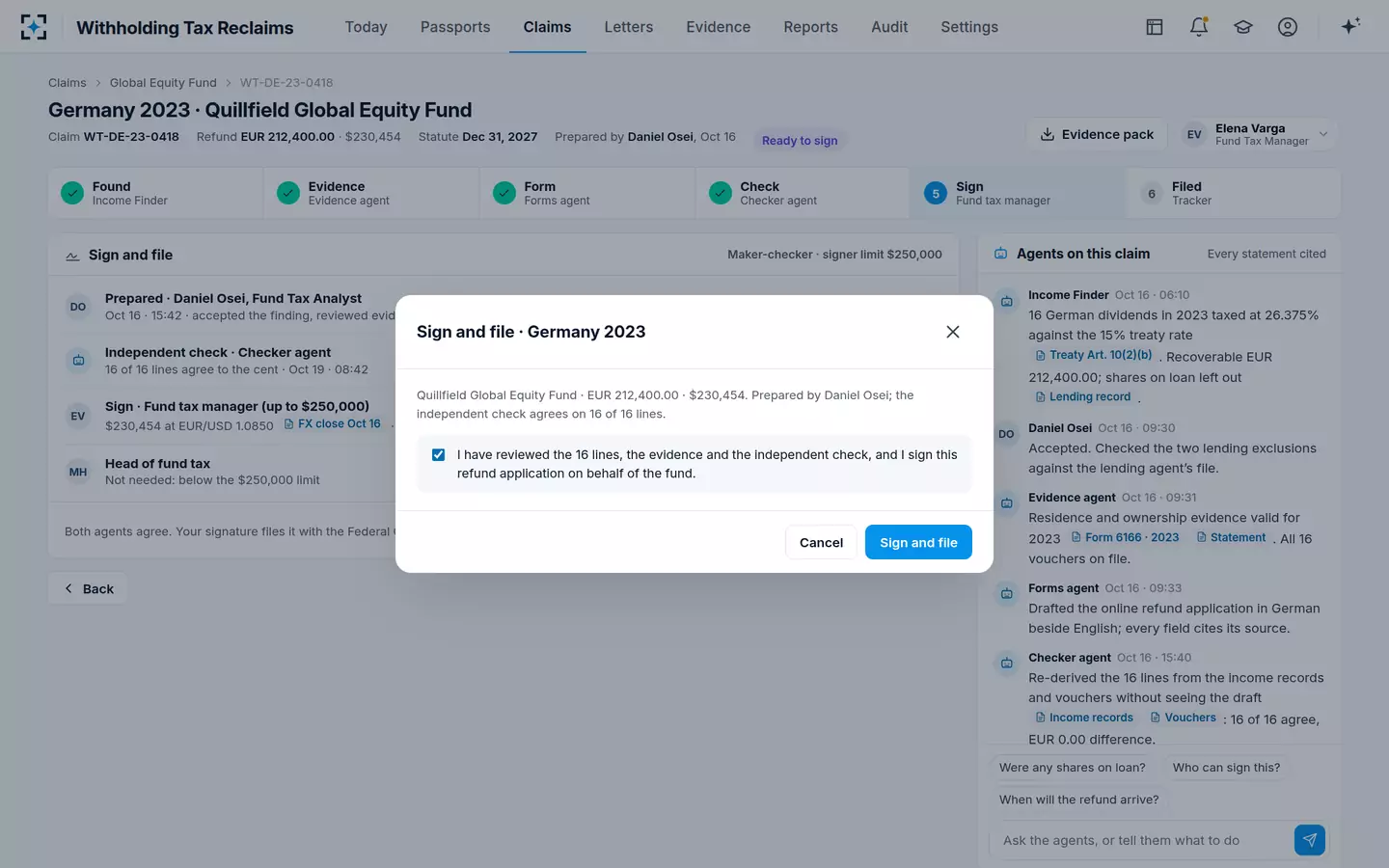
A named person signs: in the sample firm, the fund tax manager up to $250,000 and the head of fund tax above that, and never the person who prepared the claim. The agents prepare and check; the signer attests that they reviewed the lines, the evidence and the independent check. An agent cannot sign, and the rule that a preparer cannot sign their own claim cannot be switched off.
From finding to filing: two agents must agree before a person signs
Agent
Income Finder proposesFinds the excess and states its reasons and confidence.
Never: Opens the claim.
A person decides
Analyst acceptsChecks the exclusions, such as lent shares, and accepts the finding or dismisses it with a reason code.
Agent
Evidence and Forms agents prepareCheck the certificate for the year and draft the form in the country's language, every field cited.
Never: Submit the filing.
Agent
Checker re-derivesRecomputes every line from the source data without seeing the draft's reasoning; any difference blocks signing.
Never: Edits the draft.
A person decides
Manager signs within limitReviews the lines, evidence and check, attests, and files; above the limit the head of fund tax signs as well.
Why a second agent checks the first
A second agent checks the first because a drafting agent that is wrong will be wrong consistently, and a reviewer who sees its reasoning tends to follow it. The Checker agent in Withholding Tax Reclaims works only from the income data, the vouchers and the treaty table; it cannot see how the Forms agent reached its figures, it runs on a model from a different vendor, and the tolerance is EUR 0.00 per line. On the sample German claim it re-derived 16 lines and found no difference.
The independent check: 16 lines, recomputed without the draft
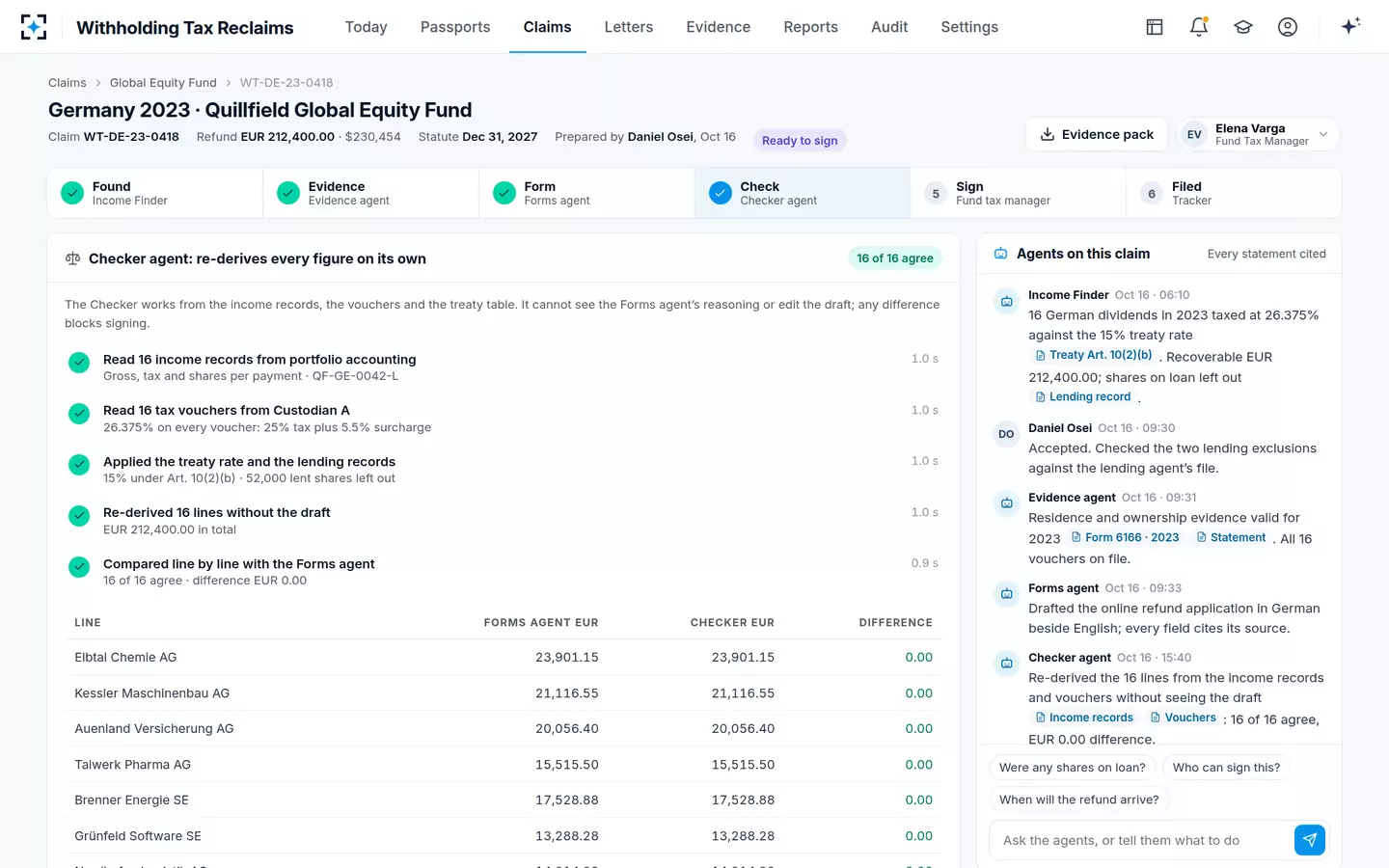
The check is also the answer to a tax authority's question. When a letter asks how a figure was computed, the fund can show two independent derivations that agree, each tied to the voucher it came from. That is a stronger position than one analyst's spreadsheet.
What did a court say about weak refund controls?
The English High Court found in 2025 that the Danish tax authority had paid 4,170 dividend tax refund claims, for just under DKK 12.1 billion, none of which was valid under Danish law, and that its controls over those refunds had been close to non-existent. The case is about the authority's checks, not a fund's, but it explains why every source country now reads reclaims sceptically.
Its controls for assessing and paying dividend tax refund claims were so flimsy as to be almost non-existent.
Mr Justice Andrew Baker, Skatteforvaltningen v Solo Capital Partners LLP and others [2025] EWHC 2364 (Comm)
The lesson for a fund is about its own side of the claim. A refund system that pays on documents alone invites claims nobody checked, and the response, in Denmark and across the EU, has been more scrutiny of ownership, lending and the payment chain. The Danish Tax Agency now asks every claimant to state whether shares were lent or borrowed on the date the dividend was adopted (Danish Tax Agency), and the EU's FASTER directive asks certified intermediaries to verify "the possible existence of any financial arrangement" on the share (Directive (EU) 2025/50). A fund whose agents can show, payment by payment, that it owned what it claimed is the claimant those controls are built to let through. The FASTER directive covers what that will mean from 2030.
How are letters from tax authorities handled?
Letters from tax authorities are read, classified and answered in their own language: the Tracker identifies each letter as an acknowledgment, a query, a refund, a partial refund or a rejection, links it to its claim, sets the reply date and drafts the reply, and a manager approves it before it goes. In the sample, the Italian Revenue Agency's office in Pescara asked for three documents within 30 days on a EUR 41,330 claim; the Tracker found all three on file and drafted the reply in Italian with them attached.
The reply is the step where a missed date costs most and a careless answer can cost more. A reply that contradicts the original claim, or attaches the wrong year's certificate, can turn a query into a rejection. That is why the reply stays a draft until a person approves it.
What should be logged for every withholding tax reclaim?
Every action on a reclaim should be logged with who or what acted, when, on which evidence and why: each finding and the person who accepted it, each document checked, each draft and every edit with its reason, the check result, the signature, each letter and reply, and the refund match. Withholding Tax Reclaims logs every action by people and agents on an append-only trail, chained so no entry can be changed afterwards, and keeps it for ten years.
Ten years matches the period the FASTER directive sets for certified intermediaries, which must "keep the documentation supporting the information reported for 10 years" (Directive (EU) 2025/50, Article 10(7)). An auditor or a tax authority asking about a 2023 claim in 2031 should get the same file the signer saw: the lines, the certificate, the form as filed in both languages, the signature, and each agent's step with its version.
What do regulators expect of AI agents?
Regulators expect firms using AI agents to keep them inside a defined scope, to keep people in the approval loop and to be able to trace what the agents did. FINRA's 2026 oversight report lists among the risks of agents "Autonomy", "Scope and Authority" and "Auditability and Transparency", and points to human review of model outputs as a practice (FINRA, 2026 Annual Regulatory Oversight Report). The SEC's examinations division, which describes registrants' use of what it calls "super intelligence", says it will prioritise examining firms' policies for monitoring it, including in back-office operations (SEC, Fiscal Year 2027 Examination Priorities).
Operations is where financial firms use AI most, and rarely without people
22%
of reported AI use cases in UK financial firms are in operations and IT, the largest area
2%
of use cases have fully autonomous decision-making
118
firms answered the Bank of England and FCA survey
A withholding tax reclaim maps onto those expectations closely. The scope of each agent is written down and enforced; the decisions that bind the fund are made by people; and every step is logged with its evidence. A recovery pilot on last year's dividends is how to test that on your own funds before relying on it.
What to ask before buying an AI system for withholding tax reclaims
Ask what the agents may do, what they may never do, and how the system proves it, on your own data. A demonstration on clean sample data shows the screens; the questions below show whether the controls survive your custodians' files, your lending book and your signing policy.
Eight questions for any AI system that prepares withholding tax reclaims
- What can each agent do, and what is it blocked from doing?
Ask for the limits in writing and how they are enforced: by permissions, or by instructions an agent could ignore.
- Who signs, and can a preparer ever sign their own claim?
Look for signing limits by amount and a preparer-signer rule that cannot be switched off.
- Is every figure checked independently before signature?
An independent re-derivation from source data, with a zero tolerance, catches what a reviewer reading the draft will not.
- Does it read your lending positions on each record date?
Lent shares are the commonest over-claim, and some countries treat lenders differently.
- Where do the country rules come from, and who approves a change?
Rates, deadlines and forms should trace to the authority and change only with your approval.
- Does it compare what was owed with what each custodian filed?
The money is in the gaps between custodians' reclaim services.
- Can every value be traced to its document?
Each field on a form, each line on a claim, each statement in an agent's answer.
- What happens when a data feed is late?
A missing custodian file should be visible the next morning, not discovered at year-end.
Be clear about what such a system is not. It is not a tax adviser: it does not decide whether a contested treaty position or an EU-law claim is worth pursuing. It depends on the data it is given, and a custodian file that arrives late delays the night's findings for the funds it covers. And it does not change the law: deadlines and evidence rules are the source countries', and the agents only apply them faster. The Withholding Tax Reclaims page shows the agents on one claim, from finding to filing.
Sign and file: preparer, check and limit on one screen
Questions people ask
Can AI agents submit reclaims directly to tax authority portals?
Technically an agent could, but it should not. In Withholding Tax Reclaims the Forms agent never submits; filing follows a named person's signature. Germany, for example, requires refund applications through its online portal, and the person who files is the one accountable for the content.
Do AI agents replace a reclaim service provider?
They replace much of the preparation a provider does, finding, evidencing and drafting, but not the judgement a fund may buy from advisers on contested claims. Many funds will combine agents for volume with advisers for EU-law and disputed cases.
How accurate are AI agents at finding reclaimable tax?
No regulator or independent study publishes accuracy figures for reclaim work. Measure it on your own data: run the agents on a past year and compare their findings line by line with what was actually filed and refunded, counting missed claims, wrong claims and correct exclusions.
What happens when the agents disagree?
The claim is blocked and the difference is shown line by line. Only the head of fund tax can override the Checker, with a reason code that is kept on the audit trail.
Can the agents handle letters in languages the team does not read?
The Tracker reads letters in their original language and shows them beside an English translation, and drafts replies in the authority's language. A manager approves every reply, reading the English beside it.