The tax reclaim process is the cycle by which a fund recovers foreign tax withheld above its treaty or domestic entitlement: monitor every dividend and coupon, find the over-withholding, assemble residence and ownership evidence, file each country's claim in its form, answer the authority's questions, and match the refund when it arrives. For a fund tax team of one or two people covering dozens of countries, the work is not hard so much as relentless, because every country runs its own clock and several clocks stop on the same night. Botminds' Withholding Tax Reclaims runs the monitoring, evidence, drafting and deadline tracking as agents, so the small team spends its time on decisions and signatures.
The deadlines below are each tax authority's own rules, linked where they appear. The worked examples use fictional sample data from Quillfield Capital, an invented manager whose 120 funds earn dividends in 35 countries.
What lapses on the night of 31 December 2026
| Country | Rule | Claims that lapse that night |
|---|---|---|
| France | 31 December of the second year after the income was paid | Dividends paid in 2024 |
| Switzerland | Three years after the end of the year the payment fell due | Payments due in 2023 |
| Germany | Four years after the end of the year the dividend was received | Dividends received in 2022 |
| Canada | Two years after the end of the year the tax was sent to the tax agency | Tax remitted in 2024 |
| Netherlands | Three or five years after the year the dividend was made available | Dividends of 2023, or of 2021, depending on the basis |
What is the tax reclaim process?
The tax reclaim process has six steps for every country and year: identify the income, find the excess, prove the entitlement, file, respond, and collect. The first two are data work, comparing what was booked and withheld with what the fund was owed. The middle two are document work. The last two are follow-through, often for a year or more after filing.
A tax reclaim itself is a request to a source country's tax authority to refund tax withheld above the rate the investor was entitled to. The European Commission's description of the steps is still the clearest: the taxpayer "needs to prove that it is a resident of the country with which the source Member State has signed a tax treaty" and for that "will need to request a certificate of residence from the tax administration of its state of residence", and then files the source country's own forms (COM(2023) 324). The four-step dividend withholding tax reclaim walks one claim through all of them.
How does a small fund tax team cover dozens of countries?
A small team covers dozens of countries by running the reclaim process as a calendar, not a queue: deadlines, certificate dates and document renewals are known a year ahead, and each month's work is set by what will lapse, not by what arrived. The table at the top of this page is the reason. A team that works its inbox in order of arrival will discover on 2 January that a French, a Swiss, a German and a Canadian year closed together.
One year in a fund tax manager's calendar, and where the deadlines bunch
| When | What falls due | Why it is fixed |
|---|---|---|
| From 2 September | Claims with a 31 December deadline reach 120 days out and start up the escalation ladder | Our arithmetic: 120 days before 31 December |
| From 1 December | Form 8802 for next year's Form 6166, for every fund | The IRS returns current-year requests postmarked before 1 December of the prior year |
| 31 December | France, Switzerland, Germany and Canada claims lapse, plus the Netherlands on its rule | Each counts its limit to a year-end (table above) |
| January and February | Form 6166 arrives, at least 45 days after filing; Form 5000 to each French paying bank before the first payment | Relief at source in France needs the form before the dividend is paid |
| All year | Danish and Italian claims lapse payment by payment; tax authorities' queries arrive with short reply windows | Denmark counts from withholding, Italy from payment |
Three habits make the calendar work. Date every claim from its country's rule the day the dividend is booked, not when the claim is found. Work back from each deadline to the date the evidence must be in hand, since a residence certificate takes at least 45 days from the IRS. And escalate on a ladder: in the sample firm's settings, a claim is raised to the analyst at 120 days before its statute date, the fund tax manager at 90, the head of fund tax at 45, and at 30 days with evidence still missing a protective claim is proposed.
What gets missed first in a tax reclaim process?
What gets missed first is income nobody is watching: dividends in accounts the custodian's reclaim service does not cover, payments where relief at source failed, and claims whose deadline changed. The European Commission's impact assessment lists why investors forgo refunds, from "failure to meet deadlines" and "claims falling outside statute" to "lack of service offering" and "incorrectly filed claims" (SWD(2023) 216). In a small team, those are the same failure: no one had time to compare what was owed with what was filed.
Rule changes are the second blind spot. In June 2026 the Danish Supreme Court ruled that the limitation period for dividend tax refunds is five years, not three, and the Danish Tax Agency says it "will automatically reopen all relevant cases" it rejected on the old rule (Danish Tax Agency). For a fund that had written off Danish years as expired, that is money back on the table, but only if someone reads the agency's page and re-dates every Danish claim.
The scale of a sample manager's reclaim book
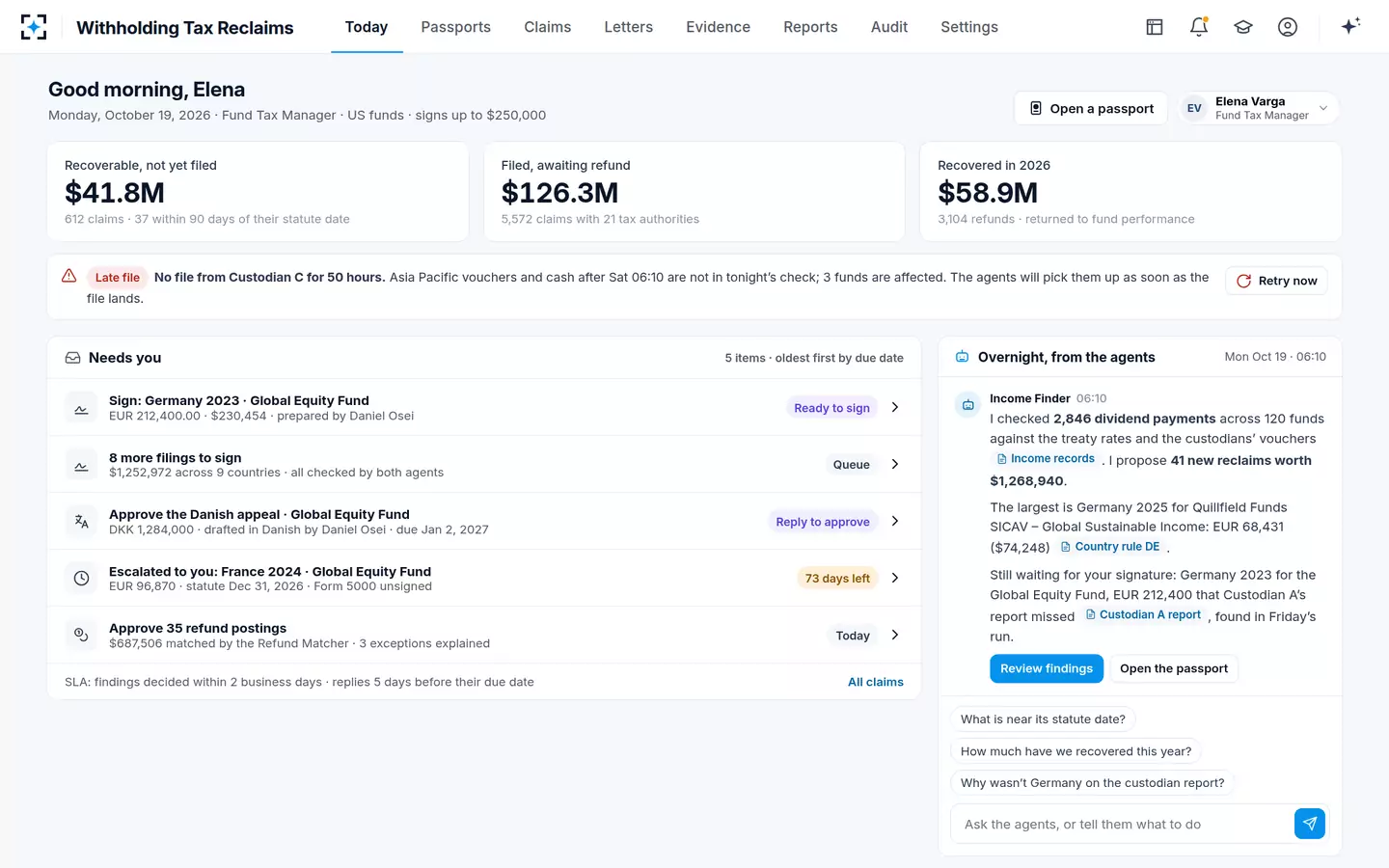
612
claims recoverable but not yet filed, worth $41.8 million
5,572
claims filed and awaiting refund from 21 tax authorities
37
claims within 90 days of their statute date, worth $6.2 million
The renewals that keep relief at source working
The cheapest reclaim is the one that never has to be filed, and for a small team that means keeping relief-at-source documents current. Each has its own life, and each lapses quietly: the paying agent simply withholds the full rate on the next payment, and the team finds out from a voucher weeks or months later.
Five documents that prevent reclaims, and when each runs out
| Document | Where it works | How long it lasts |
|---|---|---|
| Form 6166 | Proof of US residence for treaty relief abroad, at source or by refund | The period certified, normally one tax year; next year's cannot be requested before 1 December |
| Form 5000 | France: treaty rate at source under the simplified procedure | Must reach the paying bank before the payment; one per paying institution and type of income |
| German status certificate | Germany: 15% at source for an investment fund, if the withholding agent holds it | At most three years when first issued, then up to five |
| Form NR301 | Canada: treaty rate withheld by the payer | Draft forms expire on a change in eligibility or three years after signing, whichever is earlier |
| Form W-8BEN-E | United States: treaty rate for a foreign entity on US-source income | To the last day of the third calendar year after signing, unless circumstances change |
A team of one can keep this list in a calendar with the expiry of every document for every fund and every paying agent, and work it a quarter ahead. A relief-at-source failure that ends as a reclaim can often be traced to one of these dates passing unnoticed, or to a fund changing its name, custodian or structure without new forms following. In the sample, two of the night's 41 findings were exactly that: relief at source that failed at a custodian, one in Canada after an NR301 lapsed.
Where a small team's days go on one claim
On one country-year claim for one fund, our estimate is that a fund tax team spends close to seven working days by hand, and that finding the excess and collecting the evidence take half of that. Drafting the form, checking the figures, answering the authority and matching the refund take the rest. Across 35 countries and many funds, those days are the whole year.
Where the working days go on one country-year reclaim, by hand
About 6.75 days
- Finding the excess · 29.6%
- Collecting evidence · 22.2%
- Drafting the form · 14.8%
- Letters · 14.8%
- Checking and matching the refund · 18.6%
The largest share is the one most worth automating. Finding the excess means merging each custodian's reclaim report with the fund's own income, payment by payment, and that is work a person does badly at volume and an agent does well. In the Commission's public consultation, 45 of 54 businesses and business associations said collecting the documentation for one refund claim takes more than three weeks (SWD(2023) 216).
How do you track reclaims by country?
Track each claim by fund, country and year, with five dates on it: the dividend dates it covers, its statute date, the date its evidence was complete, the date it was filed, and the date it was refunded. Those five dates answer every question a board, an auditor or a tax authority asks. A spreadsheet can hold them; it cannot recompute a statute date when a country's rule changes.
Open claims by statute month, and the 37 inside 90 days
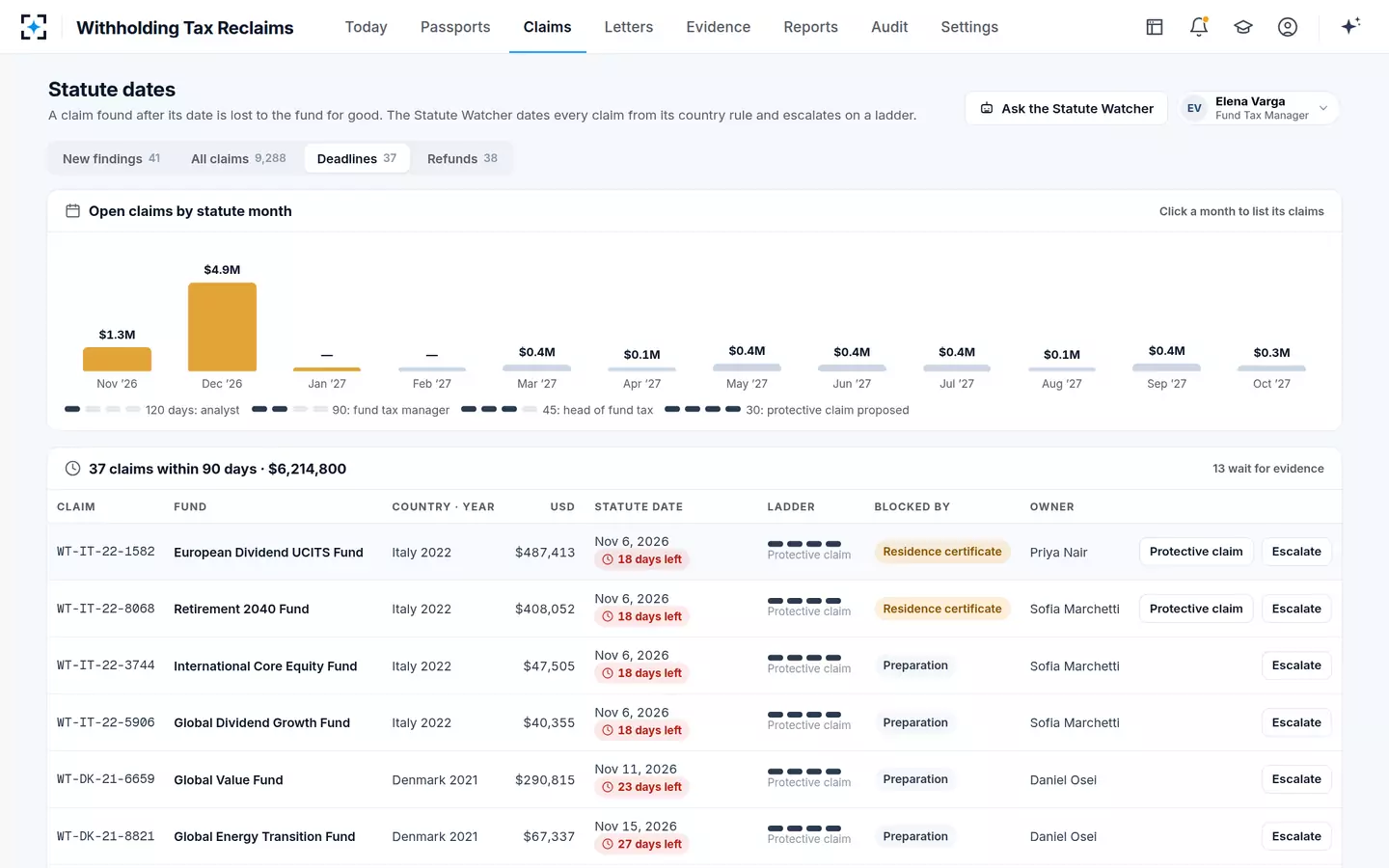
The December bar in the sample is the year-end cliff in the table above, seen from the inside. The Statute Watcher computes each date from the versioned country rule, so when Denmark's limit moved from three years to five, every Danish claim's date moved with one approved rule change. Form 6166 and its calendar covers the evidence dates that sit behind each claim.
Who signs a tax reclaim?
A tax reclaim is signed by someone authorised to act for the fund, usually a fund officer or a manager with delegated authority, or by a representative under a power of attorney. The person who prepared the claim should not be the person who signs it. In a team of two, that rule is the one most often bent, and it is the one auditors ask about.
In the sample firm's settings, an analyst prepares, a fund tax manager signs up to $250,000, and the head of fund tax signs above that; the preparer can never sign the same claim, and the rule cannot be switched off. Representatives need their own authority: Germany's Federal Central Tax Office wants a power of attorney on its template, and Denmark wants one from each representative between the filer and the shareholder.
Four people, one German claim: their month before and after
Today
Merges custodian reclaim spreadsheets with accounting income to find what is missing, country by country.
With agents
Works the overnight findings, each with its vouchers, lending data and confidence, and accepts or dismisses each with a reason.
Still theirs: The judgement on every finding
Today
Signs filings on trust in one person's arithmetic, and learns of an authority's query when it is nearly due.
With agents
Signs only after two agents agree to the cent, with the preparer and the signing limit on the same screen.
Still theirs: The signature and every reply to an authority
Today
Learns a claim lapsed only when the date has passed.
With agents
Approves the country rules, signs the large filings and reports recovery to the fund boards.
Still theirs: The rules, the write-offs and the EU-law decisions
Today
Hears that relief at source failed when the full rate shows up on a statement months later.
With agents
Gets each failure the night it happens, with a drafted note to the custodian and the proof.
Still theirs: The custodian relationship
When should a fund use a custodian or a reclaim service?
A fund should use its custodian's reclaim service for the standard claims on the assets that custodian holds, and keep its own check on everything else: other custodians, failed relief at source, pension and special rates, EU-law routes and claims the service declines. The test is coverage, not price. A service that files 90% of the fund's claims perfectly still leaves the other 10% to lapse unless someone owns them.
The economics favour owning the comparison even when the filing is outsourced. Comparing owed with filed takes data the fund already has, its own income and the custodians' reports; filing takes country knowledge a service can provide. Tax reclaim services compared sets out what each kind of provider covers, and a withholding tax recovery pilot measures the gap on the fund's own data.
A small team's morning: what needs a person, and what the agents did overnight
Questions people ask
What does the BLS call a fund tax analyst?
The Bureau of Labor Statistics has no occupation for fund tax or withholding tax reclaim specialists; the nearest is accountants and auditors, with 1,449,500 jobs and a median annual wage of $83,680 in its May 2025 occupational employment estimates. Reclaim work in a fund manager often sits with a fund tax or operations team inside that category.
How many countries does a typical global equity fund reclaim from?
No regulator or independent study publishes a count. Work it out from the fund's own income: list every country it received dividends or interest from in the last four years, and mark those where the domestic rate exceeds the fund's treaty rate and relief at source is not in place. That list is the fund's reclaim scope.
Should a small team file protective claims?
Where a deadline is close and evidence is incomplete, a protective claim filed with what is available can keep the year open while the rest arrives, if the country's procedure allows completion later. It is a judgement for the head of fund tax, because an incomplete claim can also be rejected outright.
What is a tax reclaim receivable?
In fund accounting, it is the amount of foreign tax withheld that the fund expects to recover, usually booked as a receivable once the claim is expected to be collected. It should be released when the refund is matched, and written off with a reason if the claim fails or lapses.
How often should a fund check for missed reclaims?
As often as dividends are booked, ideally the same night, because each day a missed claim goes unnoticed is a day off its statute window. At the least, a full comparison of income owed against claims filed should run before each December, when several countries' deadlines fall together.