Tax reclaim services recover foreign withholding tax that a fund paid above its treaty or domestic entitlement: they identify the excess, gather the residence and ownership evidence, file each country's claim, answer the tax authority and collect the refund. Custodians offer them for the assets they hold, specialist firms offer them across custodians, and some funds run the work in-house. The measure that matters to a fund board is net recovery for the fund's investors: everything that comes back, less what it cost, less everything that was never found or lapsed. Botminds' Withholding Tax Reclaims is a fourth option, an in-house team with agents that find, evidence, draft and track every claim across all custodians, and this guide compares all four on that measure.
The cost figures come from the European Commission's impact assessment for the FASTER directive, linked where they appear. Providers set their own prices and no regulator or independent study publishes them, so the guide shows how to compare offers rather than quoting rates. The worked examples use fictional sample data from Quillfield Capital, an invented manager with 120 funds.
Most of what withholding tax procedures cost investors is relief they never claim
EUR 6.62 bn a year
- Relief not claimed, 4.83 · 73%
- Cost of claiming, 0.97 · 14.6%
- Waiting, 0.82 · 12.4%
What do tax reclaim services do?
A tax reclaim service takes over some or all of the reclaim process for a fund: monitoring income, finding the over-withholding, collecting residence certificates and ownership statements, preparing and filing each country's forms under a power of attorney, following up the authority's queries and tracking the refund. What varies between services is scope: which assets, which countries, which kinds of claim, and who is responsible for the deadline.
The Commission's impact assessment describes what a claim costs to file: "the costs associated with the paperwork and different source country requirements, or the costs incurred by custodians or external service providers", which it assumed average "2% of the refundable amount" (SWD(2023) 216). Its larger finding is that most of the cost of today's procedures falls on relief that is never claimed at all. A service that files cheaply but covers little does not fix that.
Does the custodian's tax reclaim service cover everything?
No. A custodian's tax reclaim service covers the assets that custodian holds and the claim types it supports, so it cannot see income held at other custodians and may not file failed relief at source, pension-rate, investment-fund or EU-law claims. A fund with two or three custodians has two or three partial services, and the gaps between them belong to nobody unless the fund owns them.
Four ways to run withholding tax reclaims, compared on coverage
| Approach | Covers well | Often leaves out | Who owns the deadline |
|---|---|---|---|
| Custodian's reclaim service | Standard treaty claims on assets that custodian holds | Other custodians' assets; claim types outside its service; sub-accounts outside its scope | The custodian, for what it files; the fund for the rest |
| Specialist reclaim firm | Claims across custodians, often including complex and EU-law routes | Whatever the fund does not send it; income it cannot see | Shared, as set in the engagement |
| In-house fund tax team | Everything the team has time to find | Volume: the claims nobody had time to look for | The fund |
| In-house with agents (Withholding Tax Reclaims) | Every dividend checked nightly across custodians; evidence, drafting and deadlines handled by agents | Judgements on contested and EU-law claims, which stay with people and advisers | The fund, with each deadline dated and escalated |
In the sample, the largest single claim the agents found in one night, EUR 212,400 for Germany 2023, sat in a securities-lending sub-account that the custodian's reclaim service did not cover; the custodian had filed and been refunded for the main account. Nothing was wrong with the custodian's service. It simply did what it was set up to do.
What do investors lose when reclaims lapse?
When a reclaim lapses, the fund's investors lose that money permanently: the source country keeps the tax, and no service, appeal or later rule change brings it back, except in the rare case of a change like Denmark's. Lapsed claims never appear on a statement, so they are the loss least likely to be noticed by a board.
The Commission's reasons why investors forgo refunds read like a list of service gaps: custodians and owners unaware of the claim, missed deadlines where documents are specific and time-limited, claims outside the statute, no service offered for the claim, and claims filed wrongly (SWD(2023) 216). Deadlines can be short: under Germany's investment-fund refund route a claim must be filed within two years after the end of the fund's financial year, a period the statute allows to be extended only for delays in deciding the fund's status certificate (§11 InvStG).
Rule changes can work the other way. After a June 2026 ruling of the Danish Supreme Court, the Danish Tax Agency now applies a five-year limit instead of three, and says it will itself reopen claims it had rejected as late under the old rule (Danish Tax Agency). A service that wrote off a Danish year as expired should be asked whether it has re-dated those claims.
How do you value a reclaim pipeline?
Value a reclaim pipeline as the money expected to reach the fund, net of everything it costs to get there: what is reclaimable, less what will lapse, less what will be rejected or reduced, less fees and internal cost, less the time value of waiting. The same formula compares providers fairly, because a low fee on a narrow scope can return less than a higher fee on a complete one.
Net recovery to the fund's investors, term by term
Reclaimable found
Σ (tax withheld − tax due) on every dividend
Across every custodian and claim type, inside each deadline.
Set by coverage
Lost to lapse
Reclaimable whose deadline passes before filing
Permanent. Zero is the only acceptable target.
Set by deadline control
Rejected or reduced
Filed claims refused or cut on evidence
Wrong certificate year, missing ownership statement, outdated form.
Set by evidence quality
Cost and waiting
Fees + internal hours + certificates + refund × rate × years outstanding
The Commission assumed 2% of the refundable amount to claim, and a one-year average delay.
Set by price, process and filing speed
The first term is the one most comparisons skip, because it is invisible: a provider can only report what it found. Measure it independently, by comparing the fund's own dividend income with every claim filed, on a past year. A withholding tax recovery pilot does exactly that.
Why waiting costs more when interest rates are high
Waiting for a refund costs the fund the return it could have earned on the money, so the cost rises and falls with interest rates. The Commission's estimates show it: the opportunity cost of delayed refunds was EUR 1.84 billion in its 2009 estimate, fell to EUR 0.28 billion in 2021 when rates were near zero, and was EUR 0.82 billion in the 2022 update based on long-run yields.
The cost of waiting for refunds tracks interest rates
For a fund, speed of filing is the part of waiting it controls. A claim found the night the dividend is booked can be filed months earlier than one found in an annual review, and a claim filed with a complete evidence file is less likely to be held up by a query. Neither changes the authority's processing time, which in the sample firm's history ran from a median of 4 months in one country to 22 in another.
How are tax reclaim services paid, and what does each model reward?
Ask how a provider is paid before comparing price, because the payment model decides what the provider is rewarded for. A fee per claim filed rewards filing; a share of recoveries rewards recovering, which favours large, easy claims over small or slow ones; a service priced inside custody fees rewards keeping the scope standard. None of these rewards finding the claims that fall outside the provider's scope.
The fund's interest is different: every recoverable dollar, at the lowest total cost, with nothing lapsing. A board that sees only the provider's recovery report sees the numerator. The useful report shows the denominator too: what was reclaimable across all custodians, and what share of it was filed, recovered, rejected, still open and lost.
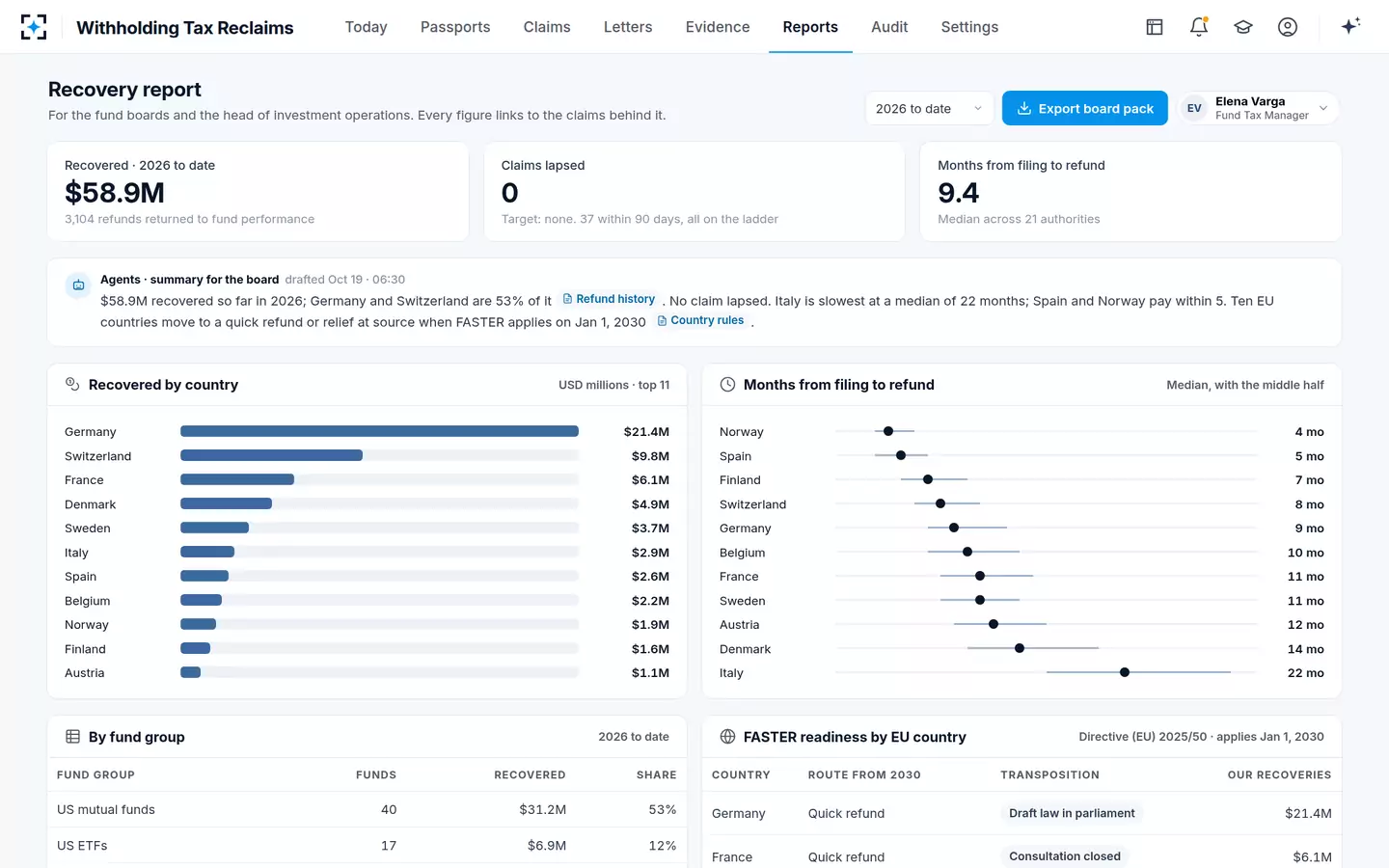
A recovery report that shows what lapsed, not only what came back
Should a fund run tax reclaims in-house?
A fund should own the comparison of what was owed with what was filed, whoever does the filing. That comparison needs the fund's own income data and every custodian's reports, which no single custodian has, and it is the only way to see the first term of the formula. Filing itself can be in-house, outsourced or split by country.
The case for doing more in-house used to be limited by people: one fund tax analyst cannot draft forms in eight languages and read letters in twelve. Agents change that arithmetic, because the volume work of finding, evidencing, drafting and tracking no longer scales with headcount. The case for keeping a specialist is judgement: contested treaty positions and EU-law claims, where advisers and sometimes litigation are part of the work. Fokus Bank claims covers those.
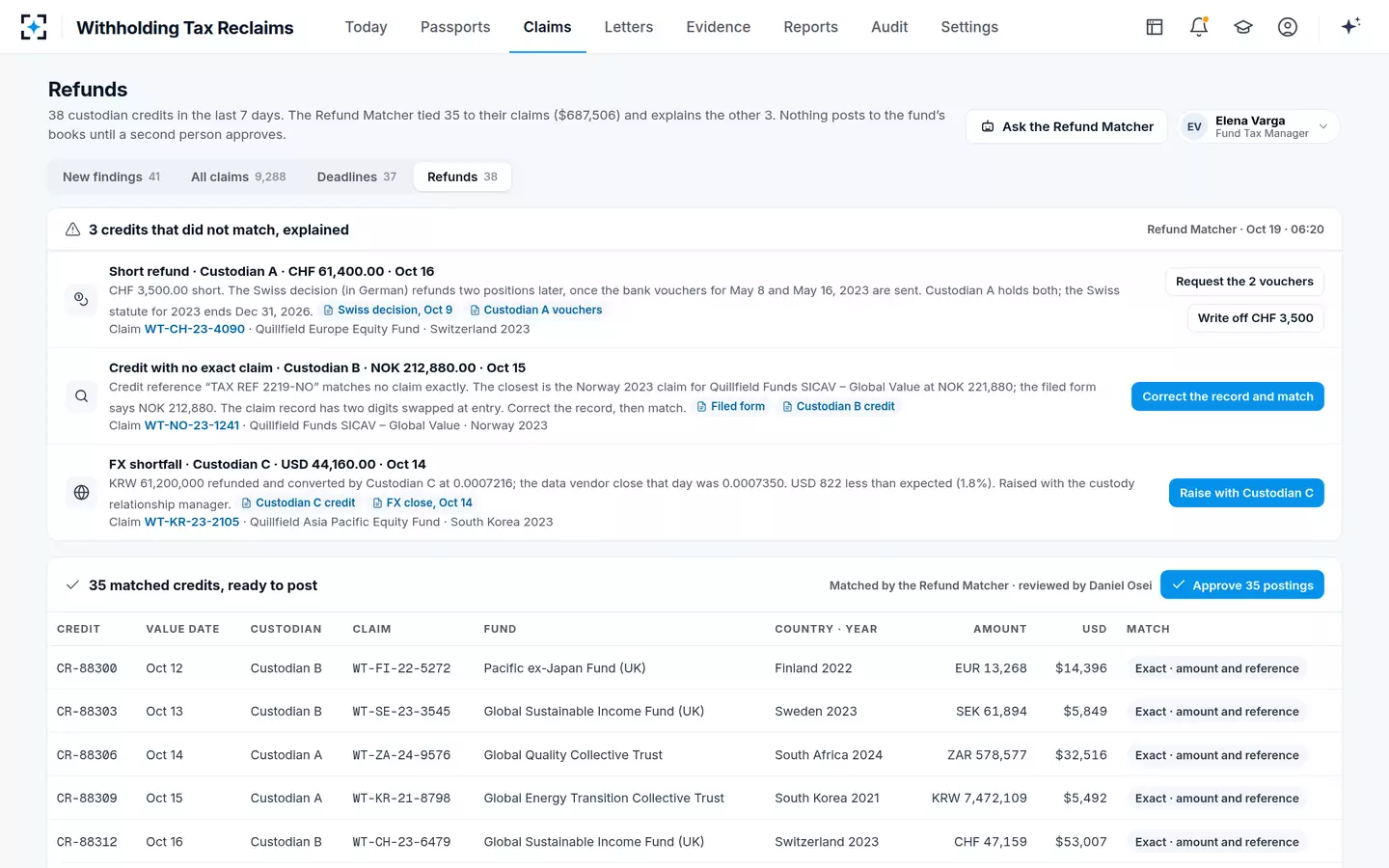
Refunds matched to claims, and three exceptions explained
What a fund board should ask to see
A fund board should ask for a recovery report that shows the whole pipeline, not just the refunds: for each country and custodian, what was reclaimable, what was filed, what was recovered, what was rejected, what is still open with its deadline, and what lapsed. Recovery belongs to the fund's shareholders, so the board's oversight question is whether everything owed to them is being claimed, not whether the provider is busy.
Three lines on that report deserve a standing place on the agenda. Lapsed claims, in money, with the reason for each: zero is the target, and anything above it is a permanent loss to shareholders. Claims within 90 days of their deadline, with what blocks each one. And the gap between what each custodian's service filed and what the fund was owed, which is the single best measure of whether the fund's arrangements cover its portfolio.
A provider's report alone rarely carries those lines, because a provider reports on what it handles. The fund's own comparison of income owed against claims filed supplies them. In the sample firm's report for its fund boards, recovery for 2026 to date sits beside the number of claims lapsed and the months from filing to refund by country, each figure linked to the claims behind it.
Where Withholding Tax Reclaims fits, and where it does not
Withholding Tax Reclaims fits a fund that wants to own the whole pipeline: every dividend checked against its entitlement the night it is booked, across all custodians, with the evidence, drafting, deadlines, letters and refund matching handled by agents and every decision taken by a named person. It works alongside a custodian's service rather than against it, flagging where a custodian already files a claim so the fund does not file it twice.
It does not replace legal advice on contested positions, and it does not litigate. A fund pursuing EU-law claims, or disputing a tax authority's reading of a treaty, will still need advisers; the solution keeps those claims inside their national deadlines and their evidence in one place. It also depends on the fund's data: if a custodian's tax vouchers arrive late, the findings for that custodian's assets wait for them.
What to ask a tax reclaim service
Ask any provider, including a custodian and including Botminds, the same questions, and ask for the answers on your own data. A provider that cannot say what it does not cover is telling you where your lapses will come from.
Questions for a tax reclaim service, in order of the money at stake
- Which assets, accounts and custodians do you cover?
Including lending sub-accounts and assets held at other custodians.
- Which claim types do you file, and which do you decline?
Treaty excess, failed relief at source, pension and special rates, investment-fund routes, EU-law claims.
- How do you know a claim exists before the deadline?
Monitoring every dividend as it is booked, or a periodic review.
- What lapsed last year, and why?
A provider that does not track lapses cannot report them.
- Who signs, under what authority, and who answers the authority's letters?
Powers of attorney, signing limits and approval of replies.
- How are you paid, and what does that reward?
Per claim, a share of recoveries or within custody fees.
- Can we see every document behind every claim?
The fund, its auditor and the tax authority may all ask.
- What do you need from us each year, and by when?
Residence certificates take at least 45 days from the IRS, and requests for next year cannot be posted before 1 December.
Withholding Tax Reclaims answers these on the fund's own data in a pilot, and the Withholding Tax Reclaims page shows the full process on one claim. For the people side of the decision, the tax reclaim process for a small team sets out who does what.
Questions people ask
What does the EU estimate withholding tax procedures cost investors?
EUR 6.62 billion a year in the Joint Research Centre's 2022 update, according to the Commission's impact assessment for the FASTER directive: EUR 4.83 billion of relief not claimed, EUR 0.97 billion of costs incurred in claiming and EUR 0.82 billion of opportunity cost while waiting. The Commission said 52% of those costs fall on EU investors.
What will the FASTER directive save investors?
In its 2023 proposal the Commission estimated savings for investors of about EUR 5.17 billion a year, EUR 730 million of it from less paperwork (COM(2023) 324). The directive applies from 1 January 2030, so claims on dividends paid before then run under today's rules.
Do tax reclaim services cover US withholding tax?
For a foreign fund, US treaty relief is usually given at source through Form W-8BEN-E rather than by reclaim. For a US fund, the reclaims run the other way, against foreign countries, with Form 6166 as the residence evidence.
Are reclaim recoveries part of fund performance?
Yes: a refund of withholding tax is income to the fund and its shareholders, and an unclaimed or lapsed reclaim is a permanent reduction in their return. That is why the recovery report belongs in front of the fund board, not only the tax team.
Can a fund switch reclaim providers mid-year?
It can, but open claims, powers of attorney and pending letters need an orderly handover, and each claim's deadline keeps running. List every open claim with its statute date and status before the switch, and agree who answers letters on claims filed by the old provider.