Withholding tax recovery is the work of getting back foreign tax a fund paid above its entitlement, and the way to judge any approach to it, a custodian's service, a specialist firm or Botminds' Withholding Tax Reclaims, is to run it on the fund's own past dividends and compare the result with what was actually filed and refunded. A pilot on a recent year shows what was missed, what was claimed wrongly and what is still inside its deadline, so it measures the approach and recovers money in the same exercise. A well-chosen pilot needs a year of dividend data from portfolio accounting, the custodians' tax vouchers and reclaim reports, the fund's lending positions and the claims already filed, and five or so countries with different rules.
The deadlines that set the timetable are each tax authority's own, linked where they appear. The examples use fictional sample data from Quillfield Capital, an invented US manager with 120 funds.
What one night's run on a sample book proposed, by kind of finding
How do we test a withholding tax recovery approach before switching?
Test it on history: give the approach a past year of the fund's dividends and see what it says the fund was owed, then compare that with what the fund's custodians and team actually filed and recovered. A pilot on history needs no change to live processes, cannot miss a live deadline, and produces a number the board can check: money owed but never claimed.
Two things make the test fair. The approach gets the same data the fund's team had, including every custodian's files, not a cleaned extract. And the comparison is line by line, dividend by dividend, so a finding that matches a filed claim, one that the custodian missed, and one the approach got wrong are all visible. A summary total hides all three.
Which year and which countries should a recovery pilot cover?
Choose the most recent full year whose claims are still open in every country you pick, and five countries that between them use different rules: a refund-only country, a relief-at-source country, a short deadline, a long one, and the country with the most dividend income. For a pilot run in late 2026 on 2024 dividends, that usually means Germany, Switzerland, France, Denmark and Canada, or the fund's own equivalents.
A 2024 dividend in five countries: when its claim lapses
| Country | Deadline rule | 2024 claim open until | Why it belongs in a pilot |
|---|---|---|---|
| France | 31 December of the second year after payment | 31 Dec 2026 | Relief at source fails if Form 5000 arrives late; the shortest window here |
| Canada | Two years after the end of the year the tax was remitted | 31 Dec 2026, if remitted in 2024 | Relief at source through Form NR301, which can lapse |
| Switzerland | Three years after the end of the year due | 31 Dec 2027 | The largest gap, 20 points, and refund only |
| Germany | Four years after the end of the year received | 31 Dec 2028 | Two routes with two deadlines; the most volume for many funds |
| Denmark | 5 years from the time the tax was withheld | 2029, payment by payment | A deadline changed by a court in June 2026 |
The table is also an argument for starting now. A French or Canadian claim on a 2024 dividend that a pilot finds in November 2026 can still be filed before the year ends; the same claim found in January 2027 is gone. A pilot that begins with the countries whose windows close first pays for itself fastest.
Why last year rather than older years? Because a recent year's data is easiest to get, every country's window is still open, and the result says something about the process running today. An older year is worth adding for countries with long windows, such as Germany, where 2022 claims stay open until the end of 2026.
What data does a withholding tax recovery pilot need?
A recovery pilot needs six sets of data, all of which a fund already holds or can request: dividend income from portfolio accounting, every custodian's tax vouchers and reclaim reports, securities lending positions on each record date, the fund entities and their residence evidence, the claims already filed with their status, and the refunds received. Most pilots stall on the second, so request it first.
The data request for a pilot, in the order to send it
- Custodian tax vouchers and reclaim reports, every custodian
Including sub-accounts and lending accounts. Germany needs the German paying agent's tax certificate, not a custodian's dividend advice.
- Dividend income from portfolio accounting
Gross, tax booked and any reclaim receivable, per payment, per fund.
- Securities lending positions on each record date
From the lending agent. Lent shares are the commonest over-claim.
- Fund entities and residence evidence
Legal names, tax IDs, Forms 6166 by year. A missing year can be requested from the IRS, allowing at least 45 days.
- Claims already filed, with status
From each custodian's service and the fund's own team: filed, refunded, rejected, open.
- Refunds received
Custodian cash credits, so recovered amounts can be tied to claims.
Relief-at-source documents belong in the request too. A fund's W-8BEN-E for US income stays valid until the last day of the third calendar year after signing unless circumstances change, according to the IRS instructions, and Canada's NR301 has its own expiry. A pilot that lists every such document with its expiry date often finds the next year's relief-at-source failures before they happen.
How do we compare the pilot with what the custodian filed?
Compare at the level of the dividend: for each payment, did the pilot find an excess, did anyone file a claim for it, and was the claim paid? That gives five outcomes, and each one means something different for the decision.
Five outcomes for each dividend in a pilot, and what each tells you
| Outcome | What it means | What to do with it |
|---|---|---|
| Found and filed | The approach and the existing process agree. | Check the amounts match; differences point to rate or exchange-rate errors. |
| Found, not filed, still open | Money the existing process missed that can still be claimed. | File it, after review, before its deadline. |
| Found, not filed, lapsed | Money the fund lost for good. | Report it: it is the cost of the current process. |
| Filed, not found | The approach missed a claim, or the filed claim was not owed. | Investigate each one; it is the approach's error rate. |
| Excluded by the approach | Lent shares, duplicates, claims already filed. | Check a sample: wrong exclusions are missed money. |
The fourth row is the one to read most carefully, because it measures the approach rather than the incumbent. No regulator or independent study publishes accuracy figures for reclaim work, so this row is how a fund measures it for itself. A good result has few unexplained rows in it, and each explanation cites a document.
One fund's countries at a glance, the pilot's main output
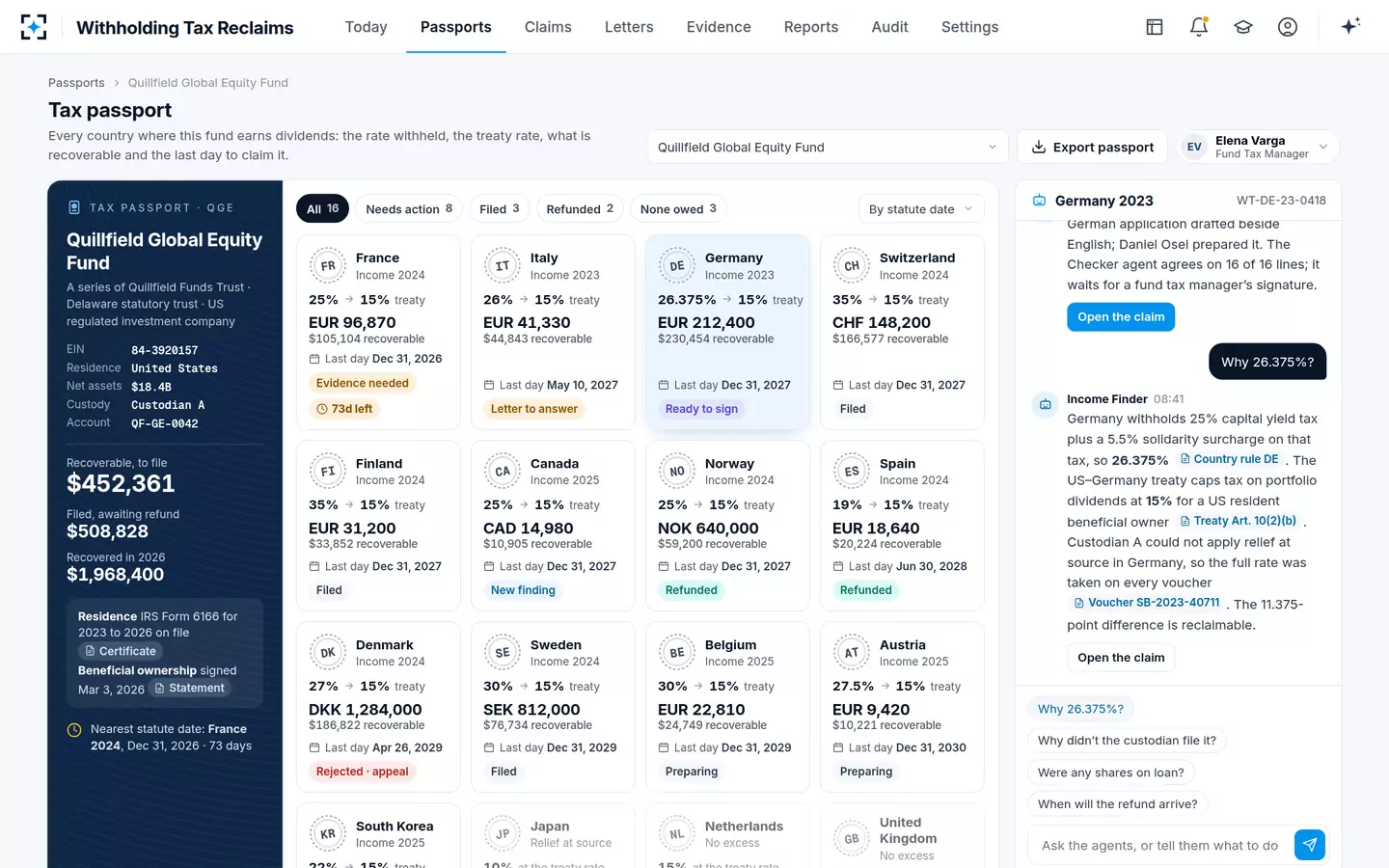
Where to look first in a pilot's findings
Look first at the findings that point to a gap in the process rather than a one-off error, because those repeat every year. Six kinds are worth sorting out on the first pass, and each has a different owner.
Six kinds of pilot finding, and who fixes the cause
| Finding | What it usually means | Who fixes the cause |
|---|---|---|
| Income in accounts no reclaim service covers | A sub-account, such as a lending account, or a custodian outside the reclaim arrangement | Custody relationship manager, with the custodian |
| Full rate withheld where relief at source should have worked | A form expired or arrived after the payment date | Fund tax analyst, with a renewals calendar |
| Claims held up by a missing certificate | A year of Form 6166 never requested, or a certificate naming the wrong entity | Fund tax analyst, a year ahead |
| The same dividend claimed twice | Two services, or a service and the fund's own team, filing the same claim | Head of fund tax, by setting who files what |
| A lower rate than the treaty's | Pension, investment-fund or EU-law routes nobody files | Head of fund tax, as a decision |
| Claims written off on an old deadline | A rule changed, as Denmark's did in 2026 | Whoever owns the country rules |
The first row is the one that surprises boards most, because nothing on any report shows it. In the sample, the largest claim the agents found in one night came from exactly that row: EUR 212,400 of German tax in a lending sub-account that the custodian's reclaim service did not cover, on 16 dividends paid in 2023.
What results should a recovery pilot report?
A recovery pilot should report six numbers for each country and the total: reclaimable found, already filed, still open and claimable, lapsed, claims the approach missed, and exclusions it made with their reasons. The board needs the first four; the tax team needs the last two to judge the approach. Report them in money and in count, because one large missed German claim and forty small Danish ones are different problems.
Report the time too. How long did it take to get the custodians' data? How many claims needed a residence certificate the fund did not have? Those are the frictions the live process will hit every year. Tax reclaim services compared shows how to turn the numbers into a net-recovery comparison between providers.
How long does a withholding tax recovery pilot take?
On our plan, a recovery pilot takes six to eight weeks, most of it waiting for data and reviewing findings, not running the comparison. The run itself takes a night; collecting every custodian's vouchers and reports often takes longer than everything else together.
A pilot plan: most of the time is data and review
- Data request and receipt3 weeks
- Run
- Review findings2 weeks
- Compare1 week
- Report
Time the pilot so its findings land before a deadline, not after one. A pilot that starts in early November on 2024 dividends can still file the French and Canadian claims it finds before 31 December; one that starts in December cannot. The same logic applies to a German 2022 year, which closes on the same night.
Who should take part in a recovery pilot?
Four people: the head of fund tax, who owns the decision; a fund tax analyst, who reviews every finding; the custody relationship manager, who gets the custodians' data and raises what they missed; and internal audit, who checks the comparison. The pilot is as much a test of the evidence trail as of the findings.
Who does what in a recovery pilot
Today
Has a recovery figure from each custodian and no view of what was missed.
With agents
Sees, country by country, what was owed, filed, recovered, still open and lost.
Still theirs: The decision, and any EU-law or contested claim
Today
Reconciles custodian reclaim reports with accounting income by hand.
With agents
Reviews each finding with its voucher, lending data and reason, and accepts or dismisses it.
Still theirs: The judgement on every line
Today
Learns of a custodian's gap when a claim has already lapsed.
With agents
Takes each custodian a list of what its service missed, with the proof.
Still theirs: The custodian conversation
Today
Samples filed claims afterwards.
With agents
Checks the pilot's comparison and opens any claim's full evidence trail.
Still theirs: Independent assurance
Every claim's evidence in one export, for audit
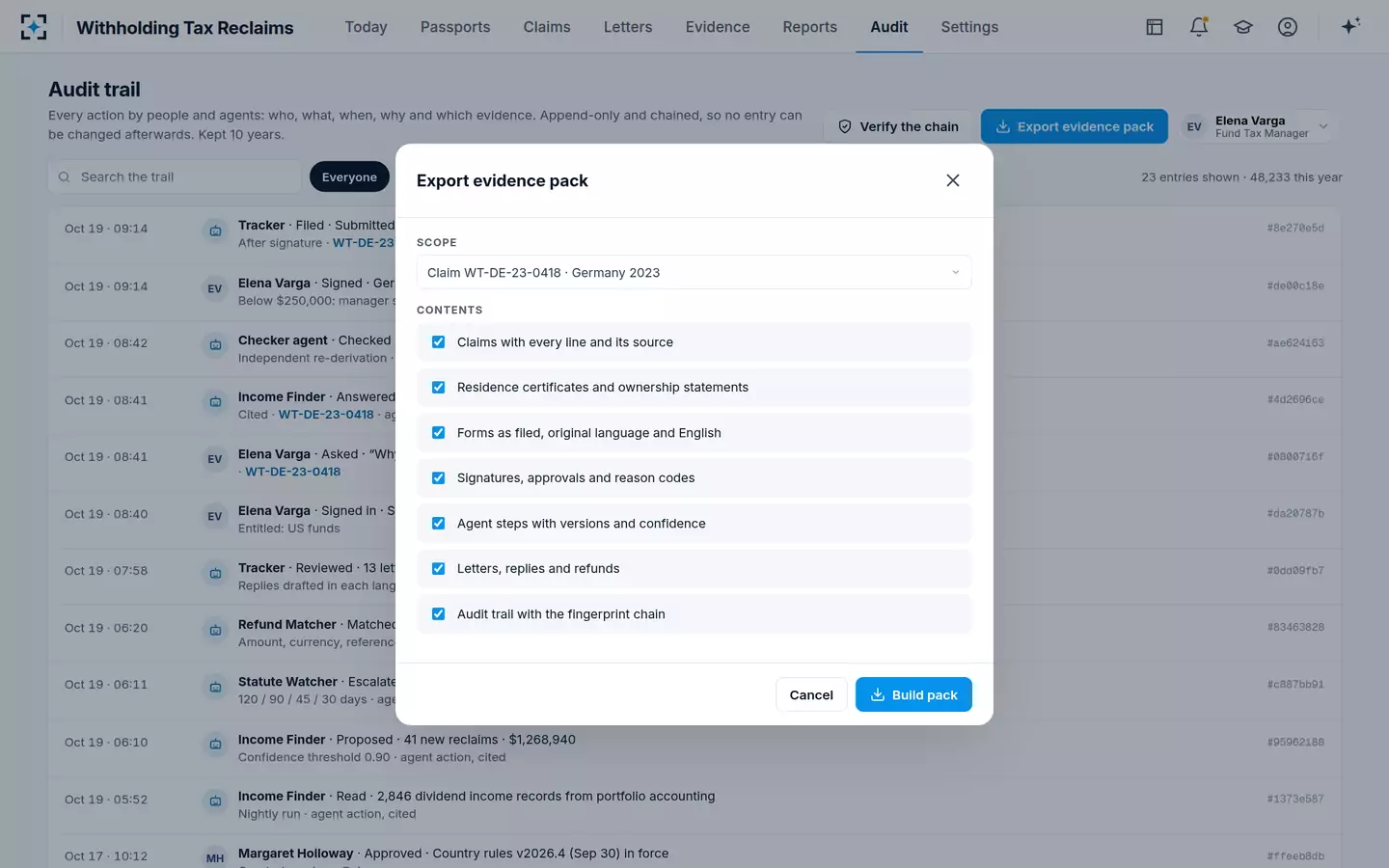
Choosing an approach once the pilot is in
Decide on four measures from the pilot, in this order: coverage, the share of what the fund was owed that the approach found; errors, the claims it missed or got wrong, from the fourth row of the comparison; evidence, how many of its findings came with every document a tax authority would ask for; and cost, internal time plus fees per unit of money recovered. A cheaper approach that covers less returns less to shareholders.
Then decide what to do with the money the pilot found. Claims still inside their deadlines should be filed, through the fund's existing route or the new one; claims that lapsed should be reported to the board as the measured cost of the current process. A pilot that ends with claims filed has already paid for some of itself, and has tested the filing step on real authorities as well.
What does "withholding tax recoverable" mean in fund accounting?
Withholding tax recoverable is the amount of foreign tax a fund has had withheld and expects to get back, carried as a receivable until the refund arrives. A pilot tests that number from both sides: receivables that will never be collected because the claim lapsed or was never filed, and recoverable tax that was never booked as a receivable at all because nobody found it.
In Withholding Tax Reclaims, the Refund Matcher ties each custodian credit to its claim and proposes the posting that releases the receivable; a second person approves every posting and only the head of fund tax can write one off, with a reason. Withholding tax reclaim with AI agents sets out each agent's limits, and the Withholding Tax Reclaims page follows one claim from finding to refund.
Questions people ask
Can a pilot run without changing our custodian arrangements?
Yes. A pilot on history needs copies of data the fund already receives and changes nothing in the live process. Only the claims it finds that are still open need action, and those can be filed through whichever route the fund chooses.
How many countries should a first pilot include?
Five is usually enough to cover the main kinds of rule: a refund-only country, a relief-at-source country, a short and a long deadline, and the fund's largest source of dividends. Adding more countries adds data requests faster than it adds insight.
What if the pilot finds claims that have already lapsed?
Report them; they are the measured cost of the current process and the strongest part of the business case. They cannot be recovered, except where a rule changes, as Denmark's limitation period did in 2026.
Should the custodian be told about the pilot?
Yes, because the pilot needs its vouchers and reclaim reports, and its findings about the custodian's service are best raised with the evidence attached. A gap is often a matter of scope rather than error, as with the lending sub-account in the sample, and scope can be extended once it is seen.
What does a pilot cost the fund's team?
Mostly the time to gather data and review findings. In the plan above that is about three weeks of data requests and two of review for one analyst, with a few hours from the head of fund tax and the custody relationship manager.