To reclaim German withholding tax on dividends, a foreign fund applies to the Federal Central Tax Office (Bundeszentralamt für Steuern, BZSt) for the tax withheld above its entitlement: Germany withholds 26.375%, and a US fund's treaty rate on portfolio dividends is 15%, so 11.375 points of each dividend come back on a valid claim. The treaty refund under §50c of the Income Tax Act must be filed electronically within four years from the end of the year the dividend was received, with a residence certificate and the German paying agent's tax certificate. A fund recognised under Germany's Investment Tax Act has a second route, with a two-year deadline. Botminds' Withholding Tax Reclaims finds every German dividend taxed above the fund's rate, drafts the German application beside English and tracks both deadlines.
The statute text comes from the German federal law portal and the Federal Central Tax Office, and the treaty from the IRS. The worked claim is fictional sample data: the Global Equity Fund of Quillfield Capital, an invented US manager with 120 funds.
Where a EUR 100 German dividend goes before and after a successful claim
Paid at 26.375%
- Fund receives · 73.625%
- Tax withheld · 26.375%
After the reclaim
- Fund keeps · 85%
- Tax owed under the treaty · 15%
How do I reclaim German withholding tax on dividends?
You reclaim German withholding tax by filing an electronic refund application with the Federal Central Tax Office through its online portal, attaching a residence certificate from your own tax authority and the tax certificate issued by the German paying agent. Since 1 January 2023, refund applications under §50c(3) of the Income Tax Act must be sent "nach amtlich vorgeschriebenem Datensatz über die amtlich bestimmte Schnittstelle", in the official data format through the official interface (BZSt, electronic application procedure). The decision comes back through the same portal.
A fund can file itself or through a representative. The BZSt requires the representative to prove its authority with a power of attorney, and says representation needs "mindestens dessen Befugnis zur geschäftsmäßigen Hilfeleistung in Steuersachen", at least authority to provide professional help in tax matters under the German Tax Advisers Act.
The two routes differ in what they rest on. The §50c route rests on the tax treaty and the fund's treaty residence. The investment-tax route under §11 of the Investment Tax Act (InvStG) rests on German law's own 15% rate for investment funds, and needs the fund's German status certificate.
Why does Germany withhold 26.375% on dividends?
Germany withholds 26.375% because two taxes are taken at source: capital yield tax (Kapitalertragsteuer) of "25 Prozent des Kapitalertrags" under §43a(1) of the Income Tax Act, and a solidarity surcharge that "beträgt 5,5 Prozent der Bemessungsgrundlage", 5.5% of the tax, under §4 of the Solidarity Surcharge Act (§4 SolZG). 25% plus 5.5% of 25% is 26.375% of the gross dividend.
The paying agent withholds at that rate even where a treaty says less. §50c(1) of the Income Tax Act says that where a treaty stands in the way of the tax, the rules on withholding, paying and declaring it "sind dessen ungeachtet ... anzuwenden", apply regardless, and the withholding agent cannot rely on the creditor's treaty rights (§50c EStG). The treaty is honoured afterwards, by refund.
What is the US–Germany treaty rate on dividends?
The US–Germany treaty rate on portfolio dividends is 15%. Article 10(2) says that where the beneficial owner is a resident of the other state, the tax "shall not exceed ... 15 percent of the gross amount of the dividends in all other cases", with 5% for a company holding at least 10% of the voting shares (US–Germany income tax treaty). A fund holding a portfolio of German shares is in "all other cases".
Two conditions sit inside that sentence. The fund must be a US resident under the treaty, which the BZSt wants confirmed by the fund's own tax authority for the date the dividend was received. And it must be the beneficial owner of the dividend, which is why shares that were on loan over the record date come out of the claim.
Two routes back to 15%: the treaty refund and the investment-fund refund
A foreign fund can recover German tax above 15% under the treaty, through §50c(3) of the Income Tax Act, or under German investment-tax law, through §11 of the Investment Tax Act. Both are handled by the Federal Central Tax Office; they differ in who may use them, what evidence they need and, above all, their deadlines.
The same 11.375 points, two statutes
| Treaty refund, §50c(3) EStG | Investment-fund refund, §11 InvStG | |
|---|---|---|
| Who may apply | A non-resident creditor entitled to treaty relief, or its representative | A foreign investment fund with a German status certificate, where the withholding agent has not refunded and will not |
| What it rests on | The treaty rate, 15% for a US portfolio holder | German law: 15% on a fund's German dividends, solidarity surcharge included (§7 InvStG) |
| Deadline | Four years from the end of the calendar year the dividend was received; not before one year after the tax was paid | Two years after the end of the fund's financial year; extended only for delays in deciding the status certificate |
| Key evidence | Residence certificate for the date of receipt; the German paying agent's tax certificate | Status certificate; tax certificates; the withholding agent's declaration that it has not refunded |
| How filed | Electronically, through the BZSt online portal (mandatory since 2023) | On the official form, or electronically through the BZSt online portal |
The §11 route is shorter in every sense. It suits a fund that holds a status certificate but whose German withholding agent took 25% plus surcharge anyway, and the BZSt describes its applicants in exactly those terms. Its deadline is unforgiving: "Eine Erstattung ist ausgeschlossen, wenn nicht alle Unterlagen innerhalb der zuvor genannten Frist eingereicht werden", no refund if all documents are not filed within the period (BZSt). A fund that misses it still has the treaty route, if its four years are not also gone.
How long do I have to reclaim German withholding tax?
Under the treaty route you have four years from the end of the calendar year in which the dividend was received, and the period does not end before one year after the tax was paid, nor before any longer period in the treaty (§50c(3), sentence 2). Under the investment-fund route you have two years from the end of the fund's financial year. For a calendar-year fund, a 2023 dividend lapses at the end of 2025 on one route and at the end of 2027 on the other.
One 2023 German dividend, two deadlines
- Year received2023
- Two years after the financial year2024–2025
- Year received2023
- Four years after year-end2024–2027
The sample claim in this guide was found in October 2026. For a calendar-year fund, the investment-fund route for 2023 had closed by then, and the treaty route had fourteen months left. That is the normal shape of a German claim found late: one route gone, one still open, and the team needs to know which.
Can a fund get German relief at source instead of a refund?
A fund cannot get the treaty rate at source in Germany: §50c(2) issues an exemption certificate for treaty relief on capital yield tax only to a company subject to tax at home that holds at least a tenth of the paying company ("an deren Nennkapital der Gläubiger zu mindestens einem Zehntel unmittelbar beteiligt ist"). A fund with portfolio holdings does not qualify, so it receives German dividends at 26.375% unless the investment-tax route works at source.
That route can work. Under §7 of the Investment Tax Act, capital yield tax on a fund's taxable German income is 15%, solidarity surcharge included, provided the withholding agent holds a status certificate in which the tax authority confirms the fund's status (§7 InvStG). The BZSt puts it plainly: "Voraussetzung für eine Ermäßigung der Steuer an der Quelle auf 15 Prozent der Kapitalerträge ist die Vorlage einer Statusbescheinigung." A first status certificate is valid for at most three years and later ones for up to five, and it can be issued retroactively for six months before the application.
The hard part is the chain. The certificate has to reach the German withholding agent, which for a foreign fund is usually several custodians away. Where it does not, the agent withholds the full rate, and the fund is back to a refund. Dividend withholding tax rates by country compares Germany's routes with five other countries'.
What does the Federal Central Tax Office need?
For a treaty refund, the BZSt needs the electronic application, a residence certificate confirming the fund's residence at the time the dividend was received, and the tax certificate from the German paying agent, uploaded through its portal. It does not want originals by post, though it may ask for one in an individual case.
The German treaty refund file
- A BZSt number and portal access
Applications go through the BZSt online portal; registration needs a BZSt number.
- A residence certificate with its period of validity
Issued by the fund's own tax authority, confirming residence "zum Zeitpunkt des Zuflusses der Kapitalerträge", when the dividends were received. For a US fund, Form 6166 for the right year.
- The German paying agent's tax certificate
It shows the type and amount of income, the capital yield tax and the surcharge. "Nicht ausreichend ist eine Gutschriftsanzeige (z.B. Dividendenbescheinigung) der (ausländischen) Depotbank": a foreign custodian's credit advice is not enough.
- A power of attorney, if a representative files
On the BZSt's template, from someone authorised to help with tax matters professionally.
- The shares actually owned on each date
Lent shares come out of the claim; the fund must be the beneficial owner of what it claims.
The tax certificate trips more claims than any other document. It must come from the German paying agent, the institution that paid the dividend on or passed it abroad, and a foreign custodian's dividend advice is not a substitute. A fund that holds German shares through a chain of custodians has to get the German certificate up that chain. Form 6166, the residency certificate, covers the other half of the file.
One German claim, worked through Withholding Tax Reclaims
Take the sample claim. In 2023 the Quillfield Global Equity Fund received 16 dividends from German issuers between April and September, EUR 1,867,252.70 gross, on which EUR 492,487.91 was withheld at 26.375%. At the 15% treaty rate the tax due was EUR 280,087.91, so EUR 212,400.00 was reclaimable. The custodian's reclaim service had missed it because the shares sat in a securities-lending sub-account it did not cover.
Two payments had shares on loan over the record date: 12,000 and 40,000 shares. On those the fund had received manufactured payments from the borrower, with no German tax withheld, so the Income Finder left out EUR 82,800 of payments, which would have added EUR 9,418.50 to the claim. An analyst checked the two exclusions against the lending agent's file and accepted the finding.
The German refund application, drafted in German beside English
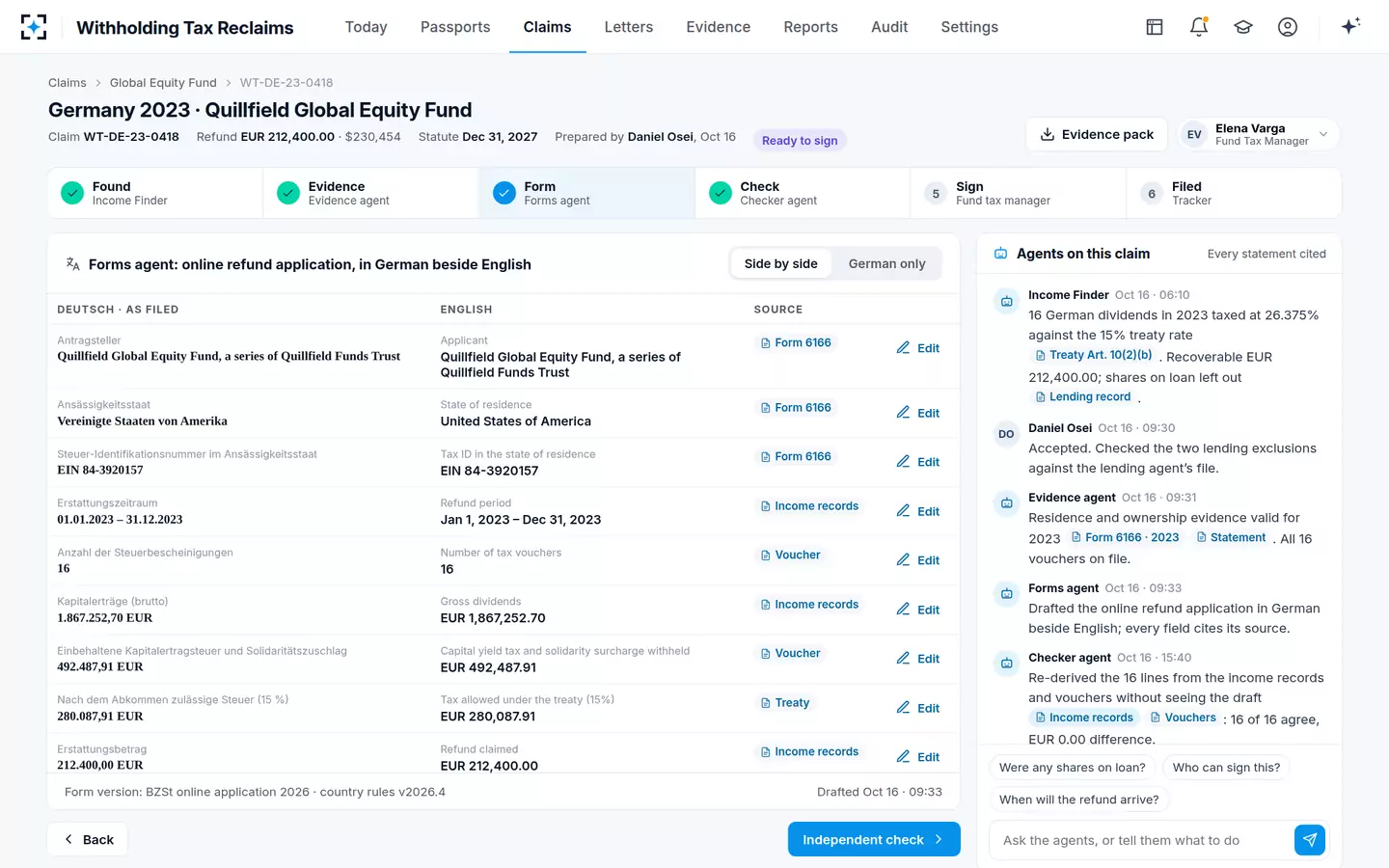
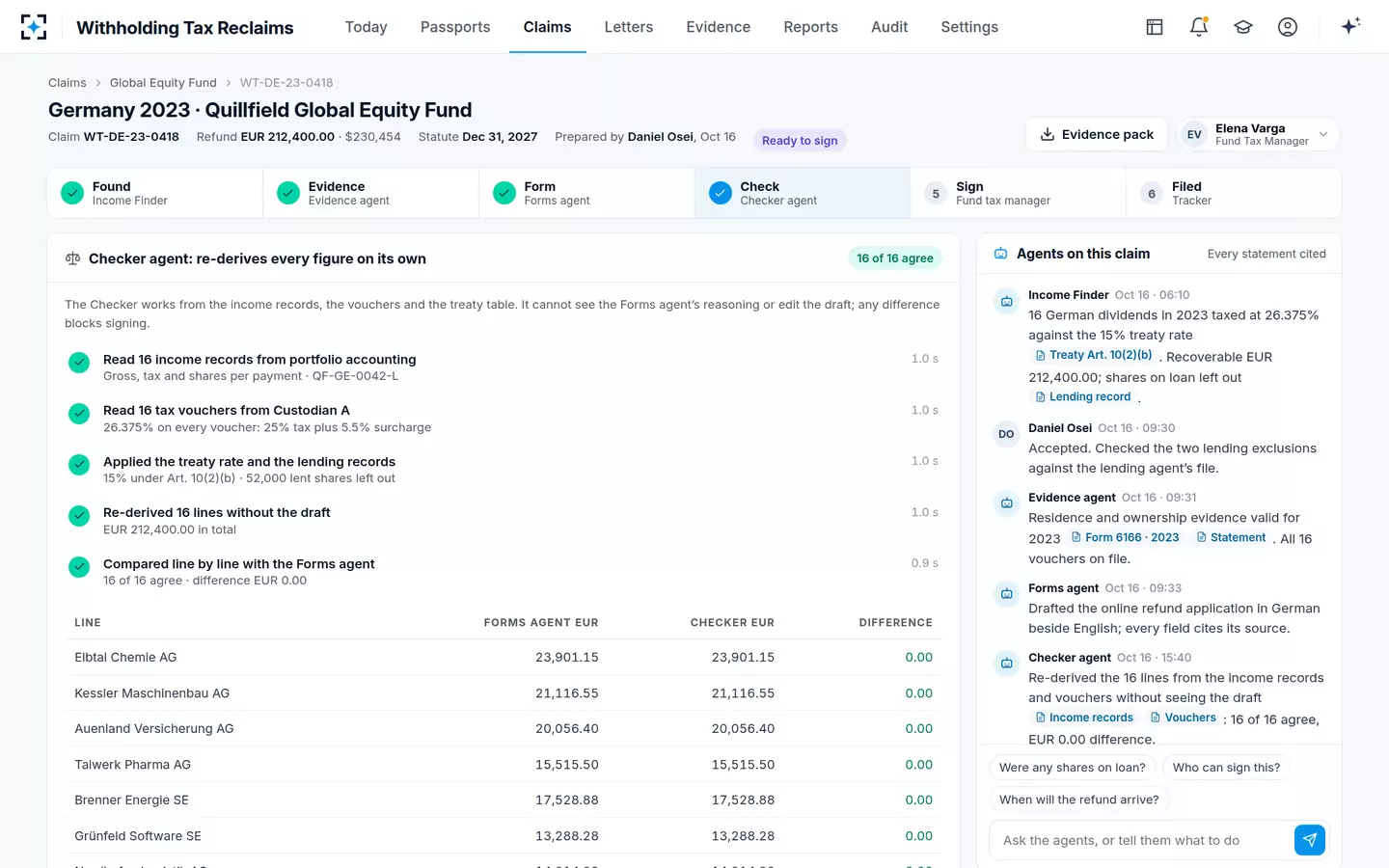
The Forms agent drafted the application in German beside English; the Checker agent, working only from the income data, the vouchers and the treaty table, re-derived all 16 lines and found a difference of EUR 0.00. The fund tax manager signed, and the claim was filed through the portal fourteen months before its deadline.
The check before signature: 16 lines re-derived without the draft
How long does a German refund take?
The Federal Central Tax Office publishes no standard processing time for treaty refunds, so a fund has to measure its own. In the sample firm's history of 214 German refunds since 2021, the median was 9 months from filing, with the middle half between 7 and 13. The BZSt asks for missing documents through its portal, and a claim with a complete file moves faster.
Do not count on interest for the wait. §50c(4) provides for interest on refunds made in connection with §50g, Germany's rule for interest and royalty payments between associated EU companies, and says nothing of interest on a fund's treaty refund of dividend tax. Eleven points of a large German dividend portfolio can sit with the tax office for most of a year, which is why a fund finding a German claim in its fourth year has no time to spare.
Germany's caution has a history. Researchers writing in International Tax and Public Finance found that cum-ex trades "caused considerable revenue losses due to illegitimate tax refunds in Germany and other countries" and "are only profitable for both buyer and seller in the presence of collusive tax fraud" (Buettner, Holzmann, Kreidl and Scholz, 2020). Electronic filing, tax certificates from the German paying agent and the scrutiny of lent shares are the controls that followed. Withholding tax reclaim with AI agents looks at what the checking side has to prove.
Questions people ask
What is the German Federal Central Tax Office?
The Bundeszentralamt für Steuern (BZSt) in Bonn is the federal tax office that handles relief from German tax on capital income for non-residents: treaty refunds under §50c of the Income Tax Act and, since 1 July 2021, refunds to foreign investment funds under §11 of the Investment Tax Act.
Can I still file a paper German refund claim?
Not for a treaty refund applied for since 1 January 2023, which must be filed electronically under §50c(5); the BZSt may waive this only on application, to avoid undue hardship. The investment-fund refund under §11 InvStG can still be made on the official form, or electronically.
Is a custodian's dividend advice enough as a tax certificate?
No. The BZSt says a credit advice from a foreign custodian bank, such as a dividend statement, is not sufficient. The tax certificate must come from the German paying agent and show the income, the capital yield tax and the solidarity surcharge.
Do US mutual funds get the 15% treaty rate on German dividends?
A US fund that is a treaty resident and the beneficial owner of the dividend is entitled to 15% on portfolio dividends under Article 10(2)(b). It must prove its US residence for the date the dividend was received, usually with IRS Form 6166, and claim the rest back from the BZSt.
Is there a minimum claim size in Germany?
§50c sets no minimum refund. Each application still needs its residence certificate and tax certificates, so small amounts are worth batching into one claim per fund and year while the oldest dividend in the batch is inside its window; the sample firm's settings in Withholding Tax Reclaims batch anything under $500 into the next claim.