Fokus Bank claims are reclaims of dividend withholding tax founded on the free movement of capital in European law rather than on a tax treaty: where a European country taxes dividends paid to a foreign investment fund more heavily than dividends paid to a comparable fund of its own, the foreign fund asks for the difference back, often the whole tax. The name comes from the EFTA Court's Fokus Bank judgment of 23 November 2004 on a Norwegian dividend rule, and the Court of Justice of the EU has since applied the principle to funds in France, Denmark, Finland and Poland, including, in 2014, a fund based in the United States. These claims are slower, more contested and more evidence-heavy than treaty reclaims. Botminds' Withholding Tax Reclaims flags dividends where an EU-law route may be open and leaves the decision to pursue one with the head of fund tax.
The judgments are cited from the courts' own publications. Where the guide shows the solution at work, it uses fictional sample data from Quillfield Capital, an invented manager with 120 funds.
A treaty reclaim and a Fokus Bank claim are different pieces of work
Treaty reclaim: Article 10 of the tax treaty between the source country and the fund's country.
Fokus Bank claim: Article 63 TFEU on the free movement of capital, or the EEA Agreement in Norway, Iceland and Liechtenstein.
Treaty reclaim: Tax above the treaty rate, typically down to 15%.
Fokus Bank claim: Tax above what a comparable domestic fund bears, which can be all of it.
Treaty reclaim: Residence, beneficial ownership and the tax withheld.
Fokus Bank claim: That the foreign fund is comparable to a domestic fund that is exempt or taxed less, plus everything a treaty claim needs.
Treaty reclaim: The country's standard refund form.
Fokus Bank claim: Often a separate application, then objection and appeal; sometimes a reference to a European court.
Treaty reclaim: Months to a few years.
Fokus Bank claim: Years: the DFA judgment came in 2014 on tax paid in 2005 and 2006.
Treaty reclaim: The analyst prepares, a manager signs.
Fokus Bank claim: A head-of-tax decision, often with outside counsel, because it can mean litigation.
What is a Fokus Bank claim?
A Fokus Bank claim is a request for a refund of withholding tax on the ground that the source country's law discriminates against foreign investors in breach of the free movement of capital. Practitioners use the name for any such EU-law reclaim, after the case that first applied the argument to dividend taxation in the European Economic Area: Fokus Bank ASA against the Norwegian State, an advisory opinion of the EFTA Court of 23 November 2004 requested by Frostating Court of Appeal, on a dividend tax credit that Norway gave only to shareholders resident there (EFTA Court, case E-1/04).
The logic is a comparison. A country may tax dividends; it may not, without justification, tax a non-resident more heavily than a resident in an objectively comparable situation. When a domestic investment fund receives a dividend tax-free and a foreign fund receives the same dividend net of 15% or more, the foreign fund argues that the difference restricts the movement of capital, and that the tax should be refunded to the level a domestic fund bears.
What does Article 63 TFEU have to do with withholding tax?
Article 63 of the Treaty on the Functioning of the European Union protects the free movement of capital, and the Court of Justice has held that withholding tax charged on foreign funds' dividends but not on comparable domestic funds' is a restriction it forbids, including where the foreign fund is outside the EU. Article 65 lets a Member State treat taxpayers differently only where their situations are not objectively comparable or an overriding reason in the public interest justifies it, and never as "a means of arbitrary discrimination or a disguised restriction", in the words the Court quotes in the DFA judgment.
The Court has applied that test to investment funds again and again, and the funds have mostly won. The table lists the judgments a fund tax team is most likely to meet, by the country whose rule was in question.
Six judgments on how countries taxed foreign funds' dividends
| Judgment | Country | What the Court ruled |
|---|---|---|
| Aberdeen Property Fininvest Alpha, C-303/07 (18 June 2009) | Finland | Freedom of establishment precluded withholding tax on dividends a Finnish subsidiary paid to its parent, a Luxembourg SICAV, where a Finnish share company would have been exempt. |
| Santander Asset Management, C-338/11 to C-347/11 (10 May 2012) | France | Articles 63 and 65 TFEU precluded withholding tax on dividends to UCITS resident in another State where resident UCITS were exempt; shareholders' situation need not be considered. |
| Emerging Markets Series of DFA Investment Trust Company, C-190/12 (10 April 2014) | Poland | The free movement of capital applied to a US fund denied the exemption given to Polish funds, where a mutual assistance convention lets the authorities verify its information. |
| Fidelity Funds, C-480/16 (21 June 2018) | Denmark | Article 63 precluded withholding tax on dividends to non-resident UCITS while resident UCITS that make or calculate a minimum distribution were exempt. |
| Sofina, C-575/17 (22 November 2018) | France | Withholding tax on non-resident companies' gross dividends was precluded where a resident company would be taxed only if it was profitable. |
| Köln-Aktienfonds Deka, C-156/17 (30 January 2020) | Netherlands | A country may require a foreign fund to prove the same conditions as a domestic one, provided they do not in fact disadvantage foreign funds. |
Can a US fund claim under EU law?
A US fund can claim under EU law where the source country taxes it more heavily than a comparable domestic fund, because Article 63 TFEU covers capital movements to and from third countries. The Court of Justice said so in 2014, in a case brought by a US fund against the Polish tax authority. Poland had taxed dividends to non-EU investment funds at 19% at source in 2005 and 2006, while Polish funds were exempt.
Articles 63 TFEU and 65 TFEU must be interpreted as precluding tax legislation of a Member State ... under which dividends paid by companies established in that Member State to an investment fund situated in a non-Member State cannot qualify for a tax exemption, provided that that Member State and the non-Member State concerned are bound by an obligation under a convention on mutual administrative assistance which enables the national tax authorities to verify any information which may be transmitted by the investment fund.
Court of Justice of the European Union, C-190/12, Emerging Markets Series of DFA Investment Trust Company, 10 April 2014
The condition at the end is the one a US fund has to satisfy. The Court left it to the national court to examine whether the exchange of information under the US–Poland framework was "in fact capable" of letting the Polish authorities verify that a US fund operates "within a regulatory framework equivalent to that of the European Union". Standing outside the EU's UCITS framework, the Court said, "cannot in itself be sufficient reason" to treat a US fund as not comparable.
Third-country claims carry one extra risk. Article 64(1) TFEU preserves restrictions on third countries that existed on 31 December 1993 for direct investment, the provision of financial services and some other categories, and a source country can argue that its rule is one of them. Portfolio investment by a fund is usually outside that list, but the argument lengthens the case.
What did the Court of Justice decide in the DFA case, and why it matters now
In DFA the Court decided that a Member State cannot deny a non-EU fund a dividend exemption it gives domestic funds, where a mutual assistance convention lets it verify the foreign fund's information. That moved EU-law claims from a European matter to one any well-documented non-EU fund could consider, and it set the evidence a US fund needs: proof of how it is formed and regulated, and proof that its tax authority can confirm it.
Where EU-law claims still have something to compare
An EU-law claim needs a difference in treatment to work on, and in several large markets the difference has narrowed. It matters less than it once did in some countries, because domestic and foreign funds are now often taxed alike. Germany has taxed investment funds on German dividends since 1 January 2018 under its Investment Tax Act, as the Federal Central Tax Office notes, domestic and foreign funds alike, at 15% at source with a status certificate (§6 and §7 InvStG). France's rule on dividends to non-residents excludes "certain undertakings for collective investment" from the 25% rate for legal entities (DGFiP, French Tax Law 2024). Where the domestic fund now bears the same tax as the foreign one, an EU-law claim for recent years has little to compare. Reclaiming German withholding tax on dividends covers the German routes as they stand.
The useful question for each country is therefore dated: for which years did the source country tax a comparable domestic fund less than it taxed yours, and are any of those years still inside its time limit? Older years may be closed in one country and open in another, and a claim for a closed year needs a legal argument about the time limit as well as the discrimination, which few funds will want to run.
How is a Fokus Bank claim different from a treaty reclaim?
A Fokus Bank claim differs from a treaty reclaim in its legal basis, its evidence, its procedure and its odds. A treaty reclaim applies a rate the source country has already agreed; an EU-law claim asks the source country to concede that its own law was unlawful as applied to the fund. The tax authority usually refuses the first application, and the claim proceeds by objection and appeal.
The evidence is about comparability. In Köln-Aktienfonds Deka, the Court accepted that the Netherlands could refuse a refund to a German fund that did not prove its shareholders met the conditions Dutch funds must meet, "provided that those conditions do not de facto disadvantage non-resident investment funds" (C-156/17). A foreign fund has to show, condition by condition, that it would have qualified as a domestic fund, and some conditions, such as a distribution requirement, were written with domestic funds in mind.
Some tax authorities now route these claims separately. The Netherlands Tax Administration has a paper form, outside its online refund procedure, for a non-resident "requesting a dividend tax refund based on the judgement in the Sofina case" or "disadvantaged compared with a similar shareholder living or based in the Netherlands" (Belastingdienst). The national time limits still apply: the Dutch refund window is three or five years after the year the dividend was made available, depending on the basis of the request.
How an EU-law claim moves, and where people decide
Agent
Spot the difference in treatmentFlag dividends from countries where a comparable domestic fund was exempt or taxed less than the foreign fund, with the domestic rule cited.
Never: Decides that a claim is worth pursuing.
A person decides
Decide whether to claimThe head of fund tax weighs the amount, the case law for that country, the evidence the fund can produce and the cost of a dispute, usually with counsel.
Agent
Assemble the comparability fileFund rules, regulatory status, distribution policy, investor data where the domestic conditions require it, plus residence and tax evidence.
Never: Signs the fund's declarations.
A person decides
File inside the national deadlineA protective application on the country's route, signed by a named person, before the ordinary time limit runs out.
Agent
Track the objection, appeal and test casesRead each letter in the authority's language, date each reply, and follow rulings that decide similar claims.
Never: Replies to the authority without a manager's approval.
How long do Fokus Bank claims take?
Fokus Bank claims take years, because they usually end in a court and sometimes in Luxembourg. The DFA claim concerned Polish tax paid in 2005 and 2006; the referring Polish court asked its question in March 2012, and the Court of Justice answered in April 2014, after which the case went back to the national court to apply the answer. Santander was quicker: referred in July 2011, decided in May 2012.
The length changes the economics. A claim that may take a decade ties up the fund's evidence, its tax team's attention and often outside counsel's fees, against a refund that may be large but is uncertain. Where several funds or managers have the same claim against the same country, a test case can settle the point for all of them, and the others' job is to keep their own claims alive inside the national deadline while they wait.
Lapse is the real risk. A fund that does not file a protective claim inside the ordinary national time limit may find, when a test case is won, that its own years are closed. Dividend withholding tax rates by country sets out how the ordinary windows are counted, and tax reclaim services compared looks at who files these claims for funds.
Where Withholding Tax Reclaims fits on an EU-law claim
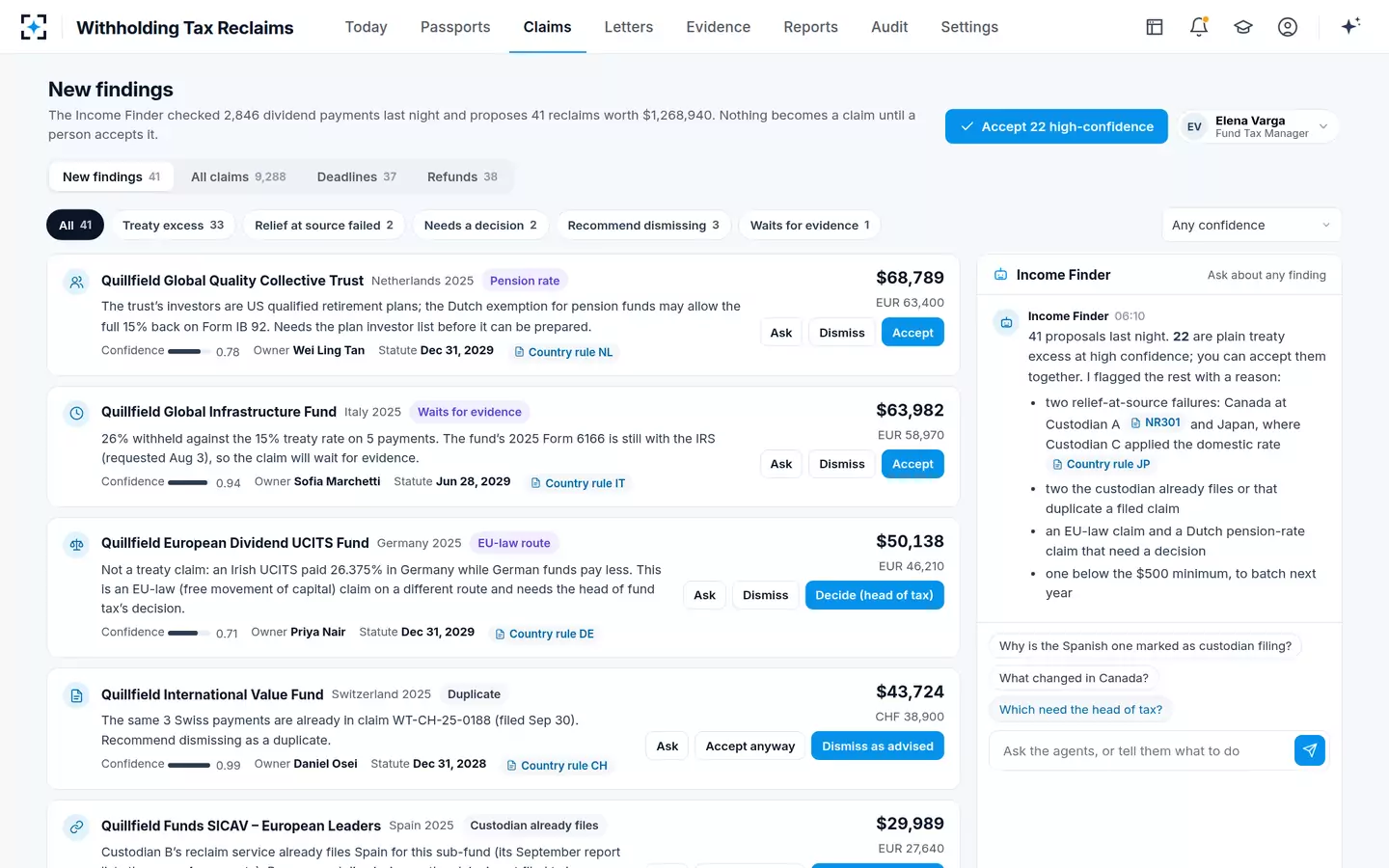
Withholding Tax Reclaims treats an EU-law route as a finding that needs a decision, not a claim to draft. The Income Finder flags a dividend where the country rule notes a more favourable domestic treatment for a comparable resident fund, cites that rule, and marks the finding for the head of fund tax. Nothing is drafted until a person decides to pursue it.
An EU-law route, flagged for the head of fund tax's decision
Once a claim is filed, the Statute Watcher tracks its national deadline and the Tracker reads the authority's letters in their language and drafts replies for a manager's approval. The legal argument stays with the fund's advisers. The Withholding Tax Reclaims page shows the treaty claims that make up most of the work.
Questions people ask
Why are they called Fokus Bank claims?
After Fokus Bank ASA, a Norwegian bank whose case produced the EFTA Court's advisory opinion of 23 November 2004 on a dividend tax credit Norway gave only to resident shareholders. The name stuck to EU-law and EEA-law dividend reclaims generally.
Do Fokus Bank claims apply in Norway?
Norway is not in the EU but is in the European Economic Area, whose agreement also protects the free movement of capital, and the EFTA Court rules on it for Norway, Iceland and Liechtenstein. The Fokus Bank opinion itself concerned Norwegian law.
Can a pension fund make an EU-law claim?
The same comparison applies: if a country exempts its own pension funds' dividends and taxes a comparable foreign pension fund, the foreign fund can argue a restriction of capital movements. Many treaties already exempt dividends paid to certain pension funds, so the treaty route should be checked first.
Do I need a lawyer for a Fokus Bank claim?
Most funds use advisers, because these claims usually proceed through objection and appeal and turn on how the domestic rule is read. The fund's own work is to keep the claim alive inside the national deadline and to hold the evidence of comparability the court will ask for.
Has the FASTER directive changed EU-law claims?
No. The directive covers procedures for relief under treaties and national law, and Member States may keep reduced rates "not deriving from double tax treaties" out of its fast-track routes, so EU-law claims stay on each country's standard procedure.