A golden copy is the single, approved version of a record that a firm treats as true and distributes to every system that needs it. In a security master it is the instrument record after the sources have been reconciled and a person has signed it off: the version the order system, portfolio accounting, compliance, pricing, risk and the fund administrator all read. It is easy to call any master database a golden copy; it is harder to prove that each value in it is right. That proof is a chain: from the issuer's page, through each check and approval, to every system the value reached. Botminds' Security Master Data Management, which sets up and checks instrument terms from prospectuses for reference data teams, keeps that chain for every field, so a wrong value can be traced back and a right one defended.
The journey below follows one bond in the solution on fictional sample data: the Calderwick Holdings 6.125% Senior Notes due 2034, set up at an asset manager called Quillfield Capital on Friday 16 October 2026. Supervisory texts and GLEIF's data documentation are linked where they are quoted.
The life of one bond's terms, from request to golden copy, in minutes
- Read, cited, tested14 min
- In the maker's queue30 min
- Decided with reasons24 min
- Approved, published9 min
What is a golden copy?
A golden copy is the version of a record a firm has decided is authoritative, built from its sources under stated rules and distributed so that every consumer sees the same thing. The term is used for customer, counterparty and product data as well as instruments; GLEIF, for one, calls its published files of LEI records "Golden Copy Files" and issues three sets a day (GLEIF Golden Copy).
Three properties make a copy golden rather than merely central. It is reconciled: where sources disagree, a rule or a person has chosen, and the choice is recorded. It is approved: someone accountable has signed it, and that person did not prepare it. It is distributed: every system that uses the data reads this version, not its own. A security master that lets the accounting system keep its own day count, or the risk system its own call schedule, has several copies and no golden one.
Golden copy vs golden source: what is the difference?
A golden source is where a value should come from; the golden copy is where the firm keeps the value once it has come. For a bond's day count the golden source is the interest provision in the offering document; for its ISIN, the numbering agency; for an issuer's LEI, the LEI registry. The golden copy is the security master record that holds all of them, each tied to its source.
The distinction matters because firms often describe a vendor feed as their golden source, and then cannot explain a disagreement between two vendors. A vendor is a secondary source: it reads the same prospectus the firm could read. Naming the primary source for each field, and the order in which secondary sources are trusted when the primary one is unavailable, is what a set of golden-source rules does. The rules then decide what enters the golden copy, field by field. The field-by-field map is in the security master in finance.
Follow one coupon: from the issuer's page to seven systems
Take one fact, the bond's day count, and follow it. At 09:58 ET a credit desk asks for the new Calderwick notes to be set up: $220 million allocated across six funds, booking at 15:00. At 10:04 the French prospectus and an English term sheet arrive from the syndicate inbox. By 10:08 an agent has drafted the record, citing the day count to page 47: "Exact/365" in the original, Actual/365 (Fixed) in English. By 10:11 a second agent has found that one vendor says 30/360, generated the coupons both ways and priced the difference at $18,458.90 on the first coupon.
At 11:06 the analyst accepts the prospectus value with the reason "Offering document governs — new issue" and submits the record. At 11:14 a different steward approves version 1.0. At 11:15 the record publishes, and within 32 seconds seven systems acknowledge it. The order system confirms that allocations can book; portfolio accounting confirms accruals from 22 October; the fund administrator confirms six funds. A minute later the vendor that carried 30/360 receives a challenge with page 47 attached.
Seconds from publication to each system's acknowledgment
The evidence at each hop
A golden copy is defensible only if each hop leaves evidence behind. The test is simple: six months later, could someone who was not there reconstruct why the value is what it is, from the records alone? The table shows what the sample chain kept.
The evidence the chain keeps, hop by hop
| Hop | What happens | Evidence kept | Whose name is on it |
|---|---|---|---|
| Source received | Prospectus and term sheet arrive and are linked to the request | The documents unchanged, with a hash; sender; time | Intake agent |
| Value drafted | Day count read from page 47 | Page, phrase, original clause and English translation; confidence | Setup agent |
| Value tested | Compared with two vendors; coupons generated under each | Vendor values; test cash flows; the priced difference | Validator agent |
| Value accepted | Analyst chooses the document value | Reason code: offering document governs, new issue | The analyst (maker) |
| Record approved | A second steward signs version 1.0 | Approval reason: checked against the source pages | The steward (checker) |
| Golden copy published | Seven systems receive the record | Each acknowledgment, timed | Downstream agent |
| Vendor told | Challenge sent with the page | The challenge, the vendor's reply, the correction date | Challenge agent, after a steward approves |
Two details make the chain trustworthy rather than merely long. The source document is kept unchanged with a hash, so the page an auditor opens is the page the analyst read. And the trail itself is hash-chained, so an entry cannot be edited without breaking the chain. A fund manager does not need a regulation to tell it that a record should be reproducible; the SEC's books-and-records rule already requires advisers to keep many records for not less than five years (Rule 204-2), and the sample firm keeps its security master trail for seven years after an instrument becomes inactive, a period it set itself.
On the audit trail: who approved the record, and on what evidence
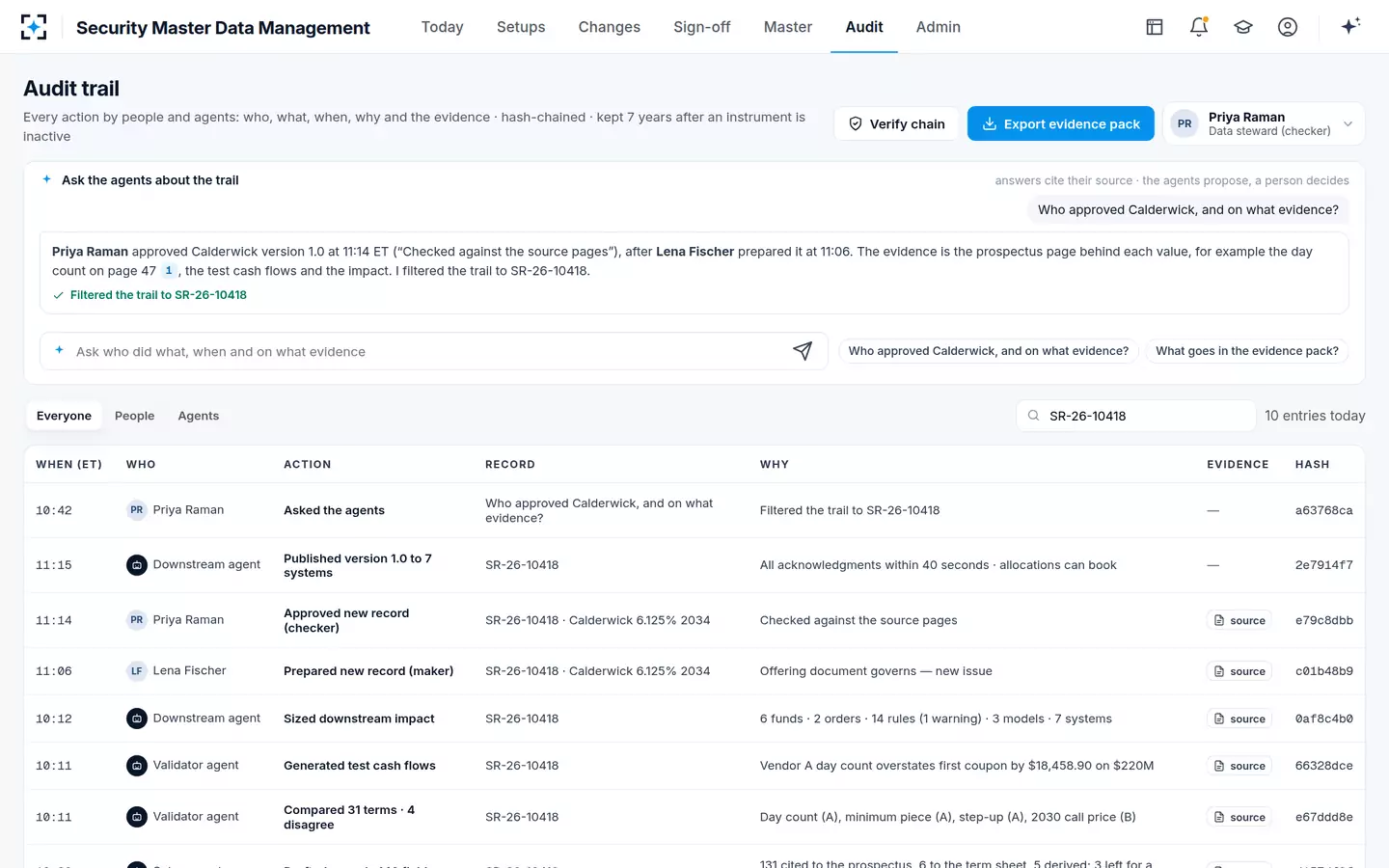
How many systems receive a coupon change?
Every system that read the original value, which in a buy-side firm is usually at least five: order management, portfolio accounting, compliance, pricing and risk, plus the fund administrator and often the custodian. The sample firm publishes to seven. A golden copy that cannot say which systems received each version of a record cannot prove that a correction reached them all.
Changes are where golden copies decay. A new bond gets attention; the coupon step-up four years later, the partial call, the coupon reset on a floating rate note, the new ISIN after an exchange offer arrive as small notices in the overnight files. In the sample month the solution processed 3,082 term changes in sixteen days: 2,611 accepted by the firm's rules and 471 decided by a steward. Each one changes the golden copy, so each one needs the same chain as the original setup: its source notice, the rule or the person that accepted it, and the systems it reached. Corporate events that cause these changes arrive as notices like those in the MT564, field by field; their effect on the instrument's terms lands in the master.
When the golden copy is wrong: tracing back
When a value is wrong, lineage is what turns a hunt into a lookup. Bank supervisors have spelled out why. The European Central Bank's 2024 guide on risk data aggregation describes data lineage as information about how data moves and is transformed from capture to report, which among other things lets a bank trace the source of a data quality incident quickly (ECB, Guide on effective risk data aggregation and risk reporting, May 2024, footnote 23). The guide is written for banks the ECB supervises, but the logic carries to any firm whose numbers start in a master.
"Large-scale miscalculations of key risk ratios and limits were observed, caused by reconciliation errors, extensive manual adjustments, inconsistent or incomplete underlying data, and weak data quality controls."
European Central Bank, Guide on effective risk data aggregation and risk reporting, May 2024
In a security master, tracing back means answering four questions in order. Which version of the record did the system read when the wrong number was produced? Which value in that version was wrong? What source did the value cite, and did the source say that? Who accepted it, and on what reason? With the chain above, each answer is one lookup. Without it, an accrued-interest break at month-end becomes a week of emails, and the person who keyed the day count in March has to be found. A three-way reconciliation is where such breaks surface; the chain is what lets them be closed at the source.
How golden copy accuracy is measured: the numbers worth reporting
No regulator or independent study publishes a benchmark for security master accuracy, so each firm measures its own. Overall accuracy, one percentage across every field, hides the fields that matter; the measures below each point at a specific failure.
Golden copy measures from one sample month
0
records published without a second steward
1.5%
of compared terms where Vendor A disagreed with the document
0.9% for Vendor B
29 of 38
vendor challenges corrected so far
99.2%
of setups published before their booking cut-off
Each number answers a different question. Unapproved publications measure control: it should be zero, always. Vendor disagreement rates measure the inputs, and the fields behind them say where to look: in the sample, one vendor's disagreements were mostly day counts and call schedules, the other's mostly call-price rounding. Challenge corrections measure whether the firm's evidence changes the vendors' data, which is what reduces the next month's work. Cut-off performance measures whether the golden copy is there when the trade needs it. A fifth measure, breaks traced to master data at month-end, closes the loop with operations and is worth adding to the list.
Golden copies outside the firm: what GLEIF's files teach
The LEI system publishes its own golden copy, and its design shows what a firm's should look like. GLEIF's files contain current and historical LEI records, are refreshed three times a day, and come in XML, CSV and JSON (GLEIF Golden Copy). History is part of the copy, not an archive beside it; refresh is scheduled and public; and the format suits whoever consumes it.
A security master golden copy needs the same three things. History, because a fund's accrual on 30 June must be explained with the record as it stood on 30 June, not as it stands today. A distribution schedule every system can rely on, with acknowledgments. And versioning, so a downstream system can say which version it read. How the LEI part of the record is kept current is in LEI renewal.
How Security Master Data Management keeps the golden copy defensible
The solution's design rests on the chain described above. Every value cites its page and phrase, with originals kept unchanged under a hash. The person who prepares a record or an economic change can never approve it; the maker's own approve button is disabled. Golden-source rules decide which source wins per asset class and field, and change only with a second approver. The Downstream agent publishes only after approval, records each system's acknowledgment, and blocks publication while a compliance rule breaks. The Quality agent checks the whole master each night, for bonds matured but still active, missing mandatory fields, duplicate identifiers, stale vendor data and records with no source document, and opens each finding for a person.
Approved and published: the maker-checker record and seven timed acknowledgments
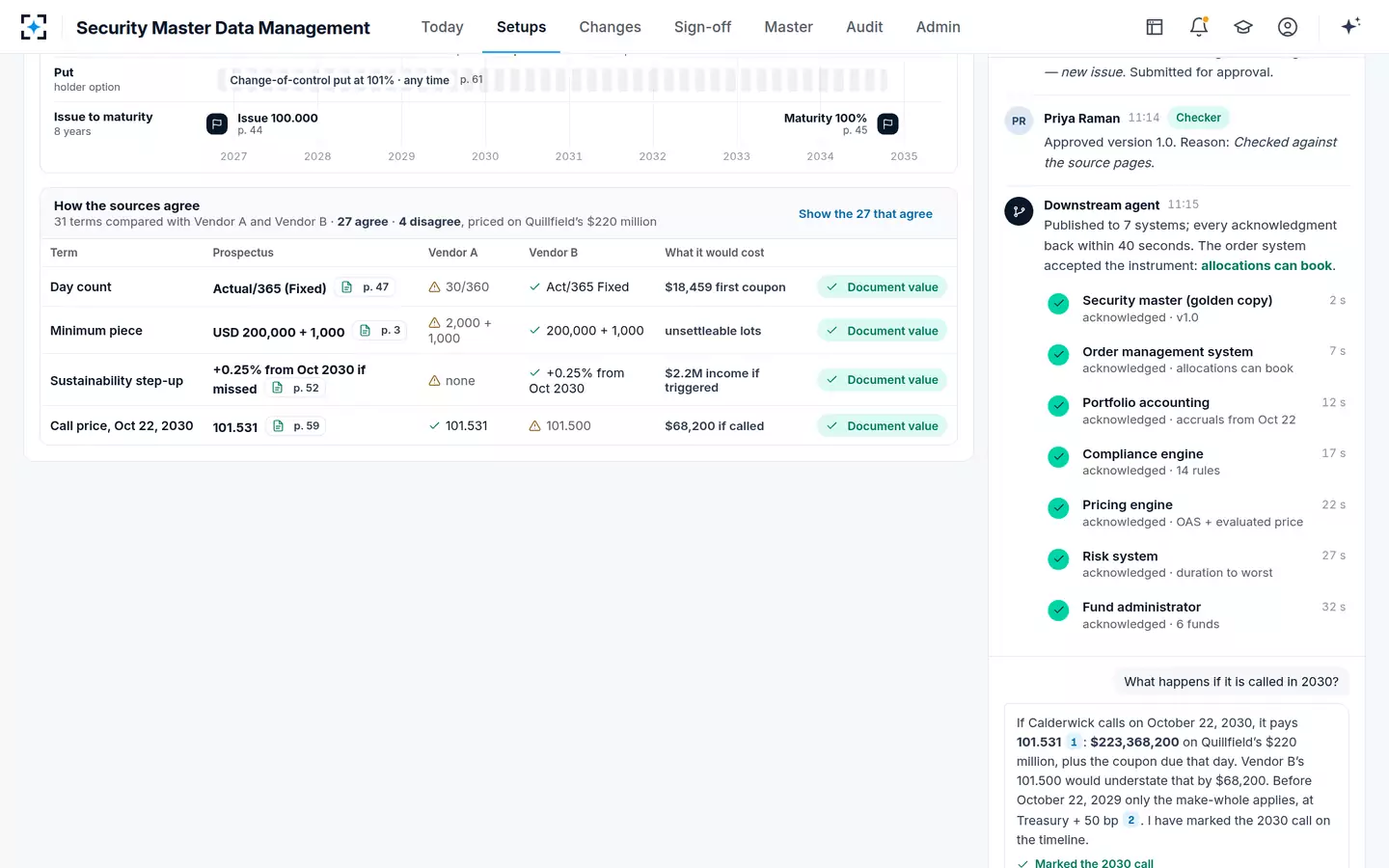
The result is a golden copy that can answer the auditor's question, "who approved this value, and on what evidence?", in seconds, and a correction process that knows which systems to reach. Where agents fit in that process, task by task, is in AI for instrument data management. The solution is on the Security Master Data Management page.
Questions people ask
What does golden copy mean in finance?
The single approved version of a data record, such as an instrument, counterparty or account, that a firm treats as authoritative and distributes to every system. It is built from sources under rules, signed off by an accountable person, and read by every consumer rather than each keeping its own.
Is a golden copy the same as master data?
Master data is the category: the core records a business shares, such as instruments and counterparties. The golden copy is the approved version of each master record. A firm can have master data without a golden copy, if each system keeps its own version.
How do you prove a security master field is right?
Show its source and its approval: the page and phrase of the offering document, or the numbering agency's file, plus who accepted the value, who approved the record and when. A value that two vendors agree on but no one has checked against the document is agreed, not proved.
How often should a golden copy be published?
As often as the business needs current data, and at least before each booking cut-off for new instruments and before each pricing and accrual run for changes. Publication on approval, as in the sample, keeps the window between decision and use to seconds.
What is a golden source in data management?
The authoritative origin for a particular field, such as the offering document for a bond's coupon or the LEI registry for an entity's identifier. Golden-source rules name the primary source for each field and the order in which secondary sources are trusted when it is unavailable.