A reference data analyst sets up new instruments in the security master and keeps existing ones correct: reading offering documents, comparing vendor feeds, keying or approving terms such as coupon, day count and call schedule, and processing changes like coupon resets, calls and new identifiers. Nobody draws the role on a trade-flow diagram, yet an allocation cannot book, a price cannot be struck and a holdings report cannot file until the analyst's record exists and is right. Under T+1 settlement that work runs against same-day deadlines. Botminds' Security Master Data Management, built for reference data teams, gives the analyst records already drafted from the document, each term cited to its page, so the job becomes settling disagreements rather than typing.
The day described below comes from the solution on fictional sample data: Lena Fischer, a reference data analyst in London at an asset manager called Quillfield Capital, on Friday 16 October 2026. The employment figures and rules come from the US Bureau of Labor Statistics, HM Treasury's T+1 group, the European Commission and the SEC.
One new bond against a 15:00 ET cut-off: the analyst's part of the clock
- Agents14 min
- Waiting30 min
- Analyst24 min
- Checker9 min
- Vendors24 min
- Find terms48 min
- Key fields30 min
- Coupons12
- Check18 min
- Publish18 min
What does a reference data analyst do?
A reference data analyst creates and maintains the records that describe instruments, and sometimes issuers and counterparties, in a firm's master data. In an asset manager the core of the job is the security master: setting up each new instrument before it trades, applying each change to an existing one, and investigating every break that turns out to be a data problem.
Where the analyst's day goes: setups, term changes and exceptions
A typical day has three streams. Setups arrive from the trading desks with a booking cut-off attached; on the sample day eight of 31 open requests had to book that day, across documents in Czech, French, German, Italian, Spanish and English. Term changes arrive overnight from vendor files and notices: 412 on the sample morning, of which 351 were accepted by the firm's rules and 61 needed a person, among them a partial call in a German notice and a coupon reset that differed from the computed rate by two basis points. Exceptions come from downstream: accrued-interest breaks, compliance rule failures on a new bond, a vendor record 41 days stale.
The skill that separates a good analyst is reading. A vendor feed says what a bond is; the offering document says what it actually is, and on new issues, private placements and local-market bonds the two often differ or the vendor has nothing at all. An analyst who can find the day count on page 47 of a French prospectus, and explain why it matters, is worth more than one who keys faster.
What is a data steward, and how is the role different?
A data steward is accountable for whether a record is right; an analyst prepares it. In a well-run reference data team the two are different people for every record and every economic change, which is the maker-checker principle applied to data. The steward approves new records, decides disagreements between sources, and owns the challenges sent to vendors when their data is wrong.
Who prepares, who approves: the reference data team's decisions
| Decision | Prepares | Approves | Why it sits there |
|---|---|---|---|
| A new instrument record | Reference data analyst (maker) | A different data steward (checker) | Every downstream system reads it from the moment it publishes. |
| A change to an economic term: coupon, day count, call, maturity, identifier | Analyst or steward | A different steward | It changes cash flows or what is being identified. |
| A non-economic change matching the firm's rules | Accepted by rule | No person, but on the audit trail | Volume: hundreds a day, bounded by the rules. |
| A challenge to a vendor | Analyst or agent drafts it | A steward approves sending it | It goes outside the firm and touches licensed data. |
| Which source wins, per asset class and field | Head of Reference Data | A second head, such as the Chief Data Officer | It decides thousands of future values at once. |
Stewardship is also where judgement lives. When one vendor rounds a call price to 101.500 and the prospectus says 101.531, the analyst can see the difference; the steward decides that the document governs, records why, and approves the message telling the vendor. On the sample bond, Priya Raman, the senior data steward, approved the record at 11:14 with the reason "Checked against the source pages". The person who prepared it could not have approved it: the button is disabled for the maker.
How does BLS classify a reference data analyst, and what does the job pay?
The US Bureau of Labor Statistics has no occupation called reference data analyst, data steward or security master analyst. The work is counted inside broader occupations, and which one depends on the seat: an analyst whose job is research and judgement on instruments is closest to financial and investment analysts, while a role centred on recording securities transactions and holdings sits nearer to brokerage clerks.
The nearest BLS occupations to a reference data analyst
$102,740
median annual wage, financial and investment analysts (13-2051)
BLS OEWS, May 2025
361,980
financial and investment analysts employed in the US, all industries
BLS OEWS, May 2025
$65,750
median annual wage, brokerage clerks (43-4011)
BLS OEWS, May 2025
35,940
brokerage clerks employed in the US, all industries
BLS OEWS, May 2025
The gap between those two medians is the gap in how firms treat the job. Where the role is seen as data entry, it is paid and staffed like clerical work, and turnover follows. Where it is seen as the control that stops a wrong coupon reaching every fund, firms hire people who can read a prospectus in two languages and hold a vendor to account. The second view is the one T+1 has made harder to avoid.
T+1 turned reference data into a settlement deadline
Under a one-day settlement cycle, an instrument that is not set up on the day it trades cannot be allocated, confirmed and affirmed on that day. In the United States, since 28 May 2024, broker-dealers must have agreements or procedures to finish allocation, confirmation and affirmation by the close of trade date at the latest (SEC Rule 15c6-2). Every one of those steps needs the instrument in the master first.
The UK and EU plans name reference data directly. HM Treasury's Accelerated Settlement Technical Group set a "highly recommended" action, STAT 03: "All Market Participants will review and test internal policies, processes and systems to ensure that reference data functions are prepared for the implementation of T+1", to be completed by 31 December 2026 (Technical Group report, February 2025). The UK government has committed to legislate for T+1 from 11 October 2027, and that legislation is still in draft.
In the EU, a Commission regulation adopted in July 2026 requires investment firms to make professional clients send every piece of reference data a trade needs to settle, electronically, and keep it up to date well before settlement (Delegated Regulation (EU) 2026/1536, Article 1, point (1)). Under its Article 2, that paragraph applies from 7 December 2026, ahead of EU T+1 on 11 October 2027. It concerns the data needed to settle, such as accounts and place of settlement, which the standard settlement instructions template lists field by field; the instrument record has to exist before any of it can be used.
The SEC counted the cost when it adopted T+1. It estimated that institutional investors would need to "configure systems and update reference data", at an initial expenditure of "$4.29 million per entity", and its arithmetic assumed operations specialists at $159 an hour and a senior operations manager at $426 (SEC, T+1 adopting release, 88 FR 13872). Reference data was written into the budget of the change.
The analyst's morning: what books today, what needs a steward, what the agents found
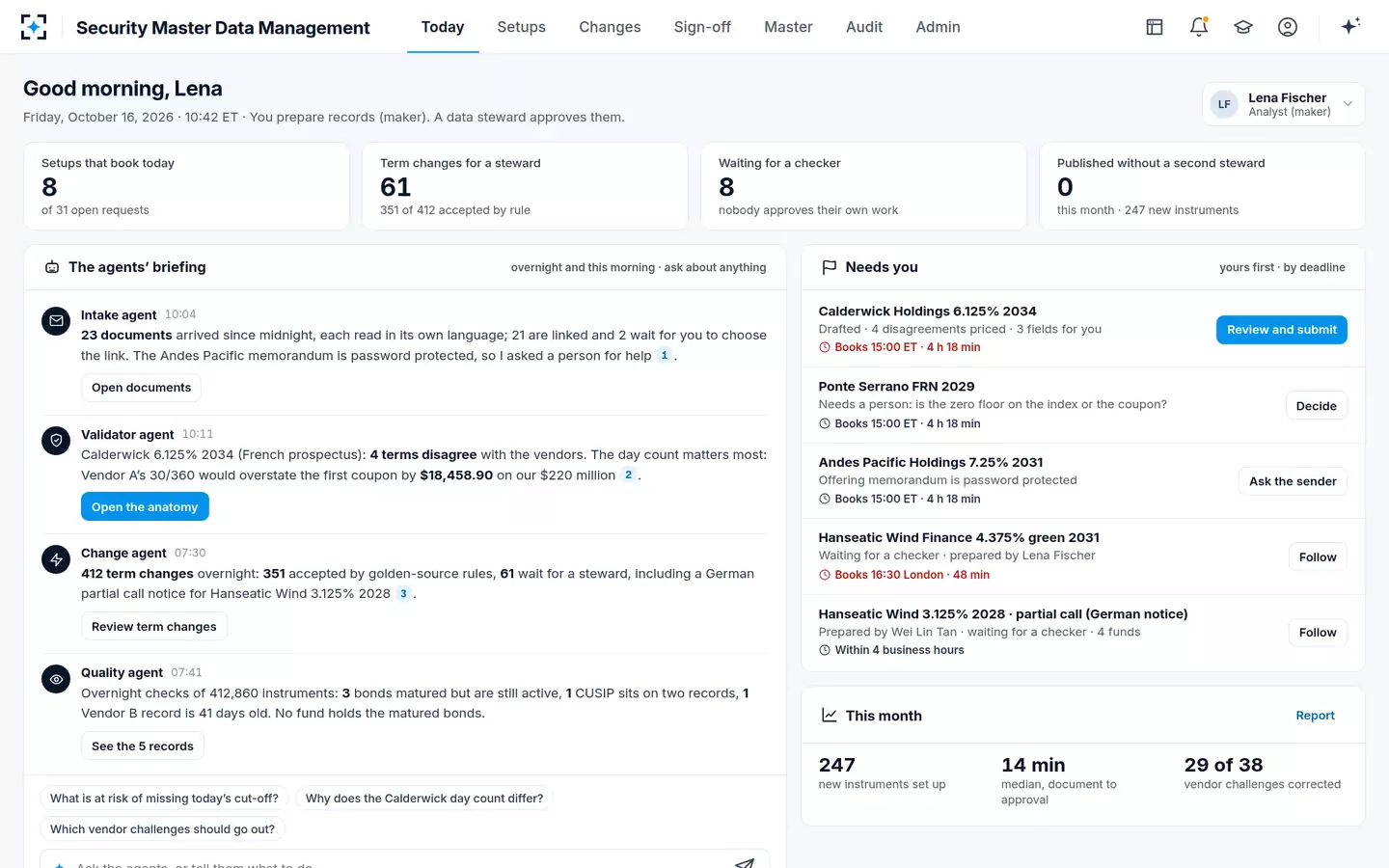
The skills that matter now: reading, deciding, arguing with a vendor
Three skills define a strong analyst. First, reading offering documents: finding the interest provisions, call schedule, step-up and selling restrictions in a prospectus of 300 to 500 pages, sometimes in a language other than English, and knowing which clause governs when the summary and the terms disagree. Second, deciding: when two vendors and the document disagree, knowing the firm's precedence rule and when to escalate. Third, pressing a vendor: writing a challenge that cites the page, so the vendor corrects its data rather than asking for more evidence.
Keying is not on the list. The by-hand lane of the timeline above is our estimate for one complex bond, about two and a half hours, and about half of it is finding terms in the document and keying them. Those are the hours that agents can take; deciding and pressing are the hours they cannot. How the hours split task by task is set out in AI for instrument data management.
What stays with the analyst when agents set up securities
When agents draft the record, the analyst keeps everything that needs a judgement and a name on the audit trail. Below a set confidence the agents only propose; disagreements are priced but not resolved; nothing publishes without a second steward. The roles around the analyst change in the same way.
Five people who carry one new bond, before and with Security Master Data Management
Today
Reads a 412-page French prospectus at 2:45 with the desk on the phone; keys every field.
With agents
Opens a record already drafted, each term pinned to its page; settles seven items and submits.
Still theirs: Every value below the confidence line, and the reason for each accepted value.
Today
Approves records without the page in front of her; owns vendor disagreements by email.
With agents
Sees what the maker accepted and why, opens any source page in its original language, approves the vendor challenges.
Still theirs: Approval, and the decision when sources disagree.
Today
Finds a wrong day count months later as an accrued-interest break.
With agents
Sees the funds, orders, compliance rules and test cash flows a bond will touch before it publishes.
Still theirs: Settlement and the custodian relationship.
Today
Learns a setup will miss the cut-off when the desk calls.
With agents
Sees setups escalated 60 minutes before the cut-off; sets which source wins per asset class and field.
Still theirs: The golden-source rules, each change approved by a second head.
Today
Pays two vendors for the same field without knowing which is right.
With agents
Takes a vendor scorecard built from page-backed disagreements into each vendor review.
Still theirs: Vendor spend and data quality reporting to the COO and the board.
Maker and checker on one record, and the publication that follows
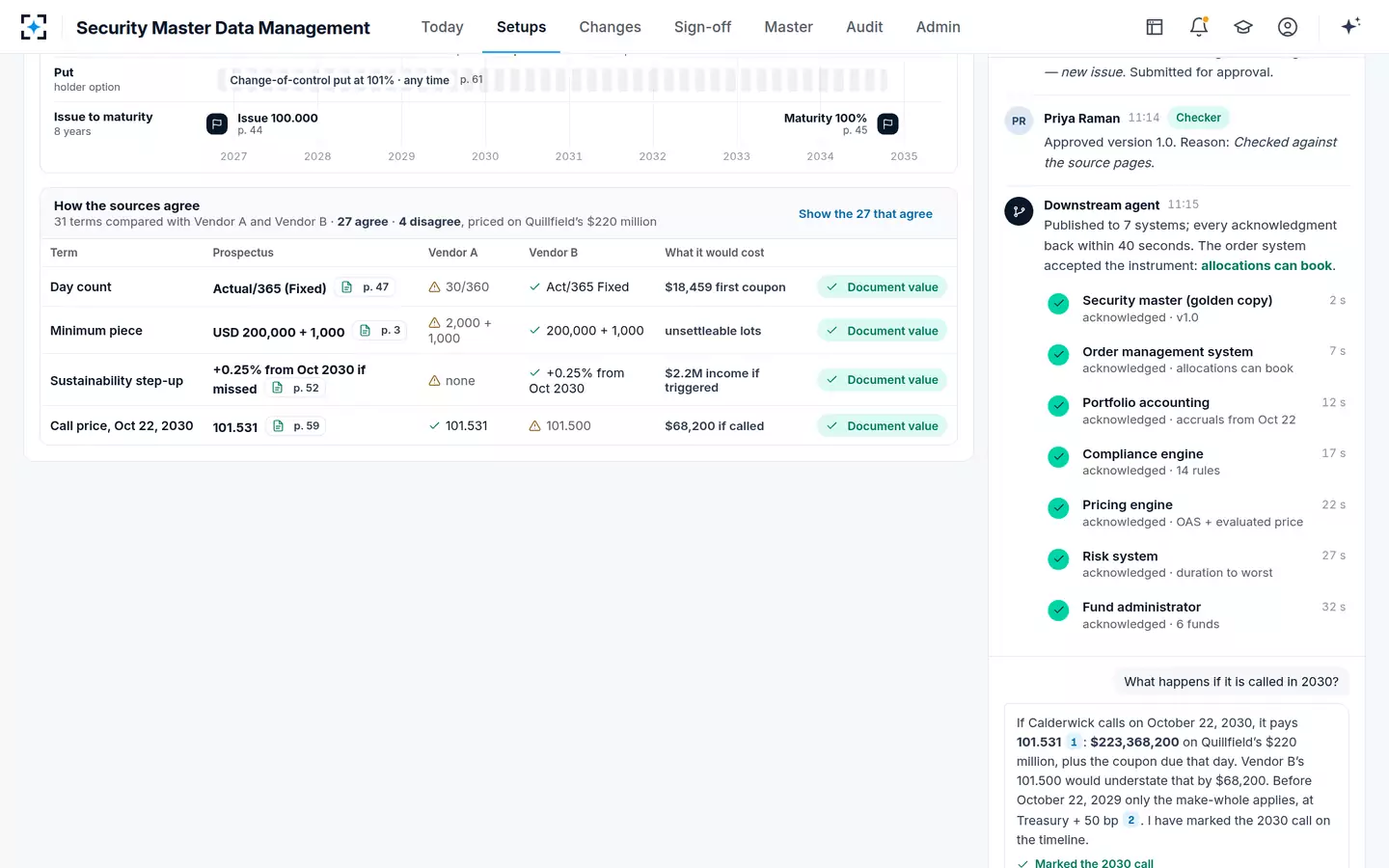
The analyst's week changes shape rather than size. Fewer hours go to hunting and keying; more go to the cases the agents flag: the password-protected memorandum, the floating rate note whose floor could apply to the index or the coupon, the call notice in German. The analyst who used to be measured on setups per day is measured on whether every record she prepared was right. Why that record matters to every system downstream is in the golden copy, and how a new bond is set up before its first trade is in bond reference data. The solution is on the Security Master Data Management page.
Questions people ask
Is a reference data analyst a good career?
It is a route into operations, data and product roles because it touches every instrument a firm trades and every system that reads them. BLS does not track the job by name; the nearest occupations range from brokerage clerks, median $65,750, to financial and investment analysts, median $102,740 (May 2025). Analysts who can read offering documents and own vendor relationships move toward the higher end.
What is the difference between a data steward and a data custodian?
A steward is accountable for the content of the data: whether a coupon or day count is right. A custodian looks after the systems that hold it: storage, access and backups. In a reference data team the steward approves records; IT or a platform team is the custodian.
What does a reference data analyst do in investment banking?
The same core work on a wider range of instruments: securities, derivatives, counterparties and settlement instructions, often split into separate teams. Banks that run trading venues or act as systematic internalisers in the EU also report instrument reference data to regulators, built on the same identifiers and classifications.
How does T+1 change a reference data analyst's job?
It removes the overnight margin. A bond allocated in the afternoon has to be set up, approved and published the same day so the trade can be confirmed and affirmed before the end of trade date. The UK's T+1 group asked every market participant to test its reference data functions for T+1 by 31 December 2026.
Will AI replace reference data analysts?
It replaces most of the hunting and keying, which in our estimate is about half of the time spent on a complex new bond. It does not replace the decisions: which source wins, whether a proposal is right, whether to challenge a vendor. In the solution those stay with named people, and the agents cannot approve or publish.