Reference data management tools for an investment firm fall into four approaches: an in-house security master, a licensed master data platform, an outsourced service run by an administrator or data provider, and agents that sit in front of an existing master to read documents, compare sources and propose changes. All four can store instrument data and send it downstream. What separates them is who decides when the offering document and two vendor feeds disagree, how that decision is recorded, and how hard it is to leave. Choose the approach that keeps that decision with your own data stewards and leaves an audit trail you can show a regulator. Botminds' Security Master Data Management is the fourth kind: seven agents draft, check and price every instrument record against its source, and two stewards decide, alongside the master data platform a firm already runs.
This guide names no vendors and quotes no prices, because neither is published in a form anyone can check. Product examples come from the solution on fictional sample data; the rules cited are the SEC's.
Four approaches to reference data management, judged on who decides
| Approach | Who resolves a disagreement | Cost shape | Switching risk | Fits best |
|---|---|---|---|---|
| Build: an in-house security master | Your stewards, under rules your developers code | Large upfront build; permanent maintenance team; you carry every vendor-format change | Low lock-in, high key-person risk | Firms with unusual instruments and a strong data engineering team |
| Buy: a licensed master data platform | Your stewards, under rules you configure in the platform | Licence plus implementation; staffing unchanged unless workflow improves | Medium: data model and rules sit in the vendor's format | Firms that want a standard model and distribution, and have the stewards |
| Outsource: an administrator or managed data service | The provider's staff, under rules you agree; you oversee | Per-instrument or per-fund fees; oversight hours stay in-house | High: the people and the history sit with the provider | Firms that want to shed setup labour and can oversee the provider |
| Add agents: in front of an existing master | Your stewards, with each disagreement priced and its source page attached | Licence on top of the platform you keep; fewer hours per setup | Low: the master and its history stay where they are | Firms with long, multilingual documents and thin vendor coverage |
What reference data management tools are there? Four approaches
There are four, and most firms end up combining two of them. The first is building: a database and a set of loaders, rules and screens maintained by the firm's own developers. The second is buying: a licensed master data platform with a standard data model for instruments, connectors for the main vendors, workflow for exceptions and distribution to downstream systems. The third is outsourcing: a fund administrator, middle-office provider or managed data service sets up and maintains instruments under agreed rules. The fourth is newer: agents that read offering documents and vendor files, draft and check records, and hand people the decisions, working with whichever master the firm keeps.
The searches people run, "reference data management system", "reference data management tool comparison", "security master software", tend to compare the first three on features. Features converge. Every serious option stores versioned records, takes vendor feeds, applies rules and publishes. The questions that separate them are about people and evidence.
Who resolves a disagreement between sources? The question that separates the approaches
The decision that matters is what happens when sources disagree, because that is where a security master's accuracy is made. When one vendor says a bond's day count is 30/360, another says Actual/365 (Fixed) and the prospectus says Actual/365 (Fixed), something has to choose, and someone has to be accountable for the choice.
In a built or bought master, the choice is made by rules the firm configures and stewards it employs, which is good, but the evidence behind the choice is usually whatever the steward remembers to write in a comment. In an outsourced model the choice is made by the provider's staff, and the firm sees the outcome, not the reasoning, unless the contract requires more. With agents in front of the master, the disagreement arrives already priced on the firm's position, with the source page attached, and the steward's decision and reason are recorded as part of the record.
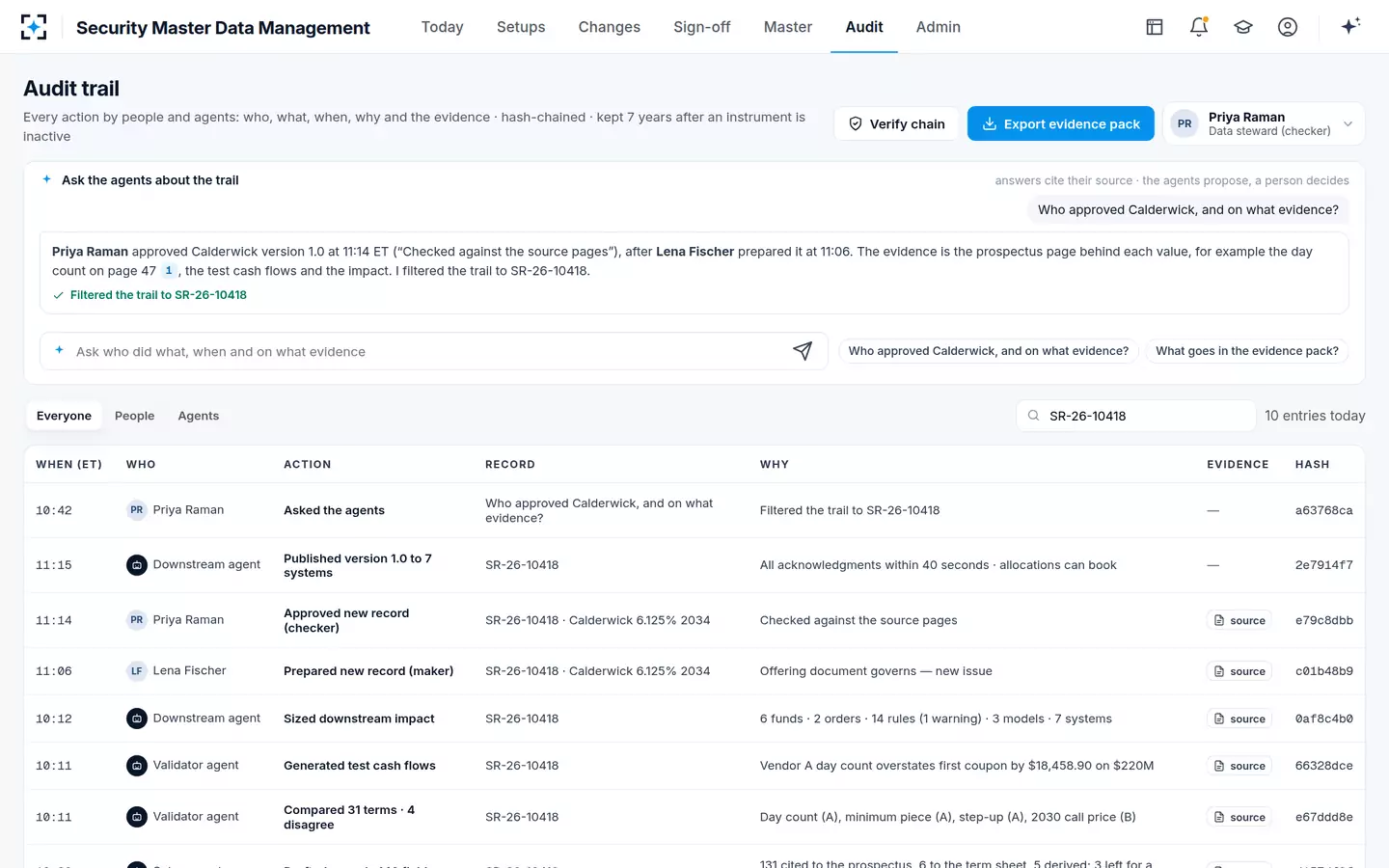
On the solution's sample bond, the difference is visible in one line. One vendor's 30/360 day count would have overstated the first coupon by $18,458.90 on a $220 million position; the steward saw that figure, opened page 47 of the French prospectus, accepted the document's value with the reason "Offering document governs — new issue", and a second steward approved. The vendor received a challenge with the page attached. Each step is on the audit trail.
Build or buy a reference data management system?
Buy the platform if a standard instrument model fits your book and you would rather spend developers on something else; build if your instruments are unusual enough that a standard model would be bent out of shape. Either way, the cost that dominates over time is the people who keep the data right, not the software.
Building or buying the security master, on the points that last
Build in-house: Exactly yours, including unusual instruments; documented only as well as your team documents it.
Buy a platform: A standard model you configure; unusual instruments go into extension fields.
Build in-house: You write and maintain every loader and every format change.
Buy a platform: Connectors maintained by the platform vendor for the main feeds.
Build in-house: Coded; changes go through a release.
Buy a platform: Configured; changes still need governance, and a second approver.
Build in-house: High: the people who built it are the documentation.
Buy a platform: Lower, but configuration knowledge still concentrates in a few people.
Build in-house: Read a 412-page prospectus, cite the page, or price a disagreement.
Buy a platform: The same. Both store the decision; neither makes the reading faster.
Outsourcing to an administrator: what moves, and what you still own
Outsourcing moves the labour of setups and changes; it does not move responsibility for the data. A US registered fund's compliance policies must provide for oversight of its service providers, the administrator among them (Rule 38a-1), and an adviser's own books and records duties stay with the adviser (Rule 204-2). If the administrator's security master carries a wrong day count, the fund's accruals are wrong and the fund's board will ask the adviser why.
The practical test of an outsourcing arrangement is whether the firm can see, for any value, the source and the decision. Ask for disagreement logs with the evidence, not just the final record; for the provider's rules for which source wins, and notice before they change; and for a monthly measure of errors found after publication. Then price the oversight hours into the comparison. Oversight of a fund administrator as a whole is a subject of its own, covered by Fund Administration Oversight.
Where agents fit beside a master data platform
Agents do not replace the platform; they replace the reading, keying and comparing that happen before a value reaches it. The platform keeps the golden copy, its versions, its distribution and the licensing controls on vendor fields. The agents take offering documents and notices in any language, draft the record with every term cited, compare it with the vendors, test the cash flows, show the downstream impact, and pass the decisions to people. Once a steward approves, the record goes to the master like any other change.
Agents in front of the master you keep: what each side does
Agent
Documents and feeds inProspectuses, term sheets, notices from inboxes and document stores; two vendors' terms and conditions files.
Never: Never creates or changes a record on intake
Agent
Draft, compare, testEvery field cited to its page; each economic term compared and priced; coupons generated under each source.
Never: Never fills below the confidence line; never resolves a disagreement
A person decides
Steward decides; a second approvesAccepts values with reasons; approves the record.
Never: The maker never approves
Agent
Publish to the existing master and systemsOrder management, accounting, compliance, pricing, risk, fund administrator; each acknowledgment timed.
Never: Never publishes before approval or while a rule breaks
A person decides
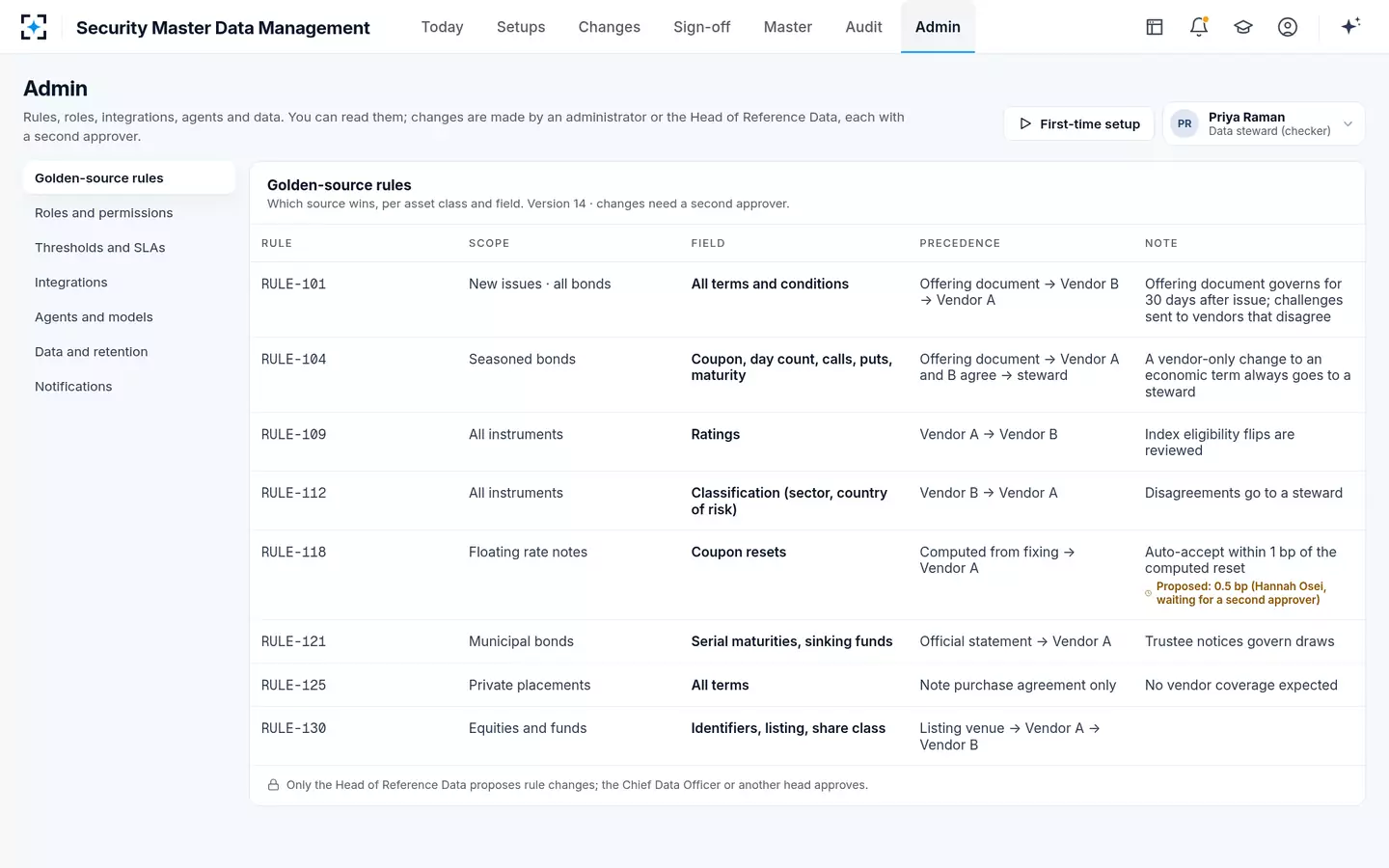
Head of reference data sets the rulesWhich source wins per asset class and field; thresholds; escalation windows.
Never: Every rule change needs a second approver
That division answers the build-or-buy gap in the previous section. A firm that bought a platform and still sets up complex bonds by hand from foreign-language prospectuses has a strong store and a slow front door. Agents work on the front door and leave the store alone, which is also why switching risk is low: nothing in the master moves.
Golden-source rules the stewards control, with a pending change waiting for a second approver
What regulators expect whichever tool you choose
No rule prescribes a reference data tool, and the US agencies' 2026 data-standards rule changes no reporting until each agency acts (FDTA final rule). What regulators expect is that firms can show their work. Records must be kept and produced; outsourced functions must be overseen; and where agents are used, supervision must reach them. FINRA's 2026 oversight report suggests firms consider how they will watch what systems and data an agent can reach, and what limits they put on what an agent may do or decide (FINRA, 2026 Annual Regulatory Oversight Report).
Translated into a tool requirement, that is three things: an audit trail that records who did what, when, why and on what evidence, including the agents; limits on agents that can be shown, not just described; and a way to produce, for any value on any date, the record as it stood. Any of the four approaches can meet them. Whether a particular product does is a question to test, not to accept from a slide.
An audit trail that records people and agents alike, with the evidence
Switching without losing history
The history is the hard part of any switch. A security master's value includes every past version of every record, which source each value came from, and who approved it; a fund's accrual in June has to be explainable with the record as it stood in June. Migrations that load only the current records leave the firm unable to answer that question for anything before the cut-over.
Three practices reduce the risk. Run old and new in parallel for at least one month-end and compare the golden copies field by field, investigating every difference rather than explaining it away. Migrate versions and sources, not just values, or keep the old system readable for as long as the firm's retention period requires. And move the golden-source rules explicitly, as a reviewed document, because rules embedded in code or configuration are the part most often lost. Adding agents in front of an existing master avoids most of this, because the master and its history stay put; the solution's guided setup imports the rules from the current reference data management system rather than recreating them.
What should a pilot of a reference data management tool test?
A pilot should replay recent real work and compare the tool's output with decisions your stewards already made. Demonstrations on clean data show that a tool works; replays on your own awkward documents show whether it works for you.
A pilot plan for any reference data management tool
- Replay last month's new issues, about 50
Include non-English prospectuses, private placements and at least one floating rate note; compare every field with the approved record.
- Replay a week of term changes
Check which the tool accepts by rule, which it routes to a person, and whether any economic change slipped through.
- Measure time to approval and errors by field
Median and slowest cases; errors in day counts and call schedules count more than errors in trustee names.
- Test the controls by trying to break them
Have the maker try to approve; try to publish without approval; try to change a rule without a second approver.
- Trace three values end to end
From the source page to every downstream system, and back from a system to the decision.
- Export the evidence for an audit
For one record and one month: would your auditors accept it without further questions?
- Plan the exit before you enter
How do records, versions, sources and rules leave the tool if you stop using it?
Where Security Master Data Management fits, and where it does not
It fits a firm that already has a security master, built or bought, and spends too many hours reading offering documents, reconciling vendor feeds and chasing breaks that start in the master. It suits books with new issues documented in several languages, private placements and local-market bonds that vendors cover late or not at all, and teams that want every value cited and every decision recorded. It works with the systems that already read the master: order management, portfolio accounting, compliance, pricing, risk and the fund administrator.
It does not replace the master data platform, distribute licensed vendor data to the rest of the firm, or price securities. Price challenges are a different job, covered in what a price challenge is. And it does not remove the need for stewards: it is built on the premise that the agents propose and two people decide. A firm without people to approve records should fix that first. How the agents divide the work task by task is in AI for instrument data management, and what the work costs per instrument is in what a security master database costs. The solution is on the Security Master Data Management page.
Questions people ask
What is a reference data management system?
Software that holds a firm's reference data, such as instruments, issuers and counterparties, applies rules for which source wins, routes exceptions to people and distributes the approved data to other systems. In investment operations the core of it is the security master.
What features should a reference data management tool have?
Versioned records with history, rules for source precedence per asset class and field, maker-checker approval, an audit trail with evidence, distribution with acknowledgments, and controls on licensed vendor data. For complex instruments, add the ability to cite each value to its source document.
Can a reference data management tool use AI?
Yes, most usefully for reading offering documents, comparing sources and triaging changes. The safeguards to look for are citations for every value, a confidence floor below which the tool only proposes, and no ability to approve or publish on its own.
How long does it take to implement a reference data management tool?
A platform migration is a project of many months because of the data model, the loaders and the history. Adding agents in front of an existing master is shorter, because the master stays put: the work is connecting sources, mapping fields, importing rules and replaying recent issues before anyone relies on the output.
Should a fund manager outsource reference data management?
It can outsource the labour, not the accountability. Fund compliance policies must cover oversight of the administrator, and the adviser's records duties remain its own, so outsourcing works only with visibility into the provider's sources, decisions and errors, and with the oversight hours budgeted.